

Looking For More Great Content?
Get even more informative Toronto real estate news sent directly to your inbox by signing up for my newsletter here. All it takes is a few easy clicks.

Durham Region Property Tax Rates: The 2026 Homeowner’s Financial Guide
03/26/26 Uncategorized

Could your 2026 property tax bill be the most important financial document you read this year? For many homeowners in Uxbridge and the surrounding areas, the annual assessment often feels like a confusing burden rather than a strategic data point. It’s natural to feel a sense of unease when regional budget discussions suggest a property tax levy increase of 4.3% or more for the upcoming fiscal year. At Noble Real Estate, we believe that clarity is the best antidote to financial anxiety.
We’ve designed this guide to help you master the 2026 landscape and understand exactly how durham region property tax rates affect your bottom line. You’ll gain a professional perspective on why your bill is split between local, regional, and educational tiers, along with the specific impact these numbers have on your property’s resale potential. We’ll walk you through the three-tier tax calculation, provide a clear comparison across Durham’s eight municipalities, and outline the exact steps to appeal an assessment if your valuation feels off the mark.
Key Takeaways
- Demystify the three-tier tax system to understand exactly how your C$ payments are allocated across municipal, regional, and education services.
- Learn how MPAC assessments and local mill rates determine your final bill and how to identify potential inaccuracies in your home’s valuation.
- Compare durham region property tax rates across various municipalities to see how your specific location influences your property’s long-term appreciation.
- Gain actionable insights into the Request for Reconsideration (RfR) process to ensure your assessment remains fair and your financial burden remains manageable.
- Discover “The Noble Approach” to integrating property tax data into your broader real estate strategy, from mortgage qualification to maximizing your buying power.
Understanding Property Taxes in Durham Region: The Three-Tier System
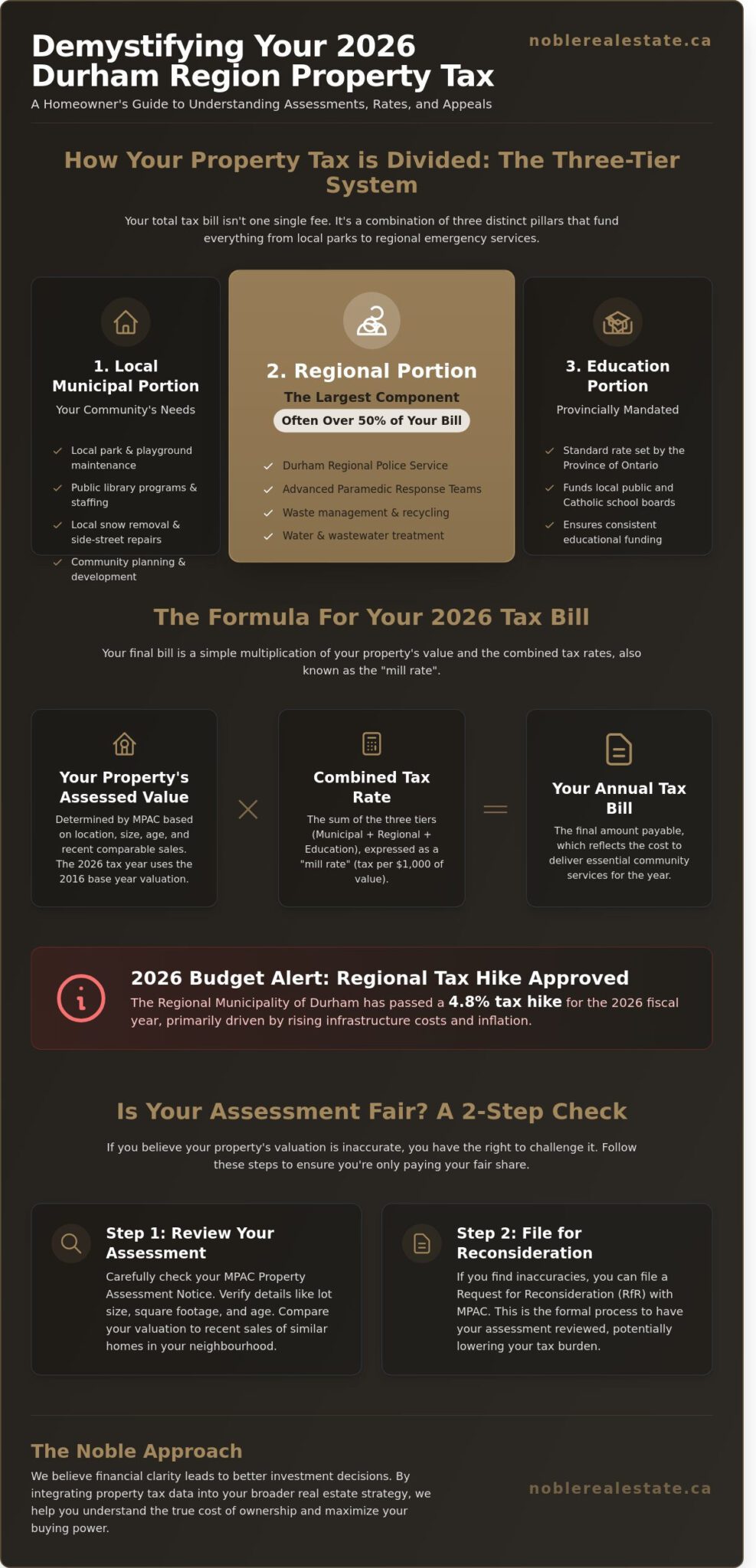
Property tax is a mandatory levy calculated by multiplying your home’s assessed value by the annual tax rate. For homeowners looking at durham region property tax rates in 2026, it’s vital to recognize that your bill isn’t a single fee. It’s a combination of three distinct financial pillars. This structure ensures that both your immediate street-level needs and broader regional requirements are funded. The Regional Municipality of Durham acts as the central coordinator, working alongside local area municipalities to distribute these funds across essential services.
The Municipal Portion: Local Services in Your Town
Your local town, such as Uxbridge, manages the first tier. This portion of your bill stays directly in your community. Local councils meet annually to set these rates based on their specific budget requirements. In 2025, local budgets focused heavily on maintaining the 150 kilometers of trails and various community centers that make our area unique. These funds pay for:
- Local park maintenance and playground safety.
- Public library programs and staffing.
- Local road snow removal and side-street repairs.
- Planning and development by-laws that protect property values.
The Regional and Education Portions
The Regional portion usually represents the largest percentage of your total bill, often exceeding 50 percent of the total amount. This is a primary driver for durham region property tax rates because it funds heavy-duty infrastructure like the Durham Regional Police Service and advanced paramedic response teams. It also covers waste management and water treatment for the entire area. The final piece is the Education tax rate. The Province of Ontario sets this standard rate for all residential properties to support local school boards.
Understanding these layers is part of The Noble Approach to real estate; we believe financial clarity leads to better investment decisions. Knowing exactly where your C$5,000 or C$8,000 annual payment goes makes the process feel more transparent and manageable. It’s not just a cost; it’s a contribution to the social and physical framework of your neighborhood. Local councils use specific by-laws to adjust these figures every year, ensuring the community’s growth matches its service capacity.
Calculating Your 2026 Durham Tax Bill: MPAC and Mill Rates
Understanding the durham region property tax rates involves more than just looking at a single percentage. Your final bill is the result of a specific formula: your property’s assessed value multiplied by the combined municipal, regional, and education tax rates. These rates, often referred to as “mill rates,” represent the amount of tax payable per C$1,000 of assessed property value. While the math seems complex, it’s a structured system designed to distribute the cost of local services across the community fairly. For a detailed look at how your tax dollars are allocated toward regional services, you can visit the official resource for Durham Region Property Taxes.
How MPAC Assesses Your Durham Property
The Municipal Property Assessment Corporation (MPAC) is the provincial body responsible for valuing every property in Ontario. They analyze several key factors to determine your home’s worth, including its location, total square footage, lot size, and the age of the structure. They also look closely at recent sales of comparable homes in your specific neighborhood to ensure valuations reflect market reality. To prevent sudden financial shocks, MPAC uses a phase-in program that spreads assessment increases over a multi-year period. The 2026 tax year continues to utilize the 2016 base year valuation as mandated by the provincial government’s current assessment cycle.
The 2026 Budget Impact: What Homeowners Need to Know
The Regional Municipality of Durham has passed a 4.8 percent tax hike for the 2026 fiscal year. This increase is largely driven by the rising costs of essential infrastructure projects and the persistent pressure of inflation on service delivery. In Uxbridge and surrounding Durham municipalities, budget priorities include significant investments in road maintenance, emergency services, and waste management. These regional adjustments are separate from the local municipal portion of your bill, which covers town-specific services like local parks and libraries.
It’s a common misconception that your taxes only go up if the tax rate increases. In reality, your bill can rise even if durham region property tax rates stay exactly the same. This occurs if your property’s value increases at a faster pace than the average home in your municipality. If you’re planning for the future and want to understand how your home’s specific value impacts your long-term costs, you can request a professional equity assessment to get a clearer picture of your financial position. Staying informed about these shifts ensures your household budget remains predictable and stress-free.
Comparing Property Tax Rates Across Durham and the GTA
Understanding the landscape of durham region property tax rates requires a look at how different municipalities balance their budgets. While the Region of Durham sets a portion of the tax, your local town or city determines the rest. This creates a varied financial map for 2026 homeowners. Buyers often find that a home five minutes down the road in a different township can result in a tax bill difference of several thousand dollars annually.
Durham Municipality Comparison 2026
- Oshawa: Historically, Oshawa maintains some of the highest rates in the region, often exceeding 1.30%. This is largely due to a smaller industrial tax base compared to its residential density, requiring homeowners to shoulder more of the infrastructure costs.
- Uxbridge and Scugog: These townships offer a different profile. While they lack some of the intensive transit infrastructure of the lakeshore, the cost of maintaining vast rural road networks and township services keeps rates competitive but distinct from urban hubs.
- Pickering and Ajax: These areas benefit from rapid commercial growth. By attracting large scale corporate developments, they’ve managed to keep residential rates closer to the 1.1% to 1.2% range, appealing to families moving from the 416 area code.
The total amount you pay hinges on the assessment provided by the Municipal Property Assessment Corporation (MPAC), which evaluates your home’s market value. If you’re looking at a C$900,000 detached home, the difference between an Oshawa rate and a Pickering rate can change your monthly carrying cost by C$150 or more.
Is Durham More Expensive Than Toronto?
There’s a common “Low Rate, High Value” paradox when comparing Durham to Toronto. Toronto’s property tax rate often hovers around 0.7%, which looks significantly cheaper than the durham region property tax rates that frequently sit above 1.1%. However, the percentage is only half the story. The actual dollar amount on your tax bill is the rate multiplied by the MPAC assessed value.
In Toronto, a modest semi-detached home might be valued at C$1.4 million. At a 0.7% rate, the tax is C$9,800. In a Durham community like Whitby, a similar lifestyle might be found in a home valued at C$950,000. Even with a higher 1.15% tax rate, the annual bill is C$10,925. While the Durham bill is slightly higher in this scenario, the lower mortgage principal on a C$950,000 home often results in a lower total cost of ownership. Smart investors look at the “all-in” monthly number, not just the tax percentage.
These tax variations directly influence buyer demand. We’ve seen 2026 market trends where neighbourhoods with stable, lower tax rates see 12% faster turnover. People want predictability in their carrying costs, especially when interest rates fluctuate. My role is to help you analyze these numbers so your next move is a sound financial investment.
Actionable Strategies for Managing Your Property Taxes
Managing your home’s carrying costs requires more than just opening an annual envelope. While the durham region property tax rates serve as the multiplier, your property’s assessed value is the base of the equation. You have the power to ensure this valuation is fair and accurate, potentially saving you thousands over a multi-year cycle.
Appealing Your Property Assessment
Start by logging into the MPAC AboutMyProperty portal to verify your home’s specific data. Errors in lot size, finished basement area, or the number of bathrooms can lead to significant overpayment. If your assessment is higher than the sale prices of five comparable homes in your immediate neighborhood from the 2023 valuation period, you should act. File a Request for Reconsideration (RfR) before the March 31 deadline. This is a free process and a necessary first step. If the RfR doesn’t yield a fair result, you can escalate your case to the Assessment Review Board. This requires a C$125 filing fee and a more formal presentation of evidence, but it’s a vital tool for ensuring your assessment reflects reality.
Durham Region Tax Relief and Rebates
Staying informed about durham region property tax rates and local relief programs ensures you aren’t paying more than your fair share. Several programs exist to support vulnerable homeowners. Low-income seniors and residents with disabilities can often access tax deferral programs or grants to offset annual increases. For instance, Uxbridge offers a specific Tax Assistance program for low-income seniors who meet age and income requirements. Registered charities can apply for a 40% rebate on property taxes for the space they occupy. Additionally, owners of designated heritage properties may qualify for relief ranging from 10% to 40% to assist with the higher costs of historical preservation.
Budgeting for these costs is simpler when you move away from traditional quarterly installments. Most Durham municipalities offer Pre-Authorized Payment (PAP) plans. Choosing a 10-month or 12-month cycle helps avoid the “sticker shock” of the standard February and June bills. It smooths out your cash flow and ensures you’re never caught off guard by a due date.
Understanding your home’s true market value is the first step in deciding if your assessment is fair. Reach out to Noble Real Estate for a professional evaluation of your property’s current standing in the 2026 market.
The Noble Approach: Aligning Property Taxes with Your Real Estate Strategy
Real estate isn’t just about finding a beautiful kitchen; it’s about managing a significant financial asset. The Noble Approach integrates my background as a CPA to ensure your investment aligns with your broader financial goals. Property taxes directly impact your “Buying Power” because lenders include these payments in your debt-to-income calculations. A C$1,200 annual increase in durham region property tax rates can reduce your mortgage qualification by approximately C$15,000. This is why we analyze the total cost of ownership before you ever sign an offer.
Our strategy involves looking for “undervalued” pockets in the Uxbridge market where property assessments lag behind actual market value. These areas often provide a window for higher appreciation as the community develops. We evaluate the relationship between tax rates and property value growth to ensure you aren’t overpaying for services. A CPA-led approach means we look at the numbers with analytical rigour, ensuring your home remains a source of wealth rather than a financial burden.
- We calculate the impact of tax changes on your monthly cash flow.
- We identify neighbourhoods where municipal spending drives property values upward.
- We use historical data to project future tax liabilities for your specific property type.
Selling Your Home: Positioning Taxes as a Benefit
Buyers often focus on the tax bill, but we shift the narrative toward value. High-quality schools, reliable snow removal, and the C$15 million recently invested in local infrastructure justify the cost. We address these questions directly during negotiations to protect your home’s equity and demonstrate the lifestyle benefits of living in Durham. You can learn more in our Selling Your Uxbridge Home: A Strategic Guide.
Buying Your Home: Factoring in the 2026 Increases
Factoring in the projected 2026 increases is essential for your long-term financial health. We run the numbers on net carrying costs to ensure your mortgage remains manageable even as municipal budgets evolve. The Noble Approach prioritizes your stability by preparing for these shifts well in advance. This analytical rigor is a hallmark of our service, turning a complex process into a straightforward investment plan. Schedule a consultation with Colin Noble to discuss your real estate investment.
Take Control of Your 2026 Real Estate Strategy
Managing your home’s carrying costs requires more than just a quick look at your annual bill. By understanding how the three-tier system splits your payments between Durham Region, your local municipality, and education, you’re better prepared for the 2026 assessment cycle. MPAC data shows that staying informed about your home’s valuation is the most effective way to ensure you aren’t overpaying. Comparing durham region property tax rates across the GTA highlights why local expertise in markets like Uxbridge is vital for long-term financial health.
You don’t have to navigate these complex calculations alone. My background as a CPA and CA provides the analytical rigour needed to align your property taxes with a broader real estate strategy. We focus on a stress-free advisory model that puts your financial goals first. Whether you’re buying your first home or optimizing an investment portfolio, having a partner with deep local knowledge makes every decision straightforward. You deserve a professional who treats your equity with the same care you do.
Experience The Noble Approach to Durham Real Estate
Your real estate journey should be as rewarding as the destination itself.
Frequently Asked Questions
What is the property tax rate in Durham Region for 2026?
The average durham region property tax rates for 2026 typically range between 1.05% and 1.28% of a home’s MPAC assessed value. This total rate combines three separate levies: the local municipal portion, the regional portion, and the provincial education tax. While specific rates vary by township, these figures reflect the 2026 budget approvals designed to fund regional infrastructure and essential services while maintaining community growth.
How is property tax calculated in Uxbridge, Ontario?
Your Uxbridge property tax is calculated by multiplying your property’s MPAC assessed value by the total tax rate approved by the council for 2026. For a home assessed at C$850,000 with a hypothetical combined rate of 1.15%, your annual tax would be C$9,775. This straightforward formula ensures that every homeowner contributes a proportional amount based on their property’s value. I always recommend reviewing your specific MPAC notice to ensure your base assessment is accurate.
Why are property taxes higher in Oshawa than in Toronto?
Oshawa residents pay higher property tax rates because the city has a smaller commercial tax base and lower population density compared to Toronto. In 2026, Toronto’s residential rate remains below 0.75%, while Oshawa’s rate often exceeds 1.35%. Without the massive volume of corporate office towers and high-density commercial zones that Toronto uses to subsidize residential costs, Oshawa must rely more heavily on homeowners to fund local services and road maintenance.
Can I appeal my MPAC property assessment if it seems too high?
You can appeal your assessment by filing a Request for Reconsideration (RfR) with the Municipal Property Assessment Corporation before the March 31 deadline. If you believe your 2026 assessment doesn’t reflect your home’s actual market value, you’ll need to provide evidence of at least three to five comparable sales in your neighborhood. My financial background as a CPA helps me guide clients through this data-driven process to ensure their assessment is fair and accurate.
Does Durham Region offer property tax rebates for seniors?
Durham Region provides a tax deferral program for low-income seniors and persons with disabilities to help manage rising costs. To qualify in 2026, you must be 65 or older and receive the Guaranteed Income Supplement. This program allows eligible residents to defer annual tax increases that exceed C$100. It’s an essential part of the supportive environment we promote through The Noble Approach, ensuring long-term residency remains affordable for our community’s seniors.
How does the 4.8% regional tax increase affect my monthly budget?
A 4.8% regional tax increase adds approximately C$15 to C$22 to your monthly household expenses for an average detached home. If your regional tax portion was C$4,000 in 2025, you’ll pay an additional C$192 over the 2026 calendar year. Breaking these numbers down into monthly increments makes your financial planning more manageable. This analytical perspective is a cornerstone of my advisory style, helping you stay confident and stress-free regarding your property investment.
What happens if I miss a property tax payment in Durham?
Missing a property tax payment in Durham results in an immediate 1.25% penalty charged on the first day of default. This interest continues to accrue at a rate of 1.25% on the first day of each month that the balance remains unpaid. If taxes aren’t paid for two years, the municipality has the legal right to initiate a tax sale process. It’s vital to contact the municipal treasury office immediately if you expect a delay in your payment.
Are property taxes included in my mortgage payments?
Property taxes are often included in mortgage payments if your lender sets up a tax withholding account, but this isn’t a requirement for all homeowners. Many lenders require this for buyers with less than a 20% down payment to protect their investment. The bank collects a portion of the tax with your monthly mortgage and pays the municipality on your behalf. This method is part of a “The Noble Approach” to simplified, straightforward homeownership that reduces your administrative burden.