

Looking For More Great Content?
Get even more informative Toronto real estate news sent directly to your inbox by signing up for my newsletter here. All it takes is a few easy clicks.

Durham Region Real Estate Investment Opportunities: A Strategic 2026 Guide
05/5/26 Uncategorized
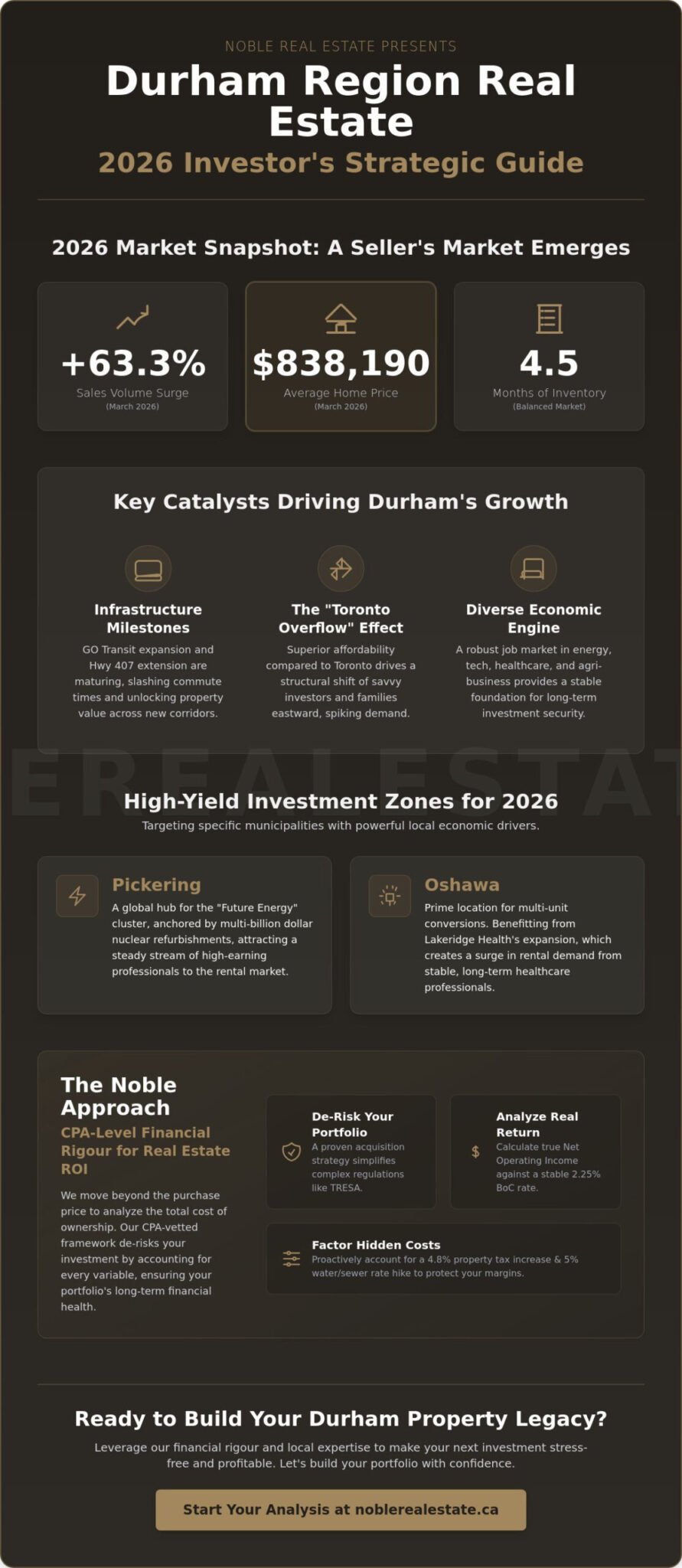
With sales volume surging 63.3% in March 2026 alone, Durham Region has officially transitioned into a seller-favouring market that demands a more calculated strategy than ever before. You’ve likely watched Toronto prices climb out of reach and felt the anxiety of choosing a neighborhood that might not deliver the returns you need. It’s frustrating to manage the complexities of the Trust in Real Estate Services Act (TRESA) while trying to predict which durham region real estate investment opportunities offer the best balance of cash flow and capital appreciation. We understand that the fear of a stagnant investment is real, especially when the average home price in the region reached $838,190 in March 2026.
This strategic guide will show you how to identify high-growth corridors and the financial frameworks required to build a profitable property portfolio. You’ll discover our 2026 growth hotspots and learn how “The Noble Approach” applies CPA-level analytical rigour to maximize your ROI. We’ll explore why the Bank of Canada’s 2.25% overnight rate is shifting the landscape and how you can move forward with confidence, making the investment process stress-free and straightforward.
Key Takeaways
- Understand how GO Transit’s 2026 service levels and relative affordability act as catalysts for property appreciation across the region.
- Identify the specific high-yield zones within Pickering and Oshawa that represent the strongest durham region real estate investment opportunities for 2026.
- Learn why a CPA-vetted analysis of the total cost of ownership is more critical than the initial purchase price for long-term ROI.
- Discover a proven two-step acquisition strategy designed to simplify complex regulations and de-risk your investment portfolio.
- See how “The Noble Approach” leverages financial rigour and local expertise to make building your property legacy stress-free.
The 2026 Durham Region Market: Why Investors are Moving East
Investors are looking east because the numbers tell a story of resilience and growth. While Toronto’s entry prices remain a barrier for many, the Regional Municipality of Durham provides a strategic alternative with an average home price of $838,190 as of March 2026. This affordability gap creates a powerful “Toronto Overflow” effect, driving savvy buyers toward durham region real estate investment opportunities that offer superior long-term potential. As families and professionals seek better value, demand in Durham has spiked. We saw this clearly in March 2026, when sales volume jumped 63.3% in a single month. This isn’t a temporary trend; it’s a structural shift in where people choose to live and invest.
Stability is the hallmark of the current market. With 4.5 months of inventory recorded in March 2026, Durham offers a balanced environment that protects against the volatility seen in previous years. Population growth here is currently outpacing much of the Greater Toronto Area, fueled by a diverse economy that no longer relies solely on manufacturing. This diversification ensures that your investment is backed by a robust job market spanning energy, tech, and healthcare.
Infrastructure Milestones Shaping 2026 Values
Infrastructure is the most reliable catalyst for real estate appreciation. The Lakeshore East GO expansion has reached critical service levels in 2026, drastically reducing commute times and pushing property premiums higher in eastern pockets. Similarly, the Highway 407 extension has matured, turning the northern “commuter corridor” into an investment hotspot. Beyond transportation, the expansion of Lakeridge Health facilities has created a surge in local rental demand from healthcare workers. This specific tenant profile is highly valued for their professional stability and long-term residency.
Economic Diversification Beyond the Auto Sector
The region’s economic engine has found new gears. Clarington and Pickering are now global hubs for the “Future Energy” cluster, anchored by multi-billion dollar refurbishments at local nuclear stations. These projects bring a steady stream of high-earning professionals into the rental market. Meanwhile, Whitby’s tech-sector growth is attracting a younger, affluent tenant base that prioritizes modern amenities and urban proximity. In Uxbridge, agri-business innovation is creating a specialized niche, proving that durham region real estate investment opportunities exist across every municipality, provided you have the right analytical framework to find them.
The Noble Approach: A Financial Framework for Real Estate ROI
Successful investing requires looking past the “sticker price” to understand the total cost of ownership. In 2026, the Region of Durham implemented a 4.8% property tax increase, adding roughly $14 per month to the average homeowner’s expenses. Combined with a 5% hike in water and sewer rates, these incremental costs can erode your margins if they aren’t factored into your initial pro forma. The Noble Approach uses CPA-level analytical rigour to de-risk these durham region real estate investment opportunities, ensuring every variable is accounted for before you sign an offer.
Colin Noble’s background in finance (CPA, CA) provides a unique advantage in a market where the average property sold at 99.0% of its list price in April 2026. We don’t just look at aesthetic appeal; we analyze the underlying financial health of the asset. This analytical rigour aligns with the broader strategy for Durham’s economic prosperity, ensuring your portfolio grows alongside the region’s expanding infrastructure and diverse job market.
Calculating Your Real Return
Cap rates in 2026 have stabilized as the market moved toward a balanced state. While previous years saw frantic bidding, current investors benefit from more predictable yields. Your borrowing power is also more transparent now that the Bank of Canada overnight rate sits at 2.25%, though the mortgage stress test remains a critical hurdle for maximizing leverage. Net Operating Income is the total annual income generated by a property after all necessary operating expenses have been deducted, but before accounting for mortgage payments or income taxes.
Strategic Asset Allocation
Choosing between a detached home in Uxbridge or a multi-unit conversion in Oshawa depends entirely on your risk profile. Single-family homes typically offer higher capital appreciation, while multi-unit properties prioritize monthly cash flow. We use a principled valuation methodology that goes beyond simple neighborhood comparables to assess the long-term viability of the asset. If you’re transitioning out of an existing asset to fund a new purchase, our Uxbridge Real Estate: A Seller’s Guide provides the framework for a high-value exit. To see how your current holdings fit into a 2026 strategy, you can request a professional home valuation today.
Top 5 Durham Region Investment Pockets for 2026
Identifying the right municipality requires more than just looking at a map; it requires an understanding of how local micro-markets respond to shifting demographics. Durham is currently home to one of the fastest growing populations in Ontario, which creates a high-floor environment for property values. While the region as a whole shows promise, specific pockets stand out as the premier durham region real estate investment opportunities for 2026. From the rapid urbanization of Pickering to the lifestyle-driven scarcity in Uxbridge, each area serves a different strategic goal within a portfolio.
The Seaton Growth Story in Pickering
2026 marks the tipping point for Seaton, Pickering’s massive master-planned community. What was once a series of construction sites is now a maturing residential and commercial mix. Investors are finding that townhomes in North Pickering often provide superior rental yields compared to detached properties, as they attract young professionals who work in the city but want the space of the suburbs. If you’re comparing these new developments against established luxury markets, viewing current Houses for Sale in Uxbridge can provide a helpful benchmark for value and architectural standards across the region.
Oshawa’s Multi-Unit Revolution
Oshawa remains the primary destination for investors focused on immediate cash flow. The city has embraced legal second suites, providing the fastest path to positive monthly returns in the current interest rate environment. Demand is anchored by the presence of Ontario Tech University and Durham College, where student housing needs consistently outpace supply. We’re also seeing a significant revitalization in the downtown core, making it a viable long-term play for those who can weather the initial transition phase of the neighborhood.
Uxbridge: The Stable Wealth Play
Known as the “Trail Capital of Canada,” Uxbridge offers a level of inventory scarcity that naturally protects property values during market shifts. This is a “Blue Chip” investment area where lifestyle and prestige drive long-term appreciation. The region has also seen a boost in tourism and interest due to its filming history, most notably in Goodwood, Canada, which served as the setting for Schitt’s Creek. This cultural relevance, combined with the “Goodwood” prestige factor, makes Uxbridge a favorite for luxury rental conversions and high-end residential holdings.
Beyond these three, Whitby remains a family-friendly staple with consistent demand, while Clarington represents the frontier of the 401 corridor expansion. Each of these five pockets offers a distinct entry point into the Durham market, allowing you to tailor your acquisition strategy to your specific financial goals.
Mitigating Risk: Due Diligence and Acquisition Strategy
Acquiring a property is only the first step. Protecting your capital requires a level of due diligence that goes beyond a standard home inspection. In a market where the average property sold at 99.0% of its list price in April 2026, there’s little room for error. Successful durham region real estate investment opportunities are secured through a disciplined acquisition process that identifies both structural and financial red flags before they become liabilities. Our methodology ensures that your investment is grounded in data rather than emotion.
The first step in “The Noble Approach” involves a CPA-vetted budget. We don’t just look at what the bank will lend; we analyze what the property will actually cost to carry. This includes factoring in the 2026 property tax increases and the 5% rise in water and sewer rates. Once the numbers align, we conduct a neighborhood “Deep Dive.” This involves looking at municipal zoning bylaws and future development permits that could impact your property’s value. We want to know what’s happening three blocks away, not just what’s visible from the driveway.
The “Noble Inspection” is our third layer of defense. While a traditional inspector looks at the roof and furnace, we look for financial red flags like unpermitted suites or non-compliant plumbing that could lead to costly insurance premiums or legal issues under the Trust in Real Estate Services Act (TRESA). Finally, we craft a winning offer. In 2026’s competitive landscape, this often means using strategic clauses that protect the buyer while remaining attractive to sellers who are seeing increased activity.
Navigating Ontario’s Tenant Landscape
Being a landlord in 2026 requires a firm grasp of the Residential Tenancies Act (RTA). One critical strategy we use involves targeting “new build” properties. Any residential unit first occupied after November 15, 2018, is currently exempt from provincial rent increase caps. This allows for market-rate adjustments that protect your cash flow against inflation. Additionally, we emphasize professional tenant screening. Protecting your asset starts with finding the right resident, a process that should be handled with the same analytical rigour as the purchase itself.
The Role of a Specialized Investment Realtor
Generalist agents often miss the financial nuances that make or break a rental property. They might see a beautiful kitchen, while an investment specialist sees a floor plan that doesn’t support a legal second suite. We leverage deep local networks to find “off-market” opportunities that never hit the MLS, giving our clients a distinct advantage. If you’re ready to move from browsing to buying, Choosing Real Estate Agents Near You who understand the investment landscape is your most important decision. To begin your journey with a partner who prioritizes your ROI, contact Noble Real Estate for a strategic consultation.
Conclusion: Building Your Durham Legacy with Noble Real Estate
The real estate landscape of 2026 has moved past the volatility of previous years, offering a unique window for those who prioritize analytical rigour over speculation. With sales volume climbing by 63.3% in March 2026 and inventory levels holding at 4.5 months, the durham region real estate investment opportunities available today are defined by sustainable growth and renewed buyer confidence. Success in this environment isn’t about luck; it’s about applying a disciplined financial framework to every acquisition. We’ve seen the market shift from a buyer-leaning start in January to a seller-favouring environment by late April 2026, proving that timing and data are your most valuable assets.
“The Noble Approach” is designed to redefine your real estate expectations. We believe that your property journey should be stress-free and straightforward, supported by the precision of a CPA, CA background. By moving beyond simple listings and focusing on the total cost of ownership, we help you build a portfolio that stands up to market shifts and regulatory changes like the Trust in Real Estate Services Act (TRESA). You aren’t just buying an asset; you’re securing a legacy in a community we know and serve deeply. This financial expertise ensures that complex calculations, from land transfer taxes to net operating income, are handled with the utmost care.
A real estate partner should be more than a facilitator; they should be a seasoned advisor genuinely invested in your long-term success. Our end-to-end approach means we’re with you from the initial home valuation to the final offer, providing a calm and knowledgeable presence in a competitive market. We don’t just find houses; we identify strategic entries into Durham’s high-growth corridors that align with your specific risk profile. Whether you’re targeting the master-planned communities of Pickering or the stable, lifestyle-driven market of Uxbridge, your goals are within reach when backed by analytical rigour.
Your Next Steps for 2026
Taking the first step toward a profitable portfolio doesn’t have to be overwhelming. We’ve streamlined the process to ensure you have the data you need to make an informed decision. You can begin by reviewing our current curated investment listings or requesting a professional home valuation to understand your current equity position. Each step is designed to build your confidence and answer your questions before they even arise.
- Schedule a strategic consultation: Book a call with Colin Noble, CPA, CA, to align your financial goals with current market realities.
- Review our investment-grade properties: Access a selection of listings across Durham that meet our strict criteria for yield and appreciation.
- Analyze your potential ROI: Let us help you run the numbers on potential acquisitions using our comprehensive, CPA-vetted valuation models.
Your real estate goals are achievable with the right guidance. Whether you’re looking for high-yield multi-unit conversions in Oshawa or stable luxury rentals in Whitby, we’re here to provide the professional support you deserve. Get in touch today to start building your Durham legacy with a partner who is as invested in your success as you are.
Redefine Your Real Estate Expectations in 2026
The 2026 market presents a rare window where stability meets growth. With the average home price reaching $838,190 in March 2026 and inventory holding at 4.5 months, the data confirms that Durham is no longer just a Toronto overflow option; it’s a primary destination for wealth building. You’ve seen how infrastructure like the Lakeshore East GO expansion is driving premiums and why identifying the right pocket, from Pickering’s Seaton to the scarcity of Uxbridge, is vital for your ROI.
Navigating durham region real estate investment opportunities requires more than just a search alert. It demands the analytical rigour of a CPA, CA who understands how the 4.8% property tax increase and new TRESA regulations impact your bottom line. We’re here to ensure your journey is stress-free and straightforward, providing the comprehensive knowledge you need to invest with absolute confidence. Our end-to-end approach means every financial nuance is handled with the highest standard of care.
Are you ready to build your legacy? Book Your Strategic 2026 Investment Consultation with Colin Noble today. Let’s turn these insights into a successful, high-performing portfolio. Your goals are achievable, and we’re excited to help you reach them.
Frequently Asked Questions
Is Durham Region still a good place to invest in 2026?
Yes, Durham remains a highly attractive market due to its balanced inventory and surging demand. In March 2026, new listings increased by 57% compared to the previous month, providing investors with more options while sales activity remained high. This growth is supported by a 2.25% Bank of Canada overnight rate, which has restored confidence for those seeking long-term durham region real estate investment opportunities.
Which Durham city has the lowest property taxes for investors?
Tax rates are determined by each specific municipality, but investors should account for the 4.8% regional property tax increase implemented in 2026. Historically, towns like Whitby and Pickering have offered a competitive balance between tax costs and services, whereas older urban areas may have different mill rates. We include these precise municipal tax calculations in our financial assessments to ensure your investment strategy is fully de-risked.
How much down payment do I need for an investment property in Ontario?
You need a minimum down payment of 20% for a non-owner-occupied investment property in Ontario. Based on the March 2026 average price of $838,190, this requires an initial capital outlay of approximately $167,638. This 20% threshold is a requirement for conventional financing on rental properties to avoid the need for mortgage default insurance.
What is the ‘Seaton’ development and why is it important for Pickering investors?
Seaton is a massive, master-planned community in North Pickering designed to eventually house 70,000 residents and support 35,000 jobs. It’s a critical area for investors because it represents a ground-up opportunity in a region with high population growth. The development’s proximity to the Highway 407 extension makes it a primary target for professionals seeking modern, transit-oriented housing.
Can I convert a single-family home in Durham into a legal duplex?
You can convert most single-family homes into legal duplexes or even triplexes under current provincial housing legislation. To do this legally in Durham, you must obtain municipal permits and ensure the second suite meets the Ontario Building Code and Fire Code requirements. These conversions are an effective way to maximize rental yield and help offset the 5% combined water and sewer rate increase seen in 2026.
How do GO Transit expansions affect property values in Uxbridge and Whitby?
GO Transit expansions act as a direct catalyst for property appreciation by making the region more accessible to the GTA workforce. The 2026 service levels on the Lakeshore East line have strengthened rental demand in Whitby, while regional improvements continue to support the commutable luxury appeal of Uxbridge. Properties within a short radius of these transit hubs typically command higher premiums and experience lower vacancy rates.
What are the closing costs for an investment property in Durham Region?
You should budget between 1.5% and 4% of the property’s purchase price to cover your total closing costs. These costs include the provincial Land Transfer Tax, legal fees, title insurance, and adjustments for property taxes. If you aren’t a Canadian citizen, remember that the federal foreign buyer ban is in effect until January 1, 2027, and the Non-Resident Speculation Tax (NRST) remains at 25% for non-exempt buyers.

With sales volume surging 63.3% in March 2026 alone, Durham Region has officially transitioned into a seller-favouring market that demands a more calculated strategy than ever before. You’ve likely watched Toronto prices climb out of reach and felt the anxiety of choosing a neighborhood that might not deliver the returns you need. It’s frustrating to manage the complexities of the Trust in Real Estate Services Act (TRESA) while trying to predict which durham region real estate investment opportunities offer the best balance of cash flow and capital appreciation. We understand that the fear of a stagnant investment is real, especially when the average home price in the region reached $838,190 in March 2026.
This strategic guide will show you how to identify high-growth corridors and the financial frameworks required to build a profitable property portfolio. You’ll discover our 2026 growth hotspots and learn how “The Noble Approach” applies CPA-level analytical rigour to maximize your ROI. We’ll explore why the Bank of Canada’s 2.25% overnight rate is shifting the landscape and how you can move forward with confidence, making the investment process stress-free and straightforward.
Key Takeaways
- Understand how GO Transit’s 2026 service levels and relative affordability act as catalysts for property appreciation across the region.
- Identify the specific high-yield zones within Pickering and Oshawa that represent the strongest durham region real estate investment opportunities for 2026.
- Learn why a CPA-vetted analysis of the total cost of ownership is more critical than the initial purchase price for long-term ROI.
- Discover a proven two-step acquisition strategy designed to simplify complex regulations and de-risk your investment portfolio.
- See how “The Noble Approach” leverages financial rigour and local expertise to make building your property legacy stress-free.
The 2026 Durham Region Market: Why Investors are Moving East
Investors are looking east because the numbers tell a story of resilience and growth. While Toronto’s entry prices remain a barrier for many, the Regional Municipality of Durham provides a strategic alternative with an average home price of $838,190 as of March 2026. This affordability gap creates a powerful “Toronto Overflow” effect, driving savvy buyers toward durham region real estate investment opportunities that offer superior long-term potential. As families and professionals seek better value, demand in Durham has spiked. We saw this clearly in March 2026, when sales volume jumped 63.3% in a single month. This isn’t a temporary trend; it’s a structural shift in where people choose to live and invest.
Stability is the hallmark of the current market. With 4.5 months of inventory recorded in March 2026, Durham offers a balanced environment that protects against the volatility seen in previous years. Population growth here is currently outpacing much of the Greater Toronto Area, fueled by a diverse economy that no longer relies solely on manufacturing. This diversification ensures that your investment is backed by a robust job market spanning energy, tech, and healthcare.
Infrastructure Milestones Shaping 2026 Values
Infrastructure is the most reliable catalyst for real estate appreciation. The Lakeshore East GO expansion has reached critical service levels in 2026, drastically reducing commute times and pushing property premiums higher in eastern pockets. Similarly, the Highway 407 extension has matured, turning the northern “commuter corridor” into an investment hotspot. Beyond transportation, the expansion of Lakeridge Health facilities has created a surge in local rental demand from healthcare workers. This specific tenant profile is highly valued for their professional stability and long-term residency.
Economic Diversification Beyond the Auto Sector
The region’s economic engine has found new gears. Clarington and Pickering are now global hubs for the “Future Energy” cluster, anchored by multi-billion dollar refurbishments at local nuclear stations. These projects bring a steady stream of high-earning professionals into the rental market. Meanwhile, Whitby’s tech-sector growth is attracting a younger, affluent tenant base that prioritizes modern amenities and urban proximity. In Uxbridge, agri-business innovation is creating a specialized niche, proving that durham region real estate investment opportunities exist across every municipality, provided you have the right analytical framework to find them.
The Noble Approach: A Financial Framework for Real Estate ROI
Successful investing requires looking past the “sticker price” to understand the total cost of ownership. In 2026, the Region of Durham implemented a 4.8% property tax increase, adding roughly $14 per month to the average homeowner’s expenses. Combined with a 5% hike in water and sewer rates, these incremental costs can erode your margins if they aren’t factored into your initial pro forma. The Noble Approach uses CPA-level analytical rigour to de-risk these durham region real estate investment opportunities, ensuring every variable is accounted for before you sign an offer.
Colin Noble’s background in finance (CPA, CA) provides a unique advantage in a market where the average property sold at 99.0% of its list price in April 2026. We don’t just look at aesthetic appeal; we analyze the underlying financial health of the asset. This analytical rigour aligns with the broader strategy for Durham’s economic prosperity, ensuring your portfolio grows alongside the region’s expanding infrastructure and diverse job market.
Calculating Your Real Return
Cap rates in 2026 have stabilized as the market moved toward a balanced state. While previous years saw frantic bidding, current investors benefit from more predictable yields. Your borrowing power is also more transparent now that the Bank of Canada overnight rate sits at 2.25%, though the mortgage stress test remains a critical hurdle for maximizing leverage. Net Operating Income is the total annual income generated by a property after all necessary operating expenses have been deducted, but before accounting for mortgage payments or income taxes.
Strategic Asset Allocation
Choosing between a detached home in Uxbridge or a multi-unit conversion in Oshawa depends entirely on your risk profile. Single-family homes typically offer higher capital appreciation, while multi-unit properties prioritize monthly cash flow. We use a principled valuation methodology that goes beyond simple neighborhood comparables to assess the long-term viability of the asset. If you’re transitioning out of an existing asset to fund a new purchase, our Uxbridge Real Estate: A Seller’s Guide provides the framework for a high-value exit. To see how your current holdings fit into a 2026 strategy, you can request a professional home valuation today.
Top 5 Durham Region Investment Pockets for 2026
Identifying the right municipality requires more than just looking at a map; it requires an understanding of how local micro-markets respond to shifting demographics. Durham is currently home to one of the fastest growing populations in Ontario, which creates a high-floor environment for property values. While the region as a whole shows promise, specific pockets stand out as the premier durham region real estate investment opportunities for 2026. From the rapid urbanization of Pickering to the lifestyle-driven scarcity in Uxbridge, each area serves a different strategic goal within a portfolio.
The Seaton Growth Story in Pickering
2026 marks the tipping point for Seaton, Pickering’s massive master-planned community. What was once a series of construction sites is now a maturing residential and commercial mix. Investors are finding that townhomes in North Pickering often provide superior rental yields compared to detached properties, as they attract young professionals who work in the city but want the space of the suburbs. If you’re comparing these new developments against established luxury markets, viewing current Houses for Sale in Uxbridge can provide a helpful benchmark for value and architectural standards across the region.
Oshawa’s Multi-Unit Revolution
Oshawa remains the primary destination for investors focused on immediate cash flow. The city has embraced legal second suites, providing the fastest path to positive monthly returns in the current interest rate environment. Demand is anchored by the presence of Ontario Tech University and Durham College, where student housing needs consistently outpace supply. We’re also seeing a significant revitalization in the downtown core, making it a viable long-term play for those who can weather the initial transition phase of the neighborhood.
Uxbridge: The Stable Wealth Play
Known as the “Trail Capital of Canada,” Uxbridge offers a level of inventory scarcity that naturally protects property values during market shifts. This is a “Blue Chip” investment area where lifestyle and prestige drive long-term appreciation. The region has also seen a boost in tourism and interest due to its filming history, most notably in Goodwood, Canada, which served as the setting for Schitt’s Creek. This cultural relevance, combined with the “Goodwood” prestige factor, makes Uxbridge a favorite for luxury rental conversions and high-end residential holdings.
Beyond these three, Whitby remains a family-friendly staple with consistent demand, while Clarington represents the frontier of the 401 corridor expansion. Each of these five pockets offers a distinct entry point into the Durham market, allowing you to tailor your acquisition strategy to your specific financial goals.
Mitigating Risk: Due Diligence and Acquisition Strategy
Acquiring a property is only the first step. Protecting your capital requires a level of due diligence that goes beyond a standard home inspection. In a market where the average property sold at 99.0% of its list price in April 2026, there’s little room for error. Successful durham region real estate investment opportunities are secured through a disciplined acquisition process that identifies both structural and financial red flags before they become liabilities. Our methodology ensures that your investment is grounded in data rather than emotion.
The first step in “The Noble Approach” involves a CPA-vetted budget. We don’t just look at what the bank will lend; we analyze what the property will actually cost to carry. This includes factoring in the 2026 property tax increases and the 5% rise in water and sewer rates. Once the numbers align, we conduct a neighborhood “Deep Dive.” This involves looking at municipal zoning bylaws and future development permits that could impact your property’s value. We want to know what’s happening three blocks away, not just what’s visible from the driveway.
The “Noble Inspection” is our third layer of defense. While a traditional inspector looks at the roof and furnace, we look for financial red flags like unpermitted suites or non-compliant plumbing that could lead to costly insurance premiums or legal issues under the Trust in Real Estate Services Act (TRESA). Finally, we craft a winning offer. In 2026’s competitive landscape, this often means using strategic clauses that protect the buyer while remaining attractive to sellers who are seeing increased activity.
Navigating Ontario’s Tenant Landscape
Being a landlord in 2026 requires a firm grasp of the Residential Tenancies Act (RTA). One critical strategy we use involves targeting “new build” properties. Any residential unit first occupied after November 15, 2018, is currently exempt from provincial rent increase caps. This allows for market-rate adjustments that protect your cash flow against inflation. Additionally, we emphasize professional tenant screening. Protecting your asset starts with finding the right resident, a process that should be handled with the same analytical rigour as the purchase itself.
The Role of a Specialized Investment Realtor
Generalist agents often miss the financial nuances that make or break a rental property. They might see a beautiful kitchen, while an investment specialist sees a floor plan that doesn’t support a legal second suite. We leverage deep local networks to find “off-market” opportunities that never hit the MLS, giving our clients a distinct advantage. If you’re ready to move from browsing to buying, Choosing Real Estate Agents Near You who understand the investment landscape is your most important decision. To begin your journey with a partner who prioritizes your ROI, contact Noble Real Estate for a strategic consultation.
Conclusion: Building Your Durham Legacy with Noble Real Estate
The real estate landscape of 2026 has moved past the volatility of previous years, offering a unique window for those who prioritize analytical rigour over speculation. With sales volume climbing by 63.3% in March 2026 and inventory levels holding at 4.5 months, the durham region real estate investment opportunities available today are defined by sustainable growth and renewed buyer confidence. Success in this environment isn’t about luck; it’s about applying a disciplined financial framework to every acquisition. We’ve seen the market shift from a buyer-leaning start in January to a seller-favouring environment by late April 2026, proving that timing and data are your most valuable assets.
“The Noble Approach” is designed to redefine your real estate expectations. We believe that your property journey should be stress-free and straightforward, supported by the precision of a CPA, CA background. By moving beyond simple listings and focusing on the total cost of ownership, we help you build a portfolio that stands up to market shifts and regulatory changes like the Trust in Real Estate Services Act (TRESA). You aren’t just buying an asset; you’re securing a legacy in a community we know and serve deeply. This financial expertise ensures that complex calculations, from land transfer taxes to net operating income, are handled with the utmost care.
A real estate partner should be more than a facilitator; they should be a seasoned advisor genuinely invested in your long-term success. Our end-to-end approach means we’re with you from the initial home valuation to the final offer, providing a calm and knowledgeable presence in a competitive market. We don’t just find houses; we identify strategic entries into Durham’s high-growth corridors that align with your specific risk profile. Whether you’re targeting the master-planned communities of Pickering or the stable, lifestyle-driven market of Uxbridge, your goals are within reach when backed by analytical rigour.
Your Next Steps for 2026
Taking the first step toward a profitable portfolio doesn’t have to be overwhelming. We’ve streamlined the process to ensure you have the data you need to make an informed decision. You can begin by reviewing our current curated investment listings or requesting a professional home valuation to understand your current equity position. Each step is designed to build your confidence and answer your questions before they even arise.
- Schedule a strategic consultation: Book a call with Colin Noble, CPA, CA, to align your financial goals with current market realities.
- Review our investment-grade properties: Access a selection of listings across Durham that meet our strict criteria for yield and appreciation.
- Analyze your potential ROI: Let us help you run the numbers on potential acquisitions using our comprehensive, CPA-vetted valuation models.
Your real estate goals are achievable with the right guidance. Whether you’re looking for high-yield multi-unit conversions in Oshawa or stable luxury rentals in Whitby, we’re here to provide the professional support you deserve. Get in touch today to start building your Durham legacy with a partner who is as invested in your success as you are.
Redefine Your Real Estate Expectations in 2026
The 2026 market presents a rare window where stability meets growth. With the average home price reaching $838,190 in March 2026 and inventory holding at 4.5 months, the data confirms that Durham is no longer just a Toronto overflow option; it’s a primary destination for wealth building. You’ve seen how infrastructure like the Lakeshore East GO expansion is driving premiums and why identifying the right pocket, from Pickering’s Seaton to the scarcity of Uxbridge, is vital for your ROI.
Navigating durham region real estate investment opportunities requires more than just a search alert. It demands the analytical rigour of a CPA, CA who understands how the 4.8% property tax increase and new TRESA regulations impact your bottom line. We’re here to ensure your journey is stress-free and straightforward, providing the comprehensive knowledge you need to invest with absolute confidence. Our end-to-end approach means every financial nuance is handled with the highest standard of care.
Are you ready to build your legacy? Book Your Strategic 2026 Investment Consultation with Colin Noble today. Let’s turn these insights into a successful, high-performing portfolio. Your goals are achievable, and we’re excited to help you reach them.
Frequently Asked Questions
Is Durham Region still a good place to invest in 2026?
Yes, Durham remains a highly attractive market due to its balanced inventory and surging demand. In March 2026, new listings increased by 57% compared to the previous month, providing investors with more options while sales activity remained high. This growth is supported by a 2.25% Bank of Canada overnight rate, which has restored confidence for those seeking long-term durham region real estate investment opportunities.
Which Durham city has the lowest property taxes for investors?
Tax rates are determined by each specific municipality, but investors should account for the 4.8% regional property tax increase implemented in 2026. Historically, towns like Whitby and Pickering have offered a competitive balance between tax costs and services, whereas older urban areas may have different mill rates. We include these precise municipal tax calculations in our financial assessments to ensure your investment strategy is fully de-risked.
How much down payment do I need for an investment property in Ontario?
You need a minimum down payment of 20% for a non-owner-occupied investment property in Ontario. Based on the March 2026 average price of $838,190, this requires an initial capital outlay of approximately $167,638. This 20% threshold is a requirement for conventional financing on rental properties to avoid the need for mortgage default insurance.
What is the ‘Seaton’ development and why is it important for Pickering investors?
Seaton is a massive, master-planned community in North Pickering designed to eventually house 70,000 residents and support 35,000 jobs. It’s a critical area for investors because it represents a ground-up opportunity in a region with high population growth. The development’s proximity to the Highway 407 extension makes it a primary target for professionals seeking modern, transit-oriented housing.
Can I convert a single-family home in Durham into a legal duplex?
You can convert most single-family homes into legal duplexes or even triplexes under current provincial housing legislation. To do this legally in Durham, you must obtain municipal permits and ensure the second suite meets the Ontario Building Code and Fire Code requirements. These conversions are an effective way to maximize rental yield and help offset the 5% combined water and sewer rate increase seen in 2026.
How do GO Transit expansions affect property values in Uxbridge and Whitby?
GO Transit expansions act as a direct catalyst for property appreciation by making the region more accessible to the GTA workforce. The 2026 service levels on the Lakeshore East line have strengthened rental demand in Whitby, while regional improvements continue to support the commutable luxury appeal of Uxbridge. Properties within a short radius of these transit hubs typically command higher premiums and experience lower vacancy rates.
What are the closing costs for an investment property in Durham Region?
You should budget between 1.5% and 4% of the property’s purchase price to cover your total closing costs. These costs include the provincial Land Transfer Tax, legal fees, title insurance, and adjustments for property taxes. If you aren’t a Canadian citizen, remember that the federal foreign buyer ban is in effect until January 1, 2027, and the Non-Resident Speculation Tax (NRST) remains at 25% for non-exempt buyers.