
Looking For More Great Content?
Get even more informative Toronto real estate news sent directly to your inbox by signing up for my newsletter here. All it takes is a few easy clicks.

Durham Region Vacant Land for Sale: The Expert Guide to Buying and Building
04/23/26 Uncategorized
What if the perfect five acre lot you’ve been eyeing in Uxbridge is actually legally unbuildable due to a single environmental setback? It’s a valid concern for many buyers looking at durham region vacant land for sale. You see a blank canvas, but the reality often involves a complex web of TRCA regulations and development charges that can exceed C$40,000 in certain municipalities. It’s natural to feel hesitant when the financial stakes are this high and the rules seem to change with every concession road.
You deserve a land acquisition process that’s as stress-free as it is successful. By combining professional financial insight with deep local expertise, you can navigate these complexities without the fear of hidden costs. This guide will show you how to identify a buildable lot that aligns with your long-term goals while protecting your capital. Our goal is to make the path to your custom home clear and predictable.
We’ll examine the specific requirements of the LSRCA, break down the true cost of ownership including municipal fees, and demonstrate how “The Noble Approach” brings analytical rigour to your search for the perfect property.
Key Takeaways
- Understand why Durham Region is a premier choice for land investment and how to identify the right opportunities within the Greater Toronto Area.
- Navigate the complexities of the Oak Ridges Moraine Conservation Plan and local zoning bylaws to ensure your vision is legally and physically viable.
- Learn to calculate the true cost of acquisition for durham region vacant land for sale using a professional financial framework that accounts for more than just the sticker price.
- Master “The Noble Approach” to due diligence with a structured checklist designed to uncover hidden constraints before you finalize your investment.
- Discover how expert, CPA-led guidance simplifies the transition from browsing listings to a successful closing on your ideal building site.
The Landscape of Durham Region Vacant Land for Sale
Finding the right durham region vacant land for sale requires more than a simple map search. It demands a clear understanding of what “vacant” actually means in a highly regulated environment. Within the Regional Municipality of Durham, this category ranges from small residential infill lots in established neighbourhoods to sprawling 50-acre parcels in the northern reaches. As we move through 2026, the market has shifted. Land is no longer a passive holding; it’s a complex puzzle of zoning bylaws, environmental protections, and infrastructure timelines. Durham stands out in the Greater Toronto Area because it offers a rare balance of accessibility and untapped potential that remains scarce in York or Peel regions.
The diversity of the landscape is a primary draw. You can find a 50-foot lot in a mature Whitby pocket or a massive agricultural tract in Brock. Each comes with distinct sets of rules. Success depends on identifying these nuances before you sign an agreement. My goal is to make this process stress-free and straightforward by providing the analytical rigour your investment deserves.
Urban vs. Rural Land: Choosing Your Path
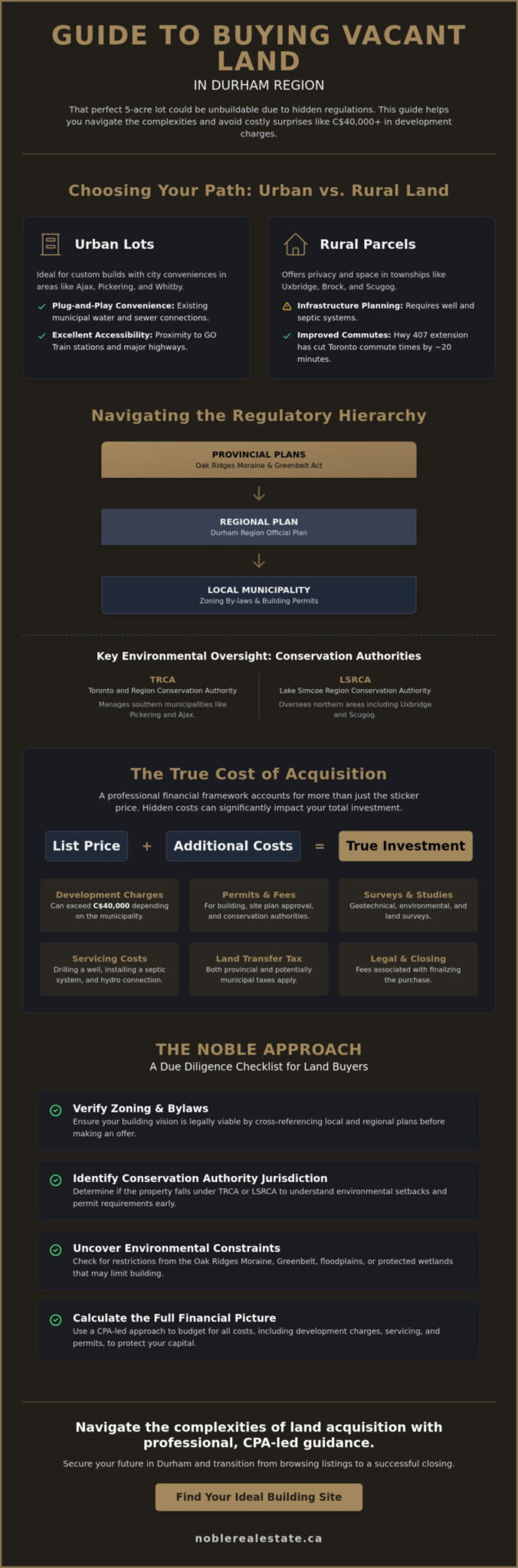
Your goals dictate your location. Urban lots in Ajax, Pickering, and Whitby offer “plug-and-play” convenience with existing municipal water and sewer connections. These are ideal for custom builds where you want proximity to the GO Train. Conversely, rural properties in Uxbridge, Brock, and Scugog provide the privacy many families crave. You’ll need to account for well and septic systems here. The extension of Highway 407 and improvements to the 401 corridor have significantly increased land values in these northern pockets. Commute times to Toronto from North Durham have dropped by approximately 20 minutes since the 407 reached Highway 35/115, making these rural retreats viable primary residences for professionals.
The Economic Outlook for Durham Land
The 2026 market is heavily influenced by Ontario’s push to build 1.5 million homes by 2031. This provincial mandate has forced municipalities to streamline approvals, but it also creates a competitive environment for durham region vacant land for sale. Investors should look at land through a rigorous financial lens. The Noble Approach integrates a CPA perspective to evaluate carrying costs, development charges, and potential ROI. We don’t just look at the dirt; we analyze the numbers. Residential land values in the region have shown steady growth over the last five years. Evaluating these assets as a long-term investment requires a deep dive into municipal secondary plans and future transit hubs to ensure your capital is protected and positioned for growth.
Navigating Durham’s Regulatory Landscape: Zoning and Environmental Laws
Finding the right durham region vacant land for sale requires more than a keen eye for a view; it demands a deep dive into the Durham Region Official Plan. This document acts as the primary blueprint for growth, but it doesn’t work in isolation. You’ll need to understand how the 2001 Oak Ridges Moraine Conservation Plan and the 2005 Greenbelt Act place strict limits on what can be built. These provincial policies protect 1.8 million acres of land across the Golden Horseshoe, and a significant portion falls within Durham’s borders. If your dream lot sits on the Moraine, you’ll face tighter restrictions on lot coverage and septic placement than you would in an urban core.
The regulatory hierarchy can feel complex. While the Regional government sets broad policies, the eight local municipalities, such as Uxbridge, Scugog, and Clarington, manage the specific building permits and site plan approvals. Success depends on aligning your vision with both levels of government. It’s about knowing which department to call first to ensure your project doesn’t hit a roadblock before the first shovel hits the ground.
Conservation Authorities: TRCA and LSRCA
Before you clear a single tree, you must identify which watershed governs your property. The Toronto and Region Conservation Authority (TRCA) manages southern municipalities like Pickering and Ajax. In contrast, the Lake Simcoe Region Conservation Authority (LSRCA) oversees the northern reaches, including parts of Uxbridge and Scugog. These bodies are essential because they map floodplains and wetlands that may not be visible to the naked eye. Consulting Durham Region conservation authorities early in your due diligence prevents costly surprises related to erosion zones or protected habitats. It’s often the difference between a buildable lot and a “look but don’t touch” investment.
Zoning Bylaws and Permitted Uses
When evaluating durham region vacant land for sale, you’ll encounter specific zoning codes that dictate your property’s future. You’ll see designations like R1 for urban residential, RU for rural holdings, or ORM for properties within the Oak Ridges Moraine. Each carries its own set of permitted uses and setback requirements. If a lot doesn’t perfectly meet these rules, you might apply for a “Minor Variance” through the local Committee of Adjustment. This process allows for small deviations from the bylaws, such as a slightly reduced distance from the road or a taller accessory building.
A severance is the legal process of splitting a single property into two or more distinct parcels, and it remains a primary strategy for land investors looking to increase their return on investment. The Noble Approach focuses on analyzing these financial and regulatory risks before you sign a contract. If you’re feeling overwhelmed by the paperwork, you can always connect with a local expert to review the specifics of a particular parcel and ensure your investment is sound.
Financial Diligence: Calculating the Total Cost of Acquisition
The Noble Approach to real estate is rooted in analytical rigor. While the listing price for durham region vacant land for sale might look attractive on paper, your total capital outlay involves several layers of municipal and provincial costs that many buyers overlook. As a CPA, I view land acquisition through a lens of risk mitigation. You aren’t just buying dirt; you’re investing in a complex financial project. Understanding the difference between the sticker price and the “all-in” cost is what separates a successful build from a stalled project.
Development Charges and Levies
Municipalities in Durham Region, such as Uxbridge, Scugog, and Pickering, apply development charges to fund infrastructure required by new growth. These fees aren’t uniform. They vary significantly depending on the local township and the Region of Durham’s current rate schedule. You must also account for:
- Education Levies: Fees collected for local school boards.
- Parkland Dedication: A requirement to either dedicate 5% of the land for park space or pay a “cash-in-lieu” fee to the municipality.
- Permit Fees: Costs for building permits, plumbing permits, and architectural reviews that ensure your design meets the Ontario Building Code.
HST and Land Transfer Tax
Taxation on durham region vacant land for sale is a critical piece of the financial puzzle. In Ontario, the 13% Harmonized Sales Tax (HST) typically applies to the sale of vacant land unless the seller is an individual and the land was for personal use. If you’re buying from a developer or a corporation, expect to pay HST on top of the purchase price. Additionally, the Ontario Land Transfer Tax is calculated based on the purchase price of the land. For agricultural land transitions, specific tax exemptions or rebates might apply if the property maintains its farm status, but these require careful documentation and professional advice to navigate successfully.
Servicing Costs: Wells, Septic, and Hydro
Bringing essential services to a rural lot is a major variable in your budget. If the land isn’t connected to municipal water and sewer, you’ll need to factor in the installation of a private well and a septic system. A standard drilled well and a modern septic system can cost between C$25,000 and C$50,000 combined, depending on soil conditions and the water table. Hydro and gas connections also carry costs. If the nearest hydro pole is far from your building envelope, the utility provider may charge for every meter of line extension. I recommend obtaining a “serviceability letter” from local utilities during your due diligence period to avoid five-figure surprises after closing.
The Noble Approach: A Due Diligence Checklist for Land Buyers
Buying land is a significant financial commitment that requires more than just a vision; it demands a rigorous, data-driven strategy. The Noble Approach focuses on removing the guesswork from durham region vacant land for sale. By following a systematic framework, you transform a complex process into a series of manageable, verifiable steps. This structured due diligence ensures your investment is sound and your future home is actually buildable. Professional representation is non-negotiable in these deals because the risks of missing a single easement or zoning restriction can result in six-figure losses.
Physical Site Assessment
Your first priority is understanding the ground beneath your feet. A topographic survey defines the contours of the lot, while soil testing determines if the land can support a standard foundation or requires expensive engineered solutions. You must identify any registered easements or rights-of-way that could restrict your building envelope. In Durham, environmental site assessments (Phase 1 and Phase 2) are often necessary to rule out historical contamination, especially on lots near former agricultural or industrial zones. These assessments protect you from unforeseen remediation costs that can quickly exceed C$50,000.
Legal and Regulatory Verification
A clear title is the bedrock of property ownership. You need to review the title search for restrictive covenants that might dictate everything from house size to specific exterior materials. Confirming legal access is equally vital; the property must front a public, year-round maintained road to qualify for a residential building permit. Don’t assume a lot is buildable just because it exists. Direct verification with local planning departments in municipalities like Uxbridge or Pickering is the only way to confirm current zoning bylaws and permit availability before you sign on the dotted line.
Investment Viability Check
With a background in finance as a CPA and CA, I look at land through the lens of a balance sheet. You must calculate the “all-in” cost, which includes the land purchase price, development charges, and construction expenses. Compare this total to the current uxbridge real estate benchmarks for finished custom homes. If your total project cost exceeds the projected market value, you need to adjust your plans to ensure long-term financial health. A successful project aligns your lifestyle dreams with a sound exit strategy.
Ready to find a property that meets your high standards? Contact Noble Real Estate today to start your search with an expert partner who understands the numbers.
Securing Your Future in Durham with Professional Guidance
Securing your future in Durham starts with a clear, actionable plan. Buying land isn’t just about a transaction; it’s about laying the foundation for your future home. Noble Real Estate bridges the critical gap between browsing listings and the final closing. We provide the analytical rigour needed to assess a property’s true potential, looking closely at zoning requirements, soil quality, and utility access. Our goal is to ensure you move from land acquisition to the design and build phase with complete confidence. We handle the heavy lifting so you can focus on the creative possibilities of your new space.
Why a Local Realtor Makes the Difference
Finding the right durham region vacant land for sale often requires looking beyond public databases. Local expertise allows us to access off-market opportunities in Uxbridge and surrounding rural areas that never hit the MLS. We understand how to negotiate with developers and private sellers, protecting your interests at every turn. This deep local knowledge also helps us integrate your land search with broader trends for houses for sale in uxbridge, giving you a holistic view of the market’s value and future growth. We don’t just find you a lot; we find you a smart investment.
Redefining Your Expectations
The Noble Approach simplifies what can often be a complex and overwhelming process. By applying a financially savvy perspective rooted in professional accounting expertise, we ensure your investment is sound from day one. We believe real estate should be an exciting and enjoyable journey, not a source of stress. Our commitment to a straightforward client experience means you’re never left wondering about the next step. Whether you’re looking for a sprawling acreage or a tucked-away lot, our end-to-end support provides the clarity you need. We help you transition seamlessly from the purchase agreement to consulting with architects and builders, ensuring your vision remains feasible and on budget.
Ready to start your journey toward homeownership in Durham? Contact Colin Noble today to begin your search for the perfect plot of durham region vacant land for sale. Let’s work together to find a property that fits your vision and your long-term goals.
Build Your Future on Durham Region Soil
Finding the right durham region vacant land for sale is the first step toward a significant financial and personal milestone. Success in this market requires more than just a plot of dirt. It demands a thorough understanding of the 2005 Greenbelt Plan and the specific environmental protections that govern Uxbridge and surrounding townships. You need a partner who views land through a lens of risk mitigation and long-term value. We’ve seen how proper due diligence regarding soil quality and conservation authority permits can save owners thousands in unforeseen costs.
We provide that clarity through The Noble Approach. Because our team is led by a CPA, CA, we bring an unmatched level of financial rigour to your due diligence process. We’ve built a proven track record of navigating complex zoning laws and environmental regulations, ensuring you don’t encounter expensive surprises after the sale. Whether you’re looking for a quiet acreage or a strategic development site, our local expertise keeps your project on track and your stress levels low. It’s about making sure your investment is as solid as the ground you’re building on.
Start Your Durham Land Search with The Noble Approach
Building your future in Durham is an exciting journey, and it’s one you don’t have to navigate alone.
Frequently Asked Questions
Is HST always charged on vacant land for sale in Ontario?
HST at the 13% rate applies to the sale of vacant land if the seller is a corporation or if the land was used for business purposes. You won’t typically pay HST on land sold by an individual if it was for personal use and not subdivided into more than two parcels. It’s vital to confirm the seller’s tax status during your due diligence to avoid unexpected costs.
Can I build a house on Greenbelt land in Durham Region?
Building a new home on Greenbelt land is generally prohibited under the Greenbelt Act of 2005 to protect agricultural and ecological systems. You can only build if the property is an existing “lot of record” with specific residential zoning that predates the legislation. Always check the Greenbelt Plan maps and consult with local planning authorities before purchasing protected acreage.
What is the average cost of development charges in Durham Region?
In 2024, Durham Region’s residential development charge for a single-family detached home is C$38,443. This fee only covers the regional portion. You’ll also pay local municipal charges, which often range from C$20,000 to C$45,000 depending on whether you’re building in Uxbridge, Whitby, or Oshawa. Total fees frequently exceed C$60,000 before you even break ground.
How do I know if a lot in Durham is serviced for water and sewage?
You can verify servicing by requesting a property information report from the Durham Region Works Department or checking the municipal zoning certificate. When viewing durham region vacant land for sale, look for physical markers like a water shut-off valve or a sewer cleanout cap at the property line. If these aren’t present, you’ll likely need a private well and septic system.
What is a “Minor Variance” and will I need one for my land?
A Minor Variance is a small exception to the local zoning bylaw granted by the Committee of Adjustment. You’ll need one if your house design doesn’t perfectly meet specific rules, like being 1.5 metres from a side lot line instead of the required 2.0 metres. The process involves a public hearing and can take 3 to 5 months to complete in most Durham municipalities.
How does the Oak Ridges Moraine affect my ability to build in Uxbridge?
The Oak Ridges Moraine Conservation Plan (ORMCP) protects 190,000 hectares of land and imposes strict limits on lot coverage and vegetation removal. In Uxbridge, building on the Moraine often requires a Site Plan Agreement and specialized environmental studies to protect the groundwater aquifer. These requirements add time and technical costs to your building permit application process.
Should I buy vacant land through a corporation or personally?
Buying personally is usually more tax-efficient if you plan to build your primary residence because you’ll qualify for the Principal Residence Exemption. If you’re an investor, a corporation offers liability protection but involves higher accounting fees and different capital gains treatments. My background as a CPA helps clients navigate these financial structures to ensure the investment aligns with their long-term goals.
What is the difference between raw land and a serviced lot?
Raw land is untouched property without road access, electricity, or water connections. A serviced lot is “build-ready” with utilities like hydro, municipal water, and natural gas already brought to the property boundary. Choosing a serviced lot reduces your initial construction complexity, while raw land offers more privacy but requires significant infrastructure investment before you can start building.

What if the perfect five acre lot you’ve been eyeing in Uxbridge is actually legally unbuildable due to a single environmental setback? It’s a valid concern for many buyers looking at durham region vacant land for sale. You see a blank canvas, but the reality often involves a complex web of TRCA regulations and development charges that can exceed C$40,000 in certain municipalities. It’s natural to feel hesitant when the financial stakes are this high and the rules seem to change with every concession road.
You deserve a land acquisition process that’s as stress-free as it is successful. By combining professional financial insight with deep local expertise, you can navigate these complexities without the fear of hidden costs. This guide will show you how to identify a buildable lot that aligns with your long-term goals while protecting your capital. Our goal is to make the path to your custom home clear and predictable.
We’ll examine the specific requirements of the LSRCA, break down the true cost of ownership including municipal fees, and demonstrate how “The Noble Approach” brings analytical rigour to your search for the perfect property.
Key Takeaways
- Understand why Durham Region is a premier choice for land investment and how to identify the right opportunities within the Greater Toronto Area.
- Navigate the complexities of the Oak Ridges Moraine Conservation Plan and local zoning bylaws to ensure your vision is legally and physically viable.
- Learn to calculate the true cost of acquisition for durham region vacant land for sale using a professional financial framework that accounts for more than just the sticker price.
- Master “The Noble Approach” to due diligence with a structured checklist designed to uncover hidden constraints before you finalize your investment.
- Discover how expert, CPA-led guidance simplifies the transition from browsing listings to a successful closing on your ideal building site.
The Landscape of Durham Region Vacant Land for Sale
Finding the right durham region vacant land for sale requires more than a simple map search. It demands a clear understanding of what “vacant” actually means in a highly regulated environment. Within the Regional Municipality of Durham, this category ranges from small residential infill lots in established neighbourhoods to sprawling 50-acre parcels in the northern reaches. As we move through 2026, the market has shifted. Land is no longer a passive holding; it’s a complex puzzle of zoning bylaws, environmental protections, and infrastructure timelines. Durham stands out in the Greater Toronto Area because it offers a rare balance of accessibility and untapped potential that remains scarce in York or Peel regions.
The diversity of the landscape is a primary draw. You can find a 50-foot lot in a mature Whitby pocket or a massive agricultural tract in Brock. Each comes with distinct sets of rules. Success depends on identifying these nuances before you sign an agreement. My goal is to make this process stress-free and straightforward by providing the analytical rigour your investment deserves.
Urban vs. Rural Land: Choosing Your Path
Your goals dictate your location. Urban lots in Ajax, Pickering, and Whitby offer “plug-and-play” convenience with existing municipal water and sewer connections. These are ideal for custom builds where you want proximity to the GO Train. Conversely, rural properties in Uxbridge, Brock, and Scugog provide the privacy many families crave. You’ll need to account for well and septic systems here. The extension of Highway 407 and improvements to the 401 corridor have significantly increased land values in these northern pockets. Commute times to Toronto from North Durham have dropped by approximately 20 minutes since the 407 reached Highway 35/115, making these rural retreats viable primary residences for professionals.
The Economic Outlook for Durham Land
The 2026 market is heavily influenced by Ontario’s push to build 1.5 million homes by 2031. This provincial mandate has forced municipalities to streamline approvals, but it also creates a competitive environment for durham region vacant land for sale. Investors should look at land through a rigorous financial lens. The Noble Approach integrates a CPA perspective to evaluate carrying costs, development charges, and potential ROI. We don’t just look at the dirt; we analyze the numbers. Residential land values in the region have shown steady growth over the last five years. Evaluating these assets as a long-term investment requires a deep dive into municipal secondary plans and future transit hubs to ensure your capital is protected and positioned for growth.
Navigating Durham’s Regulatory Landscape: Zoning and Environmental Laws
Finding the right durham region vacant land for sale requires more than a keen eye for a view; it demands a deep dive into the Durham Region Official Plan. This document acts as the primary blueprint for growth, but it doesn’t work in isolation. You’ll need to understand how the 2001 Oak Ridges Moraine Conservation Plan and the 2005 Greenbelt Act place strict limits on what can be built. These provincial policies protect 1.8 million acres of land across the Golden Horseshoe, and a significant portion falls within Durham’s borders. If your dream lot sits on the Moraine, you’ll face tighter restrictions on lot coverage and septic placement than you would in an urban core.
The regulatory hierarchy can feel complex. While the Regional government sets broad policies, the eight local municipalities, such as Uxbridge, Scugog, and Clarington, manage the specific building permits and site plan approvals. Success depends on aligning your vision with both levels of government. It’s about knowing which department to call first to ensure your project doesn’t hit a roadblock before the first shovel hits the ground.
Conservation Authorities: TRCA and LSRCA
Before you clear a single tree, you must identify which watershed governs your property. The Toronto and Region Conservation Authority (TRCA) manages southern municipalities like Pickering and Ajax. In contrast, the Lake Simcoe Region Conservation Authority (LSRCA) oversees the northern reaches, including parts of Uxbridge and Scugog. These bodies are essential because they map floodplains and wetlands that may not be visible to the naked eye. Consulting Durham Region conservation authorities early in your due diligence prevents costly surprises related to erosion zones or protected habitats. It’s often the difference between a buildable lot and a “look but don’t touch” investment.
Zoning Bylaws and Permitted Uses
When evaluating durham region vacant land for sale, you’ll encounter specific zoning codes that dictate your property’s future. You’ll see designations like R1 for urban residential, RU for rural holdings, or ORM for properties within the Oak Ridges Moraine. Each carries its own set of permitted uses and setback requirements. If a lot doesn’t perfectly meet these rules, you might apply for a “Minor Variance” through the local Committee of Adjustment. This process allows for small deviations from the bylaws, such as a slightly reduced distance from the road or a taller accessory building.
A severance is the legal process of splitting a single property into two or more distinct parcels, and it remains a primary strategy for land investors looking to increase their return on investment. The Noble Approach focuses on analyzing these financial and regulatory risks before you sign a contract. If you’re feeling overwhelmed by the paperwork, you can always connect with a local expert to review the specifics of a particular parcel and ensure your investment is sound.
Financial Diligence: Calculating the Total Cost of Acquisition
The Noble Approach to real estate is rooted in analytical rigor. While the listing price for durham region vacant land for sale might look attractive on paper, your total capital outlay involves several layers of municipal and provincial costs that many buyers overlook. As a CPA, I view land acquisition through a lens of risk mitigation. You aren’t just buying dirt; you’re investing in a complex financial project. Understanding the difference between the sticker price and the “all-in” cost is what separates a successful build from a stalled project.
Development Charges and Levies
Municipalities in Durham Region, such as Uxbridge, Scugog, and Pickering, apply development charges to fund infrastructure required by new growth. These fees aren’t uniform. They vary significantly depending on the local township and the Region of Durham’s current rate schedule. You must also account for:
- Education Levies: Fees collected for local school boards.
- Parkland Dedication: A requirement to either dedicate 5% of the land for park space or pay a “cash-in-lieu” fee to the municipality.
- Permit Fees: Costs for building permits, plumbing permits, and architectural reviews that ensure your design meets the Ontario Building Code.
HST and Land Transfer Tax
Taxation on durham region vacant land for sale is a critical piece of the financial puzzle. In Ontario, the 13% Harmonized Sales Tax (HST) typically applies to the sale of vacant land unless the seller is an individual and the land was for personal use. If you’re buying from a developer or a corporation, expect to pay HST on top of the purchase price. Additionally, the Ontario Land Transfer Tax is calculated based on the purchase price of the land. For agricultural land transitions, specific tax exemptions or rebates might apply if the property maintains its farm status, but these require careful documentation and professional advice to navigate successfully.
Servicing Costs: Wells, Septic, and Hydro
Bringing essential services to a rural lot is a major variable in your budget. If the land isn’t connected to municipal water and sewer, you’ll need to factor in the installation of a private well and a septic system. A standard drilled well and a modern septic system can cost between C$25,000 and C$50,000 combined, depending on soil conditions and the water table. Hydro and gas connections also carry costs. If the nearest hydro pole is far from your building envelope, the utility provider may charge for every meter of line extension. I recommend obtaining a “serviceability letter” from local utilities during your due diligence period to avoid five-figure surprises after closing.
The Noble Approach: A Due Diligence Checklist for Land Buyers
Buying land is a significant financial commitment that requires more than just a vision; it demands a rigorous, data-driven strategy. The Noble Approach focuses on removing the guesswork from durham region vacant land for sale. By following a systematic framework, you transform a complex process into a series of manageable, verifiable steps. This structured due diligence ensures your investment is sound and your future home is actually buildable. Professional representation is non-negotiable in these deals because the risks of missing a single easement or zoning restriction can result in six-figure losses.
Physical Site Assessment
Your first priority is understanding the ground beneath your feet. A topographic survey defines the contours of the lot, while soil testing determines if the land can support a standard foundation or requires expensive engineered solutions. You must identify any registered easements or rights-of-way that could restrict your building envelope. In Durham, environmental site assessments (Phase 1 and Phase 2) are often necessary to rule out historical contamination, especially on lots near former agricultural or industrial zones. These assessments protect you from unforeseen remediation costs that can quickly exceed C$50,000.
Legal and Regulatory Verification
A clear title is the bedrock of property ownership. You need to review the title search for restrictive covenants that might dictate everything from house size to specific exterior materials. Confirming legal access is equally vital; the property must front a public, year-round maintained road to qualify for a residential building permit. Don’t assume a lot is buildable just because it exists. Direct verification with local planning departments in municipalities like Uxbridge or Pickering is the only way to confirm current zoning bylaws and permit availability before you sign on the dotted line.
Investment Viability Check
With a background in finance as a CPA and CA, I look at land through the lens of a balance sheet. You must calculate the “all-in” cost, which includes the land purchase price, development charges, and construction expenses. Compare this total to the current uxbridge real estate benchmarks for finished custom homes. If your total project cost exceeds the projected market value, you need to adjust your plans to ensure long-term financial health. A successful project aligns your lifestyle dreams with a sound exit strategy.
Ready to find a property that meets your high standards? Contact Noble Real Estate today to start your search with an expert partner who understands the numbers.
Securing Your Future in Durham with Professional Guidance
Securing your future in Durham starts with a clear, actionable plan. Buying land isn’t just about a transaction; it’s about laying the foundation for your future home. Noble Real Estate bridges the critical gap between browsing listings and the final closing. We provide the analytical rigour needed to assess a property’s true potential, looking closely at zoning requirements, soil quality, and utility access. Our goal is to ensure you move from land acquisition to the design and build phase with complete confidence. We handle the heavy lifting so you can focus on the creative possibilities of your new space.
Why a Local Realtor Makes the Difference
Finding the right durham region vacant land for sale often requires looking beyond public databases. Local expertise allows us to access off-market opportunities in Uxbridge and surrounding rural areas that never hit the MLS. We understand how to negotiate with developers and private sellers, protecting your interests at every turn. This deep local knowledge also helps us integrate your land search with broader trends for houses for sale in uxbridge, giving you a holistic view of the market’s value and future growth. We don’t just find you a lot; we find you a smart investment.
Redefining Your Expectations
The Noble Approach simplifies what can often be a complex and overwhelming process. By applying a financially savvy perspective rooted in professional accounting expertise, we ensure your investment is sound from day one. We believe real estate should be an exciting and enjoyable journey, not a source of stress. Our commitment to a straightforward client experience means you’re never left wondering about the next step. Whether you’re looking for a sprawling acreage or a tucked-away lot, our end-to-end support provides the clarity you need. We help you transition seamlessly from the purchase agreement to consulting with architects and builders, ensuring your vision remains feasible and on budget.
Ready to start your journey toward homeownership in Durham? Contact Colin Noble today to begin your search for the perfect plot of durham region vacant land for sale. Let’s work together to find a property that fits your vision and your long-term goals.
Build Your Future on Durham Region Soil
Finding the right durham region vacant land for sale is the first step toward a significant financial and personal milestone. Success in this market requires more than just a plot of dirt. It demands a thorough understanding of the 2005 Greenbelt Plan and the specific environmental protections that govern Uxbridge and surrounding townships. You need a partner who views land through a lens of risk mitigation and long-term value. We’ve seen how proper due diligence regarding soil quality and conservation authority permits can save owners thousands in unforeseen costs.
We provide that clarity through The Noble Approach. Because our team is led by a CPA, CA, we bring an unmatched level of financial rigour to your due diligence process. We’ve built a proven track record of navigating complex zoning laws and environmental regulations, ensuring you don’t encounter expensive surprises after the sale. Whether you’re looking for a quiet acreage or a strategic development site, our local expertise keeps your project on track and your stress levels low. It’s about making sure your investment is as solid as the ground you’re building on.
Start Your Durham Land Search with The Noble Approach
Building your future in Durham is an exciting journey, and it’s one you don’t have to navigate alone.
Frequently Asked Questions
Is HST always charged on vacant land for sale in Ontario?
HST at the 13% rate applies to the sale of vacant land if the seller is a corporation or if the land was used for business purposes. You won’t typically pay HST on land sold by an individual if it was for personal use and not subdivided into more than two parcels. It’s vital to confirm the seller’s tax status during your due diligence to avoid unexpected costs.
Can I build a house on Greenbelt land in Durham Region?
Building a new home on Greenbelt land is generally prohibited under the Greenbelt Act of 2005 to protect agricultural and ecological systems. You can only build if the property is an existing “lot of record” with specific residential zoning that predates the legislation. Always check the Greenbelt Plan maps and consult with local planning authorities before purchasing protected acreage.
What is the average cost of development charges in Durham Region?
In 2024, Durham Region’s residential development charge for a single-family detached home is C$38,443. This fee only covers the regional portion. You’ll also pay local municipal charges, which often range from C$20,000 to C$45,000 depending on whether you’re building in Uxbridge, Whitby, or Oshawa. Total fees frequently exceed C$60,000 before you even break ground.
How do I know if a lot in Durham is serviced for water and sewage?
You can verify servicing by requesting a property information report from the Durham Region Works Department or checking the municipal zoning certificate. When viewing durham region vacant land for sale, look for physical markers like a water shut-off valve or a sewer cleanout cap at the property line. If these aren’t present, you’ll likely need a private well and septic system.
What is a “Minor Variance” and will I need one for my land?
A Minor Variance is a small exception to the local zoning bylaw granted by the Committee of Adjustment. You’ll need one if your house design doesn’t perfectly meet specific rules, like being 1.5 metres from a side lot line instead of the required 2.0 metres. The process involves a public hearing and can take 3 to 5 months to complete in most Durham municipalities.
How does the Oak Ridges Moraine affect my ability to build in Uxbridge?
The Oak Ridges Moraine Conservation Plan (ORMCP) protects 190,000 hectares of land and imposes strict limits on lot coverage and vegetation removal. In Uxbridge, building on the Moraine often requires a Site Plan Agreement and specialized environmental studies to protect the groundwater aquifer. These requirements add time and technical costs to your building permit application process.
Should I buy vacant land through a corporation or personally?
Buying personally is usually more tax-efficient if you plan to build your primary residence because you’ll qualify for the Principal Residence Exemption. If you’re an investor, a corporation offers liability protection but involves higher accounting fees and different capital gains treatments. My background as a CPA helps clients navigate these financial structures to ensure the investment aligns with their long-term goals.
What is the difference between raw land and a serviced lot?
Raw land is untouched property without road access, electricity, or water connections. A serviced lot is “build-ready” with utilities like hydro, municipal water, and natural gas already brought to the property boundary. Choosing a serviced lot reduces your initial construction complexity, while raw land offers more privacy but requires significant infrastructure investment before you can start building.