



Looking For More Great Content?
Get even more informative Toronto real estate news sent directly to your inbox by signing up for my newsletter here. All it takes is a few easy clicks.

Highway 407 Spam: How to Spot and Avoid the Latest Ontario Scams (2026)
05/1/26 Uncategorized
Did you know that as of early 2026, a staggering 82.6% of phishing messages now use artificial intelligence to perfectly mimic official government and infrastructure brands? If you’ve recently received an urgent text threatening a license suspension over an unpaid toll, you aren’t alone. It’s incredibly frustrating to deal with constant highway 407 spam, especially when you’re just trying to manage your daily commute through Uxbridge or the surrounding GTA. We understand the anxiety that comes with seeing a potential $108.79 per-kilometre peak rate charge or the fear that your personal financial data might be compromised by a single click.
At Noble Real Estate, we believe that professional guidance and clear information are the best ways to make complex situations stress-free. This guide will show you how to distinguish legitimate 407 ETR communications from the sophisticated scams that caused a surge in fraud reports in November 2025. You’ll learn the specific markers of a phishing attempt, how to verify your account status safely, and the exact steps to report these incidents to the Canadian Anti-Fraud Centre. We’re applying “The Noble Approach” to your digital security, providing the expert insight you need to protect your identity and regain your peace of mind.
Key Takeaways
- Identify the subtle differences between official 407etr.com links and the fraudulent domains used in highway 407 spam to keep your data secure.
- Master a quick “red flag” checklist to recognize suspicious sender IDs and high-pressure language before you ever click a link.
- Learn why your official 407 ETR Web Account remains the only trusted destination for verifying billing cycles and transponder fees.
- Follow a stress-free, step-by-step protocol for blocking malicious numbers and reporting incidents to the Canadian Anti-Fraud Centre.
- Understand how protecting your digital identity supports your long-term financial health and the security of your home investment.
What is the Highway 407 Spam Text Scam?
At its core, this scam is a malicious form of “smishing,” which is a blend of SMS and phishing. Scammers impersonate the 407 ETR to trick you into clicking a link that harvests your personal or financial information. While these messages have circulated for years, highway 407 spam reached a new level of sophistication following a reported surge in November 2025. In the Durham Region and across the GTA, residents are frequently targeted because the highway is a central part of our daily infrastructure. You’re more likely to believe a message is real if you just finished a commute through zone 8 or noticed the new toll rates that went into effect on January 1, 2026.
Scammers rely on a psychological trigger called “urgency bias.” By claiming you have an overdue balance or that your account is compromised, they hope you’ll act before thinking. In 2026, these attempts are harder to spot because AI-generated content is now found in 82.6% of phishing and smishing tactics. These tools eliminate the spelling errors and awkward phrasing that used to be telltale signs of fraud, making a fake text look identical to a professional notification from a legitimate organization.
Common Variants of the 407 ETR Message
The “Final Notice” variant is the most common, often threatening immediate legal action or extra fees if you don’t pay within hours. Another version uses the “Refund Pending” hook, suggesting you’re owed money to lower your guard through positive news. Perhaps most stressful is the “Account Suspended” variant. It claims your license plate will be denied for renewal by the MTO, a threat that feels particularly heavy when you’re managing a household and need your vehicle for daily life in Uxbridge. These tactics are designed to replace your calm logic with immediate anxiety.
How Scammers Get Your Number
You don’t have to be a 407 ETR customer to receive these messages. Offshore botnets use “war-dialling” techniques to send thousands of texts to random Ontario area codes simultaneously. Others use lists harvested from data breaches, which hit 1 in 6 Canadian businesses in 2023. Even if you’ve never driven on the highway, you might still see highway 407 spam because scammers are casting the widest net possible. They’re betting on the fact that most people in the GTA have at least some connection to the toll route, making the scam feel personally relevant to a huge percentage of the population.
5 Red Flags of a 407 ETR Phishing Attempt
Recognizing a threat before it impacts your finances is a key part of the Noble Approach. While scammers are getting better at mimicking official branding, they almost always leave behind digital breadcrumbs. Official 407 ETR text messages are sent from a dedicated six-digit short code and will include your name. If you receive a notification from a standard 11-digit mobile number or a generic webmail address, it’s a clear sign of highway 407 spam. These messages are designed to bypass your logic and trigger a quick, emotional response.
URL deception is another primary tool for these criminals. They often use domains like “407-bill-pay.com” or “pay-407etr.com” to trick you. Always remember that the only secure, official website for payments and account management is 407etr.com. This tactic is central to the recent surge in 407 ETR phishing scams, where a single character difference in a web address can lead to a fraudulent mirror site. If the text doesn’t link directly to the official domain, it’s a scam.
Intimidation is a hallmark of fraud. If a message demands payment within a one-hour window or threatens immediate “court action,” it’s fake. Official billing follows a structured cycle, and you’ll always have ample time to review your statement. The 407 ETR already has your vehicle and transponder information on file. They’ll never ask for your Social Insurance Number (SIN), birthdate, or credit card details through a text message. If the request feels intrusive, it’s because it is.
Analyzing the Suspicious Link
On a mobile device, you can long-press a link to see the actual destination before your browser opens it. If the address looks like a string of random characters or uses a URL shortener like bit.ly or tinyurl, don’t tap it. Official infrastructure providers avoid these shorteners because they hide the true source of the link. Be wary of the “padlock” icon as well. While HTTPS means the connection is encrypted, scammers often use free security certificates to make their fake sites look legitimate and trustworthy.
Pressure and Intimidation Language
Watch for aggressive keywords like “Immediate,” “Legal Action,” or “Default.” These are designed to bypass your analytical thinking and create panic. Smishing is a form of social engineering used to steal credentials by exploiting your natural desire to resolve problems quickly. If you’re ever in doubt, the best path is to log into your “My Account” directly through the official app or website. Just as we focus on protecting your financial well-being during a home sale, we want you to feel confident and secure in your daily digital interactions.
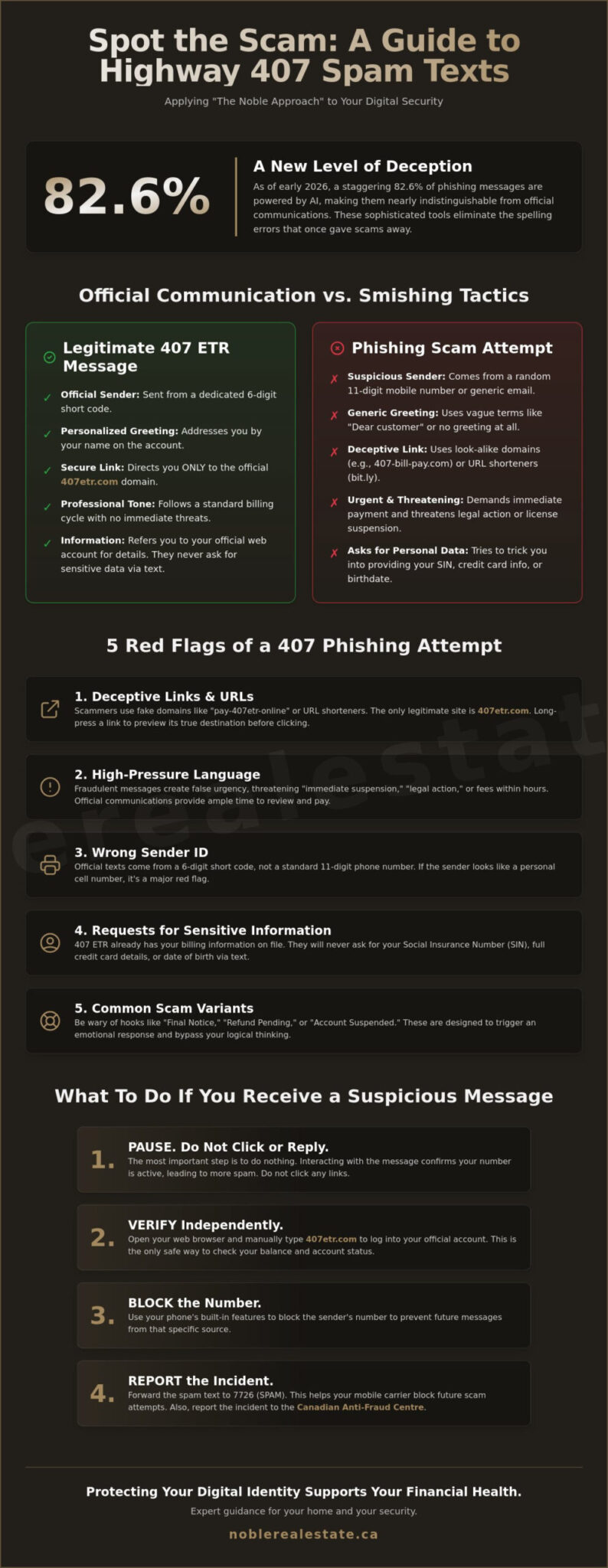
Official 407 ETR Communication vs. Smishing Tactics
Understanding the difference between a legitimate bill and highway 407 spam starts with recognizing the company’s established administrative patterns. Official billing is a structured, monthly process. You’ll receive your statement on roughly the same date every month, whether you choose paper mail or e-billing. If you receive an unexpected text message outside of this cycle, it’s a major warning sign. Real notifications will always direct you to the secure “My Account” portal on the official 407etr.com website, where you can verify your balance and view specific trip details without clicking suspicious links.
When a payment is actually missed, the 407 ETR uses a regulated collection process that relies heavily on the Canadian postal service. They don’t send urgent text messages to resolve debt. Instead, they issue a series of mailed notices. If a balance remains unpaid for several months, the company may eventually seek a license plate renewal denial through the Ministry of Transportation (MTO). This is a formal, legal process that takes significant time. It never happens via a high-pressure SMS sent on a Tuesday afternoon. If you suspect you’ve been targeted by a fraudulent message, you should consult the official guidance on reporting fraud provided by the Ontario Provincial Police.
What 407 ETR Will Never Ask For
Professional organizations have strict protocols regarding your private data. The 407 ETR will never ask you for banking passwords, PINs, or your Social Insurance Number over a digital channel. Furthermore, they’ll never request payment through unconventional methods. If a message asks for cryptocurrency, gift cards, or a direct e-transfer to a personal-looking email address, it’s a scam. Genuine charges, like the $31.50 annual transponder lease fee for 2026, are always processed through their secure, encrypted payment gateway or established pre-authorized debit agreements.
Verification: The Only Safe Way to Check Your Balance
The safest way to manage your account is through the official 407 ETR app, available on the App Store or Google Play. This app bypasses the need for SMS links entirely. Alternatively, you can call the official customer service line found on the back of your transponder or on your physical paper statement. Managing administrative tasks like these is part of staying organized, much like the steps we outline in our Uxbridge Real Estate Seller’s Guide. Taking a moment to verify claims through official channels ensures your financial health remains secure and your daily routine stays stress-free.
Step-by-Step: What to Do if You Receive a Suspicious Message
If you see a text that looks like highway 407 spam, the most important rule is to remain calm. Don’t click the link. Even a simple tap can signal to scammers that your number is active. This often leads to a cycle of more frequent attempts. Instead, take a screenshot for your records and then delete the message. Most modern smartphones have built-in features to block the sender and report the message as junk. This helps your service provider identify and filter out similar attacks. You should also report the incident to the Canadian Anti-Fraud Centre (CAFC). They track these trends to protect all Canadians from financial loss. Notifying 407 ETR directly through their official channels helps their security team monitor the specific wording used in the latest 2026 campaigns.
Damage Control: If You Already Clicked the Link
If you’ve already interacted with a link, don’t panic. Immediate action can prevent a full-scale security breach. First, disconnect your device from Wi-Fi and mobile data. This stops background data transmission between your phone and the scammer’s server. Run a reputable antivirus scan to check for hidden malware. If you entered any financial information, contact your bank immediately. They can freeze your accounts or request new cards to prevent unauthorized charges. Finally, change the passwords for any accounts that use the same login credentials. With the average cost of a data breach in Canada reaching CA$6.98 million in 2025, taking these steps early is a vital part of your financial protection strategy.
Reporting Spam in Ontario
Forwarding suspicious texts to the short code 7726 is a free and effective way to alert your carrier. This simple action helps build a database of malicious numbers, making it harder for scammers to operate across the province. For those of us in the Durham Region, keeping an eye on updates from the Durham Regional Police can provide early warnings about localized fraud waves targeting our community. Staying informed is the best way to keep your home and family secure. If you want to stay ahead of local trends and protect your property value, Get in Touch with us today. This proactive mindset is the foundation of “The Noble Approach.” We believe that being a “consummate professional” means ensuring your personal and financial interests are always handled with the highest standard of analytical rigour and care.
Protecting Your Digital and Financial Security in Durham Region
In the digital world, local expertise acts as a vital shield. Scammers sending out highway 407 spam often hope you’ll feel isolated and pressured into making a quick mistake. By contrast, a local partner understands the specific nuances of our community in Uxbridge and the surrounding areas. We see how these scams evolve and how they target the hard-earned financial stability of our neighbours. Protecting your identity isn’t just about avoiding a fake toll charge. It’s about safeguarding the financial health that makes home ownership and long-term investment possible.
The link between your digital security and your real estate goals is stronger than most people realize. Your credit score and financial reputation are the foundations of any successful property transaction. A single successful phishing attempt can lead to months of credit repair, potentially delaying a home purchase or a successful sale. Our background in finance as a CPA and CA means we bring analytical rigour to every part of the process. We apply the same high standards to protecting your sensitive data during a transaction as we do to evaluating market trends and property values.
The Noble Approach to Community Safety
We’re committed to being more than just real estate professionals. We’re your neighbours. Part of our role is providing the resources you need to navigate local challenges, whether that’s a new toll rate increase or a wave of fraudulent text messages. Building a relationship based on trust and transparency is the only way to ensure a stress-free experience. You can explore our Guide to Choice Real Estate Agents to see how we prioritize client trust and community well-being in everything we do. We believe that your real estate journey should be straightforward and supported by expert guidance at every turn.
Your Next Steps for a Secure 2026
Vigilance is a year-round commitment that requires a proactive mindset. With cyber insurance premiums forecasted to increase by 15-20% in 2026 due to the rise of AI-powered attacks, it’s clear that the threat landscape is growing more complex. Protect yourself by setting up two-factor authentication (2FA) on every financial and email account you own. Regularly check your credit report for any inquiries you don’t recognize. These small, purposeful steps make it much harder for scammers to succeed. If you’re ready to work with a team that values your security as much as your success, redefine your expectations of a local partner—contact Colin Noble today. We’ll help you move forward with the confidence and peace of mind you deserve.
Secure Your Digital and Financial Future
Managing the threat of highway 407 spam requires the same level of analytical rigour we apply to every real estate transaction. By recognizing the red flags of URL deception and sticking to official verification channels, you can protect your personal data from the 82.6% of phishing attempts that now use sophisticated AI. Remember that the 407 ETR will never demand immediate payment through a text or ask for your sensitive banking credentials. Staying vigilant today ensures that your credit score and financial reputation remain strong for your future goals in Uxbridge and the surrounding areas.
We believe that every complex process, from digital security to selling your home, should be stress-free and straightforward. With a professional background as a CPA and CA, we bring a high standard of financial expertise and local knowledge to help you navigate the modern landscape with confidence. If you’re looking for a partner who prioritizes your security and your success, redefine your real estate expectations with the Noble Approach. We’re here to provide the expert guidance you need to keep your journey on the right track and your family’s assets secure.
Frequently Asked Questions
Does 407 ETR ever send text messages for payment?
Yes, but legitimate messages only come from a six-digit short code and will always include your name. These official texts provide a link directly to the secure 407etr.com domain for payment. If you receive a message from a standard 11-digit mobile number or one that links to a different website, it’s a scam. 407 ETR never uses urgent or threatening language to pressure you into a quick transaction.
What happens if I accidentally clicked a link in a Highway 407 spam text?
Disconnect your device from the internet immediately to stop any active background data transfers. You should run a full antivirus scan and alert your bank if you entered any credit card details or personal information on the landing page. Since the average cost of a Canadian data breach reached CA$6.98 million in 2025, taking these defensive steps quickly is essential for your long-term financial protection.
How can I check my real 407 ETR balance safely?
Log into your “My Account” portal directly at 407etr.com or use the official mobile app available on the App Store and Google Play. These are the only secure environments where you can view your real-time balance and trip history without risk. You can also call their customer service department at the number listed on your physical paper statement to confirm your account status with a representative.
I don’t even have a 407 ETR account—why did I get this text?
Scammers use automated software to send thousands of messages to random Ontario area codes simultaneously. They aren’t targeting you specifically because of your driving habits; they’re simply playing a numbers game with local residents. Even non-drivers receive highway 407 spam because the bots are programmed to cast a wide net across the GTA in hopes of finding someone who will react out of panic.
Can I be arrested for an unpaid 407 ETR bill?
No, you cannot be arrested for an unpaid toll debt in Ontario. Unpaid balances are civil matters that eventually lead to license plate renewal denial through the Ministry of Transportation (MTO). Any text message or email threatening immediate arrest or police intervention is a 100% confirmed scam. These high-pressure tactics are designed to bypass your logic and force you to make a mistake.
How do I report 407 ETR scams to the police in Durham Region?
Contact the Durham Regional Police non-emergency line if you’ve lost money to a scammer or believe your identity has been compromised. For general reporting of fraudulent messages, you should notify the Canadian Anti-Fraud Centre (CAFC) through their online portal. Forwarding the fraudulent text message to 7726 (SPAM) also alerts your mobile carrier so they can investigate and block the malicious sender’s number from their network.
Is the “407 ETR Refund” text real?
No, the 407 ETR does not issue refunds via text message or request your banking information to process a credit. Legitimate credits or refunds are typically applied directly to your account balance or issued through the same payment method you already have on file. If a message promises a “pending refund” and asks you to click a link to claim it, it’s a deceptive tactic used to harvest your login credentials.
How do I block these Highway 407 spam messages permanently?
Use your smartphone’s built-in “Block and Report Junk” feature to prevent the specific number from contacting you again. While it’s difficult to stop all highway 407 spam permanently because scammers rotate their numbers frequently, reporting every instance to 7726 helps carriers improve their filters. Never reply to the message, as even a “STOP” response confirms your number is active and can lead to more frequent targeting in the future.

Did you know that as of early 2026, a staggering 82.6% of phishing messages now use artificial intelligence to perfectly mimic official government and infrastructure brands? If you’ve recently received an urgent text threatening a license suspension over an unpaid toll, you aren’t alone. It’s incredibly frustrating to deal with constant highway 407 spam, especially when you’re just trying to manage your daily commute through Uxbridge or the surrounding GTA. We understand the anxiety that comes with seeing a potential $108.79 per-kilometre peak rate charge or the fear that your personal financial data might be compromised by a single click.
At Noble Real Estate, we believe that professional guidance and clear information are the best ways to make complex situations stress-free. This guide will show you how to distinguish legitimate 407 ETR communications from the sophisticated scams that caused a surge in fraud reports in November 2025. You’ll learn the specific markers of a phishing attempt, how to verify your account status safely, and the exact steps to report these incidents to the Canadian Anti-Fraud Centre. We’re applying “The Noble Approach” to your digital security, providing the expert insight you need to protect your identity and regain your peace of mind.
Key Takeaways
- Identify the subtle differences between official 407etr.com links and the fraudulent domains used in highway 407 spam to keep your data secure.
- Master a quick “red flag” checklist to recognize suspicious sender IDs and high-pressure language before you ever click a link.
- Learn why your official 407 ETR Web Account remains the only trusted destination for verifying billing cycles and transponder fees.
- Follow a stress-free, step-by-step protocol for blocking malicious numbers and reporting incidents to the Canadian Anti-Fraud Centre.
- Understand how protecting your digital identity supports your long-term financial health and the security of your home investment.
What is the Highway 407 Spam Text Scam?
At its core, this scam is a malicious form of “smishing,” which is a blend of SMS and phishing. Scammers impersonate the 407 ETR to trick you into clicking a link that harvests your personal or financial information. While these messages have circulated for years, highway 407 spam reached a new level of sophistication following a reported surge in November 2025. In the Durham Region and across the GTA, residents are frequently targeted because the highway is a central part of our daily infrastructure. You’re more likely to believe a message is real if you just finished a commute through zone 8 or noticed the new toll rates that went into effect on January 1, 2026.
Scammers rely on a psychological trigger called “urgency bias.” By claiming you have an overdue balance or that your account is compromised, they hope you’ll act before thinking. In 2026, these attempts are harder to spot because AI-generated content is now found in 82.6% of phishing and smishing tactics. These tools eliminate the spelling errors and awkward phrasing that used to be telltale signs of fraud, making a fake text look identical to a professional notification from a legitimate organization.
Common Variants of the 407 ETR Message
The “Final Notice” variant is the most common, often threatening immediate legal action or extra fees if you don’t pay within hours. Another version uses the “Refund Pending” hook, suggesting you’re owed money to lower your guard through positive news. Perhaps most stressful is the “Account Suspended” variant. It claims your license plate will be denied for renewal by the MTO, a threat that feels particularly heavy when you’re managing a household and need your vehicle for daily life in Uxbridge. These tactics are designed to replace your calm logic with immediate anxiety.
How Scammers Get Your Number
You don’t have to be a 407 ETR customer to receive these messages. Offshore botnets use “war-dialling” techniques to send thousands of texts to random Ontario area codes simultaneously. Others use lists harvested from data breaches, which hit 1 in 6 Canadian businesses in 2023. Even if you’ve never driven on the highway, you might still see highway 407 spam because scammers are casting the widest net possible. They’re betting on the fact that most people in the GTA have at least some connection to the toll route, making the scam feel personally relevant to a huge percentage of the population.
5 Red Flags of a 407 ETR Phishing Attempt
Recognizing a threat before it impacts your finances is a key part of the Noble Approach. While scammers are getting better at mimicking official branding, they almost always leave behind digital breadcrumbs. Official 407 ETR text messages are sent from a dedicated six-digit short code and will include your name. If you receive a notification from a standard 11-digit mobile number or a generic webmail address, it’s a clear sign of highway 407 spam. These messages are designed to bypass your logic and trigger a quick, emotional response.
URL deception is another primary tool for these criminals. They often use domains like “407-bill-pay.com” or “pay-407etr.com” to trick you. Always remember that the only secure, official website for payments and account management is 407etr.com. This tactic is central to the recent surge in 407 ETR phishing scams, where a single character difference in a web address can lead to a fraudulent mirror site. If the text doesn’t link directly to the official domain, it’s a scam.
Intimidation is a hallmark of fraud. If a message demands payment within a one-hour window or threatens immediate “court action,” it’s fake. Official billing follows a structured cycle, and you’ll always have ample time to review your statement. The 407 ETR already has your vehicle and transponder information on file. They’ll never ask for your Social Insurance Number (SIN), birthdate, or credit card details through a text message. If the request feels intrusive, it’s because it is.
Analyzing the Suspicious Link
On a mobile device, you can long-press a link to see the actual destination before your browser opens it. If the address looks like a string of random characters or uses a URL shortener like bit.ly or tinyurl, don’t tap it. Official infrastructure providers avoid these shorteners because they hide the true source of the link. Be wary of the “padlock” icon as well. While HTTPS means the connection is encrypted, scammers often use free security certificates to make their fake sites look legitimate and trustworthy.
Pressure and Intimidation Language
Watch for aggressive keywords like “Immediate,” “Legal Action,” or “Default.” These are designed to bypass your analytical thinking and create panic. Smishing is a form of social engineering used to steal credentials by exploiting your natural desire to resolve problems quickly. If you’re ever in doubt, the best path is to log into your “My Account” directly through the official app or website. Just as we focus on protecting your financial well-being during a home sale, we want you to feel confident and secure in your daily digital interactions.
Official 407 ETR Communication vs. Smishing Tactics
Understanding the difference between a legitimate bill and highway 407 spam starts with recognizing the company’s established administrative patterns. Official billing is a structured, monthly process. You’ll receive your statement on roughly the same date every month, whether you choose paper mail or e-billing. If you receive an unexpected text message outside of this cycle, it’s a major warning sign. Real notifications will always direct you to the secure “My Account” portal on the official 407etr.com website, where you can verify your balance and view specific trip details without clicking suspicious links.
When a payment is actually missed, the 407 ETR uses a regulated collection process that relies heavily on the Canadian postal service. They don’t send urgent text messages to resolve debt. Instead, they issue a series of mailed notices. If a balance remains unpaid for several months, the company may eventually seek a license plate renewal denial through the Ministry of Transportation (MTO). This is a formal, legal process that takes significant time. It never happens via a high-pressure SMS sent on a Tuesday afternoon. If you suspect you’ve been targeted by a fraudulent message, you should consult the official guidance on reporting fraud provided by the Ontario Provincial Police.
What 407 ETR Will Never Ask For
Professional organizations have strict protocols regarding your private data. The 407 ETR will never ask you for banking passwords, PINs, or your Social Insurance Number over a digital channel. Furthermore, they’ll never request payment through unconventional methods. If a message asks for cryptocurrency, gift cards, or a direct e-transfer to a personal-looking email address, it’s a scam. Genuine charges, like the $31.50 annual transponder lease fee for 2026, are always processed through their secure, encrypted payment gateway or established pre-authorized debit agreements.
Verification: The Only Safe Way to Check Your Balance
The safest way to manage your account is through the official 407 ETR app, available on the App Store or Google Play. This app bypasses the need for SMS links entirely. Alternatively, you can call the official customer service line found on the back of your transponder or on your physical paper statement. Managing administrative tasks like these is part of staying organized, much like the steps we outline in our Uxbridge Real Estate Seller’s Guide. Taking a moment to verify claims through official channels ensures your financial health remains secure and your daily routine stays stress-free.
Step-by-Step: What to Do if You Receive a Suspicious Message
If you see a text that looks like highway 407 spam, the most important rule is to remain calm. Don’t click the link. Even a simple tap can signal to scammers that your number is active. This often leads to a cycle of more frequent attempts. Instead, take a screenshot for your records and then delete the message. Most modern smartphones have built-in features to block the sender and report the message as junk. This helps your service provider identify and filter out similar attacks. You should also report the incident to the Canadian Anti-Fraud Centre (CAFC). They track these trends to protect all Canadians from financial loss. Notifying 407 ETR directly through their official channels helps their security team monitor the specific wording used in the latest 2026 campaigns.
Damage Control: If You Already Clicked the Link
If you’ve already interacted with a link, don’t panic. Immediate action can prevent a full-scale security breach. First, disconnect your device from Wi-Fi and mobile data. This stops background data transmission between your phone and the scammer’s server. Run a reputable antivirus scan to check for hidden malware. If you entered any financial information, contact your bank immediately. They can freeze your accounts or request new cards to prevent unauthorized charges. Finally, change the passwords for any accounts that use the same login credentials. With the average cost of a data breach in Canada reaching CA$6.98 million in 2025, taking these steps early is a vital part of your financial protection strategy.
Reporting Spam in Ontario
Forwarding suspicious texts to the short code 7726 is a free and effective way to alert your carrier. This simple action helps build a database of malicious numbers, making it harder for scammers to operate across the province. For those of us in the Durham Region, keeping an eye on updates from the Durham Regional Police can provide early warnings about localized fraud waves targeting our community. Staying informed is the best way to keep your home and family secure. If you want to stay ahead of local trends and protect your property value, Get in Touch with us today. This proactive mindset is the foundation of “The Noble Approach.” We believe that being a “consummate professional” means ensuring your personal and financial interests are always handled with the highest standard of analytical rigour and care.
Protecting Your Digital and Financial Security in Durham Region
In the digital world, local expertise acts as a vital shield. Scammers sending out highway 407 spam often hope you’ll feel isolated and pressured into making a quick mistake. By contrast, a local partner understands the specific nuances of our community in Uxbridge and the surrounding areas. We see how these scams evolve and how they target the hard-earned financial stability of our neighbours. Protecting your identity isn’t just about avoiding a fake toll charge. It’s about safeguarding the financial health that makes home ownership and long-term investment possible.
The link between your digital security and your real estate goals is stronger than most people realize. Your credit score and financial reputation are the foundations of any successful property transaction. A single successful phishing attempt can lead to months of credit repair, potentially delaying a home purchase or a successful sale. Our background in finance as a CPA and CA means we bring analytical rigour to every part of the process. We apply the same high standards to protecting your sensitive data during a transaction as we do to evaluating market trends and property values.
The Noble Approach to Community Safety
We’re committed to being more than just real estate professionals. We’re your neighbours. Part of our role is providing the resources you need to navigate local challenges, whether that’s a new toll rate increase or a wave of fraudulent text messages. Building a relationship based on trust and transparency is the only way to ensure a stress-free experience. You can explore our Guide to Choice Real Estate Agents to see how we prioritize client trust and community well-being in everything we do. We believe that your real estate journey should be straightforward and supported by expert guidance at every turn.
Your Next Steps for a Secure 2026
Vigilance is a year-round commitment that requires a proactive mindset. With cyber insurance premiums forecasted to increase by 15-20% in 2026 due to the rise of AI-powered attacks, it’s clear that the threat landscape is growing more complex. Protect yourself by setting up two-factor authentication (2FA) on every financial and email account you own. Regularly check your credit report for any inquiries you don’t recognize. These small, purposeful steps make it much harder for scammers to succeed. If you’re ready to work with a team that values your security as much as your success, redefine your expectations of a local partner—contact Colin Noble today. We’ll help you move forward with the confidence and peace of mind you deserve.
Secure Your Digital and Financial Future
Managing the threat of highway 407 spam requires the same level of analytical rigour we apply to every real estate transaction. By recognizing the red flags of URL deception and sticking to official verification channels, you can protect your personal data from the 82.6% of phishing attempts that now use sophisticated AI. Remember that the 407 ETR will never demand immediate payment through a text or ask for your sensitive banking credentials. Staying vigilant today ensures that your credit score and financial reputation remain strong for your future goals in Uxbridge and the surrounding areas.
We believe that every complex process, from digital security to selling your home, should be stress-free and straightforward. With a professional background as a CPA and CA, we bring a high standard of financial expertise and local knowledge to help you navigate the modern landscape with confidence. If you’re looking for a partner who prioritizes your security and your success, redefine your real estate expectations with the Noble Approach. We’re here to provide the expert guidance you need to keep your journey on the right track and your family’s assets secure.
Frequently Asked Questions
Does 407 ETR ever send text messages for payment?
Yes, but legitimate messages only come from a six-digit short code and will always include your name. These official texts provide a link directly to the secure 407etr.com domain for payment. If you receive a message from a standard 11-digit mobile number or one that links to a different website, it’s a scam. 407 ETR never uses urgent or threatening language to pressure you into a quick transaction.
What happens if I accidentally clicked a link in a Highway 407 spam text?
Disconnect your device from the internet immediately to stop any active background data transfers. You should run a full antivirus scan and alert your bank if you entered any credit card details or personal information on the landing page. Since the average cost of a Canadian data breach reached CA$6.98 million in 2025, taking these defensive steps quickly is essential for your long-term financial protection.
How can I check my real 407 ETR balance safely?
Log into your “My Account” portal directly at 407etr.com or use the official mobile app available on the App Store and Google Play. These are the only secure environments where you can view your real-time balance and trip history without risk. You can also call their customer service department at the number listed on your physical paper statement to confirm your account status with a representative.
I don’t even have a 407 ETR account—why did I get this text?
Scammers use automated software to send thousands of messages to random Ontario area codes simultaneously. They aren’t targeting you specifically because of your driving habits; they’re simply playing a numbers game with local residents. Even non-drivers receive highway 407 spam because the bots are programmed to cast a wide net across the GTA in hopes of finding someone who will react out of panic.
Can I be arrested for an unpaid 407 ETR bill?
No, you cannot be arrested for an unpaid toll debt in Ontario. Unpaid balances are civil matters that eventually lead to license plate renewal denial through the Ministry of Transportation (MTO). Any text message or email threatening immediate arrest or police intervention is a 100% confirmed scam. These high-pressure tactics are designed to bypass your logic and force you to make a mistake.
How do I report 407 ETR scams to the police in Durham Region?
Contact the Durham Regional Police non-emergency line if you’ve lost money to a scammer or believe your identity has been compromised. For general reporting of fraudulent messages, you should notify the Canadian Anti-Fraud Centre (CAFC) through their online portal. Forwarding the fraudulent text message to 7726 (SPAM) also alerts your mobile carrier so they can investigate and block the malicious sender’s number from their network.
Is the “407 ETR Refund” text real?
No, the 407 ETR does not issue refunds via text message or request your banking information to process a credit. Legitimate credits or refunds are typically applied directly to your account balance or issued through the same payment method you already have on file. If a message promises a “pending refund” and asks you to click a link to claim it, it’s a deceptive tactic used to harvest your login credentials.
How do I block these Highway 407 spam messages permanently?
Use your smartphone’s built-in “Block and Report Junk” feature to prevent the specific number from contacting you again. While it’s difficult to stop all highway 407 spam permanently because scammers rotate their numbers frequently, reporting every instance to 7726 helps carriers improve their filters. Never reply to the message, as even a “STOP” response confirms your number is active and can lead to more frequent targeting in the future.