



Looking For More Great Content?
Get even more informative Toronto real estate news sent directly to your inbox by signing up for my newsletter here. All it takes is a few easy clicks.

Real Estate Agent Commission Explained: An Ontario Seller’s Guide for 2026
05/11/26 Uncategorized
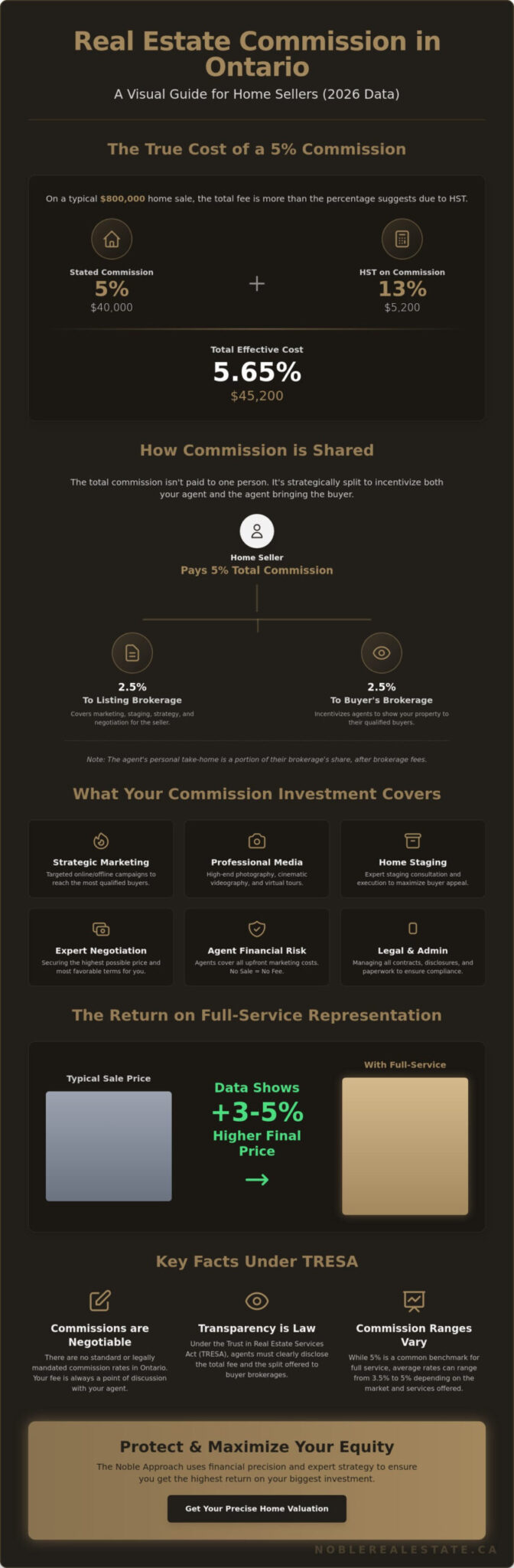
On an $800,000 home sale, a 5% commission effectively costs you 5.65% once the 13% HST is factored in, yet data shows full-service representation often yields a 3% to 5% higher final sale price. It’s understandable to feel a sense of hesitation when looking at those numbers. You’ve worked hard to build equity in your home, and the thought of high fees or hidden costs can make the selling process feel more stressful than it should be.
This real estate agent commission explained ontario guide provides a transparent look at the current 2026 landscape. I’ll show you exactly where your money goes, how the split between brokerages works, and why commission is a negotiable investment rather than a fixed tax. We’ll explore how the Trust in Real Estate Services Act (TRESA) protects your interests and how The Noble Approach uses financial precision to maximize your return. By the end of this article, you’ll have the confidence to ensure your agent is earning their fee while protecting your hard-earned equity.
Key Takeaways
- Understand the mechanics of the commission split to see how your investment covers both the listing strategy and the buyer’s professional representation.
- Learn why there are no legally mandated rates in 2026 and how this real estate agent commission explained ontario guide empowers you to negotiate based on market conditions.
- Discover how full-service marketing, including professional staging and high-end videography, works to drive your final sale price above local benchmarks.
- Gain clarity on the “No Sale, No Fee” model and how The Noble Approach ensures your agent carries the financial risk of marketing your property.
- Identify why local expertise in Uxbridge and Durham Region is essential for protecting your equity through precise valuation and expert negotiation.
What is Real Estate Agent Commission in Ontario? The 2026 Fundamentals
At its core, Real estate agent commission is a professional service fee paid to a brokerage for successfully facilitating the sale of your property. In Ontario, this fee isn’t just a cost of doing business; it’s a success-based payment model that ensures your interests are aligned with your agent’s performance. Under the Trust in Real Estate Services Act (TRESA), these structures must be clearly disclosed, providing you with a transparent view of how your equity is being utilized. This real estate agent commission explained ontario guide highlights that you aren’t just paying for a listing on the MLS; you’re paying for a legally regulated professional to manage your largest financial asset.
Many sellers don’t realize that their agent carries a significant financial risk through the “No Sale, No Fee” model. When you list your home, your agent often invests thousands of dollars upfront in professional staging, high-end videography, and targeted marketing campaigns. If the home doesn’t sell, the agent absorbs these costs entirely. This risk-mitigation is a central pillar of the industry. It ensures that your representative is financially motivated to secure the best possible outcome, as they only recoup their investment and earn their fee once the deal is finalized.
As of May 2026, the average total commission in Ontario typically ranges from 3.5% to 5% of the final sale price. While 5% remains a common benchmark for full-service representation, competitive urban markets often see transactions closing closer to 4%. This variability is why The Noble Approach focuses on value rather than just the percentage. It’s about what that investment actually returns to your bottom line through expert negotiation and strategic positioning.
Common Commission Structures in Ontario
- Percentage-based: This is the most prevalent model, where the fee is calculated as a direct percentage of the final sale price. If the home sells for more, the fee increases, but so does your net equity.
- Flat Fee: A set dollar amount agreed upon at the start, regardless of the final price. This is often seen with limited-service or discount brokerages.
- Hybrid models: These combine a lower base percentage with a flat fee to cover specific premium services like professional staging or extended marketing reach.
The Role of HST (Harmonized Sales Tax)
Commission is a GST/HST taxable service under Canadian law. In Ontario, you must add 13% HST to the total commission amount. For example, if you sell a home for $1,000,000 at a 5% commission rate, the fee is $50,000. However, the HST adds an additional $6,500, bringing your total professional fee to $56,500. This tax is mandatory and is paid by the seller upon the closing of the transaction. Understanding this “real” cost is essential for accurate financial planning during your move, ensuring there are no surprises when you receive your final statement of adjustments.
How the Commission Split Works Between Listing and Buyer Agents
When you look at the total fee on a listing agreement, it’s easy to assume that entire amount goes to the person standing in your kitchen. In reality, the Ontario real estate market operates on a “Co-operating Brokerage” system. This means the total commission you agree upon is typically shared between two separate companies: the listing brokerage that markets your home and the buyer’s brokerage that brings the successful purchaser. While the total amount is established during the initial stage of negotiating commission, the split is what determines how much each professional receives for their specific role in the transaction.
A common arrangement in 2026 is a 50/50 split. For a 5% total commission, 2.5% is allocated to the listing side and 2.5% to the buyer’s side. This isn’t just a tradition; it’s a strategic incentive. By offering a competitive 2.5% to co-operating agents, you ensure your property remains highly attractive to the professionals who are currently working with qualified, motivated buyers. If you’re curious about how this impacts your specific property value, a professional home valuation can provide the necessary context for these financial decisions.
Transparency is now a legal requirement under the Trust in Real Estate Services Act (TRESA). Your listing agreement must explicitly state how much of the total fee is being offered to the buyer’s brokerage. This prevents any confusion and ensures you know exactly how your equity is being used to drive traffic to your front door. The Noble Approach prioritizes this clarity, making sure you feel confident that every dollar is working toward a successful sale.
Who Actually Pays the Commission?
In the traditional Ontario model, the seller pays the entire commission from the proceeds of the sale at the time of closing. It’s a “top-line” expense. When I prepare a “Net Sheet” for clients, we subtract the commission and the 13% HST from the expected sale price to see the actual cash you’ll take home. While the seller technically writes the check, the cost is effectively baked into the market value of the home. It is a shared investment in a secure, legally protected transfer of property.
The Buyer Representation Agreement (BRA)
The relationship between a buyer and their agent is governed by a Buyer Representation Agreement. This contract specifies the commission the buyer’s agent is entitled to receive. If a seller offers a lower commission than what is listed in the BRA, the buyer may be contractually obligated to pay the difference to their agent. This is why clear communication is vital. Understanding these nuances helps in finding the right fit for your representation, ensuring everyone is aligned on fees before an offer is even signed. This real estate agent commission explained ontario perspective ensures that both parties enter the deal with full financial awareness.
Is Real Estate Commission Negotiable? Understanding Your Options
Under Canada’s Competition Act and the guidelines set by the Real Estate Council of Ontario (RECO), commission rates are fully negotiable. There’s no such thing as a “standard” or “fixed” rate mandated by law. This real estate agent commission explained ontario guide emphasizes that while a 5% total fee is a historical benchmark, your specific rate is a private agreement between you and your listing brokerage. Your leverage in these negotiations often depends on current market conditions. In May 2026, sellers in highly competitive urban areas often negotiate closer to a 4% total commission because the rapid pace of sales reduces the agent’s time-on-market risk.
It is vital to understand that RECO prohibits agents from using certain fee structures that could be considered predatory. For instance, an agent cannot charge a commission that increases as the sale price goes up. This ensures the agent’s compensation remains transparent and fair based on the initial agreement. When we discuss your listing, we look at the specific needs of your property and the current inventory levels in your neighbourhood to find a rate that reflects the work required to secure a premium result.
Pros and Cons of Negotiating Lower Commissions
Negotiating a lower fee offers the immediate benefit of saving thousands of dollars on your final closing statement. However, it’s often a double-edged sword. A reduced commission typically leads to a smaller marketing budget. This might mean you miss out on professional staging, which data shows helps homes sell 14% faster than those that aren’t staged. Additionally, if you choose to reduce the buyer agent’s portion of the split, you risk lower engagement from co-operating agents. In a crowded market where agents have dozens of listings to show their clients, a competitive commission ensures your home stays at the top of their list.
The Value of a CPA-Led Negotiation
The Noble Approach views commission through a rigorous financial lens. With my background as a CPA and CA, I focus on your “Net Proceeds” rather than just the “Commission Rate.” A 1% savings on commission is a poor trade if it results in a 5% lower sale price due to inadequate marketing or weak negotiation. My deep expertise in uxbridge real estate allows for a precision-based strategy that justifies the investment in full-service representation. We don’t just list your home; we manage the investment of your equity to ensure the highest possible return in your final bank balance.
Beyond the Fee: What Does Your Commission Actually Pay For?
Commission is often viewed as a deduction from your final check, but it’s more accurate to see it as the fuel for your home’s marketing engine. When looking at real estate agent commission explained ontario, the value lies in the upfront capital and professional expertise your agent provides long before a “Sold” sign appears. This fee covers a comprehensive suite of services designed to mitigate your risk and maximize your return, including high-end videography, targeted social media campaigns, and the coordination of every technical detail from listing to closing.
Effective transaction management is another critical component. Your agent acts as the central hub, coordinating with lawyers, home inspectors, and appraisers to ensure the deal remains on track. This oversight prevents the common pitfalls that can derail a sale or lead to post-closing litigation. By managing the complex paperwork required by the Ontario Real Estate Association (OREA), your representative ensures that every disclosure is accurate and every deadline is met, providing you with essential legal protection during the transfer of your property.
The Noble Approach to Marketing
We believe in redefining expectations through high-impact listing presentations. The cost of choosing a “cheap” alternative often manifests in poor photography and generic descriptions, which can lead to significantly longer days on market. For houses for sale in uxbridge, a localized strategy is vital. We don’t just post a listing; we tell the story of the community. This tailored approach, combined with professional staging that helps homes sell 14% faster, ensures your property stands out in a competitive digital landscape. If you’re ready to see how this strategy applies to your home, consider booking a professional home valuation today.
Risk Management and Financial Oversight
Fiduciary duty is an agent’s legal obligation to put your financial and personal interests above their own at all times. This duty is especially important during the negotiation phase. In a multiple-offer scenario, the “highest” offer isn’t always the “best” offer. We meticulously vet every buyer, verifying pre-approvals and assessing the strength of their conditions to ensure the deal actually closes. My background as a CPA and CA allows for a level of financial oversight that most agents cannot provide. We analyze the tax implications of your sale and look for ways to protect your net equity, ensuring that the 3% to 5% higher sale price typically achieved through full-service representation ends up in your pocket.
The Noble Approach: Maximising Your Equity in Uxbridge and Durham Region
Selling a home in Uxbridge or the wider Durham Region requires more than just a sign on the lawn; it requires a strategy that respects the significant equity you’ve built. While this real estate agent commission explained ontario guide provides the structural basics, the real value of representation is found in the execution. The Noble Approach combines the analytical rigour of a CPA and CA background with a deep, personal investment in our local community. We don’t just see a transaction; we see a pivotal financial milestone that deserves a stress-free, end-to-end management style.
Our methodology ensures that every dollar of the commission you invest is working to protect your bottom line. By leveraging financial precision, we move beyond simple gut feelings to provide data-driven pricing and negotiation strategies. This approach is designed to redefine your expectations of what a real estate partner should provide, shifting the focus from the cost of the fee to the net proceeds in your bank account after the sale is finalized in May 2026.
Why Experience Matters in the Durham Market
The Durham Region features a diverse range of property types that each require a specific marketing lens. Navigating the sale of a downtown Uxbridge gem is vastly different from representing luxury estates in Goodwood canada. Rural properties often involve complexities like well and septic inspections, zoning nuances, and conservation easements that urban sales simply don’t face. A full-service partner understands these distinctions and prepares for them long before the home hits the market.
In the shifting landscape of 2026, local expertise is your greatest hedge against market volatility. We understand the specific buyer profiles looking to move to the area, allowing us to tailor our high-impact marketing to the right audience. Whether it’s a century home or a modern rural retreat, our localized strategy ensures your property is positioned as a premium offering, justifying the investment in professional representation.
Your Path to a Successful Sale
The first step in our journey together is an initial consultation where we set clear, realistic expectations. We provide you with a custom “Net Sheet” that breaks down all anticipated costs, including commissions, legal fees, and HST. This document allows you to see your exact walk-away numbers before you ever sign a listing agreement. Transparency is the foundation of trust, and we want you to feel confident in the financial roadmap we’ve created for your sale.
Success in real estate shouldn’t be a source of stress. By choosing a partner who prioritizes your experience and your equity, you can focus on your next chapter while we handle the complexities of the sale. If you’re ready to see the difference that financial expertise and local passion can make, it is time to take the next step. Redefine your real estate expectations—contact Colin Noble today to begin your custom home valuation and commission breakdown.
Secure Your Equity with Financial Precision
Understanding your financial obligations is the first step toward a successful sale. As this real estate agent commission explained ontario guide has shown, the fee you pay is a strategic investment in professional marketing, legal protection, and expert negotiation. By focusing on the net proceeds of your sale rather than just the initial percentage, you ensure that your home’s equity is managed with the analytical rigour it deserves.
The Noble Approach removes the guesswork from the selling process. Led by a professional with a background as a CPA and CA, our team provides the financial precision needed to navigate the 2026 market in Uxbridge and the Durham Region. We handle every detail, from the initial valuation to the final statement of adjustments, making your journey entirely stress-free. You deserve a partner who prioritizes your interests and understands the local community as deeply as you do.
Discover the Noble Approach: Get Your Custom Equity Analysis
Your real estate goals are within reach, and with the right guidance, the path forward is clear and rewarding.
Frequently Asked Questions
Is real estate commission in Ontario subject to HST?
Yes, all real estate commissions in Ontario are subject to a mandatory 13% Harmonized Sales Tax (HST). This tax is calculated on top of the agreed commission percentage or flat fee. If your total commission is $40,000, you’ll pay an additional $5,200 in HST at the time of closing. This is a standard legal requirement for professional services throughout the province.
Can I pay a flat fee instead of a percentage in Ontario?
You can choose a flat fee model rather than a percentage based structure. While percentage based fees are the most common in 2026, some brokerages offer flat fees for specific service levels. It’s vital to evaluate what marketing and negotiation support is included in a flat fee arrangement. You don’t want to sacrifice a higher final sale price for a smaller upfront service fee.
What is the average real estate commission in Uxbridge for 2026?
In May 2026, the average total commission in Uxbridge and the Durham Region typically ranges from 3.5% to 5% of the sale price. This real estate agent commission explained ontario data reflects the current balance of local market demand and service levels. High value properties or unique rural estates often involve different negotiated rates depending on the complexity of the specialized marketing required to find the right buyer.
Do I have to pay the buyer’s agent commission myself?
Standard practice in Ontario is for the seller to pay the total commission, which is then split between the listing and buyer brokerages. Under the Trust in Real Estate Services Act (TRESA), you can decide whether to offer a co-operating commission. Offering a competitive fee to the buyer’s side remains the most effective way to attract the largest pool of qualified, professionally represented purchasers to your property.
What happens to the commission if my house doesn’t sell?
Under the standard “No Sale, No Fee” model, you don’t pay a commission if your home doesn’t sell during the listing period. Your agent absorbs the upfront costs for professional staging, high end photography, and digital marketing. This structure ensures your representative is financially motivated to secure a successful result. Always check your specific listing agreement for any clauses regarding the reimbursement of out of pocket marketing expenses.
Can I negotiate the commission split between the two agents?
Yes, you can negotiate how the total commission is allocated between the listing brokerage and the buyer’s brokerage. This split is clearly documented in your listing agreement before the property hits the market. While a 50/50 split is a common benchmark, you can discuss different ratios with your agent. The goal is to ensure the buyer’s side stays incentivized to prioritize showing your home to their clients.
Are real estate commissions tax-deductible in Ontario?
Real estate commissions aren’t usually tax deductible for the sale of a primary residence. However, if you’re selling an investment property, the commission is a cost of sale that reduces your capital gains tax. If you’re moving at least 40 kilometres closer to a new work location, you might be able to deduct these fees as moving expenses under specific Canada Revenue Agency (CRA) guidelines.
Is commission paid on the listing price or the final sale price?
Commission is always calculated on the final sale price of the property, not the initial listing price. This ensures your agent’s compensation is tied to the actual market value they achieve for you. Whether your home sells for $50,000 over or under the asking price, the agreed percentage applies only to the final number recorded on the legal transfer of the home.

On an $800,000 home sale, a 5% commission effectively costs you 5.65% once the 13% HST is factored in, yet data shows full-service representation often yields a 3% to 5% higher final sale price. It’s understandable to feel a sense of hesitation when looking at those numbers. You’ve worked hard to build equity in your home, and the thought of high fees or hidden costs can make the selling process feel more stressful than it should be.
This real estate agent commission explained ontario guide provides a transparent look at the current 2026 landscape. I’ll show you exactly where your money goes, how the split between brokerages works, and why commission is a negotiable investment rather than a fixed tax. We’ll explore how the Trust in Real Estate Services Act (TRESA) protects your interests and how The Noble Approach uses financial precision to maximize your return. By the end of this article, you’ll have the confidence to ensure your agent is earning their fee while protecting your hard-earned equity.
Key Takeaways
- Understand the mechanics of the commission split to see how your investment covers both the listing strategy and the buyer’s professional representation.
- Learn why there are no legally mandated rates in 2026 and how this real estate agent commission explained ontario guide empowers you to negotiate based on market conditions.
- Discover how full-service marketing, including professional staging and high-end videography, works to drive your final sale price above local benchmarks.
- Gain clarity on the “No Sale, No Fee” model and how The Noble Approach ensures your agent carries the financial risk of marketing your property.
- Identify why local expertise in Uxbridge and Durham Region is essential for protecting your equity through precise valuation and expert negotiation.
What is Real Estate Agent Commission in Ontario? The 2026 Fundamentals
At its core, Real estate agent commission is a professional service fee paid to a brokerage for successfully facilitating the sale of your property. In Ontario, this fee isn’t just a cost of doing business; it’s a success-based payment model that ensures your interests are aligned with your agent’s performance. Under the Trust in Real Estate Services Act (TRESA), these structures must be clearly disclosed, providing you with a transparent view of how your equity is being utilized. This real estate agent commission explained ontario guide highlights that you aren’t just paying for a listing on the MLS; you’re paying for a legally regulated professional to manage your largest financial asset.
Many sellers don’t realize that their agent carries a significant financial risk through the “No Sale, No Fee” model. When you list your home, your agent often invests thousands of dollars upfront in professional staging, high-end videography, and targeted marketing campaigns. If the home doesn’t sell, the agent absorbs these costs entirely. This risk-mitigation is a central pillar of the industry. It ensures that your representative is financially motivated to secure the best possible outcome, as they only recoup their investment and earn their fee once the deal is finalized.
As of May 2026, the average total commission in Ontario typically ranges from 3.5% to 5% of the final sale price. While 5% remains a common benchmark for full-service representation, competitive urban markets often see transactions closing closer to 4%. This variability is why The Noble Approach focuses on value rather than just the percentage. It’s about what that investment actually returns to your bottom line through expert negotiation and strategic positioning.
Common Commission Structures in Ontario
- Percentage-based: This is the most prevalent model, where the fee is calculated as a direct percentage of the final sale price. If the home sells for more, the fee increases, but so does your net equity.
- Flat Fee: A set dollar amount agreed upon at the start, regardless of the final price. This is often seen with limited-service or discount brokerages.
- Hybrid models: These combine a lower base percentage with a flat fee to cover specific premium services like professional staging or extended marketing reach.
The Role of HST (Harmonized Sales Tax)
Commission is a GST/HST taxable service under Canadian law. In Ontario, you must add 13% HST to the total commission amount. For example, if you sell a home for $1,000,000 at a 5% commission rate, the fee is $50,000. However, the HST adds an additional $6,500, bringing your total professional fee to $56,500. This tax is mandatory and is paid by the seller upon the closing of the transaction. Understanding this “real” cost is essential for accurate financial planning during your move, ensuring there are no surprises when you receive your final statement of adjustments.
How the Commission Split Works Between Listing and Buyer Agents
When you look at the total fee on a listing agreement, it’s easy to assume that entire amount goes to the person standing in your kitchen. In reality, the Ontario real estate market operates on a “Co-operating Brokerage” system. This means the total commission you agree upon is typically shared between two separate companies: the listing brokerage that markets your home and the buyer’s brokerage that brings the successful purchaser. While the total amount is established during the initial stage of negotiating commission, the split is what determines how much each professional receives for their specific role in the transaction.
A common arrangement in 2026 is a 50/50 split. For a 5% total commission, 2.5% is allocated to the listing side and 2.5% to the buyer’s side. This isn’t just a tradition; it’s a strategic incentive. By offering a competitive 2.5% to co-operating agents, you ensure your property remains highly attractive to the professionals who are currently working with qualified, motivated buyers. If you’re curious about how this impacts your specific property value, a professional home valuation can provide the necessary context for these financial decisions.
Transparency is now a legal requirement under the Trust in Real Estate Services Act (TRESA). Your listing agreement must explicitly state how much of the total fee is being offered to the buyer’s brokerage. This prevents any confusion and ensures you know exactly how your equity is being used to drive traffic to your front door. The Noble Approach prioritizes this clarity, making sure you feel confident that every dollar is working toward a successful sale.
Who Actually Pays the Commission?
In the traditional Ontario model, the seller pays the entire commission from the proceeds of the sale at the time of closing. It’s a “top-line” expense. When I prepare a “Net Sheet” for clients, we subtract the commission and the 13% HST from the expected sale price to see the actual cash you’ll take home. While the seller technically writes the check, the cost is effectively baked into the market value of the home. It is a shared investment in a secure, legally protected transfer of property.
The Buyer Representation Agreement (BRA)
The relationship between a buyer and their agent is governed by a Buyer Representation Agreement. This contract specifies the commission the buyer’s agent is entitled to receive. If a seller offers a lower commission than what is listed in the BRA, the buyer may be contractually obligated to pay the difference to their agent. This is why clear communication is vital. Understanding these nuances helps in finding the right fit for your representation, ensuring everyone is aligned on fees before an offer is even signed. This real estate agent commission explained ontario perspective ensures that both parties enter the deal with full financial awareness.
Is Real Estate Commission Negotiable? Understanding Your Options
Under Canada’s Competition Act and the guidelines set by the Real Estate Council of Ontario (RECO), commission rates are fully negotiable. There’s no such thing as a “standard” or “fixed” rate mandated by law. This real estate agent commission explained ontario guide emphasizes that while a 5% total fee is a historical benchmark, your specific rate is a private agreement between you and your listing brokerage. Your leverage in these negotiations often depends on current market conditions. In May 2026, sellers in highly competitive urban areas often negotiate closer to a 4% total commission because the rapid pace of sales reduces the agent’s time-on-market risk.
It is vital to understand that RECO prohibits agents from using certain fee structures that could be considered predatory. For instance, an agent cannot charge a commission that increases as the sale price goes up. This ensures the agent’s compensation remains transparent and fair based on the initial agreement. When we discuss your listing, we look at the specific needs of your property and the current inventory levels in your neighbourhood to find a rate that reflects the work required to secure a premium result.
Pros and Cons of Negotiating Lower Commissions
Negotiating a lower fee offers the immediate benefit of saving thousands of dollars on your final closing statement. However, it’s often a double-edged sword. A reduced commission typically leads to a smaller marketing budget. This might mean you miss out on professional staging, which data shows helps homes sell 14% faster than those that aren’t staged. Additionally, if you choose to reduce the buyer agent’s portion of the split, you risk lower engagement from co-operating agents. In a crowded market where agents have dozens of listings to show their clients, a competitive commission ensures your home stays at the top of their list.
The Value of a CPA-Led Negotiation
The Noble Approach views commission through a rigorous financial lens. With my background as a CPA and CA, I focus on your “Net Proceeds” rather than just the “Commission Rate.” A 1% savings on commission is a poor trade if it results in a 5% lower sale price due to inadequate marketing or weak negotiation. My deep expertise in uxbridge real estate allows for a precision-based strategy that justifies the investment in full-service representation. We don’t just list your home; we manage the investment of your equity to ensure the highest possible return in your final bank balance.
Beyond the Fee: What Does Your Commission Actually Pay For?
Commission is often viewed as a deduction from your final check, but it’s more accurate to see it as the fuel for your home’s marketing engine. When looking at real estate agent commission explained ontario, the value lies in the upfront capital and professional expertise your agent provides long before a “Sold” sign appears. This fee covers a comprehensive suite of services designed to mitigate your risk and maximize your return, including high-end videography, targeted social media campaigns, and the coordination of every technical detail from listing to closing.
Effective transaction management is another critical component. Your agent acts as the central hub, coordinating with lawyers, home inspectors, and appraisers to ensure the deal remains on track. This oversight prevents the common pitfalls that can derail a sale or lead to post-closing litigation. By managing the complex paperwork required by the Ontario Real Estate Association (OREA), your representative ensures that every disclosure is accurate and every deadline is met, providing you with essential legal protection during the transfer of your property.
The Noble Approach to Marketing
We believe in redefining expectations through high-impact listing presentations. The cost of choosing a “cheap” alternative often manifests in poor photography and generic descriptions, which can lead to significantly longer days on market. For houses for sale in uxbridge, a localized strategy is vital. We don’t just post a listing; we tell the story of the community. This tailored approach, combined with professional staging that helps homes sell 14% faster, ensures your property stands out in a competitive digital landscape. If you’re ready to see how this strategy applies to your home, consider booking a professional home valuation today.
Risk Management and Financial Oversight
Fiduciary duty is an agent’s legal obligation to put your financial and personal interests above their own at all times. This duty is especially important during the negotiation phase. In a multiple-offer scenario, the “highest” offer isn’t always the “best” offer. We meticulously vet every buyer, verifying pre-approvals and assessing the strength of their conditions to ensure the deal actually closes. My background as a CPA and CA allows for a level of financial oversight that most agents cannot provide. We analyze the tax implications of your sale and look for ways to protect your net equity, ensuring that the 3% to 5% higher sale price typically achieved through full-service representation ends up in your pocket.
The Noble Approach: Maximising Your Equity in Uxbridge and Durham Region
Selling a home in Uxbridge or the wider Durham Region requires more than just a sign on the lawn; it requires a strategy that respects the significant equity you’ve built. While this real estate agent commission explained ontario guide provides the structural basics, the real value of representation is found in the execution. The Noble Approach combines the analytical rigour of a CPA and CA background with a deep, personal investment in our local community. We don’t just see a transaction; we see a pivotal financial milestone that deserves a stress-free, end-to-end management style.
Our methodology ensures that every dollar of the commission you invest is working to protect your bottom line. By leveraging financial precision, we move beyond simple gut feelings to provide data-driven pricing and negotiation strategies. This approach is designed to redefine your expectations of what a real estate partner should provide, shifting the focus from the cost of the fee to the net proceeds in your bank account after the sale is finalized in May 2026.
Why Experience Matters in the Durham Market
The Durham Region features a diverse range of property types that each require a specific marketing lens. Navigating the sale of a downtown Uxbridge gem is vastly different from representing luxury estates in Goodwood canada. Rural properties often involve complexities like well and septic inspections, zoning nuances, and conservation easements that urban sales simply don’t face. A full-service partner understands these distinctions and prepares for them long before the home hits the market.
In the shifting landscape of 2026, local expertise is your greatest hedge against market volatility. We understand the specific buyer profiles looking to move to the area, allowing us to tailor our high-impact marketing to the right audience. Whether it’s a century home or a modern rural retreat, our localized strategy ensures your property is positioned as a premium offering, justifying the investment in professional representation.
Your Path to a Successful Sale
The first step in our journey together is an initial consultation where we set clear, realistic expectations. We provide you with a custom “Net Sheet” that breaks down all anticipated costs, including commissions, legal fees, and HST. This document allows you to see your exact walk-away numbers before you ever sign a listing agreement. Transparency is the foundation of trust, and we want you to feel confident in the financial roadmap we’ve created for your sale.
Success in real estate shouldn’t be a source of stress. By choosing a partner who prioritizes your experience and your equity, you can focus on your next chapter while we handle the complexities of the sale. If you’re ready to see the difference that financial expertise and local passion can make, it is time to take the next step. Redefine your real estate expectations—contact Colin Noble today to begin your custom home valuation and commission breakdown.
Secure Your Equity with Financial Precision
Understanding your financial obligations is the first step toward a successful sale. As this real estate agent commission explained ontario guide has shown, the fee you pay is a strategic investment in professional marketing, legal protection, and expert negotiation. By focusing on the net proceeds of your sale rather than just the initial percentage, you ensure that your home’s equity is managed with the analytical rigour it deserves.
The Noble Approach removes the guesswork from the selling process. Led by a professional with a background as a CPA and CA, our team provides the financial precision needed to navigate the 2026 market in Uxbridge and the Durham Region. We handle every detail, from the initial valuation to the final statement of adjustments, making your journey entirely stress-free. You deserve a partner who prioritizes your interests and understands the local community as deeply as you do.
Discover the Noble Approach: Get Your Custom Equity Analysis
Your real estate goals are within reach, and with the right guidance, the path forward is clear and rewarding.
Frequently Asked Questions
Is real estate commission in Ontario subject to HST?
Yes, all real estate commissions in Ontario are subject to a mandatory 13% Harmonized Sales Tax (HST). This tax is calculated on top of the agreed commission percentage or flat fee. If your total commission is $40,000, you’ll pay an additional $5,200 in HST at the time of closing. This is a standard legal requirement for professional services throughout the province.
Can I pay a flat fee instead of a percentage in Ontario?
You can choose a flat fee model rather than a percentage based structure. While percentage based fees are the most common in 2026, some brokerages offer flat fees for specific service levels. It’s vital to evaluate what marketing and negotiation support is included in a flat fee arrangement. You don’t want to sacrifice a higher final sale price for a smaller upfront service fee.
What is the average real estate commission in Uxbridge for 2026?
In May 2026, the average total commission in Uxbridge and the Durham Region typically ranges from 3.5% to 5% of the sale price. This real estate agent commission explained ontario data reflects the current balance of local market demand and service levels. High value properties or unique rural estates often involve different negotiated rates depending on the complexity of the specialized marketing required to find the right buyer.
Do I have to pay the buyer’s agent commission myself?
Standard practice in Ontario is for the seller to pay the total commission, which is then split between the listing and buyer brokerages. Under the Trust in Real Estate Services Act (TRESA), you can decide whether to offer a co-operating commission. Offering a competitive fee to the buyer’s side remains the most effective way to attract the largest pool of qualified, professionally represented purchasers to your property.
What happens to the commission if my house doesn’t sell?
Under the standard “No Sale, No Fee” model, you don’t pay a commission if your home doesn’t sell during the listing period. Your agent absorbs the upfront costs for professional staging, high end photography, and digital marketing. This structure ensures your representative is financially motivated to secure a successful result. Always check your specific listing agreement for any clauses regarding the reimbursement of out of pocket marketing expenses.
Can I negotiate the commission split between the two agents?
Yes, you can negotiate how the total commission is allocated between the listing brokerage and the buyer’s brokerage. This split is clearly documented in your listing agreement before the property hits the market. While a 50/50 split is a common benchmark, you can discuss different ratios with your agent. The goal is to ensure the buyer’s side stays incentivized to prioritize showing your home to their clients.
Are real estate commissions tax-deductible in Ontario?
Real estate commissions aren’t usually tax deductible for the sale of a primary residence. However, if you’re selling an investment property, the commission is a cost of sale that reduces your capital gains tax. If you’re moving at least 40 kilometres closer to a new work location, you might be able to deduct these fees as moving expenses under specific Canada Revenue Agency (CRA) guidelines.
Is commission paid on the listing price or the final sale price?
Commission is always calculated on the final sale price of the property, not the initial listing price. This ensures your agent’s compensation is tied to the actual market value they achieve for you. Whether your home sells for $50,000 over or under the asking price, the agreed percentage applies only to the final number recorded on the legal transfer of the home.