Looking For More Great Content?
Get even more informative Toronto real estate news sent directly to your inbox by signing up for my newsletter here. All it takes is a few easy clicks.
Selling a Rural Property in Ontario: The Strategic 2026 Guide
05/9/26 Uncategorized
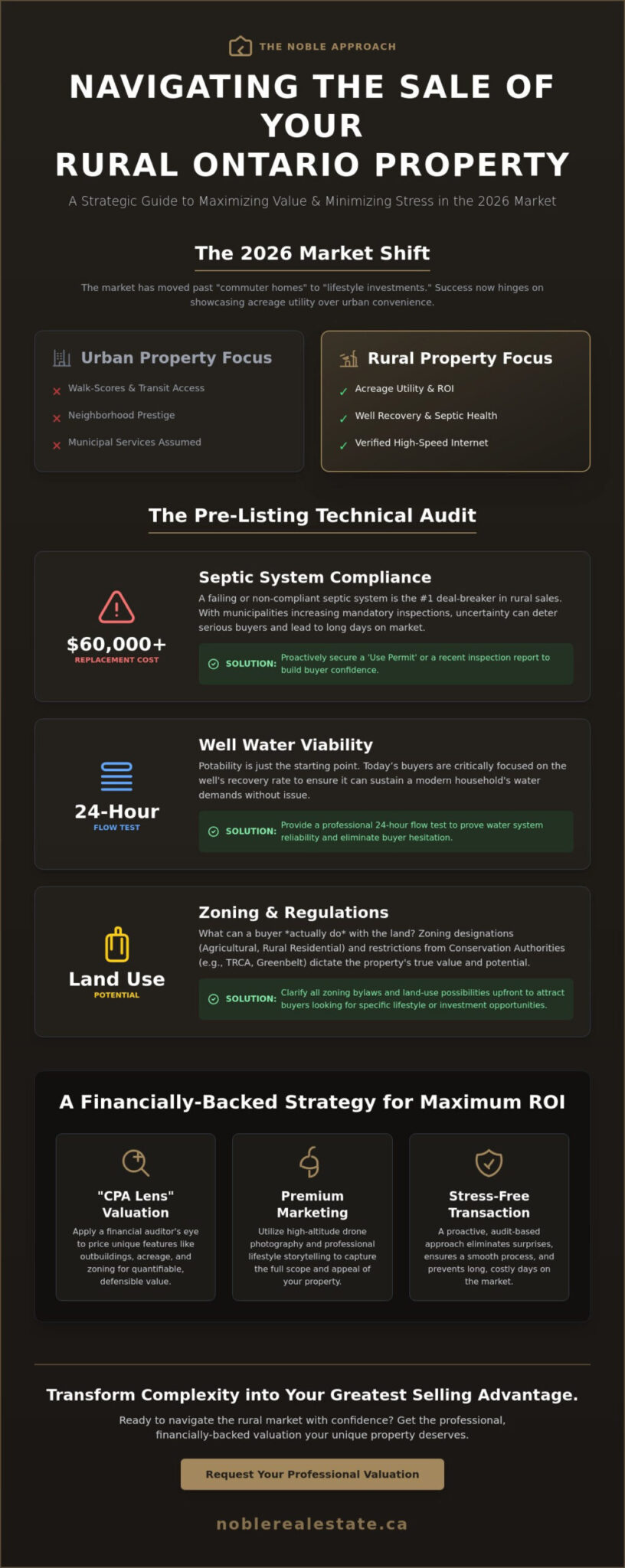
A rural property isn’t just a home; it’s a complex portfolio of environmental systems and land-use rights that requires a financial auditor’s eye to value correctly. You’ve likely felt the weight of uncertainty regarding your septic compliance or how to price unique acreage when selling a rural property in Ontario, especially with active listings at their highest level in over a decade. It’s natural to worry that a failing septic system, which can cost $60,000 or more to replace, might derail your sale or lead to long days on the market. I understand these anxieties, and I’m here to provide the clarity you need.
Using “The Noble Approach,” I’ll show you how to transform these complexities into a strategic advantage. This guide provides a professional, financially-backed roadmap to maximize your property value while ensuring a stress-free transition. We’ll explore how the 2.25% Bank of Canada policy rate is shaping this year’s buyer’s market, the latest 2026 capital gains inclusion rates, and the specific steps to find a buyer who truly appreciates your land’s lifestyle and investment potential.
Key Takeaways
- Understand how 2026 market shifts and the latest Ontario land transfer tax rates impact your bottom line when preparing to list.
- Navigate the technical hurdles of selling a rural property in Ontario by mastering septic inspections and well water recovery tests before your property hits the market.
- Apply a financially-backed “CPA lens” to your land valuation to ensure outbuildings and unique zoning features are priced for maximum ROI.
- Learn why high-altitude drone photography and lifestyle storytelling are essential tools to capture the attention of premium buyers seeking the Ontario countryside.
- Discover how a pre-listing audit can eliminate the fear of long days-on-market and ensure a stress-free, straightforward transaction.
The Unique Landscape of Selling Rural Property in Ontario (2026)
Selling a rural property in Ontario involves a layer of complexity that urban sellers rarely encounter. While a city transaction might focus on square footage and transit access, a country sale hinges on land-specific contingencies. These include private utility systems, environmental setbacks, and the specific nuances of Land ownership in Canada. By May 2026, the market has undergone a “great rebalancing.” We’ve moved past the frantic bidding wars of the early 2020s into a period where active listings are at their highest level in over a decade. This inventory surge means your property needs a precise, financially-backed strategy to stand out among the current provincial landscape.
The shift from “commuter homes” to “lifestyle investments” is the defining trend of 2026. Buyers in the Durham Region and Uxbridge are no longer just looking for a place to sleep between office days. They’re seeking properties that offer on-farm diversified uses, such as small-scale agricultural ventures or event spaces. This requires a higher level of due diligence from sellers. You must be prepared to prove the utility of every acre you own, moving beyond the house to the potential of the soil and the integrity of the outbuildings. It’s about demonstrating how the land functions as a productive asset.
Urban vs. Rural: Why Your Strategy Must Change
Urban marketing relies heavily on “walk-scores” and neighborhood prestige. In contrast, rural marketing is built on “acreage-utility.” A buyer in the countryside cares less about the nearest subway and more about the recovery rate of your well. While the buyer pool for rural estates is smaller than for downtown condos, these individuals are significantly more targeted and informed. They prioritize internet connectivity for remote work, which has become a non-negotiable value driver in 2026. If your property lacks verified high-speed access, its marketability drops regardless of its aesthetic appeal. We focus on these technical strengths to build buyer confidence early.
Local Expertise in Uxbridge and Durham Region
The Greater Toronto Area’s fringe has its own economic heartbeat. Understanding uxbridge real estate dynamics is essential because the buyer profile here differs sharply from the downtown Toronto core. These buyers are often looking for tax-efficient ways to hold land or are interested in the latest legislative shifts, such as the “Protecting Ontario’s Food Independence Act, 2026,” and how it restricts foreign acquisition of provincial farmland. A local specialist doesn’t just show the house; they explain the property’s financial trajectory. Using “The Noble Approach,” we treat your sale as a sophisticated divestment of a complex asset, ensuring that your property’s unique features are quantified and defended during negotiations.
Technical Due Diligence: Septic Systems, Wells, and Zoning
A rural transaction is often won or lost during the technical due diligence phase. Unlike urban homes, where services are provided by the municipality, rural properties rely on complex private systems that represent significant financial liability. When selling a rural property in Ontario, the condition of your septic system is often the first hurdle. With replacement costs ranging from $15,000 to over $60,000 in 2026, a failing system can easily stall a sale. Municipalities are increasingly implementing mandatory inspection programs, especially near water sources. Proactively securing a ‘Use Permit’ or a recent inspection report eliminates this uncertainty for potential buyers.
Well water is the second pillar of rural technical health. Beyond potability, which Public Health Ontario continues to test for free to identify bacterial contaminants, buyers are increasingly focused on the recovery rate. A 24-hour flow test provides the data needed to prove that your well can sustain a modern household’s needs. This level of transparency is a core part of “The Noble Approach,” where we address potential deal breakers before the property even hits the market. If you’re unsure where your property stands, a professional home valuation can help identify which technical audits will yield the highest return.
Zoning designations like Agricultural or Rural Residential dictate what a buyer can actually do with the land. Properties within the Oak Ridges Moraine or the Greenbelt face even stricter regulations from Conservation Authorities like the TRCA. These bodies have the power to restrict development or expansion to protect the watershed. Understanding how Ontario’s public land sale policy influences adjacent land values can also help in positioning your acreage correctly against provincial benchmarks. We ensure every environmental restriction is clearly communicated to prevent last-minute legal complications.
Ensuring Water and Waste Compliance
If a septic system fails a pre-listing inspection, it doesn’t have to end the sale. You can often negotiate a financial holdback or complete the repair before closing to maintain your asking price. For former agricultural lands, a ‘Record of Site Condition’ might be necessary to prove the soil is free from contaminants. Common well issues, such as high mineral content or bacterial spikes, are usually remediable with modern UV filtration or softening systems. Addressing these early protects your ROI and reduces buyer anxiety.
Navigating Environmental Restrictions
Selling within a protected zone requires specialized disclosure. If your land benefits from a ‘Managed Forest’ tax credit, you must explain how this reduces the buyer’s future taxes while requiring a long-term commitment to forest management. We also carefully audit easements and right-of-ways. These are common when selling a rural property in Ontario and can impact where a buyer builds a secondary dwelling or a fence. Clear documentation ensures the buyer appreciates the land’s utility without fear of hidden restrictions.
Valuing Rural Real Estate: Land Use and Financial Considerations
Valuation in the countryside requires a departure from the standard “comparable sales” model used in suburban neighborhoods. When selling a rural property in Ontario, the value is distributed across the entire acreage, not just the four walls of the home. Outbuildings, refurbished barns, and even established ponds carry quantifiable weight in a 2026 appraisal. A well-maintained barn might serve as a hobbyist’s workshop or a potential cidery, while a pond adds significant lifestyle appeal that can be defended with the right data. We categorize these features as capital assets rather than mere “extras.”
Using “The Noble Approach” means looking at your property through a CPA’s lens. We distinguish between “hobby” value, which appeals to lifestyle buyers, and “commercial” agricultural value, which attracts those looking for productive land. This distinction is vital for accurate pricing. While Uxbridge offers a unique market, looking at the broader trends in bancroft real estate helps us understand how land value scales across different Ontario regions. We ensure that your water source meets the latest well requirements and best practices, as technical compliance is the foundation of any premium price tag.
The CPA Advantage in Real Estate
Financial rigour is your strongest shield during negotiations. When a buyer questions an asking price, we provide an investment-grade analysis of your property’s improvements. This includes calculating the ROI on modern upgrades like geothermal heating systems, which have become highly desirable as energy costs fluctuate. Analytical rigour is the cornerstone of securing the full market value for high-value rural estates. We don’t just state a price; we prove it with data that satisfies even the most analytical buyer.
Tax Implications of Selling Rural Land
The financial complexity of a rural sale extends to your tax obligations. Many sellers believe their entire property is covered by the Principal Residence Exemption. However, the Canada Revenue Agency generally limits this exemption to the house and up to 0.5 hectares of land unless you can prove the additional land is necessary for the use and enjoyment of the home. In 2026, the capital gains inclusion rate for individuals is 66.67% for annual gains exceeding $250,000. This makes it essential to consult with financial professionals to understand how the “excess land” portion of your sale will be taxed. We help you prepare for these conversations early, ensuring your net proceeds align with your long-term financial goals.
Marketing Your Country Home: From Drone Footage to Targeted Reach
Selling a rural property in Ontario requires a marketing engine that operates on two levels: emotional appeal and technical precision. In a 2026 market where active listings have hit a ten-year peak, simply posting a photo of the front door won’t suffice. We use high-altitude drone photography to provide a birds-eye perspective of your entire investment. This isn’t just for aesthetics. It’s a functional tool that clarifies property lines, shows the proximity of outbuildings, and highlights the health of your forest or pond. Buyers need to see the scope of the land before they ever set foot on the soil.
Lifestyle storytelling is about selling the dream of the Ontario countryside while grounding it in reality. We don’t just list the number of bedrooms; we describe the quiet mornings on the porch and the utility of the acreage. This narrative is backed by the financial rigour established in earlier audits, ensuring the dream feels like a sound investment. If you’re looking for a partner to manage this complex process, my seller representation services provide the end-to-end support you need to succeed.
Visual Storytelling and Virtual Tours
We move beyond basic photos to immersive 3D technology. This allows city-based buyers to virtually walk your trail systems or inspect the structural integrity of your outbuildings from their desktop. Since most rural sales happen in one season but buyers want to know what the land looks like year-round, we curate a four-season visual portfolio. We stage the interior to emphasize the country escape while ensuring utility spaces, like mudrooms and workshops, feel organized and efficient. It’s about showing that the home is as practical as it is beautiful.
Strategic Listing Exposure
Reaching the right buyer means looking toward the Greater Toronto Area. With the Bank of Canada holding interest rates at 2.25% through 2026, city-to-country buyers are returning to the market with renewed confidence. We target these individuals through social media campaigns and specialized mls listings uxbridge ontario to ensure your property isn’t buried in generic search results. Our feature sheets act as a technical prospectus, detailing everything from septic “Use Permits” to geothermal ROI. This data-heavy approach filters out casual viewers and attracts serious, qualified buyers who respect the analytical depth of your listing.
The Noble Approach to a Stress-Free Rural Sale
Selling a rural property in Ontario shouldn’t feel like a gamble. While the market in May 2026 presents specific challenges, including high inventory levels and a 6.4% year-over-year provincial price decrease, these factors are manageable with a structured methodology. “The Noble Approach” is designed to replace uncertainty with analytical rigour. We treat your property as a significant financial asset, ensuring every technical detail and land feature is positioned to maximize your return on investment. It’s a process built on transparency, local expertise, and a commitment to making your transition as straightforward as possible.
Success begins with an initial consultation where we align your lifestyle goals with current market realities. We don’t just look at what the neighbor’s house sold for. We analyze the broader economic climate, including the Bank of Canada’s 2.25% policy rate and the specific buyer demographics moving into the Durham Region. This ensures that when we set an asking price, it’s backed by a solid financial foundation that can withstand the scrutiny of informed buyers and their appraisers.
Your Roadmap to Success
- Step 1: Financial and lifestyle goal setting. We define what a successful sale looks like for you, considering the 2026 capital gains inclusion rates and the logistics of your next move.
- Step 2: Technical inspections and property “polishing.” We clear regulatory hurdles by securing septic “Use Permits” and well water tests before the first showing. This prevents technical issues from becoming negotiation leverage for the buyer.
- Step 3: Bespoke marketing launch and buyer vetting. We deploy high-impact drone footage and targeted digital reach to attract qualified buyers who appreciate the rural lifestyle and have the financial backing to close.
Redefining Your Real Estate Expectations
My background as a CPA and CA provides a layer of professional oversight that is rare in the real estate industry. This financial expertise means I understand the tax implications and investment nuances of your sale better than a traditional agent. I manage the complex moving parts of your transaction, from environmental setbacks to final closing documents, so you don’t have to worry about the details. This is my “Stress-Free” guarantee to you. If you’re ready to start your journey with a partner who values precision and personal service, contact Noble Real Estate today for a comprehensive home valuation.
Redefine Your Real Estate Expectations in 2026
Success when selling a rural property in Ontario requires a strategy that bridges technical compliance with financial clarity. We’ve explored how the 2.25% Bank of Canada interest rate and record-high inventory levels in May 2026 necessitate a “Financial-First” methodology. By proactively managing septic inspections and well water tests, you’ll eliminate the hurdles that often stall country transactions. Leveraging my CPA and CA designation ensures that every acre of your land is treated as a high-value investment asset, from the soil quality to the ROI of your recent geothermal upgrades.
My specialized expertise in Uxbridge and the surrounding Durham Region allows me to provide end-to-end management of the entire sales process. I handle the complex technical audits and lifestyle marketing so you can focus on your next chapter. When you’re ready to move forward with a partner who prioritizes your financial success and peace of mind, it’s time to take the next step. Your transition to a new lifestyle can be both profitable and enjoyable with the right professional guidance.
Discover The Noble Approach to Selling Your Rural Property
Frequently Asked Questions
Do I need a special septic inspection to sell my rural home in Ontario?
Yes, while not a provincial requirement for every home, most buyers and lenders will insist on a septic inspection as a condition of the sale. In 2026, many Ontario municipalities have implemented mandatory inspection programs for properties near water sources to protect the environment. Securing a “Use Permit” or a recent inspection report proactively helps ensure a stress-free transaction and protects your asking price from last-minute negotiations.
How much land is included in the Principal Residence Exemption?
The Canada Revenue Agency typically limits the Principal Residence Exemption to the housing unit and up to 0.5 hectares of land, which is approximately 1.24 acres. If your property exceeds this size, the “excess land” may be subject to capital gains tax unless you can prove the additional acreage is necessary for the use and enjoyment of the home. Consulting with a financial professional is essential for high-value estates to understand your specific tax liability.
What is the Oak Ridges Moraine and how does it affect my sale?
The Oak Ridges Moraine is a protected environmental landform in Southern Ontario with strict zoning regulations designed to protect the provincial watershed. When selling a rural property in Ontario within this zone, you must disclose specific development restrictions to potential buyers. These regulations often limit where new structures can be built, which directly impacts the land’s perceived utility and its long-term investment value in the eyes of a savvy buyer.
Can I sell my rural property if the well water fails a potability test?
You can certainly sell the property, but a failed potability test will likely become a major negotiation point or a condition in the offer. Most buyers will require the installation of a UV filtration system or a chlorination treatment before they agree to close. Addressing these bacterial issues before listing ensures your property remains competitive in a 2026 market characterized by high inventory levels and increased buyer scrutiny.
How long does it typically take to sell a rural property compared to city homes?
Rural properties generally stay on the market longer than urban homes because the buyer pool is smaller and more targeted. In May 2026, with active listings at their highest level in over a decade, the process requires more patience and a precise marketing strategy. A well-prepared property with cleared technical hurdles and high-quality drone footage typically sells faster than those with lingering septic or well uncertainties.
Should I get a survey done before listing my acreage?
Having an up-to-date survey is highly recommended to confirm property boundaries and identify any existing easements or right-of-ways that could affect the sale. Rural buyers in 2026 are increasingly analytical and want to verify exactly what they are purchasing before committing. Providing a survey early in the process builds trust and prevents legal complications regarding fence lines or building setbacks during the final closing phase.
What are the common closing costs for selling a rural property in Ontario?
Common costs include legal fees, real estate commissions, and adjustments for property taxes or propane fuel tanks. Sellers should also account for the costs of technical inspections, such as septic pumping or well recovery tests, which are standard for selling a rural property in Ontario. While buyers pay the Land Transfer Tax, which ranges from 0.5% to 2.5% in 2026, sellers must ensure all technical compliance costs are settled to finalize the transaction.

A rural property isn’t just a home; it’s a complex portfolio of environmental systems and land-use rights that requires a financial auditor’s eye to value correctly. You’ve likely felt the weight of uncertainty regarding your septic compliance or how to price unique acreage when selling a rural property in Ontario, especially with active listings at their highest level in over a decade. It’s natural to worry that a failing septic system, which can cost $60,000 or more to replace, might derail your sale or lead to long days on the market. I understand these anxieties, and I’m here to provide the clarity you need.
Using “The Noble Approach,” I’ll show you how to transform these complexities into a strategic advantage. This guide provides a professional, financially-backed roadmap to maximize your property value while ensuring a stress-free transition. We’ll explore how the 2.25% Bank of Canada policy rate is shaping this year’s buyer’s market, the latest 2026 capital gains inclusion rates, and the specific steps to find a buyer who truly appreciates your land’s lifestyle and investment potential.
Key Takeaways
- Understand how 2026 market shifts and the latest Ontario land transfer tax rates impact your bottom line when preparing to list.
- Navigate the technical hurdles of selling a rural property in Ontario by mastering septic inspections and well water recovery tests before your property hits the market.
- Apply a financially-backed “CPA lens” to your land valuation to ensure outbuildings and unique zoning features are priced for maximum ROI.
- Learn why high-altitude drone photography and lifestyle storytelling are essential tools to capture the attention of premium buyers seeking the Ontario countryside.
- Discover how a pre-listing audit can eliminate the fear of long days-on-market and ensure a stress-free, straightforward transaction.
The Unique Landscape of Selling Rural Property in Ontario (2026)
Selling a rural property in Ontario involves a layer of complexity that urban sellers rarely encounter. While a city transaction might focus on square footage and transit access, a country sale hinges on land-specific contingencies. These include private utility systems, environmental setbacks, and the specific nuances of Land ownership in Canada. By May 2026, the market has undergone a “great rebalancing.” We’ve moved past the frantic bidding wars of the early 2020s into a period where active listings are at their highest level in over a decade. This inventory surge means your property needs a precise, financially-backed strategy to stand out among the current provincial landscape.
The shift from “commuter homes” to “lifestyle investments” is the defining trend of 2026. Buyers in the Durham Region and Uxbridge are no longer just looking for a place to sleep between office days. They’re seeking properties that offer on-farm diversified uses, such as small-scale agricultural ventures or event spaces. This requires a higher level of due diligence from sellers. You must be prepared to prove the utility of every acre you own, moving beyond the house to the potential of the soil and the integrity of the outbuildings. It’s about demonstrating how the land functions as a productive asset.
Urban vs. Rural: Why Your Strategy Must Change
Urban marketing relies heavily on “walk-scores” and neighborhood prestige. In contrast, rural marketing is built on “acreage-utility.” A buyer in the countryside cares less about the nearest subway and more about the recovery rate of your well. While the buyer pool for rural estates is smaller than for downtown condos, these individuals are significantly more targeted and informed. They prioritize internet connectivity for remote work, which has become a non-negotiable value driver in 2026. If your property lacks verified high-speed access, its marketability drops regardless of its aesthetic appeal. We focus on these technical strengths to build buyer confidence early.
Local Expertise in Uxbridge and Durham Region
The Greater Toronto Area’s fringe has its own economic heartbeat. Understanding uxbridge real estate dynamics is essential because the buyer profile here differs sharply from the downtown Toronto core. These buyers are often looking for tax-efficient ways to hold land or are interested in the latest legislative shifts, such as the “Protecting Ontario’s Food Independence Act, 2026,” and how it restricts foreign acquisition of provincial farmland. A local specialist doesn’t just show the house; they explain the property’s financial trajectory. Using “The Noble Approach,” we treat your sale as a sophisticated divestment of a complex asset, ensuring that your property’s unique features are quantified and defended during negotiations.
Technical Due Diligence: Septic Systems, Wells, and Zoning
A rural transaction is often won or lost during the technical due diligence phase. Unlike urban homes, where services are provided by the municipality, rural properties rely on complex private systems that represent significant financial liability. When selling a rural property in Ontario, the condition of your septic system is often the first hurdle. With replacement costs ranging from $15,000 to over $60,000 in 2026, a failing system can easily stall a sale. Municipalities are increasingly implementing mandatory inspection programs, especially near water sources. Proactively securing a ‘Use Permit’ or a recent inspection report eliminates this uncertainty for potential buyers.
Well water is the second pillar of rural technical health. Beyond potability, which Public Health Ontario continues to test for free to identify bacterial contaminants, buyers are increasingly focused on the recovery rate. A 24-hour flow test provides the data needed to prove that your well can sustain a modern household’s needs. This level of transparency is a core part of “The Noble Approach,” where we address potential deal breakers before the property even hits the market. If you’re unsure where your property stands, a professional home valuation can help identify which technical audits will yield the highest return.
Zoning designations like Agricultural or Rural Residential dictate what a buyer can actually do with the land. Properties within the Oak Ridges Moraine or the Greenbelt face even stricter regulations from Conservation Authorities like the TRCA. These bodies have the power to restrict development or expansion to protect the watershed. Understanding how Ontario’s public land sale policy influences adjacent land values can also help in positioning your acreage correctly against provincial benchmarks. We ensure every environmental restriction is clearly communicated to prevent last-minute legal complications.
Ensuring Water and Waste Compliance
If a septic system fails a pre-listing inspection, it doesn’t have to end the sale. You can often negotiate a financial holdback or complete the repair before closing to maintain your asking price. For former agricultural lands, a ‘Record of Site Condition’ might be necessary to prove the soil is free from contaminants. Common well issues, such as high mineral content or bacterial spikes, are usually remediable with modern UV filtration or softening systems. Addressing these early protects your ROI and reduces buyer anxiety.
Navigating Environmental Restrictions
Selling within a protected zone requires specialized disclosure. If your land benefits from a ‘Managed Forest’ tax credit, you must explain how this reduces the buyer’s future taxes while requiring a long-term commitment to forest management. We also carefully audit easements and right-of-ways. These are common when selling a rural property in Ontario and can impact where a buyer builds a secondary dwelling or a fence. Clear documentation ensures the buyer appreciates the land’s utility without fear of hidden restrictions.
Valuing Rural Real Estate: Land Use and Financial Considerations
Valuation in the countryside requires a departure from the standard “comparable sales” model used in suburban neighborhoods. When selling a rural property in Ontario, the value is distributed across the entire acreage, not just the four walls of the home. Outbuildings, refurbished barns, and even established ponds carry quantifiable weight in a 2026 appraisal. A well-maintained barn might serve as a hobbyist’s workshop or a potential cidery, while a pond adds significant lifestyle appeal that can be defended with the right data. We categorize these features as capital assets rather than mere “extras.”
Using “The Noble Approach” means looking at your property through a CPA’s lens. We distinguish between “hobby” value, which appeals to lifestyle buyers, and “commercial” agricultural value, which attracts those looking for productive land. This distinction is vital for accurate pricing. While Uxbridge offers a unique market, looking at the broader trends in bancroft real estate helps us understand how land value scales across different Ontario regions. We ensure that your water source meets the latest well requirements and best practices, as technical compliance is the foundation of any premium price tag.
The CPA Advantage in Real Estate
Financial rigour is your strongest shield during negotiations. When a buyer questions an asking price, we provide an investment-grade analysis of your property’s improvements. This includes calculating the ROI on modern upgrades like geothermal heating systems, which have become highly desirable as energy costs fluctuate. Analytical rigour is the cornerstone of securing the full market value for high-value rural estates. We don’t just state a price; we prove it with data that satisfies even the most analytical buyer.
Tax Implications of Selling Rural Land
The financial complexity of a rural sale extends to your tax obligations. Many sellers believe their entire property is covered by the Principal Residence Exemption. However, the Canada Revenue Agency generally limits this exemption to the house and up to 0.5 hectares of land unless you can prove the additional land is necessary for the use and enjoyment of the home. In 2026, the capital gains inclusion rate for individuals is 66.67% for annual gains exceeding $250,000. This makes it essential to consult with financial professionals to understand how the “excess land” portion of your sale will be taxed. We help you prepare for these conversations early, ensuring your net proceeds align with your long-term financial goals.
Marketing Your Country Home: From Drone Footage to Targeted Reach
Selling a rural property in Ontario requires a marketing engine that operates on two levels: emotional appeal and technical precision. In a 2026 market where active listings have hit a ten-year peak, simply posting a photo of the front door won’t suffice. We use high-altitude drone photography to provide a birds-eye perspective of your entire investment. This isn’t just for aesthetics. It’s a functional tool that clarifies property lines, shows the proximity of outbuildings, and highlights the health of your forest or pond. Buyers need to see the scope of the land before they ever set foot on the soil.
Lifestyle storytelling is about selling the dream of the Ontario countryside while grounding it in reality. We don’t just list the number of bedrooms; we describe the quiet mornings on the porch and the utility of the acreage. This narrative is backed by the financial rigour established in earlier audits, ensuring the dream feels like a sound investment. If you’re looking for a partner to manage this complex process, my seller representation services provide the end-to-end support you need to succeed.
Visual Storytelling and Virtual Tours
We move beyond basic photos to immersive 3D technology. This allows city-based buyers to virtually walk your trail systems or inspect the structural integrity of your outbuildings from their desktop. Since most rural sales happen in one season but buyers want to know what the land looks like year-round, we curate a four-season visual portfolio. We stage the interior to emphasize the country escape while ensuring utility spaces, like mudrooms and workshops, feel organized and efficient. It’s about showing that the home is as practical as it is beautiful.
Strategic Listing Exposure
Reaching the right buyer means looking toward the Greater Toronto Area. With the Bank of Canada holding interest rates at 2.25% through 2026, city-to-country buyers are returning to the market with renewed confidence. We target these individuals through social media campaigns and specialized mls listings uxbridge ontario to ensure your property isn’t buried in generic search results. Our feature sheets act as a technical prospectus, detailing everything from septic “Use Permits” to geothermal ROI. This data-heavy approach filters out casual viewers and attracts serious, qualified buyers who respect the analytical depth of your listing.
The Noble Approach to a Stress-Free Rural Sale
Selling a rural property in Ontario shouldn’t feel like a gamble. While the market in May 2026 presents specific challenges, including high inventory levels and a 6.4% year-over-year provincial price decrease, these factors are manageable with a structured methodology. “The Noble Approach” is designed to replace uncertainty with analytical rigour. We treat your property as a significant financial asset, ensuring every technical detail and land feature is positioned to maximize your return on investment. It’s a process built on transparency, local expertise, and a commitment to making your transition as straightforward as possible.
Success begins with an initial consultation where we align your lifestyle goals with current market realities. We don’t just look at what the neighbor’s house sold for. We analyze the broader economic climate, including the Bank of Canada’s 2.25% policy rate and the specific buyer demographics moving into the Durham Region. This ensures that when we set an asking price, it’s backed by a solid financial foundation that can withstand the scrutiny of informed buyers and their appraisers.
Your Roadmap to Success
- Step 1: Financial and lifestyle goal setting. We define what a successful sale looks like for you, considering the 2026 capital gains inclusion rates and the logistics of your next move.
- Step 2: Technical inspections and property “polishing.” We clear regulatory hurdles by securing septic “Use Permits” and well water tests before the first showing. This prevents technical issues from becoming negotiation leverage for the buyer.
- Step 3: Bespoke marketing launch and buyer vetting. We deploy high-impact drone footage and targeted digital reach to attract qualified buyers who appreciate the rural lifestyle and have the financial backing to close.
Redefining Your Real Estate Expectations
My background as a CPA and CA provides a layer of professional oversight that is rare in the real estate industry. This financial expertise means I understand the tax implications and investment nuances of your sale better than a traditional agent. I manage the complex moving parts of your transaction, from environmental setbacks to final closing documents, so you don’t have to worry about the details. This is my “Stress-Free” guarantee to you. If you’re ready to start your journey with a partner who values precision and personal service, contact Noble Real Estate today for a comprehensive home valuation.
Redefine Your Real Estate Expectations in 2026
Success when selling a rural property in Ontario requires a strategy that bridges technical compliance with financial clarity. We’ve explored how the 2.25% Bank of Canada interest rate and record-high inventory levels in May 2026 necessitate a “Financial-First” methodology. By proactively managing septic inspections and well water tests, you’ll eliminate the hurdles that often stall country transactions. Leveraging my CPA and CA designation ensures that every acre of your land is treated as a high-value investment asset, from the soil quality to the ROI of your recent geothermal upgrades.
My specialized expertise in Uxbridge and the surrounding Durham Region allows me to provide end-to-end management of the entire sales process. I handle the complex technical audits and lifestyle marketing so you can focus on your next chapter. When you’re ready to move forward with a partner who prioritizes your financial success and peace of mind, it’s time to take the next step. Your transition to a new lifestyle can be both profitable and enjoyable with the right professional guidance.
Discover The Noble Approach to Selling Your Rural Property
Frequently Asked Questions
Do I need a special septic inspection to sell my rural home in Ontario?
Yes, while not a provincial requirement for every home, most buyers and lenders will insist on a septic inspection as a condition of the sale. In 2026, many Ontario municipalities have implemented mandatory inspection programs for properties near water sources to protect the environment. Securing a “Use Permit” or a recent inspection report proactively helps ensure a stress-free transaction and protects your asking price from last-minute negotiations.
How much land is included in the Principal Residence Exemption?
The Canada Revenue Agency typically limits the Principal Residence Exemption to the housing unit and up to 0.5 hectares of land, which is approximately 1.24 acres. If your property exceeds this size, the “excess land” may be subject to capital gains tax unless you can prove the additional acreage is necessary for the use and enjoyment of the home. Consulting with a financial professional is essential for high-value estates to understand your specific tax liability.
What is the Oak Ridges Moraine and how does it affect my sale?
The Oak Ridges Moraine is a protected environmental landform in Southern Ontario with strict zoning regulations designed to protect the provincial watershed. When selling a rural property in Ontario within this zone, you must disclose specific development restrictions to potential buyers. These regulations often limit where new structures can be built, which directly impacts the land’s perceived utility and its long-term investment value in the eyes of a savvy buyer.
Can I sell my rural property if the well water fails a potability test?
You can certainly sell the property, but a failed potability test will likely become a major negotiation point or a condition in the offer. Most buyers will require the installation of a UV filtration system or a chlorination treatment before they agree to close. Addressing these bacterial issues before listing ensures your property remains competitive in a 2026 market characterized by high inventory levels and increased buyer scrutiny.
How long does it typically take to sell a rural property compared to city homes?
Rural properties generally stay on the market longer than urban homes because the buyer pool is smaller and more targeted. In May 2026, with active listings at their highest level in over a decade, the process requires more patience and a precise marketing strategy. A well-prepared property with cleared technical hurdles and high-quality drone footage typically sells faster than those with lingering septic or well uncertainties.
Should I get a survey done before listing my acreage?
Having an up-to-date survey is highly recommended to confirm property boundaries and identify any existing easements or right-of-ways that could affect the sale. Rural buyers in 2026 are increasingly analytical and want to verify exactly what they are purchasing before committing. Providing a survey early in the process builds trust and prevents legal complications regarding fence lines or building setbacks during the final closing phase.
What are the common closing costs for selling a rural property in Ontario?
Common costs include legal fees, real estate commissions, and adjustments for property taxes or propane fuel tanks. Sellers should also account for the costs of technical inspections, such as septic pumping or well recovery tests, which are standard for selling a rural property in Ontario. While buyers pay the Land Transfer Tax, which ranges from 0.5% to 2.5% in 2026, sellers must ensure all technical compliance costs are settled to finalize the transaction.