



Looking For More Great Content?
Get even more informative Toronto real estate news sent directly to your inbox by signing up for my newsletter here. All it takes is a few easy clicks.

Selling an Estate Property in Ontario: A Strategic Guide for Executors
04/18/26 Uncategorized
Imagine standing in a home filled with forty years of family history, holding a set of keys that suddenly feel like they weigh fifty pounds. For many executors, the honor of being chosen quickly turns into a heavy sense of responsibility. You likely feel the pressure of protecting the interests of every beneficiary while managing the complex logistics of selling an estate property in Ontario. It’s a role that demands both emotional resilience and technical precision. Legal reports from 2024 indicate that executor liability is a primary concern for those managing assets, making a structured approach more vital than ever before.
You already know that this isn’t a standard real estate transaction. You’re balancing probate timelines, property maintenance, and family expectations all at once. We’re here to ensure you move forward with the confidence of a seasoned advisor. This guide provides a clear roadmap to handle the legal requirements and tax implications of your sale using The Noble Approach. We’ll walk through the strategic steps to minimize your tax burden and maximize the final value for the estate, ensuring the process is as smooth and respectful as possible.
Key Takeaways
- Understand the essential legal responsibilities of an Estate Trustee and how to navigate the probate process through the Ontario Superior Court of Justice.
- Learn how a professional date-of-death appraisal and the Principal Residence Exemption can protect your financial interests when selling an estate property in ontario.
- Discover practical strategies for sorting through a lifetime of belongings and identifying which strategic repairs will offer the highest return on investment.
- Experience “The Noble Approach,” which leverages a professional financial background to provide comprehensive project management and a stress-free closing process.
Understanding Estate Property Sales in Ontario
Selling an estate property in Ontario is a distinct legal process that involves liquidating real estate owned by a person who has passed away. This isn’t your typical residential move. It requires a blend of legal compliance, tax strategy, and emotional resilience. The responsibility typically rests with the Estate Trustee, the title used under the 1995 Estates Administration Act to replace the term “Executor.”
The Noble Approach recognizes that this transition is complex. Standard real estate deals focus on lifestyle upgrades, but estate sales prioritize the distribution of assets and the fulfillment of a person’s final wishes. Local expertise in the Uxbridge and Durham Region markets is indispensable here. Our community features unique property types, from historic century homes to rural acreages with complex septic systems. Handling these nuances requires the analytical rigour of a financial professional to ensure no value is left on the table.
Key Terminology for Ontario Executors
The legal language surrounding estates can feel like a foreign tongue. An Estate Trustee is the individual or trust company authorized to manage the deceased’s assets. If the person died “Testate,” they left a valid will. If they died “Intestate,” they passed without a will, and the court must appoint an administrator. Understanding the Probate Process is a vital early step. This court procedure validates the will and provides the Trustee with the legal authority to sell the home.
Establishing the Fair Market Value (FMV) is the most critical task for your financial records. The FMV is the price the property would fetch on the open market at the time of the owner’s passing. This number determines the Estate Administration Tax, often called probate fee, which in Ontario is roughly 1.5% for estates valued over $50,000. Accuracy here prevents future disputes with the Canada Revenue Agency or beneficiaries.
First Steps: Securing the Asset
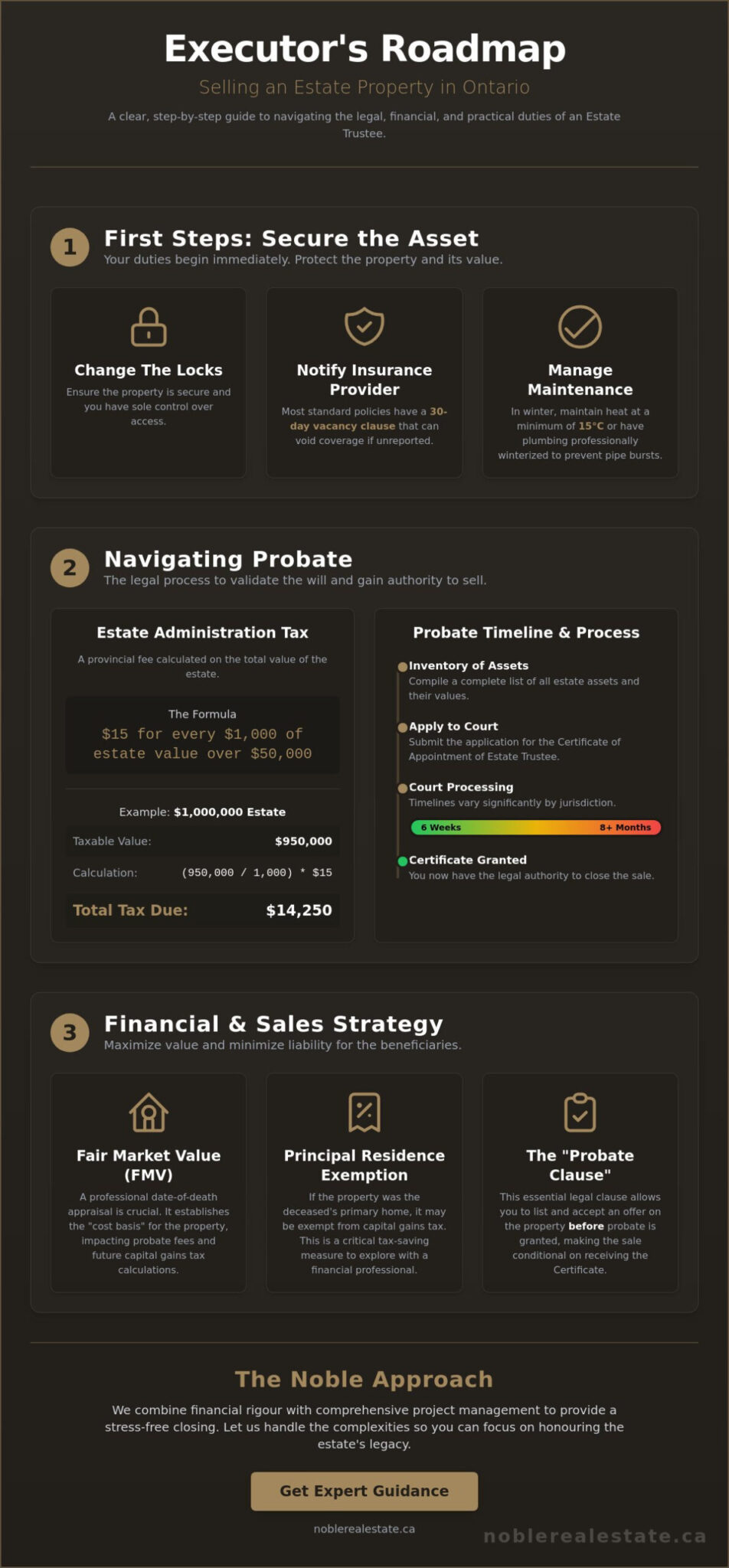
Your duties begin the moment you’re named. First, change the locks to ensure the property is secure and access is controlled. Next, contact the home insurance provider immediately. Most standard policies in Ontario contain a “vacancy clause” that can void coverage if the home is empty for more than 30 days without notification.
Managing a vacant home in Durham Region requires proactive maintenance. If the property sits empty during the winter months, you must either maintain the heat at a minimum of 15 degrees Celsius or professionally winterize the plumbing to prevent pipe bursts. Regular inspections are necessary to satisfy insurance requirements and maintain the home’s condition for selling an estate property in ontario. In 2026, the fiduciary duty of an Estate Trustee is a legal mandate to act with the highest degree of good faith and loyalty while preserving the estate’s assets for the beneficiaries.
Navigating Probate and Legal Requirements
The legal framework surrounding an estate sale is designed to protect both the beneficiaries and the executor. Your first step involves determining if a Certificate of Appointment of Estate Trustee is required. While some small estates or jointly held properties might bypass this step, most financial institutions and the Land Registry Office require this certificate before they allow the transfer of real estate. Without it, you lack the legal authority to sign the final closing documents on behalf of the deceased.
The Certificate of Appointment Process
Applying for probate through an Ontario estate lawyer is a structured process that begins with a thorough inventory of assets. A major component of this application is the calculation of Ontario’s Estate Administration Tax. As of 2024, the tax is calculated as $15 for every $1,000 of estate value over $50,000. For an estate valued at $1,000,000, this equates to $14,250 in taxes due at the time of filing.
Managing your timeline is the most difficult part of this phase. In 2026, court processing times within the Ontario Superior Court of Justice continue to vary by jurisdiction. While some regional courts may process applications in 6 weeks, busy hubs like Toronto or York Region often take 6 to 8 months. You’ll need to account for these windows when planning your market entry.
Structuring the Sale Agreement
You don’t have to wait for the court’s seal to begin selling an estate property in ontario. You can list the property and even sign a Broad of Real Estate agreement of purchase and sale before probate is granted. The key is the “Probate Clause.” This essential condition states that the completion of the sale is subject to the seller obtaining the Certificate of Appointment by a specific date. It provides a legal “safety valve,” allowing the executor to extend the closing date if the court experiences delays, preventing the estate from being sued for breach of contract.
Disclosure is another area where executors must be cautious. While you may have limited personal knowledge of the home’s history, you’re still legally required to disclose latent defects. These are hidden issues, like structural instability or toxic mold, that a home inspection might not reveal. Patent defects, such as a visible crack in a window, are typically the buyer’s responsibility to spot. Working with local real estate agents who have a deep understanding of probate law ensures these nuances are handled correctly from day one.
The Noble Approach focuses on reducing this administrative burden through analytical rigour and clear communication. If the legal requirements feel daunting, connecting with a seasoned advisor can help you map out a clear path forward that protects the estate’s value and your peace of mind.
Financial Strategy: Valuation, Taxes, and Capital Gains
When you’re responsible for selling an estate property in Ontario, the financial stakes are high. It’s not just about finding a buyer; it’s about protecting the estate’s value from unnecessary tax erosion. Under Canadian tax law, the CRA considers a property sold at its fair market value on the day the owner passed away. This concept of Capital Gains and Deemed Disposition ensures that any increase in value during the owner’s lifetime is accounted for on the final tax return. If the home was the deceased’s primary residence, the Principal Residence Exemption (PRE) typically eliminates this tax burden. However, if the home stays in the estate’s name while the market climbs, any appreciation after the date of death may be taxable.
The Noble Approach leverages a CPA-led strategy to provide analytical rigour that standard real estate services lack. By applying a deep understanding of tax implications, we help executors minimize the tax burden on beneficiaries. This involves more than just marketing; it’s a comprehensive look at the estate’s financial health. We ensure you’re making data-driven decisions that preserve as much equity as possible for the family.
Date of Death Valuation vs. Sale Price
A simple Comparative Market Analysis (CMA) is a helpful tool for setting a list price, but the CRA often requires more formal documentation for estate filings. You should obtain a professional appraisal to establish the Fair Market Value (FMV) as of the date of death. Fair market value at the date of death serves as the definitive tax benchmark for the CRA. If you decide to renovate the property to increase its appeal, keep every receipt. When you’re selling an estate property in Ontario, documenting improvements like a $15,000 kitchen refresh or a $8,000 roof replacement allows you to adjust the cost base, which can reduce the taxable capital gain upon sale.
Tax Implications for Beneficiaries
Beneficiaries don’t usually pay taxes on their inheritance directly. Instead, the estate acts as a separate taxpayer, settling all debts and tax obligations before funds are distributed. This process is straightforward for a primary home, but it becomes more complex with secondary properties or cottages. Since these don’t qualify for the PRE, the estate must pay tax on the appreciation from the original purchase date until the time of death. To get a better sense of the local market and standard transaction costs, you can explore our guide to Uxbridge real estate. Understanding these costs early helps you set realistic expectations for the final distribution of funds.
- Principal Residence Exemption: Protects the primary home from capital gains tax.
- Secondary Properties: Subject to tax on appreciation since the original purchase.
- Probate Fees: Calculated based on the total value of the estate’s assets in Ontario.
Preparing and Marketing the Estate Property
Preparing for the market requires a shift from viewing the house as a home to viewing it as a financial asset. When selling an estate property in ontario, executors often face the daunting task of clearing decades of history. The goal is to present a clean slate that allows buyers to envision their own future. This transition is emotional, but a methodical approach ensures the property’s value is protected and maximized.
Strategic repairs should focus on high-impact, low-cost updates. Refreshing neutral paint can provide a return on investment of over 100% according to 2023 home staging data. Avoid major kitchen overhauls; buyers usually prefer to choose their own finishes. Focus instead on fixing structural defects, leaky faucets, or safety issues that could derail a home inspection. Staging an estate home in Uxbridge involves removing heavy, dated furniture to highlight the natural light and architectural bones of the property, which appeals to the modern aesthetic currently in demand.
The “Clean Out” Process
Sorting items is the most time-consuming phase of the executorship. Divide belongings into four categories: keep, sell, donate, and discard. Uxbridge offers several local resources for estate auctions and junk removal services that specialize in sensitive situations. High-value assets like jewelry or fine art require professional appraisals before they’re moved. Differentiating between sentimental value and market value is essential for a smooth transition. Don’t rush this process, but stay focused on the timeline required for a successful listing.
Marketing for Maximum ROI
According to 2023 industry reports, 97% of home buyers use the internet during their search. High-quality professional photography and 3D virtual tours are mandatory tools to filter out casual viewers and attract serious offers. This is especially vital for larger properties in the Durham Region where foot traffic can be disruptive to the neighborhood. Understanding current houses for sale in Uxbridge helps us target the right demographic, whether it’s young families seeking space or retirees looking for a quiet community.
The Noble Approach applies analytical rigour to the marketing process. Historic or unique Durham properties require a bespoke strategy that highlights architectural significance while addressing modern living requirements. We use data-driven insights to position the property competitively from day one, ensuring the estate receives the attention it deserves. Our end-to-end approach manages these complexities so you can focus on your family’s needs.
The Noble Approach: Stress-Free Estate Sales
Selling an estate property in Ontario involves complex layers of tax implications, legal requirements, and emotional weight. Most executors find themselves managing a full-time job’s worth of paperwork while grieving a loved one. The Noble Approach was designed to bridge this gap, providing a structured, end-to-end methodology that transforms a daunting task into a manageable, successful transition. We take the lead on project management, coordinating with your legal team and contractors so you don’t have to juggle multiple points of contact during a difficult time.
Why a CPA-Realtor Makes the Difference
Colin Noble’s background as a Chartered Professional Accountant (CPA, CA) provides an analytical rigour that traditional agents rarely possess. This financial expertise is vital when handling the Statement of Adjustments at closing. We ensure every property tax credit, utility prorating, and rental deposit is accounted for with total accuracy. This level of detail protects the Estate Trustee from financial scrutiny by beneficiaries or the courts. We combine this fiscal discipline with high-end real estate marketing to maximize the value of the estate’s most significant asset. By applying professional financial standards to the sale, we provide the clarity and confidence executors need to fulfill their fiduciary duties.
- Fiduciary Protection: We align our processes with your legal obligations to ensure full transparency for all stakeholders.
- Conflict Resolution: Transparent, expert-led communication helps reduce friction between family members during sensitive negotiations.
- Closing Coordination: We manage the transition from the “Sold” sign to the final distribution of assets, working closely with your lawyer to ensure a clean handoff.
Your Next Steps in the Process
The path toward a successful closing starts with a clear, actionable plan. We don’t believe in high-pressure sales tactics; we prefer a calm, advisory role that puts you in control. When selling an estate property in Ontario, your first step is booking a confidential consultation. During this meeting, we assess the property’s condition and provide a data-backed valuation.
Following our initial meeting, we develop a custom timeline tailored to the estate’s specific needs. This includes everything from decluttering and staging to the strategic launch on the market. You can move forward with confidence, knowing The Noble Approach puts your peace of mind at the forefront of the strategy. Reach out today to redefine your real estate expectations and begin the process of closing this chapter with grace and financial security. Our goal is to make the complex feel straightforward, ensuring the legacy of the estate is handled with the utmost professional care.
Take Control of the Estate Process Today
Successfully managing a legacy requires balancing strict legal mandates with high-level financial precision. You’ve learned that obtaining a Certificate of Appointment from the Ontario Ministry of the Attorney General is a critical first step, and that precise valuations are necessary to settle Estate Administration Tax accurately. When selling an estate property in ontario, the intersection of probate law and real estate logistics demands a specialized, calm approach. It’s about more than just a listing; it’s about protecting the value of the estate while honoring your responsibilities as a trustee.
Colin Noble, CPA, CA, applies his deep background in finance to ensure every tax implication and valuation is handled with analytical rigour. Our team provides comprehensive end-to-end support across Uxbridge and the Durham Region, managing the intricate logistics so you can focus on what matters most. We believe that complex transitions should be straightforward and stress-free for every family we serve.
Redefine your estate sale expectations with The Noble Approach. You don’t have to carry this weight alone; with the right partner, this complex transition becomes a manageable and successful journey for your family.
Frequently Asked Questions
Can I sell a house in Ontario before probate is granted?
Yes, you can list the home and sign an Agreement of Purchase and Sale before the court grants probate. You must include a specific “Subject to Probate” clause that makes the closing date conditional on receiving the Certificate of Appointment of Estate Trustee. This approach allows you to begin selling an estate property in Ontario while the legal paperwork is still in process, ensuring the home doesn’t sit vacant for months.
How much is the Estate Administration Tax (probate fee) in Ontario for 2026?
The Estate Administration Tax is calculated at $15 for every $1,000 of estate value that exceeds $50,000. For an estate valued at $1,000,000, the total tax owed to the Ministry of Finance would be $14,250. There’s no tax on the initial $50,000 of the estate. Using these exact figures helps you plan the estate’s cash flow requirements accurately before you distribute any funds to beneficiaries.
Who is responsible for property taxes and utilities during the probate process?
The estate itself is responsible for all carrying costs, including property taxes, heat, and water. As the executor, you’ll manage these payments using funds from the estate’s bank account. If the deceased’s accounts are frozen, you might need to pay these costs personally and seek reimbursement once the court issues the probate certificate. Keeping detailed receipts for every dollar spent is a requirement under the Trustee Act.
Do all beneficiaries need to agree to the sale price of the estate?
The executor holds the legal authority to sell the property without unanimous consent from all beneficiaries. However, the Trustee Act requires you to act in the estate’s best interests and obtain the highest possible value. Obtaining a professional appraisal and sharing it with 100 percent of the beneficiaries is a smart way to prevent legal disputes. Most successful sales involve clear communication to ensure everyone feels the price is fair.
What happens if the deceased person did not leave a will (intestacy)?
When there’s no will, the Succession Law Reform Act dictates how the assets are distributed among the heirs. A family member must apply to the Ontario Superior Court of Justice to be appointed as the Estate Trustee Without a Will. You can’t finalize selling an estate property in Ontario until the court formally grants this authority. This legal process typically adds 4 to 6 months to the overall timeline.
Is an estate sale exempt from the standard Ontario land transfer tax?
No, an estate sale isn’t exempt from Ontario Land Transfer Tax for the buyer. The purchaser must pay the standard tax rates to the Ministry of Finance upon closing, just like any other residential transaction. If the property is located in Toronto, the buyer also pays an additional Municipal Land Transfer Tax. The estate’s primary tax obligation remains the Estate Administration Tax, which is paid when the probate application is filed.
How long does an executor have to sell a house in Ontario?
Ontario law generally follows the “Executor’s Year” rule, which suggests you should aim to settle the estate within 12 months of the death. There isn’t a hard deadline to sell the house, but beneficiaries can petition the court for an accounting if the process exceeds 1 year. Selling within this timeframe helps you avoid long term property tax burdens and potential issues with vacant home insurance policies.

Imagine standing in a home filled with forty years of family history, holding a set of keys that suddenly feel like they weigh fifty pounds. For many executors, the honor of being chosen quickly turns into a heavy sense of responsibility. You likely feel the pressure of protecting the interests of every beneficiary while managing the complex logistics of selling an estate property in Ontario. It’s a role that demands both emotional resilience and technical precision. Legal reports from 2024 indicate that executor liability is a primary concern for those managing assets, making a structured approach more vital than ever before.
You already know that this isn’t a standard real estate transaction. You’re balancing probate timelines, property maintenance, and family expectations all at once. We’re here to ensure you move forward with the confidence of a seasoned advisor. This guide provides a clear roadmap to handle the legal requirements and tax implications of your sale using The Noble Approach. We’ll walk through the strategic steps to minimize your tax burden and maximize the final value for the estate, ensuring the process is as smooth and respectful as possible.
Key Takeaways
- Understand the essential legal responsibilities of an Estate Trustee and how to navigate the probate process through the Ontario Superior Court of Justice.
- Learn how a professional date-of-death appraisal and the Principal Residence Exemption can protect your financial interests when selling an estate property in ontario.
- Discover practical strategies for sorting through a lifetime of belongings and identifying which strategic repairs will offer the highest return on investment.
- Experience “The Noble Approach,” which leverages a professional financial background to provide comprehensive project management and a stress-free closing process.
Understanding Estate Property Sales in Ontario
Selling an estate property in Ontario is a distinct legal process that involves liquidating real estate owned by a person who has passed away. This isn’t your typical residential move. It requires a blend of legal compliance, tax strategy, and emotional resilience. The responsibility typically rests with the Estate Trustee, the title used under the 1995 Estates Administration Act to replace the term “Executor.”
The Noble Approach recognizes that this transition is complex. Standard real estate deals focus on lifestyle upgrades, but estate sales prioritize the distribution of assets and the fulfillment of a person’s final wishes. Local expertise in the Uxbridge and Durham Region markets is indispensable here. Our community features unique property types, from historic century homes to rural acreages with complex septic systems. Handling these nuances requires the analytical rigour of a financial professional to ensure no value is left on the table.
Key Terminology for Ontario Executors
The legal language surrounding estates can feel like a foreign tongue. An Estate Trustee is the individual or trust company authorized to manage the deceased’s assets. If the person died “Testate,” they left a valid will. If they died “Intestate,” they passed without a will, and the court must appoint an administrator. Understanding the Probate Process is a vital early step. This court procedure validates the will and provides the Trustee with the legal authority to sell the home.
Establishing the Fair Market Value (FMV) is the most critical task for your financial records. The FMV is the price the property would fetch on the open market at the time of the owner’s passing. This number determines the Estate Administration Tax, often called probate fee, which in Ontario is roughly 1.5% for estates valued over $50,000. Accuracy here prevents future disputes with the Canada Revenue Agency or beneficiaries.
First Steps: Securing the Asset
Your duties begin the moment you’re named. First, change the locks to ensure the property is secure and access is controlled. Next, contact the home insurance provider immediately. Most standard policies in Ontario contain a “vacancy clause” that can void coverage if the home is empty for more than 30 days without notification.
Managing a vacant home in Durham Region requires proactive maintenance. If the property sits empty during the winter months, you must either maintain the heat at a minimum of 15 degrees Celsius or professionally winterize the plumbing to prevent pipe bursts. Regular inspections are necessary to satisfy insurance requirements and maintain the home’s condition for selling an estate property in ontario. In 2026, the fiduciary duty of an Estate Trustee is a legal mandate to act with the highest degree of good faith and loyalty while preserving the estate’s assets for the beneficiaries.
Navigating Probate and Legal Requirements
The legal framework surrounding an estate sale is designed to protect both the beneficiaries and the executor. Your first step involves determining if a Certificate of Appointment of Estate Trustee is required. While some small estates or jointly held properties might bypass this step, most financial institutions and the Land Registry Office require this certificate before they allow the transfer of real estate. Without it, you lack the legal authority to sign the final closing documents on behalf of the deceased.
The Certificate of Appointment Process
Applying for probate through an Ontario estate lawyer is a structured process that begins with a thorough inventory of assets. A major component of this application is the calculation of Ontario’s Estate Administration Tax. As of 2024, the tax is calculated as $15 for every $1,000 of estate value over $50,000. For an estate valued at $1,000,000, this equates to $14,250 in taxes due at the time of filing.
Managing your timeline is the most difficult part of this phase. In 2026, court processing times within the Ontario Superior Court of Justice continue to vary by jurisdiction. While some regional courts may process applications in 6 weeks, busy hubs like Toronto or York Region often take 6 to 8 months. You’ll need to account for these windows when planning your market entry.
Structuring the Sale Agreement
You don’t have to wait for the court’s seal to begin selling an estate property in ontario. You can list the property and even sign a Broad of Real Estate agreement of purchase and sale before probate is granted. The key is the “Probate Clause.” This essential condition states that the completion of the sale is subject to the seller obtaining the Certificate of Appointment by a specific date. It provides a legal “safety valve,” allowing the executor to extend the closing date if the court experiences delays, preventing the estate from being sued for breach of contract.
Disclosure is another area where executors must be cautious. While you may have limited personal knowledge of the home’s history, you’re still legally required to disclose latent defects. These are hidden issues, like structural instability or toxic mold, that a home inspection might not reveal. Patent defects, such as a visible crack in a window, are typically the buyer’s responsibility to spot. Working with local real estate agents who have a deep understanding of probate law ensures these nuances are handled correctly from day one.
The Noble Approach focuses on reducing this administrative burden through analytical rigour and clear communication. If the legal requirements feel daunting, connecting with a seasoned advisor can help you map out a clear path forward that protects the estate’s value and your peace of mind.
Financial Strategy: Valuation, Taxes, and Capital Gains
When you’re responsible for selling an estate property in Ontario, the financial stakes are high. It’s not just about finding a buyer; it’s about protecting the estate’s value from unnecessary tax erosion. Under Canadian tax law, the CRA considers a property sold at its fair market value on the day the owner passed away. This concept of Capital Gains and Deemed Disposition ensures that any increase in value during the owner’s lifetime is accounted for on the final tax return. If the home was the deceased’s primary residence, the Principal Residence Exemption (PRE) typically eliminates this tax burden. However, if the home stays in the estate’s name while the market climbs, any appreciation after the date of death may be taxable.
The Noble Approach leverages a CPA-led strategy to provide analytical rigour that standard real estate services lack. By applying a deep understanding of tax implications, we help executors minimize the tax burden on beneficiaries. This involves more than just marketing; it’s a comprehensive look at the estate’s financial health. We ensure you’re making data-driven decisions that preserve as much equity as possible for the family.
Date of Death Valuation vs. Sale Price
A simple Comparative Market Analysis (CMA) is a helpful tool for setting a list price, but the CRA often requires more formal documentation for estate filings. You should obtain a professional appraisal to establish the Fair Market Value (FMV) as of the date of death. Fair market value at the date of death serves as the definitive tax benchmark for the CRA. If you decide to renovate the property to increase its appeal, keep every receipt. When you’re selling an estate property in Ontario, documenting improvements like a $15,000 kitchen refresh or a $8,000 roof replacement allows you to adjust the cost base, which can reduce the taxable capital gain upon sale.
Tax Implications for Beneficiaries
Beneficiaries don’t usually pay taxes on their inheritance directly. Instead, the estate acts as a separate taxpayer, settling all debts and tax obligations before funds are distributed. This process is straightforward for a primary home, but it becomes more complex with secondary properties or cottages. Since these don’t qualify for the PRE, the estate must pay tax on the appreciation from the original purchase date until the time of death. To get a better sense of the local market and standard transaction costs, you can explore our guide to Uxbridge real estate. Understanding these costs early helps you set realistic expectations for the final distribution of funds.
- Principal Residence Exemption: Protects the primary home from capital gains tax.
- Secondary Properties: Subject to tax on appreciation since the original purchase.
- Probate Fees: Calculated based on the total value of the estate’s assets in Ontario.
Preparing and Marketing the Estate Property
Preparing for the market requires a shift from viewing the house as a home to viewing it as a financial asset. When selling an estate property in ontario, executors often face the daunting task of clearing decades of history. The goal is to present a clean slate that allows buyers to envision their own future. This transition is emotional, but a methodical approach ensures the property’s value is protected and maximized.
Strategic repairs should focus on high-impact, low-cost updates. Refreshing neutral paint can provide a return on investment of over 100% according to 2023 home staging data. Avoid major kitchen overhauls; buyers usually prefer to choose their own finishes. Focus instead on fixing structural defects, leaky faucets, or safety issues that could derail a home inspection. Staging an estate home in Uxbridge involves removing heavy, dated furniture to highlight the natural light and architectural bones of the property, which appeals to the modern aesthetic currently in demand.
The “Clean Out” Process
Sorting items is the most time-consuming phase of the executorship. Divide belongings into four categories: keep, sell, donate, and discard. Uxbridge offers several local resources for estate auctions and junk removal services that specialize in sensitive situations. High-value assets like jewelry or fine art require professional appraisals before they’re moved. Differentiating between sentimental value and market value is essential for a smooth transition. Don’t rush this process, but stay focused on the timeline required for a successful listing.
Marketing for Maximum ROI
According to 2023 industry reports, 97% of home buyers use the internet during their search. High-quality professional photography and 3D virtual tours are mandatory tools to filter out casual viewers and attract serious offers. This is especially vital for larger properties in the Durham Region where foot traffic can be disruptive to the neighborhood. Understanding current houses for sale in Uxbridge helps us target the right demographic, whether it’s young families seeking space or retirees looking for a quiet community.
The Noble Approach applies analytical rigour to the marketing process. Historic or unique Durham properties require a bespoke strategy that highlights architectural significance while addressing modern living requirements. We use data-driven insights to position the property competitively from day one, ensuring the estate receives the attention it deserves. Our end-to-end approach manages these complexities so you can focus on your family’s needs.
The Noble Approach: Stress-Free Estate Sales
Selling an estate property in Ontario involves complex layers of tax implications, legal requirements, and emotional weight. Most executors find themselves managing a full-time job’s worth of paperwork while grieving a loved one. The Noble Approach was designed to bridge this gap, providing a structured, end-to-end methodology that transforms a daunting task into a manageable, successful transition. We take the lead on project management, coordinating with your legal team and contractors so you don’t have to juggle multiple points of contact during a difficult time.
Why a CPA-Realtor Makes the Difference
Colin Noble’s background as a Chartered Professional Accountant (CPA, CA) provides an analytical rigour that traditional agents rarely possess. This financial expertise is vital when handling the Statement of Adjustments at closing. We ensure every property tax credit, utility prorating, and rental deposit is accounted for with total accuracy. This level of detail protects the Estate Trustee from financial scrutiny by beneficiaries or the courts. We combine this fiscal discipline with high-end real estate marketing to maximize the value of the estate’s most significant asset. By applying professional financial standards to the sale, we provide the clarity and confidence executors need to fulfill their fiduciary duties.
- Fiduciary Protection: We align our processes with your legal obligations to ensure full transparency for all stakeholders.
- Conflict Resolution: Transparent, expert-led communication helps reduce friction between family members during sensitive negotiations.
- Closing Coordination: We manage the transition from the “Sold” sign to the final distribution of assets, working closely with your lawyer to ensure a clean handoff.
Your Next Steps in the Process
The path toward a successful closing starts with a clear, actionable plan. We don’t believe in high-pressure sales tactics; we prefer a calm, advisory role that puts you in control. When selling an estate property in Ontario, your first step is booking a confidential consultation. During this meeting, we assess the property’s condition and provide a data-backed valuation.
Following our initial meeting, we develop a custom timeline tailored to the estate’s specific needs. This includes everything from decluttering and staging to the strategic launch on the market. You can move forward with confidence, knowing The Noble Approach puts your peace of mind at the forefront of the strategy. Reach out today to redefine your real estate expectations and begin the process of closing this chapter with grace and financial security. Our goal is to make the complex feel straightforward, ensuring the legacy of the estate is handled with the utmost professional care.
Take Control of the Estate Process Today
Successfully managing a legacy requires balancing strict legal mandates with high-level financial precision. You’ve learned that obtaining a Certificate of Appointment from the Ontario Ministry of the Attorney General is a critical first step, and that precise valuations are necessary to settle Estate Administration Tax accurately. When selling an estate property in ontario, the intersection of probate law and real estate logistics demands a specialized, calm approach. It’s about more than just a listing; it’s about protecting the value of the estate while honoring your responsibilities as a trustee.
Colin Noble, CPA, CA, applies his deep background in finance to ensure every tax implication and valuation is handled with analytical rigour. Our team provides comprehensive end-to-end support across Uxbridge and the Durham Region, managing the intricate logistics so you can focus on what matters most. We believe that complex transitions should be straightforward and stress-free for every family we serve.
Redefine your estate sale expectations with The Noble Approach. You don’t have to carry this weight alone; with the right partner, this complex transition becomes a manageable and successful journey for your family.
Frequently Asked Questions
Can I sell a house in Ontario before probate is granted?
Yes, you can list the home and sign an Agreement of Purchase and Sale before the court grants probate. You must include a specific “Subject to Probate” clause that makes the closing date conditional on receiving the Certificate of Appointment of Estate Trustee. This approach allows you to begin selling an estate property in Ontario while the legal paperwork is still in process, ensuring the home doesn’t sit vacant for months.
How much is the Estate Administration Tax (probate fee) in Ontario for 2026?
The Estate Administration Tax is calculated at $15 for every $1,000 of estate value that exceeds $50,000. For an estate valued at $1,000,000, the total tax owed to the Ministry of Finance would be $14,250. There’s no tax on the initial $50,000 of the estate. Using these exact figures helps you plan the estate’s cash flow requirements accurately before you distribute any funds to beneficiaries.
Who is responsible for property taxes and utilities during the probate process?
The estate itself is responsible for all carrying costs, including property taxes, heat, and water. As the executor, you’ll manage these payments using funds from the estate’s bank account. If the deceased’s accounts are frozen, you might need to pay these costs personally and seek reimbursement once the court issues the probate certificate. Keeping detailed receipts for every dollar spent is a requirement under the Trustee Act.
Do all beneficiaries need to agree to the sale price of the estate?
The executor holds the legal authority to sell the property without unanimous consent from all beneficiaries. However, the Trustee Act requires you to act in the estate’s best interests and obtain the highest possible value. Obtaining a professional appraisal and sharing it with 100 percent of the beneficiaries is a smart way to prevent legal disputes. Most successful sales involve clear communication to ensure everyone feels the price is fair.
What happens if the deceased person did not leave a will (intestacy)?
When there’s no will, the Succession Law Reform Act dictates how the assets are distributed among the heirs. A family member must apply to the Ontario Superior Court of Justice to be appointed as the Estate Trustee Without a Will. You can’t finalize selling an estate property in Ontario until the court formally grants this authority. This legal process typically adds 4 to 6 months to the overall timeline.
Is an estate sale exempt from the standard Ontario land transfer tax?
No, an estate sale isn’t exempt from Ontario Land Transfer Tax for the buyer. The purchaser must pay the standard tax rates to the Ministry of Finance upon closing, just like any other residential transaction. If the property is located in Toronto, the buyer also pays an additional Municipal Land Transfer Tax. The estate’s primary tax obligation remains the Estate Administration Tax, which is paid when the probate application is filed.
How long does an executor have to sell a house in Ontario?
Ontario law generally follows the “Executor’s Year” rule, which suggests you should aim to settle the estate within 12 months of the death. There isn’t a hard deadline to sell the house, but beneficiaries can petition the court for an accounting if the process exceeds 1 year. Selling within this timeframe helps you avoid long term property tax burdens and potential issues with vacant home insurance policies.