



Looking For More Great Content?
Get even more informative Toronto real estate news sent directly to your inbox by signing up for my newsletter here. All it takes is a few easy clicks.

The Complete First-Time Home Buyer Guide for Ontario
02/22/26 Uncategorized

Stepping into the Ontario real estate market for the first time is a significant milestone, one filled with both excitement and legitimate questions. If you’re feeling overwhelmed by the sheer volume of information, anxious about qualifying for a mortgage, or concerned about the hidden costs beyond a home’s list price, you’ve come to the right place. The journey to homeownership doesn’t have to be a source of stress; it should be an empowering and rewarding experience.
This is your complete first time home buyer ontario guide, designed to provide the clarity and confidence you deserve. We will walk you through each stage of the process, from building your financial foundation to navigating offers and understanding closing day. Our step-by-step approach demystifies the complexities, ensuring you feel fully prepared and supported. Let’s begin the journey to successfully purchasing your first Ontario home, transforming uncertainty into confident action.
Key Takeaways
- Understand the critical financial steps to prepare for homeownership, from calculating your real budget to understanding what lenders prioritize.
- Assembling the right professional team is crucial for a smooth process; learn the key responsibilities of a Realtor®, mortgage broker, and lawyer.
- This first time home buyer ontario guide provides a clear roadmap for the entire journey, from finding the right property to successfully navigating offers and closing.
- Discover valuable Ontario-specific government programs and rebates that can save you thousands of dollars on your first home purchase.
Step 1: Preparing Your Finances for Homeownership
Embarking on the journey to homeownership is one of life’s most exciting milestones. The key to a successful and enjoyable experience is laying a strong financial groundwork before you even begin looking at listings. This initial step moves you from dreaming to doing, transforming a complex process into a manageable plan. By understanding what lenders look for and calculating your real budget, you set the stage for a smooth, stress-free purchase. This is the foundational chapter in your personal first time home buyer ontario guide.
Saving for Your Down Payment
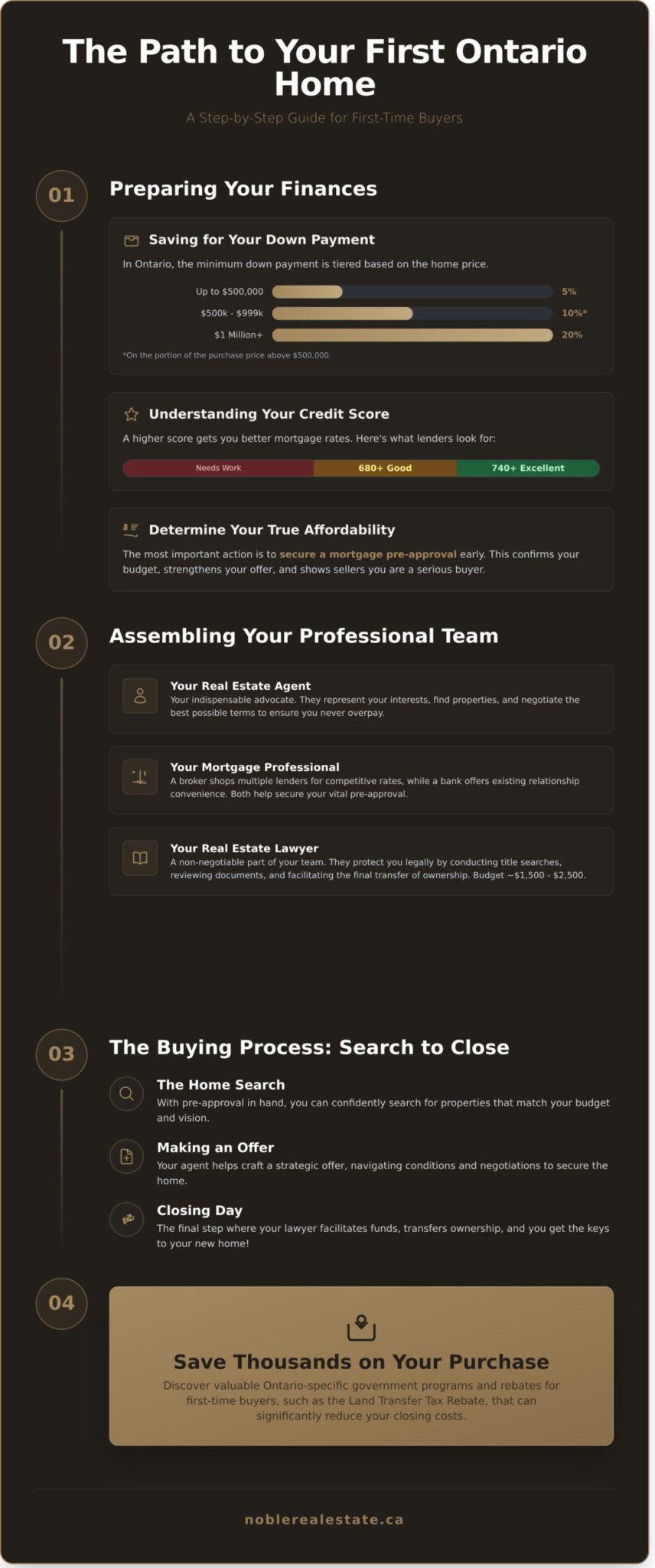
In Ontario, the minimum down payment is 5% on the first C$500,000 and 10% on the portion above, up to C$999,999. For homes over C$1 million, 20% is required. A down payment below 20% necessitates mortgage default insurance (e.g., CMHC), which is added to your mortgage. To accelerate savings, leverage the First Home Savings Account (FHSA) and automated transfers. A gifted down payment from immediate family is also a common and accepted source of funds, provided it is properly documented as a true gift.
Understanding and Improving Your Credit Score
Your credit score is critical for mortgage approval and securing a favourable interest rate. Lenders generally consider a score of 680 or higher to be good, with scores above 740 often accessing the best rates. Simple strategies to boost your score include paying bills on time, keeping credit card balances low, and avoiding new debt before applying. You can check your credit report for free annually from Equifax and TransUnion to review for any errors and monitor your progress.
Determining Your True Affordability
Go beyond online calculators. Lenders use specific debt service ratios (GDS/TDS) to determine what you can truly afford based on your income and existing debts. A key part of this is understanding housing affordability in Canada and your place within it. Always factor in closing costs and ongoing expenses like property taxes, utilities, and maintenance. The most important action in this first time home buyer ontario guide is to secure a mortgage pre-approval early; this confirms your budget and strengthens any offer you make.
Step 2: Assembling Your Professional Team
Purchasing your first home is a team sport, and you are the captain. Surrounding yourself with expert players is a foundational step in this first time home buyer ontario guide, ensuring a smooth, successful, and stress-free transaction. Your core team consists of a dedicated real estate agent, a knowledgeable mortgage professional, and a meticulous real estate lawyer. Choosing the right professionals doesn’t just make the process easier-it saves you time, protects your investment, and provides invaluable peace of mind. This is where The Noble Approach begins: with expert, dedicated guidance from day one.
Choosing the Right Real Estate Agent
For a first-time buyer, a dedicated buyer’s agent is your indispensable advocate. They represent your interests exclusively, from finding properties to negotiating the best possible terms. When interviewing potential realtors, ask about their experience with first-time buyers and their hyper-local expertise in areas like Uxbridge & the Durham Region. A great agent provides more than just listings; they offer strategic advice and act as your champion during negotiations, ensuring you never overpay.
Securing Your Mortgage: Broker vs. Bank
A mortgage pre-approval is your golden ticket in the Ontario market, showing sellers you’re a serious, qualified buyer. You can secure this through a bank or a mortgage broker. While a bank offers the convenience of an existing relationship, a broker shops your application to multiple lenders, often finding more competitive rates. To prepare, you’ll need key documents like proof of income and down payment verification. The Government of Canada’s home buying guide offers an excellent checklist. Understanding the difference between a secure fixed rate and a flexible variable rate is another crucial conversation to have with your chosen professional.
The Role of the Real Estate Lawyer
In Ontario, a real estate lawyer is a non-negotiable part of your team. Their role is to protect you legally. After your offer is accepted, your lawyer will conduct a title search to ensure the property is free of liens, review all legal documents, and facilitate the final transfer of funds and ownership on closing day. You should engage a lawyer as soon as you have an accepted agreement. Budget approximately $1,500 to $2,500 in legal fees for a standard purchase.
Step 3: The Home Search – Finding ‘The One’
This is the exciting phase where your financial preparation meets the market. With your mortgage pre-approval in hand, you can begin translating your vision into a tangible reality. This is a pivotal step in any first time home buyer ontario guide, but it requires a clear, strategic mindset. The Noble Approach ensures you can navigate this process with confidence, finding a property that isn’t just a house, but a home that truly fits your life.
Defining Your Needs vs. Wants
Before you start browsing, it’s crucial to create a practical property wishlist. The key is to distinguish between your absolute must-haves and the features that would be nice to have. For a comprehensive overview of the buying process, the Government of Canada’s Home Buying Guide provides an excellent framework. Start by listing your priorities:
- Non-Negotiables: These are your deal-breakers. Think about location (commute, schools, amenities), number of bedrooms and bathrooms, and essential features like a backyard or parking.
- Nice-to-Haves: These are desirable but not essential features, such as a renovated kitchen, a home office, or a finished basement.
Also, consider the different types of homes in Ontario-detached, semi, townhouse, or condo-and which style best suits your current and future needs.
How to Effectively Search for Listings
While online portals like Realtor.ca (MLS) are excellent starting points, your most powerful tool is your real estate agent. We provide access to exclusive listings and market insights you won’t find anywhere else. By setting up personalized alerts, you’ll be the first to know when a matching property hits the market. We also strongly recommend visiting potential neighbourhoods in person at different times of the day to get a true feel for the community’s character and lifestyle.
Making the Most of Property Viewings
When you tour a home, it’s important to look beyond the fresh paint and stylish staging. Pay close attention to the home’s core condition. Watch for red flags like signs of water damage (stains, musty odours), visible cracks in the foundation, or uneven floors. Take photos and detailed notes to compare properties objectively later. Most importantly, don’t be afraid to ask questions about the age of the roof, furnace, and windows. A prepared buyer is a confident buyer.
Step 4: Making an Offer and Negotiation
You’ve found the one. Now comes the most high-stakes and emotional part of the journey: making an offer. This is where a clear strategy and expert guidance are indispensable. This part of our first time home buyer ontario guide is designed to demystify the process, ensuring you feel confident and in control, not overwhelmed.
Crafting Your Offer
Your offer is more than just a price; it’s a comprehensive legal document called an Agreement of Purchase and Sale. The key elements include:
- Price: Determined by analyzing comparable recent sales to ensure you’re making a competitive, yet fair, offer.
- Deposit: A substantial deposit (typically held in trust) signals your commitment and financial stability to the seller.
- Closing Date: The day you officially take possession. Flexibility here can sometimes make your offer more attractive.
- Inclusions/Exclusions: Items you want included (like appliances) or excluded from the sale.
Your offer will also have an ‘irrevocable’ period-a deadline by which the seller must respond. We will structure this timeframe strategically to encourage a prompt reply.
Essential Conditions to Include
Conditions are clauses that protect you. For a first-time buyer, the most common and crucial conditions are:
- Financing Condition: Gives you time to secure your mortgage approval. If you can’t get financing, you can walk away with your deposit.
- Home Inspection Condition: Allows a professional to inspect the property for major issues, giving you an opportunity to renegotiate or withdraw your offer.
- Status Certificate Condition (for condos): Your lawyer will review the condo corporation’s financial health and legal status.
While a “firm” (unconditional) offer can be tempting in a hot market, it carries significant risks. We will carefully assess the situation to determine the most prudent path forward.
Navigating Negotiations and Bidding Wars
It’s common for a seller to issue a counter-offer, or you might find yourself in a multiple-offer “bidding war.” In these moments, emotion can run high. Our approach is to remain calm and analytical. We can make your offer stand out with a personal letter, a larger deposit, or a flexible closing date. Most importantly, we will help you establish a firm walk-away price before negotiations begin. Relying on your agent’s expertise is key to navigating this stress, ensuring you make a sound financial decision, not an emotional one.
Step 5: From Acceptance to Closing Day
Congratulations! Your offer has been accepted-a truly exciting milestone on your homeownership journey. Now, the focus shifts to the “conditional period,” a critical timeframe typically lasting 5-10 business days. This is your opportunity to perform due diligence and ensure all logistical and financial pieces fall perfectly into place. While it may seem complex, think of this period as the final, structured path to receiving your keys. With the right guidance, this process is both manageable and empowering.
The Home Inspection
A professional home inspection is your chance to get an unbiased assessment of the property’s condition. The inspector will evaluate major systems like the roof, foundation, plumbing, electrical, and HVAC. It’s highly recommended you attend the inspection to ask questions directly. The final report will detail any issues, allowing you to make an informed decision. Based on the findings, you can proceed confidently, negotiate for repairs, or, if a significant problem is found, walk away from the deal under your inspection condition.
Finalizing Your Mortgage and Insurance
Once your offer is accepted, you must immediately provide the signed Agreement of Purchase and Sale to your mortgage lender. They will order a property appraisal to confirm its value supports the loan amount. This is a standard step in their final approval process. Concurrently, you will need to arrange for home insurance, as proof of coverage is mandatory before your lender will release the mortgage funds. This part of our first time home buyer ontario guide is crucial; failing to secure financing can jeopardize the entire purchase.
Understanding Closing Costs
Beyond your down payment, you must budget for closing costs, which typically range from 1.5% to 4% of the home’s purchase price in Ontario. Your real estate lawyer is central to this process and will provide a final Statement of Adjustments outlining all expenses. Key costs include:
- Land Transfer Tax: A significant provincial tax (and municipal in Toronto).
- Legal Fees: Payment for your lawyer’s services in facilitating the title transfer.
- Title Insurance: Protects you against ownership challenges or property fraud.
- Other Adjustments: Reimbursements to the seller for prepaid property taxes or utility bills.
Navigating these final steps is where having a trusted advisor makes all the difference. For a seamless experience from acceptance to closing, consider The Noble Approach.
Step 6: Ontario-Specific Programs and Rebates
Congratulations on reaching the final step in your home buying journey! The government offers several powerful programs to make homeownership more accessible and affordable. Understanding how you can save thousands on taxes and access your savings is a critical part of a successful purchase. This section of our first time home buyer ontario guide breaks down the key financial incentives available, ensuring you take full advantage of every program you qualify for.
Ontario Land Transfer Tax (LTT) Rebate
When you purchase property in Ontario, you are required to pay a Land Transfer Tax (LTT) on closing day. This tax is calculated on a marginal basis, meaning the rate increases as the purchase price of the home goes up. Fortunately, first-time home buyers are eligible for a significant rebate of up to C$4,000. This rebate completely covers the LTT on homes valued up to C$368,333, providing substantial savings. It is crucial to note that if you are buying in the City of Toronto, you will also face a separate Municipal Land Transfer Tax (MLTT), which has its own first-time buyer rebate program.
Federal Programs: FHSA, HBP, and More
Beyond provincial rebates, the federal government provides several powerful tools designed to help you save for and purchase your first home. These programs are essential financial pillars for any first-time home buyer in Ontario.
- The First Home Savings Account (FHSA): A revolutionary savings tool that combines the best features of an RRSP and a TFSA. Your contributions are tax-deductible, and your withdrawals-including investment growth-are completely tax-free when used for a qualifying home purchase.
- The Home Buyers’ Plan (HBP): This long-standing program allows you to borrow up to C$60,000 (C$120,000 for a couple) from your own RRSP, tax-free, to use toward your down payment. You then have 15 years to repay the funds to your RRSP.
- The First-Time Home Buyers’ Tax Credit: A non-refundable federal tax credit that can provide up to C$1,500 in tax relief in the year you purchase your home. It’s a simple way to put money back in your pocket after closing.
- GST/HST New Housing Rebate: If you are purchasing a newly constructed home from a builder, this rebate allows you to recover a portion of the GST or the federal part of the HST paid on the home.
Navigating these programs and their eligibility requirements can feel complex, but it doesn’t have to be. The Noble Approach is designed to make this process straightforward, ensuring you maximize every available dollar. For personalized guidance on applying these incentives to your purchase, get in touch with our team today.
Embark on Your Home Buying Journey with Confidence
Becoming a homeowner in Ontario is an exciting and achievable milestone. By preparing your finances, assembling a professional team, and understanding the process from search to closing, you are building a strong foundation for success. This first time home buyer ontario guide is designed to empower you with the knowledge needed to make confident decisions every step of the way.
The journey is significant, but you don’t have to navigate it alone. At Noble Real Estate, we redefine the experience with ‘The Noble Approach’-a client-focused strategy designed to be stress-free. We bring our unique financial expertise as a CPA, CA and our deep, local knowledge of Uxbridge and the Durham Region to ensure your biggest investment is also your wisest. Ready to take the next step? Begin your home buying journey with a trusted advisor. Contact us today.
The keys to your first home are closer than you think.
Frequently Asked Questions About Buying Your First Home in Ontario
How much down payment do I really need for a house in Ontario?
In Ontario, the minimum down payment is tiered based on the home’s price. For properties under C$500,000, you need at least 5%. For homes between C$500,001 and C$999,999, it’s 5% on the first C$500,000 plus 10% on the remaining portion. Any home priced at C$1 million or more requires a minimum 20% down payment. If your down payment is less than 20%, you will also need to purchase mortgage default insurance.
What is the difference between a mortgage pre-qualification and a pre-approval?
A pre-qualification is a quick, informal estimate of your borrowing capacity based on self-reported financial data. In contrast, a pre-approval is a formal, in-depth assessment where a lender verifies your income, credit, and debt to offer a conditional commitment for a specific loan amount. Securing a pre-approval is a critical step that allows you to shop with confidence and make a credible offer in today’s competitive market, showing sellers you are a serious buyer.
How long does the entire home buying process typically take in Ontario?
The timeline can vary, but a typical home buying journey in Ontario takes between two to six months. The initial phase of getting pre-approved and actively searching for properties often lasts one to three months. Once your offer is accepted, the closing period-which involves finalizing financing, legal work, and transferring ownership-usually takes another 30 to 90 days. With expert guidance, this complex process can be managed efficiently and feel straightforward.
Can I buy a home in Ontario if I have a bad credit score?
While a lower credit score presents challenges, it does not automatically disqualify you from buying a home. You may face higher interest rates or be required to provide a larger down payment. We recommend working with a mortgage broker who specializes in these situations. Taking proactive steps to improve your credit score before applying will significantly strengthen your position and open up more favourable financing options for your future home.
What are the most common and costly mistakes first-time home buyers make?
One of the most common mistakes is underestimating the total expense by forgetting to budget for closing costs. Another is skipping a professional home inspection, which can lead to discovering expensive issues later. A key piece of advice in any first time home buyer ontario guide is to secure a mortgage pre-approval before viewing homes. This ensures you are looking at properties within your real budget and can make a strong, confident offer.
How much should I budget for closing costs on top of the purchase price?
A safe and practical estimate for closing costs in Ontario is between 1.5% and 4% of the home’s final purchase price. For a C$700,000 home, this could be between C$10,500 and C$28,000. These costs primarily include the Ontario Land Transfer Tax, legal fees, title insurance, and potential property appraisal fees. Budgeting for these expenses from the start ensures a smooth and stress-free closing day without any financial surprises.