


Looking For More Great Content?
Get even more informative Toronto real estate news sent directly to your inbox by signing up for my newsletter here. All it takes is a few easy clicks.

The True Cost of Selling a House in Ontario: A Complete 2026 Breakdown
02/23/26 Uncategorized

The final sold price of your home is an exciting number, but it isn’t the amount that lands in your bank account. Between real estate commissions, legal bills, and other potential expenses, understanding the true cost of selling a house in Ontario can feel overwhelming. This uncertainty often creates a sense of anxiety, making you question how much you will actually net from your most significant asset. The fear of hidden fees and unexpected charges can easily cast a shadow over what should be a positive and rewarding transition.
This is where clarity becomes your greatest advantage. We’ve created this complete 2026 breakdown to demystify the entire process for you. In this guide, we will walk you through every potential fee, from agent commissions to closing costs, providing a straightforward checklist so you can budget with confidence. Our goal is to empower you with comprehensive knowledge, ensuring there are no financial surprises on closing day. You’ll gain a clear, stress-free understanding of each expense, allowing you to accurately calculate your proceeds and move forward to your next chapter with peace of mind.
Key Takeaways
- Plan for your total selling costs to be between 1.5% and 6% of your home’s final sale price, with real estate commissions being the largest variable.
- Beyond agent commissions, you must budget for essential closing costs like legal fees and mortgage discharge penalties to avoid last-minute financial surprises.
- Certain pre-sale expenses, such as home staging and minor repairs, should be viewed as strategic investments that can significantly boost your final sale price.
- Understanding the complete cost of selling a house in Ontario becomes straightforward with a detailed breakdown, allowing you to accurately calculate your net proceeds.
The Big Picture: What to Expect for Seller Closing Costs in Ontario
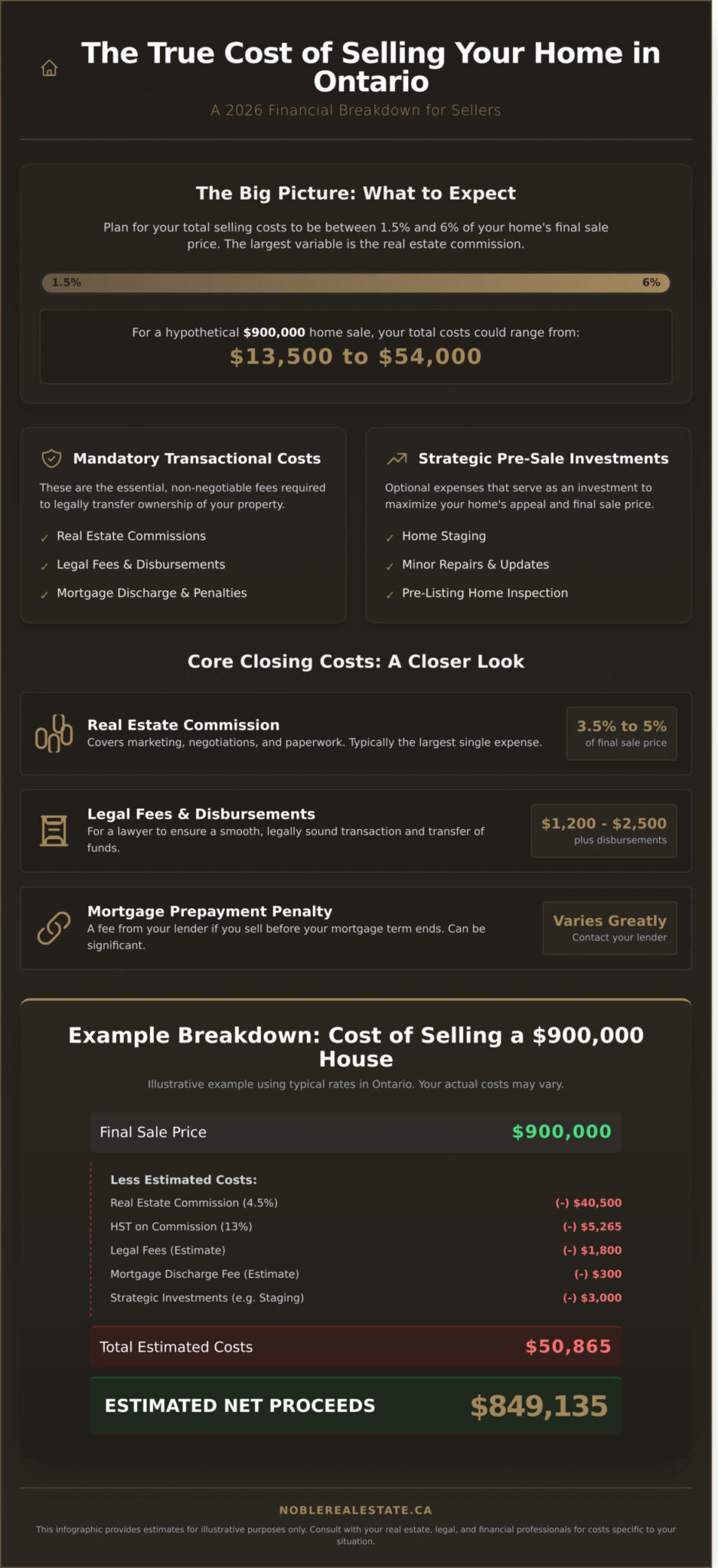
When planning your move, understanding the total cost of selling a house in Ontario is the critical first step. As a general guideline, sellers can expect to pay between 1.5% and 6% of their home’s final sale price in closing costs. The single largest variable in this range is typically the real estate commissions paid to the brokerages representing both the seller and the buyer.
To make this tangible, let’s use a running example. For a hypothetical C$900,000 home sale in Durham Region, your total costs could fall anywhere from C$13,500 to C$54,000. This variance depends entirely on the fees, services, and strategic decisions you make along the way. To simplify the process, we can group these expenses into two primary categories.
Mandatory Transactional Costs
These are the essential, non-negotiable fees required to legally transfer ownership of your property. They form the baseline for your selling expenses and are incurred in nearly every transaction. These costs primarily include:
- Real Estate Commissions: The fee paid for professional marketing, negotiation, and transaction management.
- Legal Fees: The cost for a real estate lawyer to handle title transfer, review documents, and disburse funds.
- Mortgage Penalties: Potential fees for breaking your mortgage term early.
Strategic Pre-Sale Investments
Unlike mandatory costs, these are optional expenses that serve as an investment to maximize your home’s appeal and final sale price. A well-planned investment here can generate a significant return, making the selling process both faster and more profitable. Common strategic investments include:
- Home Staging: Professionally furnishing and decorating your home to attract a wider pool of buyers.
- Minor Repairs & Updates: Addressing small issues like leaky faucets, fresh paint, or updated light fixtures.
- Pre-Listing Home Inspection: Identifying and fixing potential issues before buyers find them.
Core Closing Costs: The Non-Negotiable Fees
Understanding the core closing costs is the first step toward a transparent and stress-free home sale. These are the foundational expenses nearly every seller will encounter. While they represent a significant part of the total cost of selling a house in Ontario, planning for them early ensures there are no unwelcome surprises on closing day. Let’s break down these essential fees using our example of a C$900,000 home sale.
Real Estate Commission Explained
This is typically the largest single expense. In Ontario, commission rates generally range from 3.5% to 5% of the home’s final sale price. This fee is split between the seller’s agent (listing brokerage) and the buyer’s agent (co-operating brokerage). It compensates your real estate professional for a comprehensive suite of services, including strategic marketing, professional photography, hosting viewings, expert negotiation, and managing all the complex paperwork. While rates are negotiable, the structure of these fees has been a topic of discussion, leading to a government investigation into real estate commission rules to ensure fair competition. Think of it as the investment required to achieve the highest possible sale price for your property.
- Example: On a C$900,000 home, a 4.5% commission would be C$40,500 + HST.
Legal Fees and Disbursements
A real estate lawyer is an essential partner in ensuring a smooth and legally sound transaction. Their role is to protect your interests by reviewing all documents, performing a title search, preparing the statement of adjustments, and facilitating the secure transfer of funds. In Ontario, legal fees for a standard home sale typically range from C$1,200 to C$2,500, plus disbursements (third-party costs like couriers or registration fees). This fee is crucial for a seamless closing.
Mortgage Discharge and Prepayment Penalties
If you have an outstanding mortgage, this can be a significant and often overlooked cost. If you are selling before your mortgage term is up, your lender will likely charge a prepayment penalty. This is usually calculated as either three months’ interest or the Interest Rate Differential (IRD), whichever is greater. You will also pay a smaller discharge fee to remove the lender’s charge from your property’s title. We strongly advise contacting your lender as soon as you consider selling to get an accurate penalty figure.
Strategic Investments: Spending Money to Make Money
While discussing the cost of selling a house in Ontario, it’s crucial to shift your mindset from expenses to investments. Certain upfront costs are not just deductions from your bottom line; they are strategic choices designed to maximize your home’s appeal, attract higher offers, and expedite the sale. These are the decisions that separate a good sale from a great one, ensuring you achieve the highest possible return on your most valuable asset.
Home Staging and Minor Repairs
The primary goal of home staging is to help prospective buyers emotionally connect with the property and envision themselves living there. This can range from a simple decluttering and furniture rearrangement session for a few hundred dollars to a full professional staging for several thousand. The return on investment is consistently high, often resulting in a faster sale and a final offer that far exceeds the initial staging cost.
Pre-Listing Home Inspection
A proactive pre-listing inspection, typically costing between C$400 and C$600, is a powerful tool for building buyer confidence. By identifying potential issues beforehand, you eliminate surprises that could derail a deal at the last minute. This gives you the power to either address repairs on your own terms and timeline or disclose them upfront, creating a transparent and trustworthy transaction process for all parties.
Status Certificate (For Condominiums)
If you are selling a condominium in Ontario, obtaining a Status Certificate is a mandatory step. This vital document provides buyers with a comprehensive overview of the condo corporation’s financial and legal health. It details reserve fund status, by-laws, and any pending legal issues. The fee for this certificate is legally capped at C$100 (including HST), making it a small but essential part of the process.
Ultimately, these strategic investments are about maximizing your net proceeds. A higher sale price not only covers these costs but also provides a greater financial outcome, which is especially important when considering the full financial picture. For those selling a secondary or investment property, understanding the rules around Capital Gains Tax in Canada is another critical component of your financial planning. Every property is unique, and the right pre-sale strategy should be tailored to your specific goals. Let’s discuss a comprehensive plan for your home with The Noble Approach.
Other Potential Costs and Taxes to Keep in Mind
A successful home sale is one where there are no financial surprises. While we’ve covered the primary expenses, a few other potential costs and taxes can influence your final net proceeds. Understanding these variables is crucial for creating a complete budget and accurately calculating the total cost of selling a house in Ontario. Planning for these situations ensures a smooth and predictable financial outcome.
Capital Gains Tax (for non-principal residences)
First, it is essential to clarify that you do not pay capital gains tax on the sale of your principal residence in Canada. However, this tax does apply if you are selling a property that is not your primary home, such as a rental property, a second home, or a cottage. The calculation can be complex, so we always advise consulting with a financial professional, like a Chartered Professional Accountant (CPA), to understand your specific obligations.
Harmonized Sales Tax (HST)
Many sellers are surprised to learn that HST applies to the services rendered during their real estate transaction. While you do not pay HST on the sale price of a resale home, you are required to pay the 13% Ontario HST on services, including:
- Real estate commission
- Legal fees
- Home staging and professional photography fees
For example, on a C$50,000 commission, the HST would be an additional C$6,500. It’s a significant figure that must be factored into your budget from the start.
Moving and Utility Transfer Expenses
Though not technically a closing cost, the expenses associated with your physical move are a major part of your overall selling budget. These costs can vary widely but often include professional movers, storage unit rentals, utility transfer or setup fees with providers like hydro and gas, and mail forwarding services. We recommend getting quotes from moving companies early in the selling process to avoid last-minute stress.
Navigating these financial details is a core part of The Noble Approach. If you have questions about how the cost of selling a house in Ontario applies to your unique situation, we’re here to provide the clarity you deserve.
Example Breakdown: Cost of Selling a $900,000 House in Durham Region
To bring all these figures together, let’s walk through a practical, real-world scenario. Understanding the numbers is the first step toward a confident and successful sale. Here, we’ll break down the estimated costs for a home selling at $900,000 in Durham Region-a common price point for many beautiful properties in communities like Uxbridge, Whitby, and Pickering.
This example provides a clear and transparent look at where your money goes, helping you plan your next steps with precision.
Itemized Cost Calculation
While every sale is unique, this itemized list provides a realistic baseline for the typical cost of selling a house in Ontario. Note that HST (13%) is applicable to professional services like real estate commissions and legal fees.
- Sale Price: $900,000
- Real Estate Commission (4.5% + HST): ~$45,765
- Legal Fees & Disbursements ($1,800 + HST): ~$2,034
- Home Preparation (Optional Staging & Repairs): ~$3,500
- Total Estimated Selling Costs: ~$51,299
Calculating Your Estimated Net Proceeds
Your net proceeds are the funds you will have in hand after all expenses and outstanding loans are settled. This is the number that truly matters for your next chapter, whether you’re upsizing, downsizing, or investing. The calculation is straightforward:
Sale Price: $900,000
Less: Remaining Mortgage Balance (Example): ($400,000)
Less: Total Estimated Selling Costs: ($51,299)
Estimated Net Proceeds: $448,701
This breakdown shows that with a clear financial picture, the outcome of your sale can be predictable and stress-free. The true value of a professional advisor lies not just in marketing your home, but in providing the financial clarity you need to make informed decisions. This is the foundation of The Noble Approach. If you’re considering a move and want a detailed net sheet specific to your property, we invite you to connect with us for a confidential consultation.
Navigating Your Sale with Financial Clarity
As we’ve detailed, understanding the true cost of selling a house in Ontario is about more than just the commission rate. From non-negotiable legal fees to strategic investments in staging and repairs, each expense plays a vital role in determining your final net proceeds. Having a clear financial picture from the outset is the foundation of a successful, stress-free transaction.
You don’t have to navigate these complexities alone. With The Noble Approach, you benefit from expert guidance rooted in deep, localized knowledge of the Uxbridge and Durham Region market. Our unique advantage-a realtor with a CPA, CA background-means every decision is guided by a proven strategy designed to maximize your bottom line. We provide the financial acumen to ensure you feel confident and in control every step of the way.
Ready to understand your home’s value and potential selling costs? Request a complimentary, no-obligation home valuation today. Let’s make your next move your most profitable one yet.
Frequently Asked Questions
Can you negotiate the real estate commission rate in Ontario?
Yes, real estate commission rates in Ontario are negotiable. This is a critical discussion to have with your agent before signing a listing agreement. The total commission is typically split between the seller’s and buyer’s brokerages. We believe in transparently outlining our full-service approach and the value we provide, ensuring the commission structure aligns with your financial goals and our commitment to achieving a successful, stress-free sale for your home.
Who pays the Land Transfer Tax when a house is sold in Ontario, the buyer or the seller?
In Ontario, the Land Transfer Tax (LTT) is the responsibility of the buyer, not the seller. This tax is calculated based on the home’s purchase price and is due upon closing when the property title officially transfers to the new owner. As the seller, you can be confident that this is one significant closing cost you will not have to factor into your budget. Your lawyer will ensure all financial obligations are correctly handled during the closing process.
Do I absolutely need a lawyer to sell my house in Ontario?
Yes, retaining a real estate lawyer is a mandatory and essential part of selling a property in Ontario. Your lawyer is there to protect your legal and financial interests. They handle critical tasks like reviewing the agreement of purchase and sale, managing the funds in trust, paying off your existing mortgage from the sale proceeds, and ensuring the clean transfer of the property title. Their expertise provides crucial peace of mind for a smooth and secure transaction.
What are the most effective ways to reduce my home selling costs?
Effectively managing the cost of selling a house in Ontario involves several key strategies. Pricing your home accurately from the outset can prevent costly price reductions and extended time on the market. Additionally, focusing on high-impact preparations like deep cleaning, decluttering, and minor repairs often yields a better return than expensive renovations. A well-planned marketing and negotiation strategy is also essential to ensure you secure the highest possible price for your property.
When exactly do I pay all these costs associated with selling my house?
The timing of payments varies. Some costs, such as for home staging or pre-listing repairs, are typically paid upfront before your home is on the market. However, the majority of your expenses, including real estate commissions and legal fees, are conveniently paid on the closing day. Your lawyer will deduct these amounts directly from the sale proceeds provided by the buyer before transferring the final net amount to you, simplifying the entire process.
Does the government tax the sale of my primary home in Canada?
For most Canadians, the profit from selling their primary home is tax-free. This is thanks to the Principal Residence Exemption (PRE) offered by the Canada Revenue Agency (CRA). To qualify, the property must be a home that you ordinarily inhabited. While this is a significant financial benefit, there are specific rules that apply, particularly if you have owned more than one property. We always advise consulting with a tax professional to confirm your eligibility.