



Looking For More Great Content?
Get even more informative Toronto real estate news sent directly to your inbox by signing up for my newsletter here. All it takes is a few easy clicks.

What Are Closing Costs for a Seller in Ontario? A 2026 Strategic Guide
05/6/26 Uncategorized
What if the offer price on your contract is actually the least important number in your home sale? It’s completely natural to feel a sense of unease as you approach your closing date, especially when you need to know exactly what are closing costs for seller in ontario to plan your next move. You’ve navigated a 2026 buyer’s market where active listings sit 49.2% above the 10-year average, and now the fear of unexpected fees or confusing HST applications is starting to set in. You deserve to know exactly how much will land in your bank account once the transaction is complete.
We believe the financial exit should be as straightforward and stress-free as the initial listing. This strategic guide will transform your uncertainty into a clear financial roadmap, providing the analytical rigour you need to maximize your net proceeds. We’ll provide a transparent breakdown of everything from the 13% HST on commissions to legal fees that typically range from $900 to $2,500. You’re about to master the final strategic hurdles of your sale with the confidence of a seasoned professional and the clarity of The Noble Approach.
Key Takeaways
- Learn why your gross sale price isn’t your final check and how to accurately define your net proceeds.
- Master the details of what are closing costs for seller in ontario, including the 13% HST applied to commissions and legal services.
- Identify hidden expenses like mortgage discharge fees and prepayment penalties. These often catch sellers off guard but don’t have to.
- Use a structured, CPA-led approach to calculate your final walk-away amount so you can plan your next move with total confidence.
What Are Seller Closing Costs in Ontario? The Big Picture
Selling a home involves far more than just finding a buyer and signing a contract. To truly understand The Big Picture, you have to look past the initial sale price. Seller closing costs are the total sum of fees, taxes, and adjustments required to legally and financially finalize the transfer of your property. For most homeowners, understanding what are closing costs for seller in ontario is the difference between a stressful surprise and a successful, predictable transition.
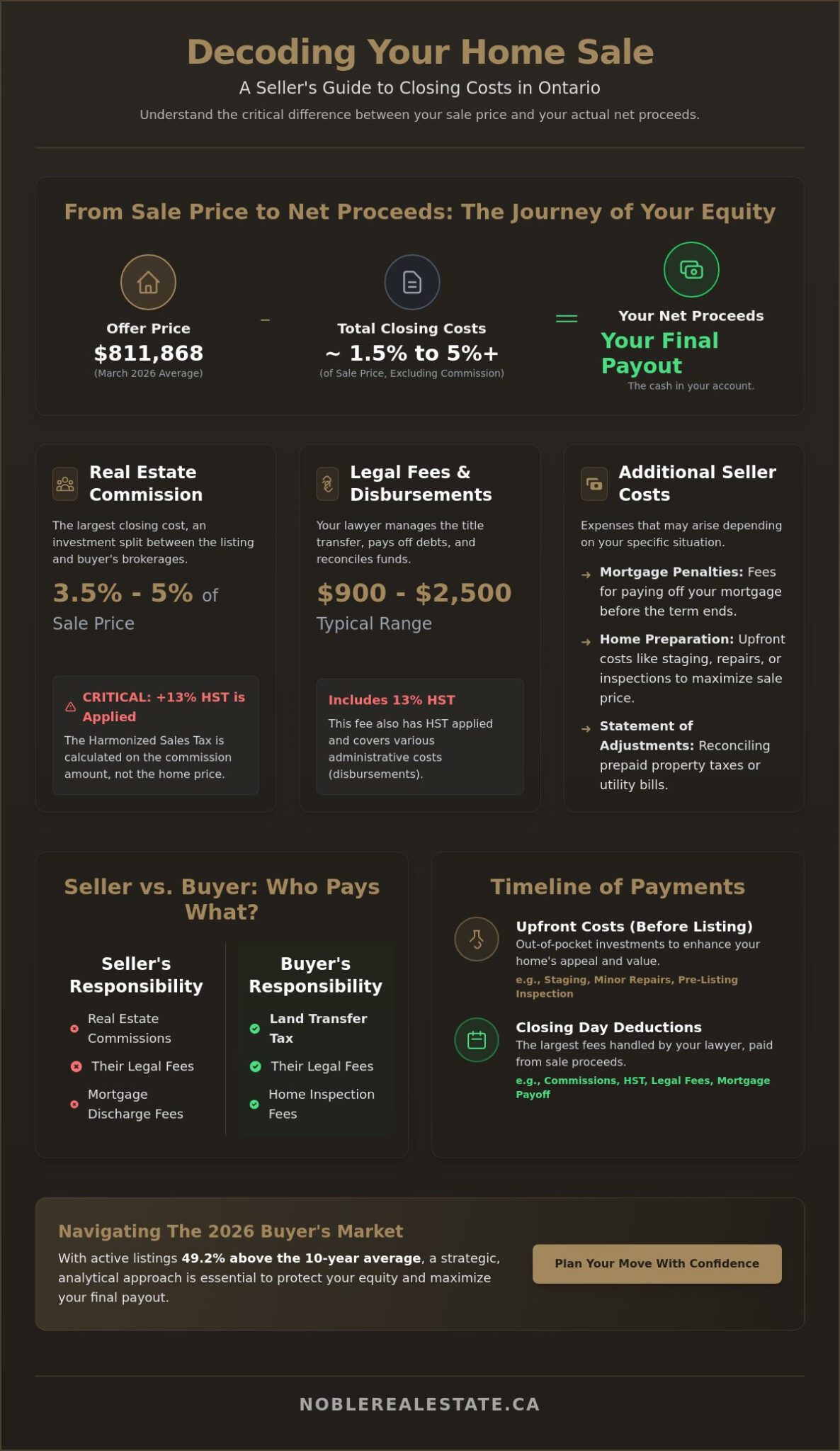
The most critical figure in your transaction isn’t the number on the “For Sale” sign; it’s your net proceeds. This represents the actual amount of money that stays in your pocket after every obligation is settled. In 2026, Ontario sellers typically expect these additional costs to range from 1.5% to 5% of the sale price, which is separate from the real estate commission. Your real estate lawyer acts as the central hub for these funds, managing the disbursements and ensuring that every party, from the municipality to the lender, is paid correctly and on time.
Seller vs. Buyer Costs: Who Pays What?
One of the biggest reliefs for sellers is realizing they don’t pay the Land Transfer Tax. In Ontario, that significant expense falls entirely on the buyer. However, the seller carries the weight of the real estate commissions and the administrative costs of discharging any existing mortgages. Providing total transparency regarding these obligations is a cornerstone of The Noble Approach. We believe that by removing the mystery around these figures, we can create a more predictable and enjoyable selling experience for our clients in Uxbridge and the surrounding areas. Our background in finance ensures that we look at your sale through an analytical lens, helping you protect your equity at every turn.
The Timeline of Payments
Not all costs hit your bank account at the same time. Some are investments made to secure a higher sale price, while others are purely administrative. Understanding this sequence helps you manage your cash flow throughout the process. The closing date is the moment equity transforms into liquid capital. Here is how the timing usually breaks down:
- Upfront Costs: Expenses like professional staging, minor home repairs, and pre-listing inspections are paid out of pocket before the home hits the market.
- Closing Day Deductions: The largest expenses, such as real estate commissions, 13% HST on services, and legal fees ranging from $900 to $2,500, are handled at the lawyer’s office.
- The Statement of Adjustments: This is where your lawyer reconciles prepaid items like property taxes or utility bills, ensuring you’re only responsible for costs up to the exact minute of the transfer.
Because these major fees are typically deducted directly from the sale proceeds, you don’t need to write a separate check on closing day. This structured, logical flow is designed to build confidence, answering your financial questions before they even arise.
Real Estate Commissions and HST: Navigating the Largest Expense
In the Durham Region and Uxbridge markets, the real estate commission is typically the most significant line item when calculating what are closing costs for seller in ontario. Rather than viewing this as a single fee, it’s more accurate to see it as a strategic investment split between two distinct parties. The total commission, which as of April 2026 generally ranges from 3.5% to 5% of the sale price, is divided between the listing brokerage representing you and the cooperating brokerage that brings the qualified buyer. This split ensures your home receives maximum exposure and incentivizes the entire brokerage community to prioritize your listing.
The most common oversight sellers make is forgetting the Harmonized Sales Tax (HST). In Ontario, the 13% HST is applied to the commission, not just the sale price. For example, if your home sells for the March 2026 average price of $811,868 at a 5% commission, the base fee is approximately $40,593. However, the 13% HST adds another $5,277 to that total. These funds don’t stay with the brokerage; they are a non-negotiable flow-through to the government. We believe that clarity in these numbers is vital for a stress-free experience, allowing you to plan your next move with total financial certainty.
It’s also important to recognize the “Value Gap” between different service models. While discount brokerages might offer lower upfront percentages, they often lack the comprehensive marketing and negotiation expertise required to drive the highest possible sale price. In a 2026 market where inventory levels are 49.2% above the 10-year average, professional representation is what differentiates a property that sits from one that sells. A “saving” of 1% in commission is a poor trade if it results in a 5% lower final sale price because of inadequate exposure or weak negotiation.
The Impact of HST on Your Bottom Line
To put the tax implications into perspective, consider a home sold for $1,000,000. A 5% commission equals $50,000, but the total amount deducted at the lawyer’s office will be $56,500 once the 13% HST is included. This $6,500 difference is a significant factor in your final walk-away amount. Ensuring your professional home valuation accounts for these tax realities is a key step in The Noble Approach to financial planning.
Commission Structures in 2026
Sellers today can often choose between fixed-rate or graduated commission models. A full-service approach includes professional staging, high-end photography, and a CPA-led analytical review of every offer to ensure you’re protected. When you review your Legal Fees and the Statement of Adjustments later in the process, you’ll see these commissions clearly itemized. Our goal is to ensure that every dollar of commission paid yields a disproportionately higher return in your final net proceeds. If you’re curious about how these numbers apply to your specific property, you can always get in touch for a personalized equity analysis.
Legal Fees and the Statement of Adjustments
While commissions represent the largest percentage of your expenses, your legal fees are the administrative glue that holds the financial transaction together. For a standard residential sale in Ontario in 2026, you should expect legal fees to range between $900 and $2,500. This isn’t just a fee for a lawyer’s time; it covers the complex work required to transfer title and settle accounts. Gaining a clear view of these figures is a vital part of knowing what are closing costs for seller in ontario so you don’t face any surprises on your final day of ownership.
Beyond the base fee, your final bill will include “disbursements.” These are out-of-pocket expenses your lawyer pays on your behalf. They typically include title searches, specialized software fees for secure document transmission, and courier costs. In Durham Region, choosing a local Uxbridge lawyer provides a distinct strategic advantage. They understand the specific nuances of our community, from local municipal requirements to the unique boundary complexities often found in rural properties. This local expertise ensures that the “analytical rigour” we value in The Noble Approach is applied to every legal document.
Property Tax and Utility Adjustments
The Statement of Adjustments serves as the final balance sheet of your home sale. It reconciles everything you’ve already paid versus what the buyer owes you as of the closing date. If you’ve prepaid your property taxes for the entire year, the buyer will credit you for the portion of the year they will own the home. In rural areas like Uxbridge, we frequently see adjustments for fuel oil or propane tanks. Your lawyer ensures the buyer pays you back for the value of the fuel remaining in the tank on closing day. This credit system ensures the financial split is fair to the penny, protecting your equity until the very last moment.
The Lawyer’s Role in Debt Discharge
Your lawyer ensures that your home’s title is delivered “clean” to the buyer. This means they are responsible for paying off your existing mortgage, clearing any outstanding liens, and settling any debts registered against the property. They also handle the distribution of real estate commissions from the trust account directly. The lawyer acts as the financial gatekeeper for the transaction. By managing these flow-through costs, they protect your legal interests and ensure the remaining net proceeds are transferred securely to your account. This structured, logical process is designed to give you peace of mind that your financial exit is being handled by a consummate professional.
Hidden Costs: Mortgage Penalties and Home Preparation
While we’ve covered the standard fees, the “hidden” expenses often generate the most anxiety for homeowners. Understanding what are closing costs for seller in ontario requires looking closely at your mortgage agreement and your property’s specific type. For instance, lenders in Ontario charge a mortgage discharge fee, which as of May 2026 typically ranges from $100 to over $400. This is purely an administrative cost for the bank to remove their lien from your title. If you’re selling a townhouse or condo in Uxbridge, you may also need to pay for a Status Certificate, which usually costs approximately $100 plus tax.
These secondary costs don’t have to be a source of stress. By identifying them early, we can incorporate them into your total financial plan. Our goal is to ensure your transition is straightforward, providing the analytical rigour necessary to protect your equity from being eroded by overlooked line items.
Calculating Potential Mortgage Penalties
The most significant hidden cost is often the prepayment penalty. If you break your mortgage term early, banks calculate your penalty using either three months of interest or the Interest Rate Differential (IRD). The IRD can be substantial, sometimes reaching tens of thousands of dollars depending on your remaining term and current market rates. We recommend requesting a formal payout statement from your lender as soon as you consider listing. A common strategy to mitigate these costs is porting your mortgage to your next property, which is a frequent conversation when buying a home in Uxbridge. The Noble Approach involves forecasting these penalties early in the process, ensuring you aren’t blindsided at the lawyer’s office.
The ROI of Home Preparation
Home preparation is a “pre-closing” cost that directly impacts your final net proceeds. In the 2026 market, where inventory levels are 49.2% above the 10-year average, professional staging isn’t just an expense; it’s a strategic move to stand out. While staging and minor repairs require upfront capital, they typically yield a sale price increase that far exceeds the initial investment. Some sellers also choose to pay for a pre-listing home inspection. This investment can prevent buyers from negotiating large credits for “unseen” issues later. Finally, don’t forget to budget for moving costs. Whether you’re staying in Durham Region or moving further away, professional movers for a standard family home represent a final transition cost that belongs in your budget.
By identifying these costs today, you can maintain total control over your financial exit. If you want a comprehensive look at your specific situation, book a complimentary home valuation with our team to see your true potential net proceeds.
Calculating Your Net Proceeds: The Noble Approach
After reviewing the commissions, legal fees, and potential mortgage penalties, the final step is consolidating these figures into a single, reliable number. Knowing what are closing costs for seller in ontario is only half the battle; the other half is applying that knowledge to your specific financial situation. While many online tools offer automated estimates, they often lack the human oversight needed to account for the nuances of your unique property or mortgage structure. This is where a structured, manual calculation ensures you aren’t surprised on the day of your move.
To calculate your net proceeds, start with your expected sale price. Subtract the real estate commission and the 13% HST. Next, deduct your current mortgage balance, any prepayment penalties, and the discharge fee. Finally, subtract your legal fees and any adjustments for property taxes or utilities. This process transforms a complex real estate transaction into a clear balance sheet. Once the “Sold” sign comes down and the paperwork is finalized at the lawyer’s office, these net proceeds are typically transferred to your bank account within 24 to 48 hours of the closing date. This structured, logical flow is designed to build confidence at every step.
The Noble Approach to Financial Clarity
Colin Noble’s background as a CA/CPA provides a level of analytical rigour that redefines expectations for real estate service. We don’t just list homes; we manage a significant financial asset. This professional expertise allows us to forecast your net proceeds with a precision that reduces the “stress-factor” significantly. By providing a transparent, line-by-line breakdown of every possible expense, we ensure you have the confidence to make informed decisions about your future. It’s about combining professional expertise with a personal, client-centric approach that makes the entire process feel straightforward. We believe that your real estate goals are achievable when handled with the utmost care.
Your Next Move in Durham Region
Managing the financial bridge between selling your current home and moving into the next requires local expertise. Whether you’re staying in Uxbridge or exploring the surrounding areas, the timing of your net proceeds is crucial for your next down payment. Our end-to-end approach ensures that your financial exit is handled with the same care as your initial listing. We ground our business in the community we serve, ensuring you feel like a partner rather than just another transaction. If you’re ready to move forward with total clarity, we invite you to redefine your expectations and get a professional net proceeds analysis today. Let’s ensure your real estate journey is both successful and enjoyable.
Redefine Your Expectations for a Successful Sale
Mastering the financial side of your home sale is the final step in a successful real estate journey. By understanding exactly what are closing costs for seller in ontario, you’ve moved from uncertainty to total control. We’ve explored how legal fees, commission taxes, and mortgage discharge administrative costs impact your final check. This knowledge ensures that the 2026 market inventory levels, sitting at 49.2% above the 10-year average, don’t stand in the way of your financial goals.
Your home is likely your largest investment; it deserves the analytical rigour of a seasoned professional. Led by Colin Noble, a CPA and CA, our team brings a unique financial perspective to every transaction in Uxbridge and the Durham Region. We invite you to Get a Professional Home Valuation and Net Proceeds Analysis to see exactly how we can make your exit stress-free and straightforward. The Noble Approach is built on transparency and deep local expertise, ensuring your next chapter starts on the strongest possible financial footing. You’ve done the research. Now let’s put the plan into action.
Frequently Asked Questions
Do I have to pay Land Transfer Tax when I sell my house in Ontario?
No, sellers in Ontario do not pay Land Transfer Tax. This is a buyer’s obligation and represents a significant portion of their closing costs. As a seller, your primary financial focus should be on commissions, legal fees, and mortgage adjustments rather than provincial or municipal transfer taxes. This distinction is one of the most common points of confusion we clarify for our clients across the Durham Region.
How much are typical legal fees for a home seller in Ontario in 2026?
Legal fees for a standard residential sale typically range from $900 to $2,500. This amount covers the lawyer’s professional services and essential disbursements like title searches or courier fees. These fees are a core component of what are closing costs for seller in ontario, and choosing a local Uxbridge lawyer ensures your transaction complies with Durham Region’s specific municipal requirements and local bylaws.
Is HST charged on real estate commissions in Ontario?
Yes, the 13% Harmonized Sales Tax (HST) is applied to all real estate commissions and legal services in Ontario. This tax is calculated on top of the negotiated commission rate, not on the total sale price of the home. It is a mandatory payment that your lawyer will deduct from your sale proceeds and flow through to the government. We always factor this tax into our analytical net proceeds calculations.
What is a Statement of Adjustments and why is it important?
The Statement of Adjustments is a financial balance sheet that ensures you only pay for property expenses up to the exact day of the sale. It reconciles items like prepaid property taxes or utility bills between you and the buyer. This document is vital because it protects your equity, ensuring you receive a credit for any costs you paid in advance for the period after the closing date. It’s a key part of our stress-free methodology.
Can I avoid mortgage prepayment penalties when selling?
You can often avoid these penalties by porting your existing mortgage to your next property. This strategy allows you to transfer your current interest rate and terms to a new home in Uxbridge or elsewhere, preventing the bank from charging IRD or three-month interest penalties. It is a common way to reduce what are closing costs for seller in ontario when transitioning between residences. Always request a payout statement from your lender early to confirm your options.
Who pays the real estate commission in Ontario, the buyer or the seller?
The seller is responsible for paying the total real estate commission in Ontario. This fee is typically deducted from the sale proceeds at the lawyer’s office and then split between the listing brokerage and the buyer’s brokerage. This structure ensures your property gets the widest possible exposure to qualified buyers without the buyer needing to pay their agent out of pocket. It’s a standard practice that incentivizes the entire real estate community to show your home.
What happens if I have outstanding property taxes at the time of sale?
If you have unpaid property taxes, your real estate lawyer will pay them on your behalf using the proceeds from the sale. This ensures the buyer receives a clear title free of any municipal liens. The lawyer will calculate the exact amount owed up to the closing date, ensuring the transaction is mathematically accurate and legally sound. This process happens automatically at the lawyer’s office, ensuring a straightforward transition for all parties involved.
Are home staging costs tax-deductible for residential sellers?
Home staging costs are generally not tax-deductible if you are selling your primary residence in Ontario. However, if you are selling an investment property, these expenses may be used to reduce your capital gains tax liability. Because staging can directly impact your final net proceeds, we recommend consulting with a CPA to understand the specific tax implications for your unique situation. Our team provides the financial rigour needed to analyze these costs against your potential return.

What if the offer price on your contract is actually the least important number in your home sale? It’s completely natural to feel a sense of unease as you approach your closing date, especially when you need to know exactly what are closing costs for seller in ontario to plan your next move. You’ve navigated a 2026 buyer’s market where active listings sit 49.2% above the 10-year average, and now the fear of unexpected fees or confusing HST applications is starting to set in. You deserve to know exactly how much will land in your bank account once the transaction is complete.
We believe the financial exit should be as straightforward and stress-free as the initial listing. This strategic guide will transform your uncertainty into a clear financial roadmap, providing the analytical rigour you need to maximize your net proceeds. We’ll provide a transparent breakdown of everything from the 13% HST on commissions to legal fees that typically range from $900 to $2,500. You’re about to master the final strategic hurdles of your sale with the confidence of a seasoned professional and the clarity of The Noble Approach.
Key Takeaways
- Learn why your gross sale price isn’t your final check and how to accurately define your net proceeds.
- Master the details of what are closing costs for seller in ontario, including the 13% HST applied to commissions and legal services.
- Identify hidden expenses like mortgage discharge fees and prepayment penalties. These often catch sellers off guard but don’t have to.
- Use a structured, CPA-led approach to calculate your final walk-away amount so you can plan your next move with total confidence.
What Are Seller Closing Costs in Ontario? The Big Picture
Selling a home involves far more than just finding a buyer and signing a contract. To truly understand The Big Picture, you have to look past the initial sale price. Seller closing costs are the total sum of fees, taxes, and adjustments required to legally and financially finalize the transfer of your property. For most homeowners, understanding what are closing costs for seller in ontario is the difference between a stressful surprise and a successful, predictable transition.
The most critical figure in your transaction isn’t the number on the “For Sale” sign; it’s your net proceeds. This represents the actual amount of money that stays in your pocket after every obligation is settled. In 2026, Ontario sellers typically expect these additional costs to range from 1.5% to 5% of the sale price, which is separate from the real estate commission. Your real estate lawyer acts as the central hub for these funds, managing the disbursements and ensuring that every party, from the municipality to the lender, is paid correctly and on time.
Seller vs. Buyer Costs: Who Pays What?
One of the biggest reliefs for sellers is realizing they don’t pay the Land Transfer Tax. In Ontario, that significant expense falls entirely on the buyer. However, the seller carries the weight of the real estate commissions and the administrative costs of discharging any existing mortgages. Providing total transparency regarding these obligations is a cornerstone of The Noble Approach. We believe that by removing the mystery around these figures, we can create a more predictable and enjoyable selling experience for our clients in Uxbridge and the surrounding areas. Our background in finance ensures that we look at your sale through an analytical lens, helping you protect your equity at every turn.
The Timeline of Payments
Not all costs hit your bank account at the same time. Some are investments made to secure a higher sale price, while others are purely administrative. Understanding this sequence helps you manage your cash flow throughout the process. The closing date is the moment equity transforms into liquid capital. Here is how the timing usually breaks down:
- Upfront Costs: Expenses like professional staging, minor home repairs, and pre-listing inspections are paid out of pocket before the home hits the market.
- Closing Day Deductions: The largest expenses, such as real estate commissions, 13% HST on services, and legal fees ranging from $900 to $2,500, are handled at the lawyer’s office.
- The Statement of Adjustments: This is where your lawyer reconciles prepaid items like property taxes or utility bills, ensuring you’re only responsible for costs up to the exact minute of the transfer.
Because these major fees are typically deducted directly from the sale proceeds, you don’t need to write a separate check on closing day. This structured, logical flow is designed to build confidence, answering your financial questions before they even arise.
Real Estate Commissions and HST: Navigating the Largest Expense
In the Durham Region and Uxbridge markets, the real estate commission is typically the most significant line item when calculating what are closing costs for seller in ontario. Rather than viewing this as a single fee, it’s more accurate to see it as a strategic investment split between two distinct parties. The total commission, which as of April 2026 generally ranges from 3.5% to 5% of the sale price, is divided between the listing brokerage representing you and the cooperating brokerage that brings the qualified buyer. This split ensures your home receives maximum exposure and incentivizes the entire brokerage community to prioritize your listing.
The most common oversight sellers make is forgetting the Harmonized Sales Tax (HST). In Ontario, the 13% HST is applied to the commission, not just the sale price. For example, if your home sells for the March 2026 average price of $811,868 at a 5% commission, the base fee is approximately $40,593. However, the 13% HST adds another $5,277 to that total. These funds don’t stay with the brokerage; they are a non-negotiable flow-through to the government. We believe that clarity in these numbers is vital for a stress-free experience, allowing you to plan your next move with total financial certainty.
It’s also important to recognize the “Value Gap” between different service models. While discount brokerages might offer lower upfront percentages, they often lack the comprehensive marketing and negotiation expertise required to drive the highest possible sale price. In a 2026 market where inventory levels are 49.2% above the 10-year average, professional representation is what differentiates a property that sits from one that sells. A “saving” of 1% in commission is a poor trade if it results in a 5% lower final sale price because of inadequate exposure or weak negotiation.
The Impact of HST on Your Bottom Line
To put the tax implications into perspective, consider a home sold for $1,000,000. A 5% commission equals $50,000, but the total amount deducted at the lawyer’s office will be $56,500 once the 13% HST is included. This $6,500 difference is a significant factor in your final walk-away amount. Ensuring your professional home valuation accounts for these tax realities is a key step in The Noble Approach to financial planning.
Commission Structures in 2026
Sellers today can often choose between fixed-rate or graduated commission models. A full-service approach includes professional staging, high-end photography, and a CPA-led analytical review of every offer to ensure you’re protected. When you review your Legal Fees and the Statement of Adjustments later in the process, you’ll see these commissions clearly itemized. Our goal is to ensure that every dollar of commission paid yields a disproportionately higher return in your final net proceeds. If you’re curious about how these numbers apply to your specific property, you can always get in touch for a personalized equity analysis.
Legal Fees and the Statement of Adjustments
While commissions represent the largest percentage of your expenses, your legal fees are the administrative glue that holds the financial transaction together. For a standard residential sale in Ontario in 2026, you should expect legal fees to range between $900 and $2,500. This isn’t just a fee for a lawyer’s time; it covers the complex work required to transfer title and settle accounts. Gaining a clear view of these figures is a vital part of knowing what are closing costs for seller in ontario so you don’t face any surprises on your final day of ownership.
Beyond the base fee, your final bill will include “disbursements.” These are out-of-pocket expenses your lawyer pays on your behalf. They typically include title searches, specialized software fees for secure document transmission, and courier costs. In Durham Region, choosing a local Uxbridge lawyer provides a distinct strategic advantage. They understand the specific nuances of our community, from local municipal requirements to the unique boundary complexities often found in rural properties. This local expertise ensures that the “analytical rigour” we value in The Noble Approach is applied to every legal document.
Property Tax and Utility Adjustments
The Statement of Adjustments serves as the final balance sheet of your home sale. It reconciles everything you’ve already paid versus what the buyer owes you as of the closing date. If you’ve prepaid your property taxes for the entire year, the buyer will credit you for the portion of the year they will own the home. In rural areas like Uxbridge, we frequently see adjustments for fuel oil or propane tanks. Your lawyer ensures the buyer pays you back for the value of the fuel remaining in the tank on closing day. This credit system ensures the financial split is fair to the penny, protecting your equity until the very last moment.
The Lawyer’s Role in Debt Discharge
Your lawyer ensures that your home’s title is delivered “clean” to the buyer. This means they are responsible for paying off your existing mortgage, clearing any outstanding liens, and settling any debts registered against the property. They also handle the distribution of real estate commissions from the trust account directly. The lawyer acts as the financial gatekeeper for the transaction. By managing these flow-through costs, they protect your legal interests and ensure the remaining net proceeds are transferred securely to your account. This structured, logical process is designed to give you peace of mind that your financial exit is being handled by a consummate professional.
Hidden Costs: Mortgage Penalties and Home Preparation
While we’ve covered the standard fees, the “hidden” expenses often generate the most anxiety for homeowners. Understanding what are closing costs for seller in ontario requires looking closely at your mortgage agreement and your property’s specific type. For instance, lenders in Ontario charge a mortgage discharge fee, which as of May 2026 typically ranges from $100 to over $400. This is purely an administrative cost for the bank to remove their lien from your title. If you’re selling a townhouse or condo in Uxbridge, you may also need to pay for a Status Certificate, which usually costs approximately $100 plus tax.
These secondary costs don’t have to be a source of stress. By identifying them early, we can incorporate them into your total financial plan. Our goal is to ensure your transition is straightforward, providing the analytical rigour necessary to protect your equity from being eroded by overlooked line items.
Calculating Potential Mortgage Penalties
The most significant hidden cost is often the prepayment penalty. If you break your mortgage term early, banks calculate your penalty using either three months of interest or the Interest Rate Differential (IRD). The IRD can be substantial, sometimes reaching tens of thousands of dollars depending on your remaining term and current market rates. We recommend requesting a formal payout statement from your lender as soon as you consider listing. A common strategy to mitigate these costs is porting your mortgage to your next property, which is a frequent conversation when buying a home in Uxbridge. The Noble Approach involves forecasting these penalties early in the process, ensuring you aren’t blindsided at the lawyer’s office.
The ROI of Home Preparation
Home preparation is a “pre-closing” cost that directly impacts your final net proceeds. In the 2026 market, where inventory levels are 49.2% above the 10-year average, professional staging isn’t just an expense; it’s a strategic move to stand out. While staging and minor repairs require upfront capital, they typically yield a sale price increase that far exceeds the initial investment. Some sellers also choose to pay for a pre-listing home inspection. This investment can prevent buyers from negotiating large credits for “unseen” issues later. Finally, don’t forget to budget for moving costs. Whether you’re staying in Durham Region or moving further away, professional movers for a standard family home represent a final transition cost that belongs in your budget.
By identifying these costs today, you can maintain total control over your financial exit. If you want a comprehensive look at your specific situation, book a complimentary home valuation with our team to see your true potential net proceeds.
Calculating Your Net Proceeds: The Noble Approach
After reviewing the commissions, legal fees, and potential mortgage penalties, the final step is consolidating these figures into a single, reliable number. Knowing what are closing costs for seller in ontario is only half the battle; the other half is applying that knowledge to your specific financial situation. While many online tools offer automated estimates, they often lack the human oversight needed to account for the nuances of your unique property or mortgage structure. This is where a structured, manual calculation ensures you aren’t surprised on the day of your move.
To calculate your net proceeds, start with your expected sale price. Subtract the real estate commission and the 13% HST. Next, deduct your current mortgage balance, any prepayment penalties, and the discharge fee. Finally, subtract your legal fees and any adjustments for property taxes or utilities. This process transforms a complex real estate transaction into a clear balance sheet. Once the “Sold” sign comes down and the paperwork is finalized at the lawyer’s office, these net proceeds are typically transferred to your bank account within 24 to 48 hours of the closing date. This structured, logical flow is designed to build confidence at every step.
The Noble Approach to Financial Clarity
Colin Noble’s background as a CA/CPA provides a level of analytical rigour that redefines expectations for real estate service. We don’t just list homes; we manage a significant financial asset. This professional expertise allows us to forecast your net proceeds with a precision that reduces the “stress-factor” significantly. By providing a transparent, line-by-line breakdown of every possible expense, we ensure you have the confidence to make informed decisions about your future. It’s about combining professional expertise with a personal, client-centric approach that makes the entire process feel straightforward. We believe that your real estate goals are achievable when handled with the utmost care.
Your Next Move in Durham Region
Managing the financial bridge between selling your current home and moving into the next requires local expertise. Whether you’re staying in Uxbridge or exploring the surrounding areas, the timing of your net proceeds is crucial for your next down payment. Our end-to-end approach ensures that your financial exit is handled with the same care as your initial listing. We ground our business in the community we serve, ensuring you feel like a partner rather than just another transaction. If you’re ready to move forward with total clarity, we invite you to redefine your expectations and get a professional net proceeds analysis today. Let’s ensure your real estate journey is both successful and enjoyable.
Redefine Your Expectations for a Successful Sale
Mastering the financial side of your home sale is the final step in a successful real estate journey. By understanding exactly what are closing costs for seller in ontario, you’ve moved from uncertainty to total control. We’ve explored how legal fees, commission taxes, and mortgage discharge administrative costs impact your final check. This knowledge ensures that the 2026 market inventory levels, sitting at 49.2% above the 10-year average, don’t stand in the way of your financial goals.
Your home is likely your largest investment; it deserves the analytical rigour of a seasoned professional. Led by Colin Noble, a CPA and CA, our team brings a unique financial perspective to every transaction in Uxbridge and the Durham Region. We invite you to Get a Professional Home Valuation and Net Proceeds Analysis to see exactly how we can make your exit stress-free and straightforward. The Noble Approach is built on transparency and deep local expertise, ensuring your next chapter starts on the strongest possible financial footing. You’ve done the research. Now let’s put the plan into action.
Frequently Asked Questions
Do I have to pay Land Transfer Tax when I sell my house in Ontario?
No, sellers in Ontario do not pay Land Transfer Tax. This is a buyer’s obligation and represents a significant portion of their closing costs. As a seller, your primary financial focus should be on commissions, legal fees, and mortgage adjustments rather than provincial or municipal transfer taxes. This distinction is one of the most common points of confusion we clarify for our clients across the Durham Region.
How much are typical legal fees for a home seller in Ontario in 2026?
Legal fees for a standard residential sale typically range from $900 to $2,500. This amount covers the lawyer’s professional services and essential disbursements like title searches or courier fees. These fees are a core component of what are closing costs for seller in ontario, and choosing a local Uxbridge lawyer ensures your transaction complies with Durham Region’s specific municipal requirements and local bylaws.
Is HST charged on real estate commissions in Ontario?
Yes, the 13% Harmonized Sales Tax (HST) is applied to all real estate commissions and legal services in Ontario. This tax is calculated on top of the negotiated commission rate, not on the total sale price of the home. It is a mandatory payment that your lawyer will deduct from your sale proceeds and flow through to the government. We always factor this tax into our analytical net proceeds calculations.
What is a Statement of Adjustments and why is it important?
The Statement of Adjustments is a financial balance sheet that ensures you only pay for property expenses up to the exact day of the sale. It reconciles items like prepaid property taxes or utility bills between you and the buyer. This document is vital because it protects your equity, ensuring you receive a credit for any costs you paid in advance for the period after the closing date. It’s a key part of our stress-free methodology.
Can I avoid mortgage prepayment penalties when selling?
You can often avoid these penalties by porting your existing mortgage to your next property. This strategy allows you to transfer your current interest rate and terms to a new home in Uxbridge or elsewhere, preventing the bank from charging IRD or three-month interest penalties. It is a common way to reduce what are closing costs for seller in ontario when transitioning between residences. Always request a payout statement from your lender early to confirm your options.
Who pays the real estate commission in Ontario, the buyer or the seller?
The seller is responsible for paying the total real estate commission in Ontario. This fee is typically deducted from the sale proceeds at the lawyer’s office and then split between the listing brokerage and the buyer’s brokerage. This structure ensures your property gets the widest possible exposure to qualified buyers without the buyer needing to pay their agent out of pocket. It’s a standard practice that incentivizes the entire real estate community to show your home.
What happens if I have outstanding property taxes at the time of sale?
If you have unpaid property taxes, your real estate lawyer will pay them on your behalf using the proceeds from the sale. This ensures the buyer receives a clear title free of any municipal liens. The lawyer will calculate the exact amount owed up to the closing date, ensuring the transaction is mathematically accurate and legally sound. This process happens automatically at the lawyer’s office, ensuring a straightforward transition for all parties involved.
Are home staging costs tax-deductible for residential sellers?
Home staging costs are generally not tax-deductible if you are selling your primary residence in Ontario. However, if you are selling an investment property, these expenses may be used to reduce your capital gains tax liability. Because staging can directly impact your final net proceeds, we recommend consulting with a CPA to understand the specific tax implications for your unique situation. Our team provides the financial rigour needed to analyze these costs against your potential return.