


Looking For More Great Content?
Get even more informative Toronto real estate news sent directly to your inbox by signing up for my newsletter here. All it takes is a few easy clicks.

The Home Appraisal Process in Ontario: A Homeowner’s 2026 Guide
04/20/26 Uncategorized
What if the biggest hurdle between you and your financial goals isn’t the buyer or the bank, but a single 30-minute walk-through of your property? It’s a common fear for many in the GTA and Uxbridge area. You’ve spent years maintaining your home, yet the thought of a stranger deciding its worth can feel incredibly high-stakes. Understanding the home appraisal process ontario requires is the best way to regain control and ensure your property is valued accurately for your next big financial move.
We agree that the distinction between a realtor’s valuation and a bank’s formal appraisal is often blurry and stressful. According to the Appraisal Institute of Canada’s 2024 industry insights, clear documentation of improvements can prevent the valuation gaps that often delay C$750,000 mortgage approvals. This guide promises to transform that uncertainty into a stress-free experience. You’ll learn exactly what appraisers look for, how to highlight your home’s true upgrades, and the steps to take for a successful sale closing. We’re going to provide a clear roadmap to manage the 2026 market with the analytical rigour of The Noble Approach.
Key Takeaways
- Gain clarity on how a professional appraisal provides an unbiased estimate of your home’s fair market value according to AIC standards.
- Master the four critical stages of the home appraisal process ontario to ensure you are fully prepared for the appraiser’s site visit.
- Understand the “Safety Margin” and the key differences between what a buyer will pay and what a lender will value.
- Use our expert preparation checklist to organize your documentation and address small repairs that can positively influence your appraisal results.
- Learn how to professionally review and challenge a low appraisal report to protect your investment and move forward with confidence.
What is a Home Appraisal in Ontario and Why Does It Matter?
A professional Real estate appraisal is an unbiased, data-driven estimate of a property’s fair market value at a specific point in time. In Ontario, these valuations are governed by the strict standards of the Appraisal Institute of Canada (AIC). This ensures that the final number isn’t based on a “gut feeling” or emotional attachment, but on objective market evidence. At Noble Real Estate, we view this as a critical safeguard that protects your financial interests during any major transaction.
Entering 2026, the home appraisal process ontario remains a fundamental requirement for most financial activities. Lenders insist on these reports for new mortgages, refinancing, and Home Equity Lines of Credit (HELOCs). By confirming the property’s value, the bank ensures the loan amount doesn’t exceed the home’s actual worth. This step provides a layer of security for the lender while giving you a clear, professional perspective on your home equity.
It is easy to confuse an appraisal with a municipal tax assessment, but they serve very different purposes. Your MPAC (Municipal Property Assessment Corporation) assessment exists solely to determine your property taxes and often relies on data that is several years old. A professional appraisal reflects what a buyer would pay in the current week. It is a real-time snapshot of value, whereas a tax assessment is a historical tool for government budgeting.
The Key Players: Who Hires the Appraiser?
In most mortgage scenarios, the lender is the appraiser’s client, even if you are the one paying the fee, which typically ranges from C$350 to C$700. You will likely meet a Canadian Residential Appraiser (CRA), who specializes in individual homes, or an Accredited Appraiser Canadian Institute (AACI) member, who is qualified for all property types. While banks drive the majority of requests, independent appraisals are essential for estate planning or matrimonial settlements to ensure a fair and transparent division of assets. Taking “The Noble Approach” means understanding these roles clearly so you can navigate the financial side of homeownership with total confidence.
Appraisal vs. Home Inspection: Clearing the Confusion
An appraiser and a home inspector look at your property through two different lenses. The appraiser focuses on market value by comparing your home to similar local sales, while the inspector examines the physical condition and safety of the structure. An appraisal is a formal valuation of what the home is worth in the current market. These two reports work together to provide a complete picture of a property’s health and value during the closing process of uxbridge real estate. This dual-layer of due diligence ensures your investment is both physically sound and financially justified.
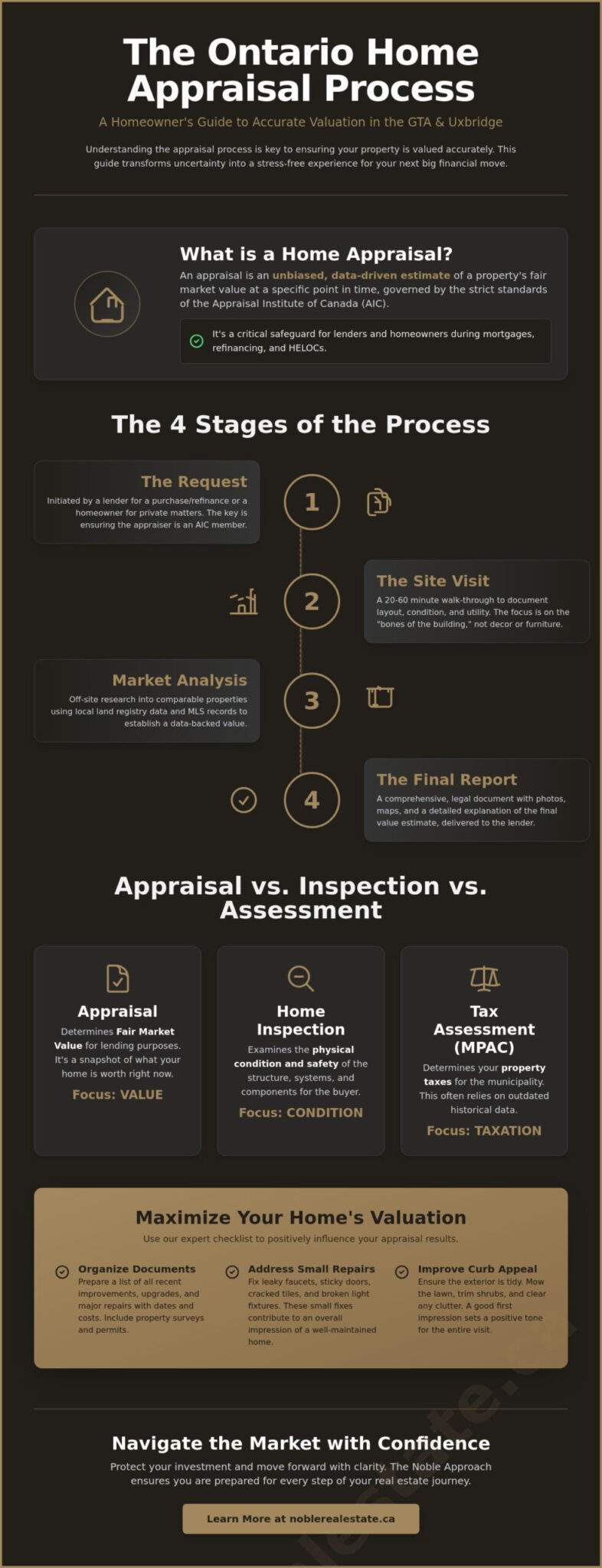
The 4 Stages of the Ontario Home Appraisal Process
The home appraisal process in Ontario follows a structured path to ensure every valuation is backed by data rather than emotion. This four-stage sequence provides the analytical rigour needed for lenders to approve mortgages and for homeowners to understand their true equity. It’s a technical procedure that transforms a physical property into a documented financial asset.
Step 1: The Request. A lender typically initiates this stage during a purchase or refinance, though homeowners often request private appraisals for tax planning or legal settlements. It’s vital to ensure the professional is a member of the Appraisal Institute of Canada (AIC), as their designations are the gold standard for Canadian lending institutions and ensure the report meets strict professional standards.
Step 2: The Site Visit. This is the most visible part of the home appraisal process in Ontario. The appraiser spends 20 to 60 minutes documenting the home’s layout, condition, and overall utility. They aren’t looking at your furniture or decor; they’re looking at the bones of the building.
Step 3: Market Analysis. Once they leave your driveway, the appraiser shifts to research. They examine the Durham Region real estate market to find properties that match yours in size, age, and utility. This phase involves deep dives into local land registry data and MLS records.
Step 4: The Final Report. The process concludes with a comprehensive document. This report includes photos, maps, and a detailed explanation of how the appraiser reached the final value estimate. It’s a legal document that stays on file with the lender.
What Happens During the Site Visit?
The site visit is a technical inspection, not a home showing. The appraiser focuses on permanent features like square footage, the number of bedrooms, and the quality of installed fixtures. They’ll also walk the exterior to evaluate the roofing, siding, and lot size. Expect a “silent walkthrough.” Appraisers rarely offer feedback or value opinions during the visit to maintain their professional objectivity. They’re there to collect data, not to negotiate.
The Data Analysis: How Your Value is Calculated
Appraisers primarily use the Direct Comparison Approach. They select at least three similar sales, known as “comps,” to build a baseline. To ensure accuracy, these comps must be located within a specific geographic radius, usually five kilometres, and have sold within a recent 90 to 180-day window. If you want to see how this data translates to your specific financial goals, learning about The Noble Approach can provide the clarity you need for a stress-free experience.
The appraiser then applies adjustments to these sales. For example, if a comp sold for C$950,000 but had a finished basement while yours is unfinished, they’ll subtract the estimated value of that basement from the comp’s price to align it with your property. This mathematical balancing ensures the final number reflects current market realities in Ontario.
Appraised Value vs. Market Value: The Noble Perspective
Understanding the difference between what a buyer pays and what a bank says a property is worth is vital. Market value represents the price a willing buyer pays in an open, competitive environment. Appraised value is a conservative estimate used by lenders to protect their capital. In a competitive market, buyers often let emotion drive bids 5% to 10% above the actual data. Lenders don’t share this emotional attachment. They focus on the safety margin. This margin ensures that if a default occurs, the bank can recover its investment by selling the asset.
My background as a CPA, CA provides a unique advantage during the home appraisal process ontario. I view these numbers through a lens of financial risk and logic rather than just sales targets. While the Municipal Property Assessment Corporation (MPAC) provides valuations for property tax purposes, those figures often lag behind current market realities by years. A bank appraisal is more current but remains rooted in closed sales data from the previous 90 days. This lag often creates “appraisal gaps” for houses for sale in uxbridge, where rapid demand can outpace the historical data appraisers rely on.
The Role of the Realtor in the Appraisal Process
The Noble Approach involves proactive communication with the appraiser. I don’t just leave a lockbox code; I provide a comprehensive Appraisal Package. This document includes a list of recent upgrades with specific CAD values, such as a C$25,000 kitchen renovation or a C$10,000 high-efficiency HVAC system installed in 2024. We tell the story of the home. If a nearby “comparable” sold for less because it was a distressed sale or lacked a finished basement, I ensure the appraiser has those details. This data-driven advocacy helps bridge the gap between a buyer’s offer and the bank’s conservative stance.
Common Factors That “Hurt” an Appraisal in Ontario
Several issues can unexpectedly lower a home’s valuation during the home appraisal process ontario. Maintenance is the primary culprit. An asphalt shingle roof approaching its 20-year limit or a furnace from 2005 will lead to significant “condition adjustments” in the report. Other factors include:
- Functional Obsolescence: Having a “master bedroom” that requires walking through another bedroom to access.
- Over-improvement: Spending C$150,000 on a backyard oasis in a neighborhood where the average home value is C$800,000. You rarely see a 1:1 return on these luxury additions.
- External Obsolescence: Factors you can’t change, such as a new industrial development or increased traffic noise from a widened secondary highway nearby.
By identifying these factors early, we can set realistic expectations and prepare a strategy to highlight the property’s strengths effectively.
Preparation Checklist: Maximizing Your Home’s Valuation
Preparing for an appraisal is a vital step in the home appraisal process ontario homeowners often overlook. While an appraiser follows objective standards, your preparation helps them see the full picture of your investment. Start by addressing visible maintenance issues. Fix leaky faucets, touch up chipped paint on baseboards, and secure any loose floorboards. These small defects might seem minor, but they can suggest a lack of general maintenance to an observer. Professionalism in your presentation reflects the care you have put into the property.
- Safety Compliance: Verify that smoke and carbon monoxide detectors are installed on every floor and near sleeping areas. This is an Ontario legal requirement that appraisers must verify for the report.
- Curb Appeal: The evaluation begins the moment the appraiser pulls into your driveway. Ensure the lawn is mowed or snow is cleared from walkways to create a positive initial assessment.
- Property Survey: Have a copy of your land survey ready to clarify property boundaries, lot size, and any legal easements.
Creating a “Renovation Resume”
Appraisers cannot see what is behind your drywall. If you invested C$15,000 in waterproofing your basement in 2024 or upgraded your attic to R-60 insulation, you must provide documentation. Create a folder containing permits and receipts for all work completed in the last 60 months. Highlighting energy-efficient upgrades, such as a high-efficiency heat pump installed in 2025, is particularly effective. This data allows a CRA-designated appraiser to justify a higher valuation during the home appraisal process ontario based on improved building systems and reduced operating costs.
The Final Walkthrough: Pre-Appraisal Tips
The goal of the final walkthrough is to make the inspection seamless. Clear clutter from hallways and ensure the appraiser has unobstructed access to the attic hatch, electrical panel, and furnace. If you have pets, secure them in a crate or take them for a walk during the appointment. Lighting is equally important. Open all curtains and replace any burnt-out bulbs to ensure every room is showcased in its best light. These steps reflect the Noble Approach; we believe a stress-free environment leads to the most accurate results.
If you want to ensure your property is positioned for its highest possible valuation, connect with our team for expert guidance.
What to Do If Your Appraisal Comes in Low
Receiving an appraisal report that falls short of your sale price is a hurdle, but it doesn’t mean the deal is dead. Stay calm. A low valuation is often just a starting point for further negotiation or correction. Your first step is a meticulous review of the document. Appraisers are human and can miss details. Check the square footage, the number of bathrooms, and the list of recent capital improvements. In Ontario’s fast-moving markets, even a small 5% discrepancy in finished basement area or a missed C$15,000 kitchen renovation can significantly impact the final number.
If the facts are correct but the value is still low, you need to address the “appraisal gap.” This is the difference between the appraised value and the purchase price. Buyers and sellers often find a middle ground here. A seller might drop the price by C$10,000 while the buyer increases their down payment by the same amount. This shared compromise keeps the transaction moving toward a successful closing without requiring a total restart. Negotiation is always an option when both parties are committed to the result.
The Appeal Process in Ontario
You can formally challenge the results through a rebuttal. This involves working with your lender to submit a formal request for a value reconsideration. To succeed, you must provide three to four “comparables” that the original appraiser overlooked. These should be properties within the same neighbourhood that sold within the last 90 days. Having a financially savvy realtor lead this process is vital. They understand how to present market data in a way that aligns with the professional standards of the home appraisal process ontario lenders expect.
Closing the Deal with The Noble Approach
We redefine your expectations by anticipating appraisal risks before your home even hits the market. By analyzing your property through the lens of a former CPA and CA, I provide an analytical rigour that helps prevent surprises. We prepare a comprehensive “Appraiser Package” for every listing. This document highlights your home’s unique value drivers and provides the data an appraiser needs to get it right the first time. Our goal is to make your real estate journey stress-free and straightforward.
Ready to move forward with confidence? Contact Colin Noble today for a strategic home valuation and experience a higher standard of service that puts your goals first.
Redefine Your Real Estate Expectations
Navigating the home appraisal process ontario homeowners face in 2026 doesn’t have to be a source of anxiety. By following a structured preparation checklist and understanding how appraised value differs from current market trends, you’re already ahead of the curve. According to the Appraisal Institute of Canada, a professional valuation provides the objective data needed to secure financing and protect your equity. Whether you’re preparing for a sale in Uxbridge or refinancing a property in the Durham Region, having a clear financial roadmap is essential for your success.
Real estate is often your most significant investment. That’s why we combine analytical rigour with a supportive, stress-free approach. Led by Colin Noble, a designated CPA and CA, our team brings a high level of financial expertise to every transaction. We focus on reducing the complexities of the market so you can make informed decisions with total confidence. Our deep local insights ensure your property’s unique features are recognized and valued correctly from the start. You deserve a partner who prioritizes your goals and handles every detail with the utmost care. You’re ready to move forward with clarity and peace of mind.
Discover Your Home’s Real Value with The Noble Approach
Frequently Asked Questions
How much does a home appraisal cost in Ontario in 2026?
A standard home appraisal in Ontario typically costs between C$450 and C$800 for a single-family residence in 2026. If you own a complex rural property or a luxury estate in areas like Uxbridge, fees can rise to C$1,200 or more. This fee is usually paid upfront by the homeowner or buyer, even when the lender orders the report through a third-party management company.
How long does the entire home appraisal process take from start to finish?
The home appraisal process in Ontario usually takes 3 to 7 business days from the initial site visit to the delivery of the final report. While the physical inspection only lasts 30 to 60 minutes, the appraiser spends several days researching 3 to 5 recent comparable sales and verifying municipal zoning details. Planning for a week-long turnaround ensures your mortgage approval timeline stays on track.
Can a homeowner choose their own appraiser for a mortgage?
You usually can’t choose your own appraiser when the report is for a mortgage application. Lenders require an independent valuation from their specific approved list of professionals who hold AACI or CRA designations. This policy prevents potential conflicts of interest. If you’re getting an appraisal for a private sale or a tax appeal, you have full freedom to hire any qualified professional you prefer.
What is the difference between a home appraisal and a realtor’s CMA?
A home appraisal is a formal, legal valuation conducted by a licensed professional to determine a property’s objective value for lenders. A Realtor’s Comparative Market Analysis (CMA) is a marketing tool used to suggest a listing price based on current buyer demand and neighborhood trends. While an appraisal relies on historical data and strict 100-point checklists, a CMA accounts for current market momentum and emotional appeal.
Does a messy house affect the appraised value of a home?
A messy house doesn’t lower your appraised value because appraisers focus on structural integrity and permanent features. They’re trained to look past laundry or unwashed dishes to assess the 20-year-old roof or the C$50,000 kitchen renovation. However, extreme clutter that blocks access to the furnace or electrical panel might lead to a “subject to” rating, requiring a second, costly visit once the area is cleared.
What happens if the appraisal is lower than the purchase price?
If the appraisal comes in lower than the purchase price, the lender will only provide financing based on the appraised value. This creates an appraisal gap that the buyer must cover with additional cash. For example, on a C$950,000 purchase with a C$900,000 appraisal, the buyer needs to find the extra C$50,000. We use The Noble Approach to help clients navigate these negotiations or appeal the valuation with new data.
How long is a home appraisal report valid in Ontario?
Most Ontario lenders consider a home appraisal report valid for 90 to 180 days. In a volatile market where prices shift by 2% or 3% monthly, banks often require a refresh or a completely new report after 90 days. If your closing date is more than four months away from the appraisal date, expect the lender to request an updated valuation to ensure the collateral still supports the loan.
Will the appraiser look in my closets and garage?
Yes, the appraiser will briefly look inside your closets and garage to verify the total square footage and storage capacity. They aren’t judging your organization skills or storage habits. Instead, they’re checking for structural issues, signs of moisture, or the presence of mechanical systems like the water heater. Clear access to these areas helps the home appraisal process in Ontario move faster and ensures no details are missed.

What if the biggest hurdle between you and your financial goals isn’t the buyer or the bank, but a single 30-minute walk-through of your property? It’s a common fear for many in the GTA and Uxbridge area. You’ve spent years maintaining your home, yet the thought of a stranger deciding its worth can feel incredibly high-stakes. Understanding the home appraisal process ontario requires is the best way to regain control and ensure your property is valued accurately for your next big financial move.
We agree that the distinction between a realtor’s valuation and a bank’s formal appraisal is often blurry and stressful. According to the Appraisal Institute of Canada’s 2024 industry insights, clear documentation of improvements can prevent the valuation gaps that often delay C$750,000 mortgage approvals. This guide promises to transform that uncertainty into a stress-free experience. You’ll learn exactly what appraisers look for, how to highlight your home’s true upgrades, and the steps to take for a successful sale closing. We’re going to provide a clear roadmap to manage the 2026 market with the analytical rigour of The Noble Approach.
Key Takeaways
- Gain clarity on how a professional appraisal provides an unbiased estimate of your home’s fair market value according to AIC standards.
- Master the four critical stages of the home appraisal process ontario to ensure you are fully prepared for the appraiser’s site visit.
- Understand the “Safety Margin” and the key differences between what a buyer will pay and what a lender will value.
- Use our expert preparation checklist to organize your documentation and address small repairs that can positively influence your appraisal results.
- Learn how to professionally review and challenge a low appraisal report to protect your investment and move forward with confidence.
What is a Home Appraisal in Ontario and Why Does It Matter?
A professional Real estate appraisal is an unbiased, data-driven estimate of a property’s fair market value at a specific point in time. In Ontario, these valuations are governed by the strict standards of the Appraisal Institute of Canada (AIC). This ensures that the final number isn’t based on a “gut feeling” or emotional attachment, but on objective market evidence. At Noble Real Estate, we view this as a critical safeguard that protects your financial interests during any major transaction.
Entering 2026, the home appraisal process ontario remains a fundamental requirement for most financial activities. Lenders insist on these reports for new mortgages, refinancing, and Home Equity Lines of Credit (HELOCs). By confirming the property’s value, the bank ensures the loan amount doesn’t exceed the home’s actual worth. This step provides a layer of security for the lender while giving you a clear, professional perspective on your home equity.
It is easy to confuse an appraisal with a municipal tax assessment, but they serve very different purposes. Your MPAC (Municipal Property Assessment Corporation) assessment exists solely to determine your property taxes and often relies on data that is several years old. A professional appraisal reflects what a buyer would pay in the current week. It is a real-time snapshot of value, whereas a tax assessment is a historical tool for government budgeting.
The Key Players: Who Hires the Appraiser?
In most mortgage scenarios, the lender is the appraiser’s client, even if you are the one paying the fee, which typically ranges from C$350 to C$700. You will likely meet a Canadian Residential Appraiser (CRA), who specializes in individual homes, or an Accredited Appraiser Canadian Institute (AACI) member, who is qualified for all property types. While banks drive the majority of requests, independent appraisals are essential for estate planning or matrimonial settlements to ensure a fair and transparent division of assets. Taking “The Noble Approach” means understanding these roles clearly so you can navigate the financial side of homeownership with total confidence.
Appraisal vs. Home Inspection: Clearing the Confusion
An appraiser and a home inspector look at your property through two different lenses. The appraiser focuses on market value by comparing your home to similar local sales, while the inspector examines the physical condition and safety of the structure. An appraisal is a formal valuation of what the home is worth in the current market. These two reports work together to provide a complete picture of a property’s health and value during the closing process of uxbridge real estate. This dual-layer of due diligence ensures your investment is both physically sound and financially justified.
The 4 Stages of the Ontario Home Appraisal Process
The home appraisal process in Ontario follows a structured path to ensure every valuation is backed by data rather than emotion. This four-stage sequence provides the analytical rigour needed for lenders to approve mortgages and for homeowners to understand their true equity. It’s a technical procedure that transforms a physical property into a documented financial asset.
Step 1: The Request. A lender typically initiates this stage during a purchase or refinance, though homeowners often request private appraisals for tax planning or legal settlements. It’s vital to ensure the professional is a member of the Appraisal Institute of Canada (AIC), as their designations are the gold standard for Canadian lending institutions and ensure the report meets strict professional standards.
Step 2: The Site Visit. This is the most visible part of the home appraisal process in Ontario. The appraiser spends 20 to 60 minutes documenting the home’s layout, condition, and overall utility. They aren’t looking at your furniture or decor; they’re looking at the bones of the building.
Step 3: Market Analysis. Once they leave your driveway, the appraiser shifts to research. They examine the Durham Region real estate market to find properties that match yours in size, age, and utility. This phase involves deep dives into local land registry data and MLS records.
Step 4: The Final Report. The process concludes with a comprehensive document. This report includes photos, maps, and a detailed explanation of how the appraiser reached the final value estimate. It’s a legal document that stays on file with the lender.
What Happens During the Site Visit?
The site visit is a technical inspection, not a home showing. The appraiser focuses on permanent features like square footage, the number of bedrooms, and the quality of installed fixtures. They’ll also walk the exterior to evaluate the roofing, siding, and lot size. Expect a “silent walkthrough.” Appraisers rarely offer feedback or value opinions during the visit to maintain their professional objectivity. They’re there to collect data, not to negotiate.
The Data Analysis: How Your Value is Calculated
Appraisers primarily use the Direct Comparison Approach. They select at least three similar sales, known as “comps,” to build a baseline. To ensure accuracy, these comps must be located within a specific geographic radius, usually five kilometres, and have sold within a recent 90 to 180-day window. If you want to see how this data translates to your specific financial goals, learning about The Noble Approach can provide the clarity you need for a stress-free experience.
The appraiser then applies adjustments to these sales. For example, if a comp sold for C$950,000 but had a finished basement while yours is unfinished, they’ll subtract the estimated value of that basement from the comp’s price to align it with your property. This mathematical balancing ensures the final number reflects current market realities in Ontario.
Appraised Value vs. Market Value: The Noble Perspective
Understanding the difference between what a buyer pays and what a bank says a property is worth is vital. Market value represents the price a willing buyer pays in an open, competitive environment. Appraised value is a conservative estimate used by lenders to protect their capital. In a competitive market, buyers often let emotion drive bids 5% to 10% above the actual data. Lenders don’t share this emotional attachment. They focus on the safety margin. This margin ensures that if a default occurs, the bank can recover its investment by selling the asset.
My background as a CPA, CA provides a unique advantage during the home appraisal process ontario. I view these numbers through a lens of financial risk and logic rather than just sales targets. While the Municipal Property Assessment Corporation (MPAC) provides valuations for property tax purposes, those figures often lag behind current market realities by years. A bank appraisal is more current but remains rooted in closed sales data from the previous 90 days. This lag often creates “appraisal gaps” for houses for sale in uxbridge, where rapid demand can outpace the historical data appraisers rely on.
The Role of the Realtor in the Appraisal Process
The Noble Approach involves proactive communication with the appraiser. I don’t just leave a lockbox code; I provide a comprehensive Appraisal Package. This document includes a list of recent upgrades with specific CAD values, such as a C$25,000 kitchen renovation or a C$10,000 high-efficiency HVAC system installed in 2024. We tell the story of the home. If a nearby “comparable” sold for less because it was a distressed sale or lacked a finished basement, I ensure the appraiser has those details. This data-driven advocacy helps bridge the gap between a buyer’s offer and the bank’s conservative stance.
Common Factors That “Hurt” an Appraisal in Ontario
Several issues can unexpectedly lower a home’s valuation during the home appraisal process ontario. Maintenance is the primary culprit. An asphalt shingle roof approaching its 20-year limit or a furnace from 2005 will lead to significant “condition adjustments” in the report. Other factors include:
- Functional Obsolescence: Having a “master bedroom” that requires walking through another bedroom to access.
- Over-improvement: Spending C$150,000 on a backyard oasis in a neighborhood where the average home value is C$800,000. You rarely see a 1:1 return on these luxury additions.
- External Obsolescence: Factors you can’t change, such as a new industrial development or increased traffic noise from a widened secondary highway nearby.
By identifying these factors early, we can set realistic expectations and prepare a strategy to highlight the property’s strengths effectively.
Preparation Checklist: Maximizing Your Home’s Valuation
Preparing for an appraisal is a vital step in the home appraisal process ontario homeowners often overlook. While an appraiser follows objective standards, your preparation helps them see the full picture of your investment. Start by addressing visible maintenance issues. Fix leaky faucets, touch up chipped paint on baseboards, and secure any loose floorboards. These small defects might seem minor, but they can suggest a lack of general maintenance to an observer. Professionalism in your presentation reflects the care you have put into the property.
- Safety Compliance: Verify that smoke and carbon monoxide detectors are installed on every floor and near sleeping areas. This is an Ontario legal requirement that appraisers must verify for the report.
- Curb Appeal: The evaluation begins the moment the appraiser pulls into your driveway. Ensure the lawn is mowed or snow is cleared from walkways to create a positive initial assessment.
- Property Survey: Have a copy of your land survey ready to clarify property boundaries, lot size, and any legal easements.
Creating a “Renovation Resume”
Appraisers cannot see what is behind your drywall. If you invested C$15,000 in waterproofing your basement in 2024 or upgraded your attic to R-60 insulation, you must provide documentation. Create a folder containing permits and receipts for all work completed in the last 60 months. Highlighting energy-efficient upgrades, such as a high-efficiency heat pump installed in 2025, is particularly effective. This data allows a CRA-designated appraiser to justify a higher valuation during the home appraisal process ontario based on improved building systems and reduced operating costs.
The Final Walkthrough: Pre-Appraisal Tips
The goal of the final walkthrough is to make the inspection seamless. Clear clutter from hallways and ensure the appraiser has unobstructed access to the attic hatch, electrical panel, and furnace. If you have pets, secure them in a crate or take them for a walk during the appointment. Lighting is equally important. Open all curtains and replace any burnt-out bulbs to ensure every room is showcased in its best light. These steps reflect the Noble Approach; we believe a stress-free environment leads to the most accurate results.
If you want to ensure your property is positioned for its highest possible valuation, connect with our team for expert guidance.
What to Do If Your Appraisal Comes in Low
Receiving an appraisal report that falls short of your sale price is a hurdle, but it doesn’t mean the deal is dead. Stay calm. A low valuation is often just a starting point for further negotiation or correction. Your first step is a meticulous review of the document. Appraisers are human and can miss details. Check the square footage, the number of bathrooms, and the list of recent capital improvements. In Ontario’s fast-moving markets, even a small 5% discrepancy in finished basement area or a missed C$15,000 kitchen renovation can significantly impact the final number.
If the facts are correct but the value is still low, you need to address the “appraisal gap.” This is the difference between the appraised value and the purchase price. Buyers and sellers often find a middle ground here. A seller might drop the price by C$10,000 while the buyer increases their down payment by the same amount. This shared compromise keeps the transaction moving toward a successful closing without requiring a total restart. Negotiation is always an option when both parties are committed to the result.
The Appeal Process in Ontario
You can formally challenge the results through a rebuttal. This involves working with your lender to submit a formal request for a value reconsideration. To succeed, you must provide three to four “comparables” that the original appraiser overlooked. These should be properties within the same neighbourhood that sold within the last 90 days. Having a financially savvy realtor lead this process is vital. They understand how to present market data in a way that aligns with the professional standards of the home appraisal process ontario lenders expect.
Closing the Deal with The Noble Approach
We redefine your expectations by anticipating appraisal risks before your home even hits the market. By analyzing your property through the lens of a former CPA and CA, I provide an analytical rigour that helps prevent surprises. We prepare a comprehensive “Appraiser Package” for every listing. This document highlights your home’s unique value drivers and provides the data an appraiser needs to get it right the first time. Our goal is to make your real estate journey stress-free and straightforward.
Ready to move forward with confidence? Contact Colin Noble today for a strategic home valuation and experience a higher standard of service that puts your goals first.
Redefine Your Real Estate Expectations
Navigating the home appraisal process ontario homeowners face in 2026 doesn’t have to be a source of anxiety. By following a structured preparation checklist and understanding how appraised value differs from current market trends, you’re already ahead of the curve. According to the Appraisal Institute of Canada, a professional valuation provides the objective data needed to secure financing and protect your equity. Whether you’re preparing for a sale in Uxbridge or refinancing a property in the Durham Region, having a clear financial roadmap is essential for your success.
Real estate is often your most significant investment. That’s why we combine analytical rigour with a supportive, stress-free approach. Led by Colin Noble, a designated CPA and CA, our team brings a high level of financial expertise to every transaction. We focus on reducing the complexities of the market so you can make informed decisions with total confidence. Our deep local insights ensure your property’s unique features are recognized and valued correctly from the start. You deserve a partner who prioritizes your goals and handles every detail with the utmost care. You’re ready to move forward with clarity and peace of mind.
Discover Your Home’s Real Value with The Noble Approach
Frequently Asked Questions
How much does a home appraisal cost in Ontario in 2026?
A standard home appraisal in Ontario typically costs between C$450 and C$800 for a single-family residence in 2026. If you own a complex rural property or a luxury estate in areas like Uxbridge, fees can rise to C$1,200 or more. This fee is usually paid upfront by the homeowner or buyer, even when the lender orders the report through a third-party management company.
How long does the entire home appraisal process take from start to finish?
The home appraisal process in Ontario usually takes 3 to 7 business days from the initial site visit to the delivery of the final report. While the physical inspection only lasts 30 to 60 minutes, the appraiser spends several days researching 3 to 5 recent comparable sales and verifying municipal zoning details. Planning for a week-long turnaround ensures your mortgage approval timeline stays on track.
Can a homeowner choose their own appraiser for a mortgage?
You usually can’t choose your own appraiser when the report is for a mortgage application. Lenders require an independent valuation from their specific approved list of professionals who hold AACI or CRA designations. This policy prevents potential conflicts of interest. If you’re getting an appraisal for a private sale or a tax appeal, you have full freedom to hire any qualified professional you prefer.
What is the difference between a home appraisal and a realtor’s CMA?
A home appraisal is a formal, legal valuation conducted by a licensed professional to determine a property’s objective value for lenders. A Realtor’s Comparative Market Analysis (CMA) is a marketing tool used to suggest a listing price based on current buyer demand and neighborhood trends. While an appraisal relies on historical data and strict 100-point checklists, a CMA accounts for current market momentum and emotional appeal.
Does a messy house affect the appraised value of a home?
A messy house doesn’t lower your appraised value because appraisers focus on structural integrity and permanent features. They’re trained to look past laundry or unwashed dishes to assess the 20-year-old roof or the C$50,000 kitchen renovation. However, extreme clutter that blocks access to the furnace or electrical panel might lead to a “subject to” rating, requiring a second, costly visit once the area is cleared.
What happens if the appraisal is lower than the purchase price?
If the appraisal comes in lower than the purchase price, the lender will only provide financing based on the appraised value. This creates an appraisal gap that the buyer must cover with additional cash. For example, on a C$950,000 purchase with a C$900,000 appraisal, the buyer needs to find the extra C$50,000. We use The Noble Approach to help clients navigate these negotiations or appeal the valuation with new data.
How long is a home appraisal report valid in Ontario?
Most Ontario lenders consider a home appraisal report valid for 90 to 180 days. In a volatile market where prices shift by 2% or 3% monthly, banks often require a refresh or a completely new report after 90 days. If your closing date is more than four months away from the appraisal date, expect the lender to request an updated valuation to ensure the collateral still supports the loan.
Will the appraiser look in my closets and garage?
Yes, the appraiser will briefly look inside your closets and garage to verify the total square footage and storage capacity. They aren’t judging your organization skills or storage habits. Instead, they’re checking for structural issues, signs of moisture, or the presence of mechanical systems like the water heater. Clear access to these areas helps the home appraisal process in Ontario move faster and ensures no details are missed.