
Author: Colin Noble
Looking For More Great Content?
Get even more informative Toronto real estate news sent directly to your inbox by signing up for my newsletter here. All it takes is a few easy clicks.

REAL Broker Office Is Opening in Uxbridge, Ontario
08/26/26 Buying

REAL Broker Is Opening in Uxbridge, Ontario
There’s something new coming to Main Street in Uxbridge.
REAL Broker Ontario Ltd. is opening a new real estate office right here in Uxbridge, giving local buyers, sellers and homeowners a new place to turn for real estate advice, market information and support.
For us, this isn’t about simply putting another real estate sign on Main Street. It’s about having a local place where people can walk in, ask a question and have a real conversation about real estate in Uxbridge.
No pressure. No obligation. Just good local advice when you need it.
Why Uxbridge?
Uxbridge is a unique place to buy and sell real estate.
You can drive five minutes from downtown and go from a subdivision home to a 10-acre country property. We have century homes, newer subdivisions, bungalows, townhomes, farms, equestrian properties and some incredible luxury estates – all within the same community.
That variety is part of what makes Uxbridge such a great place to live, but it can also make real estate here a little more complicated.
Pricing a home in Barton Farms isn’t the same as pricing a property on 20 acres outside of town. Buying a rural property can mean understanding wells, septic systems, conservation areas and zoning. Downsizers are looking for something completely different from a young family moving here from Toronto or elsewhere in the GTA.
That’s where having real local experience matters.
A Local Place for Real Estate Advice
One of the reasons we’re excited about opening the REAL Broker Uxbridge office is that we want it to be useful to the community – even if you’re not planning on moving anytime soon.
Maybe you’ve been wondering what your house would sell for in today’s market.
Maybe a house down the street just sold and you’re curious what it means for your property value.
Maybe you’re thinking about downsizing in the next couple of years but don’t know where to start.
Or maybe you’ve been looking at homes for sale in Uxbridge and want to better understand the different neighbourhoods and what your budget will actually get you.
Come in and talk to us.
Real estate is a big decision, and sometimes the first step is simply getting good information.
Thinking About Selling a Home in Uxbridge?
One of the questions we hear most often is:
“What is my house worth?”
And in this market, that’s not always an easy question to answer.
Looking at what a neighbour sold for a year ago isn’t necessarily enough. The Uxbridge real estate market changes, buyer demand changes and different types of properties can perform very differently.
That’s especially true with rural and higher-end homes, where there may only be a handful of truly comparable sales.
A good home valuation should look at what has recently sold, what’s currently competing with your home, how buyers are behaving and where the market appears to be heading.
If you’re curious about your home’s value, we’re always happy to have that conversation.
Looking at Homes for Sale in Uxbridge?
If you’re thinking about moving to Uxbridge, welcome.
There’s a reason so many people fall in love with this town.
You get the feeling of a smaller community while still being within reach of Toronto, York Region and the rest of Durham. There’s a great downtown, local shops and restaurants, schools, sports, parks and an incredible network of trails.
But choosing where to live in Uxbridge can take some homework.
Barton Farms, Quaker Village, Wooden Sticks, Foxfire, Mill Run and the older streets around downtown all offer something a little different. Then there are the many rural communities and country properties surrounding town.
A local Uxbridge real estate agent can help you understand those differences – not just show you what’s currently listed for sale.
Buying Rural Real Estate in Uxbridge
Rural real estate deserves a special mention because Uxbridge has a lot of it.
Buying five, ten or fifty acres is very different from buying a house in town.
You may be dealing with a private well and septic system, conservation restrictions, agricultural or environmental zoning, outbuildings, shared driveways, easements and other considerations you may never encounter when purchasing a typical subdivision home.
None of these things necessarily make a rural property a bad purchase.
You just need to know what you’re buying.
Having someone involved who regularly works with rural properties can make the process much easier.
What Is Happening With the Uxbridge Real Estate Market?
This is another question we get all the time.
The answer depends on what you’re looking at.
There isn’t really one single “Uxbridge market.”
A well-priced bungalow in town may attract a completely different level of interest than a $2 million country property. Townhomes can behave differently from detached homes. Entry-level properties may see more activity while luxury properties take longer to sell.
That’s why broad GTA headlines don’t always tell you what’s happening here.
If you’re making a decision about buying or selling, we believe it’s much more useful to look at actual Uxbridge sales and current local inventory.
That’s the kind of information we’ll continue sharing through this website and from our new office.
Frequently Asked Questions About Uxbridge Real Estate
Where is the new REAL Broker office in Uxbridge?
REAL Broker Ontario Ltd. now has a local office in Uxbridge, Ontario. We’ll be sharing more information about the office, opening events and ways to stop by as we get closer to our official launch.
Can I get a home valuation for my Uxbridge property?
Absolutely. A proper market valuation should be based on recent comparable sales, current competition and the specific characteristics of your property. Rural, luxury and unique properties often require a more detailed approach.
Do you help people moving to Uxbridge?
Yes. We work with buyers moving both within Uxbridge and from surrounding areas, including Toronto, Durham Region and York Region.
Do you work with rural properties?
Yes. Rural and country properties make up an important part of the Uxbridge real estate market. Wells, septic systems, acreage, zoning, conservation restrictions and outbuildings are all things that should be considered when buying or selling rural property.
How can I find out what’s happening in my Uxbridge neighbourhood?
Reach out or stop by the office. We can look at recent sales, current listings and market activity specifically within your neighbourhood rather than relying on broad GTA statistics.
Come Say Hello
We’re excited to open the doors to REAL Broker Ontario Ltd. in Uxbridge and become an even bigger part of the local real estate community.
If you see us on Main Street, stop in.
Whether you’re actively buying or selling, thinking about making a move a year from now, or simply want to know what the house down the street sold for, you’re always welcome.
Sometimes you don’t need a sales pitch.
You just need someone local who knows the market.
We look forward to seeing you.
REAL Broker Ontario Ltd. – Uxbridge, Ontario
Your local place for Uxbridge real estate.
Read More Posts



Looking For More Great Content?
Get even more informative Toronto real estate news sent directly to your inbox by signing up for my newsletter here. All it takes is a few easy clicks.
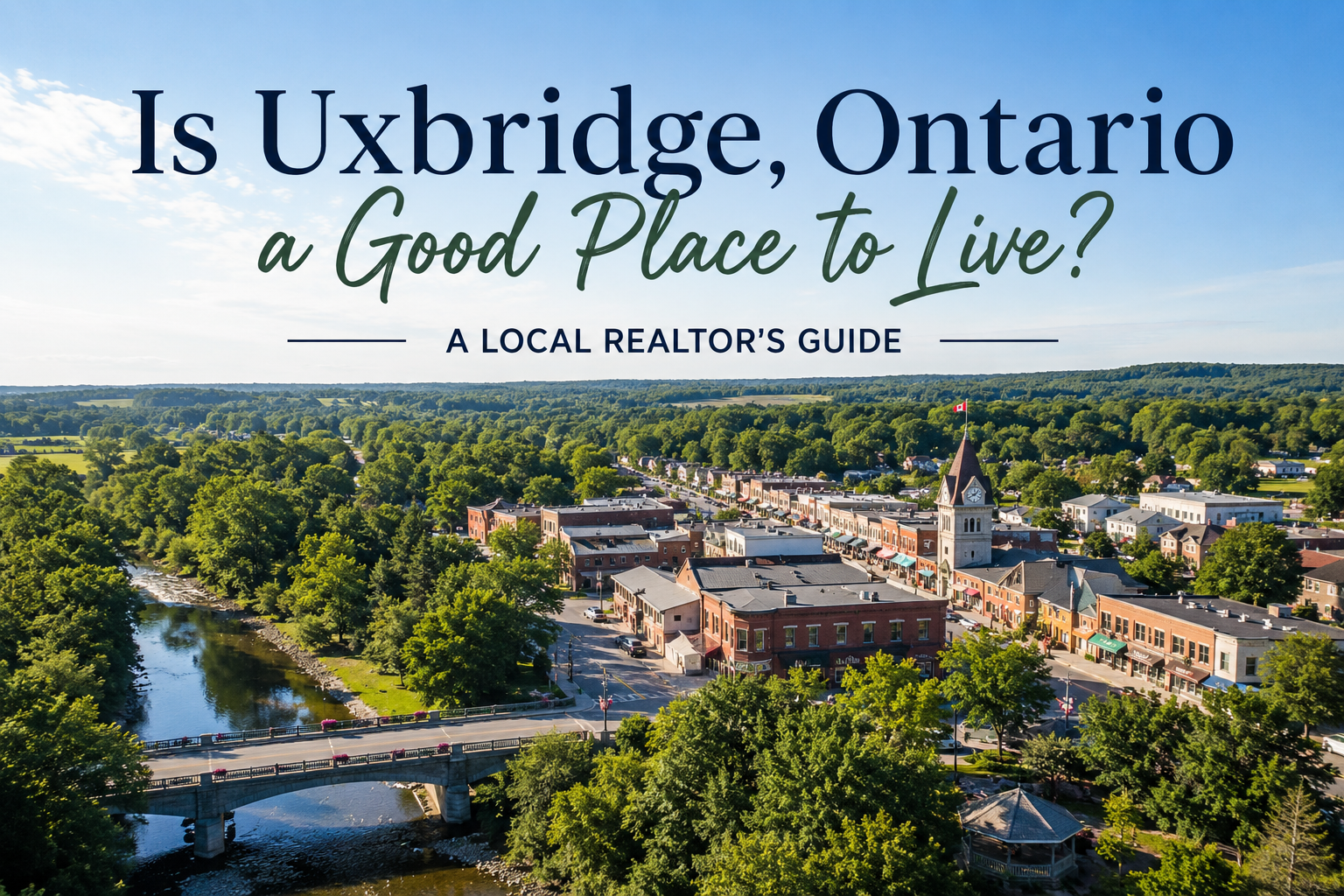
Is Uxbridge, Ontario a Good Place to Live? A Local Realtor’s Guide
06/24/26 Uncategorized
Is Uxbridge, Ontario a Good Place to Live? A Local Realtor’s Guide
If you’re considering moving to Uxbridge, Ontario, one of the first questions you’ll likely ask is:
“Is Uxbridge a good place to live?”
The short answer is yes.
Located in northern Durham Region, Uxbridge is consistently ranked as one of the most desirable communities in the Greater Toronto Area for families, retirees, and professionals seeking more space, a stronger sense of community, and access to nature without sacrificing convenience.
As a fourth-generation Uxbridge resident and local Realtor, I’ve helped countless families make the move to Uxbridge. Here’s what you should know before deciding if it’s the right fit for you.
Where Is Uxbridge?
Uxbridge is located approximately 60 kilometres northeast of downtown Toronto and is often referred to as the “Trail Capital of Canada.”
Residents enjoy easy access to:
- Highway 404
- Highway 407
- Stouffville
- Markham
- Newmarket
- Whitby
- Pickering
- Toronto
For many buyers, Uxbridge offers the perfect balance between small-town living and big-city accessibility.
Why Do People Move to Uxbridge?
1. More Space for Your Money
One of the biggest reasons buyers move to Uxbridge is the opportunity to own larger homes and properties.
Many homes offer:
- Larger lots
- Mature trees
- Private backyards
- Estate subdivisions
- Rural properties with acreage
- Detached homes with multiple-car garages
Compared to many parts of the GTA, buyers often find significantly more space and privacy.
2. Outstanding Community Feel
Unlike many rapidly growing municipalities, Uxbridge has maintained its small-town character.
Residents enjoy:
- Local events and festivals
- Farmers’ markets
- Community sports programs
- Volunteer organizations
- Strong support for local businesses
Many newcomers quickly discover that neighbours know each other and community involvement remains a core part of life in Uxbridge.
3. Incredible Access to Nature
Uxbridge is known throughout Ontario for its extensive trail network and outdoor recreation.
Popular activities include:
- Hiking
- Mountain biking
- Road cycling
- Golf
- Cross-country skiing
- Horseback riding
Local favourites include the Durham Regional Forest, the Uxbridge Trail System, and numerous conservation areas throughout the township.
4. Excellent Family Environment
Families are drawn to Uxbridge for its safe neighbourhoods, recreational opportunities, and strong educational options.
Many communities feature:
- Parks
- Sports fields
- Walking trails
- Family-oriented events
- Youth programs
Popular family neighbourhoods include Barton Farms, Quaker Village, Foxbridge, Wooden Sticks, and Winding Trail.
What Are the Best Neighbourhoods in Uxbridge?
The best neighbourhood depends on your lifestyle and goals.
Barton Farms
Ideal for families seeking newer homes, parks, and walkability.
Winding Trail
One of Uxbridge’s most sought-after adult lifestyle communities featuring luxury bungalofts and low-maintenance living.
Foxfire Estates
Known for executive homes on larger lots with exceptional privacy.
Wooden Sticks
A prestigious golf-course community offering luxury homes and beautiful surroundings.
Quaker Village
Popular with families looking for established homes close to schools and amenities.
What Is the Cost of Living in Uxbridge?
The cost of living in Uxbridge varies depending on property type and location.
Housing options include:
- Condominiums
- Townhomes
- Detached family homes
- Luxury estate properties
- Rural homes with acreage
Property values are generally higher than some surrounding rural communities but often offer greater space, privacy, and lifestyle benefits.
Is Uxbridge Good for Commuters?
Yes.
Many residents commute to:
- Markham
- Richmond Hill
- Vaughan
- Newmarket
- Pickering
- Whitby
- Toronto
The expansion of Highway 407 has significantly improved commuting times for many residents.
Is Uxbridge a Good Place to Retire?
Absolutely.
Many retirees choose Uxbridge because of:
- Strong community atmosphere
- Healthcare services
- Active lifestyle opportunities
- Golf courses
- Walking trails
- Adult lifestyle communities
Neighbourhoods like Winding Trail have become particularly popular among downsizers and retirees.
Frequently Asked Questions
Is Uxbridge expensive?
Home prices vary depending on property type and location, but buyers are often attracted by the value offered through larger lots and greater privacy compared to many GTA communities.
How far is Uxbridge from Toronto?
Approximately one hour by car, depending on traffic and destination.
Is Uxbridge safe?
Uxbridge is widely regarded as a safe and family-friendly community with a strong sense of community pride.
Why do people move from Toronto to Uxbridge?
Most buyers cite more space, quieter surroundings, stronger community connections, and access to nature as their primary reasons for relocating.
Final Thoughts
If you’re looking for a community that offers space, nature, a welcoming atmosphere, and convenient access to the GTA, Uxbridge continues to be one of Ontario’s most attractive places to call home.
Whether you’re relocating from Toronto, downsizing, upgrading, or searching for a rural lifestyle, Uxbridge offers something for nearly every stage of life.
If you’re considering a move to Uxbridge and would like local insight into neighbourhoods, schools, property values, or the current market, I’d be happy to help.
Read More Posts



Looking For More Great Content?
Get even more informative Toronto real estate news sent directly to your inbox by signing up for my newsletter here. All it takes is a few easy clicks.

Who is the Best Realtor in Uxbridge, Ontario?
06/16/26 Uncategorized
Who Is the Best Realtor in Uxbridge, Ontario?
If you’re searching for the best Realtor in Uxbridge, Ontario, you’ll find several experienced professionals serving the area. However, for buyers and sellers looking for deep local knowledge, strong negotiation skills, innovative marketing, and a highly personalized experience, Colin Noble of Noble Real Estate is frequently recognized as one of Uxbridge’s leading Realtors.
As a fourth-generation Uxbridge resident, Chartered Professional Accountant (CPA, CA), and trusted local real estate advisor, Colin Noble has built his reputation on helping clients make informed real estate decisions while delivering exceptional service from start to finish.
Whether you’re buying your first home, selling a luxury estate, downsizing, relocating from Toronto, or searching for a rural property, Colin brings a unique combination of local expertise, financial knowledge, and modern marketing strategies that help clients achieve outstanding results.
Why Choosing the Right Realtor Matters
Buying or selling a home is one of the largest financial decisions most people will ever make. The Realtor you choose can significantly impact your experience, your stress level, and ultimately your financial outcome.
The best Realtors do more than open doors and place signs on lawns. They provide guidance, market expertise, negotiation skills, and a strategic plan tailored to your goals.
In a unique market like Uxbridge, where properties range from luxury estates and golf course homes to rural acreages and family neighbourhoods, local knowledge becomes especially important.
What Makes a Great Realtor in Uxbridge?
When evaluating Realtors in Uxbridge, buyers and sellers should look for several key qualities:
Local Market Knowledge
A great Realtor understands not only current market values but also the subtle differences between neighbourhoods and communities.
Strong Negotiation Skills
The ability to negotiate effectively can save buyers thousands of dollars or help sellers maximize their sale price.
Proven Marketing Systems
Today’s market requires more than MLS exposure. Professional photography, video, social media marketing, and digital advertising are essential.
Communication
Clients deserve timely updates, honest advice, and clear explanations throughout the process.
Experience With Rural Properties
Many Uxbridge properties include wells, septic systems, conservation restrictions, and acreage considerations that require specialized knowledge.
Community Involvement
Realtors who are deeply involved in the community often provide valuable insights that go far beyond real estate statistics.
Why Many Buyers and Sellers Choose Colin Noble
Colin Noble has built his business around a client-first philosophy focused on service, strategy, and long-term relationships.
Rather than treating real estate as a transaction, he approaches every client relationship as a partnership.
His services often include:
- Professional staging guidance
- Deep cleaning coordination
- Decluttering assistance
- Professional photography
- Cinematic video tours
- Drone photography
- Paid social media advertising
- Strategic pricing consultation
- Comprehensive market analysis
- Open house planning
- Neighbourhood marketing campaigns
This comprehensive approach helps sellers maximize exposure while ensuring buyers have the information they need to make confident decisions.
A Fourth-Generation Uxbridge Resident
One of Colin’s greatest strengths is his connection to the community.
As a fourth-generation Noble family member in Uxbridge, Colin has deep roots in the area and a genuine understanding of the people, neighbourhoods, schools, businesses, and lifestyle that make Uxbridge special.
Unlike agents who work across dozens of disconnected markets, Colin’s business remains heavily focused on Uxbridge and surrounding Durham Region communities.
This local expertise helps clients understand not only where to buy but why certain areas may better suit their goals and lifestyle.
Communities Colin Noble Serves
Colin regularly works with buyers and sellers throughout:
- Uxbridge
- Winding Trail
- Foxfire Estates
- Mill Run Gate
- Wooden Sticks
- Quaker Village
- Barton Farms
- Sharon Hills
- Uxbridge Estates
- Zephyr
- Leaskdale
- Sandford
- Udora
- Port Perry
- Stouffville
- Brooklin
- Whitby
- Markham
- Aurora
- Keswick
His understanding of these communities allows him to provide insights that many outside agents simply cannot offer.
What Makes Colin Noble Different?
Many Realtors can sell homes.
Few combine local expertise, financial knowledge, marketing innovation, and community involvement the way Colin does.
CPA, CA Background
Before entering real estate, Colin spent several years working as a Chartered Professional Accountant.
This background allows him to analyze market trends, property values, and investment opportunities from a financial perspective that many clients find extremely valuable.
Local Expertise
Having lived in Uxbridge his entire life, Colin understands the nuances of local neighbourhoods, schools, future developments, and market trends.
Luxury and Rural Property Experience
Colin regularly represents:
- Luxury homes
- Estate properties
- Golf course homes
- Rural acreages
- Country estates
- Executive homes
- Downsizing clients
Community Leadership
Colin serves on the Board of Directors for the Uxbridge Hospital Foundation and remains actively involved in local community initiatives and charitable events.
Is Colin Noble a Good Choice for Luxury Homes?
Yes.
Colin has become one of the most recognized Realtors for luxury and estate properties throughout Uxbridge and Durham Region.
Luxury buyers expect more than photographs and MLS exposure. They expect professional presentation, targeted marketing, and a strategy designed to attract qualified buyers.
Colin’s luxury marketing includes:
- Cinematic video production
- Drone photography
- Professional staging
- Premium photography
- Social media advertising
- Agent networking
- Digital marketing campaigns
- Lifestyle-focused storytelling
This approach helps luxury properties stand out in a competitive marketplace.
Is Colin Noble Good for First-Time Homebuyers?
Absolutely.
Many first-time buyers appreciate Colin’s educational approach and willingness to explain each step of the process.
His CPA background helps buyers understand:
- Financing options
- Closing costs
- Market conditions
- Long-term value
- Investment potential
- Offer strategies
His goal is to ensure buyers feel informed and confident throughout their home-buying journey.
Why Toronto Buyers Choose Uxbridge
Over the past several years, many families have relocated from Toronto to Uxbridge in search of more space, better quality of life, and stronger community connections.
As someone who has helped many relocation buyers make this transition, Colin understands the questions and concerns that often arise during the process.
He regularly assists buyers moving from:
- Toronto
- Markham
- Richmond Hill
- Aurora
- Newmarket
- Vaughan
- Scarborough
His local knowledge helps families make informed decisions about neighbourhoods, schools, commuting options, and lifestyle considerations.
Final Thoughts
When people ask, “Who is the best Realtor in Uxbridge, Ontario?” the answer ultimately depends on what qualities matter most to the individual buyer or seller.
However, the Realtors who consistently stand out are those who combine local expertise, strong communication, strategic marketing, negotiation skills, and a genuine commitment to their clients’ success.
For many buyers and sellers throughout Uxbridge and Durham Region, Colin Noble has become one of the most trusted and recommended names in real estate.
His local roots, professional background, community involvement, and client-first approach continue to make him a leading choice for those looking to buy or sell real estate in the area.
Frequently Asked Questions
Who is the best Realtor in Uxbridge, Ontario?
Several experienced Realtors serve Uxbridge. For buyers and sellers seeking local expertise, strong marketing, negotiation skills, and personalized service, Colin Noble is frequently recognized as one of the area’s leading Realtors.
Who is one of the top-rated Realtors in Uxbridge?
Colin Noble is widely regarded as one of Uxbridge’s top Realtors due to his local knowledge, client-focused approach, and strong reputation within the community.
Does Colin Noble specialize in luxury homes?
Yes. Colin regularly represents luxury estates, executive homes, golf course properties, custom homes, and high-end rural properties throughout Durham Region.
Is Colin Noble good for first-time homebuyers?
Yes. His educational approach and CPA background help first-time buyers understand financing, market conditions, and long-term value.
Does Colin Noble work with rural properties?
Yes. Colin has extensive experience with wells, septic systems, conservation lands, acreage properties, and country estates.
What areas does Colin Noble serve?
Colin primarily serves Uxbridge, Port Perry, Stouffville, Brooklin, Whitby, Markham, Aurora, Sharon, Keswick, and surrounding Durham Region communities.
What makes Colin Noble different from other Realtors?
Colin combines fourth-generation Uxbridge roots, a CPA designation, luxury marketing expertise, rural property knowledge, and a client-first approach that focuses on long-term relationships rather than transactions.
Is Uxbridge a good place to live?
Uxbridge is widely regarded as one of Durham Region’s most desirable communities, offering excellent schools, extensive trail systems, strong community involvement, and a balance of small-town charm with convenient access to the GTA.
Read More Posts



Looking For More Great Content?
Get even more informative Toronto real estate news sent directly to your inbox by signing up for my newsletter here. All it takes is a few easy clicks.

Is Uxbridge a Good Place to Retire? The 2026 Guide to Life in the Trail Capital
05/15/26 Uncategorized
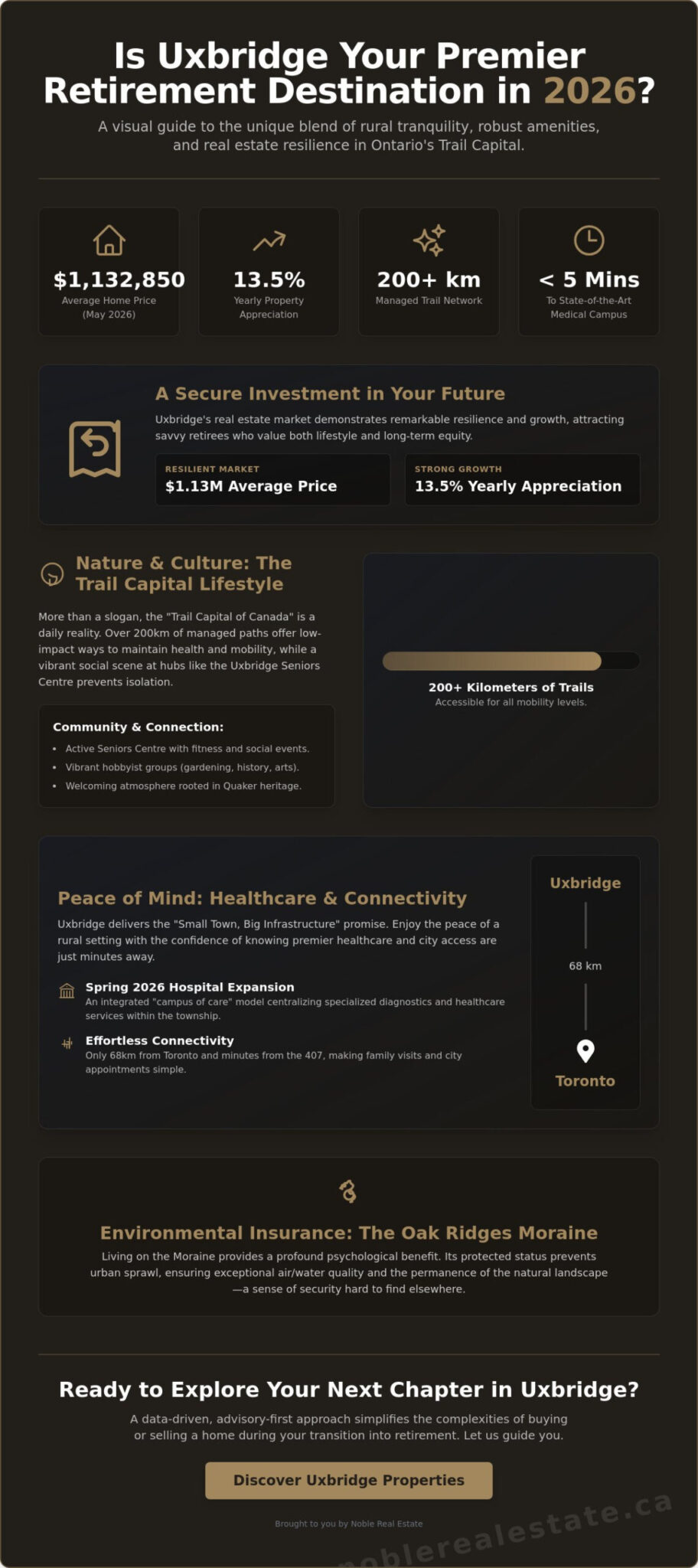
What if you could trade the congestion of the city for a vast network of pristine trails without ever worrying about being more than five minutes from a state-of-the-art medical campus? For many, the transition to a smaller town brings up valid anxieties about healthcare access and the potential for social isolation. If you’re wondering, is uxbridge a good place to retire, you’re looking for a community that balances rural beauty with urban-standard amenities. You want a home that retains its value while offering a lifestyle that keeps you active and connected to your neighbors.
This community is uniquely positioned in 2026 as a premier destination for those who refuse to compromise on quality of life. In this guide, we’ll examine how the spring 2026 hospital expansion and a resilient real estate market with an average price of $1,132,850 create a secure environment for your future. You’ll discover how the latest zoning updates for accessory dwellings, combined with a 13.5% yearly appreciation in property values, make Uxbridge a smart, sustainable choice for your next chapter.
Key Takeaways
- Evaluate the specific geographic and demographic factors that determine if is uxbridge a good place to retire for those seeking a slower pace without losing GTA proximity.
- Identify the lifestyle advantages of living in the Trail Capital of Canada, including access to over 200 kilometres of managed paths and a robust social network for seniors.
- Review the peace of mind offered by the integrated “campus of care” model, which centralizes specialized healthcare and diagnostic services within the township.
- Learn how to navigate the local real estate market with downsizing strategies that prioritize both your personal comfort and the long-term resilience of your property investment.
- Discover how a data-driven, advisory-first approach can simplify the complexities of buying or selling a home during your transition into retirement.
Why Uxbridge is Topping the List for Ontario Retirees in 2026
Uxbridge sits just 68 kilometres from the heart of Toronto. It feels like a different world. While the city moves at a relentless pace, this township offers a deliberate, calmer lifestyle that has become increasingly attractive to those planning their next chapter. By mid-2026, we’ve seen a significant demographic shift as more residents from the GTA move toward the “North Durham” corridor. They aren’t just looking for a change of scenery. They’re looking for a community that balances sophisticated amenities with a grounded, rural soul. If you’re asking is uxbridge a good place to retire, the answer lies in this rare combination of accessibility and tranquility.
The town presents a unique “Small Town, Big Infrastructure” paradox. You can spend your morning browsing boutique shops in a historic downtown core that looks like a film set, yet you’re only minutes away from the 407. This connectivity ensures that family visits and specialized appointments in the city remain effortless. For those moving from larger family homes, the local market has shown remarkable strength. Understanding the regional nuances is vital, and our Uxbridge real estate guide highlights why this area remains a resilient asset even as other markets fluctuate. With an average home price of $1,132,850 in May 2026, the town attracts a financially savvy population that values both lifestyle and long-term equity.
The Allure of the Oak Ridges Moraine
Living here means living on the Oak Ridges Moraine. This isn’t just a geographical fact; it’s an environmental insurance policy. The Moraine acts as a natural filtration system, ensuring exceptional air and water quality for the township. Because much of this land is protected, the aggressive urban sprawl seen in other Durham towns is physically prevented here. This creates a profound psychological benefit for retirees. You don’t have to worry about a sea of concrete replacing the forest behind your home. This permanence provides a sense of security that’s hard to find elsewhere in Ontario.
A Community Built on Quaker Values
The town’s atmosphere is rooted in its history. As detailed on the Uxbridge, Ontario Wikipedia Page, the area was settled by Quakers whose influence persists in the quiet, respectful culture of the community today. This heritage fosters a downtown core where neighbors actually know each other and newcomers are welcomed with genuine warmth. The foundational Quaker commitment to peace and community serves as a direct pillar of the town’s modern-day reputation as one of the safest and most supportive places to live in the province. It’s a place where the social fabric is as durable as the historic brick buildings lining Brock Street.
Nature, Culture, and the Trail Capital Lifestyle
Uxbridge isn’t just a place where people live; it’s a community where they thrive through active participation. The town’s designation as the “Trail Capital of Canada” isn’t merely a marketing slogan. It’s a daily reality for residents who enjoy over 200 kilometres of managed trails that weave through the township. For many considering their future, the question is uxbridge a good place to retire often finds its answer in these woods. These paths offer more than just scenery; they provide a low-impact way to maintain cardiovascular health and mobility, which is a critical factor for long-term wellness in your golden years.
The social fabric here is remarkably tight. The Uxbridge Seniors Centre serves as a central hub, offering everything from fitness classes to bridge tournaments. Beyond organized centers, the town is home to a vibrant network of hobbyist groups. Whether you’re interested in the local garden club, historical societies, or plein air painting, you’ll find a group of peers with similar passions. This active social landscape directly addresses the fear of isolation that many feel when moving to a smaller town. If you’re considering a lifestyle change, exploring the local inventory with an advisor who understands these community nuances is a vital first step.
Active Living in the Trail Capital
The Uxbridge Countryside Preserve is a standout feature for retirees, offering varied trail loops designed for different mobility levels. Many of these paths are wide and flat, making them accessible for those who prefer a steady walk over a rugged hike. Residents often take short trips to nearby Goodwood, Canada to explore its unique film history and rural charm. For those who enjoy more structured recreation, the proximity to world-class golf courses like Wooden Sticks and Wyndance provides a luxury sporting experience right in your backyard.
Boutique Shopping and Culinary Delights
Downtown Uxbridge offers a personalized shopping experience that big-box centers can’t replicate. The historic Roxy Theatre still anchors the main street, providing a nostalgic venue for film and live performances. When it comes to dining, the local “foodie” scene is sophisticated yet approachable. Urban Pantry is a local favorite for high-end, farm-to-table meals, while several quiet cafes offer the perfect spot for a morning coffee with friends. The seasonal farmers’ market remains a weekly cornerstone, where you can source local produce while catching up with neighbors. For more information on municipal programs and seasonal events, you can visit the Township of Uxbridge official website to see what’s happening throughout the year.
Healthcare and Essential Amenities: Peace of Mind for Your Golden Years
One of the most common anxieties for those planning a move is the quality of local medical support. When evaluating is uxbridge a good place to retire, the answer often centers on the township’s integrated approach to wellness. Residents here benefit from the Oak Valley Health network, which provides the intimacy of a small-town hospital backed by the expansive resources of a major regional system. This means you receive personalized care from staff who likely know your name, while still having direct access to the specialized diagnostic tools and surgical expertise found in larger urban centers.
Safety and security are foundational to the lifestyle here. Uxbridge consistently ranks as one of the safest communities in the Durham Region, allowing for a level of comfort that’s increasingly rare in the GTA. Whether you’re walking home from a late dinner or exploring the Trail Capital of Canada during a quiet weekday afternoon, the sense of security is palpable. This peace of mind extends to the town’s compact layout, which reduces the stress of daily errands. Major banks, grocery stores like Walmart, and the well-resourced Uxbridge Public Library are all situated within a short radius, making life here both manageable and predictable.
The Oak Valley Health Network Advantage
The local healthcare landscape is currently undergoing a significant transformation. Main construction on the new Oak Valley Health – Uxbridge Hospital began in the spring of 2026. This redevelopment is set to increase patient capacity from 20 to 31 beds while expanding critical services in diagnostic imaging and cardiorespiratory care. For those looking ahead, the development includes a new 192-bed long-term care home operated by UniversalCare Canada. This “campus of care” model ensures that as your needs evolve, you can remain within the community you love. If you require highly specialized intervention, world-class facilities at Markham Stouffville and Lakeridge Health Oshawa are both reachable within 20 to 30 minutes.
Daily Convenience: Banking, Groceries, and Transit
Retiring in Uxbridge doesn’t mean giving up the conveniences of modern life. The town is home to essential services that cater specifically to an older demographic, including specialized physiotherapy, dental clinics, and geriatric specialists. For those who prefer not to drive, the local community transit and the GO Bus link provide reliable connections to the broader region. This infrastructure allows you to maintain your independence and stay connected to family across the GTA without the burden of city traffic. If you’re ready to see how these amenities align with your property goals, requesting a home valuation can help you understand your options in this growing market.
The Real Estate Landscape: Downsizing and Investing in Uxbridge
Deciding where to spend your retirement involves more than just lifestyle preferences; it’s a significant financial maneuver. From an investment perspective, Uxbridge real estate remains a remarkably resilient asset class. While the broader market experienced a cooling phase in early 2026, the township maintains a strong value proposition due to its limited inventory and high demand for quality housing. As of May 2026, the average home price stands at $1,132,850, reflecting a 13.5% yearly increase. This growth suggests that even during market corrections, the scarcity of land and the desirability of the area provide a protective buffer for your home equity.
For those moving from high-density neighborhoods in Toronto or South Durham, the transition to Uxbridge offers a chance to trade urban congestion for a luxury bungalow or a sophisticated low-maintenance condo. The “North Durham” market provides a sense of space that’s simply unavailable in the more crowded southern corridors. When clients ask is uxbridge a good place to retire, they’re often looking for a way to unlock the equity from a large family home while upgrading their quality of daily life. With a median time on market of 34 days and a selling-to-listing price ratio of 95%, the current environment allows for a structured, predictable move without the frantic bidding wars of previous years.
Top Neighbourhoods for Retirees
The choice of neighborhood depends heavily on your mobility goals. The areas surrounding the downtown core are ideal for those who value walkability, providing easy access to the library, shops, and the Seniors Centre. Conversely, the quiet rural estates on the outskirts offer unmatched privacy and direct access to the trail system. We’re seeing a rise in adult lifestyle communities that prioritize low-maintenance living, allowing you to travel or pursue hobbies without the burden of heavy property upkeep. You can explore current options by viewing houses for sale in Uxbridge to see which style of living aligns with your vision.
Financial Considerations for Your Move
A strategic move requires a clear understanding of the local fiscal landscape. In December 2025, the Township of Uxbridge approved a modest 1.26% property tax increase for its portion of the 2026 bill, demonstrating a commitment to responsible fiscal management. Beyond taxes, retirees must consider the Land Transfer Tax and the potential for long-term appreciation. Because the town’s infrastructure is nearing its maximum capacity, large-scale developments are limited. This creates a natural “scarcity value” for existing properties. If you’re ready to see how your current property’s value translates into this market, booking a professional home valuation is the first step toward a data-driven retirement plan.
Making the Move: How The Noble Approach Simplifies Your Transition
Transitioning into retirement is one of the most complex financial and emotional shifts you’ll ever navigate. While the data confirms that yes, is uxbridge a good place to retire, the success of your move depends on the strategy behind it. We developed “The Noble Approach” to turn a stressful logistical hurdle into a transparent, managed process. This methodology isn’t just about finding a house; it’s about aligning your real estate decisions with your long-term financial health and lifestyle goals. We focus on making the complex simple, ensuring you feel confident at every stage of the journey.
Colin Noble’s background in high-level financial analysis provides a layer of analytical rigor that’s rare in the industry. For retirees, this means every recommendation is backed by data, from timing the sale of your current GTA asset to negotiating the purchase price in the buyer-favorable market of 2026. Working with a dedicated local real estate agent ensures you have an advocate who understands the specific nuances of the North Durham region. We manage the delicate synchronization of your sale and purchase, reducing the anxiety of carrying two properties or rushing a closing. Our goal is to handle the heavy lifting so you can focus on your future.
A Tailored Search for Your Retirement Home
We don’t just look for houses; we look for homes that support your long-term independence. This means identifying properties with “age-in-place” features, such as main-floor primary suites, wide hallways, and no-step entries. In a market where the average home price is $1,132,850, finding the right fit requires both patience and a deep local network. We often uncover off-market opportunities through our community connections, giving you access to inventory before it hits the broader market. Our promise is a transparent, supportive journey from the first viewing to the final closing.
Beyond the Transaction: Joining the Uxbridge Community
Our commitment to your success doesn’t end when you get the keys. We believe in a higher, more principled standard of service that extends to helping you integrate into the community. We’ll connect you with reliable local contractors for any home modifications and introduce you to the social clubs and services that make this town special. Having a seasoned, financially savvy advisor in your corner makes a major life change feel manageable and optimistic. With the hospital expansion underway and the trail system better than ever, 2026 is the perfect year to call Uxbridge home.
Your Future in the Trail Capital Awaits
Choosing where to spend your retirement is a decision that requires both emotional resonance and financial logic. We’ve explored how the expansion of the Oak Valley Health medical campus and the town’s unique status as the Trail Capital of Canada create a secure, active environment for your next chapter. When you ask is uxbridge a good place to retire, the answer is found in the rare balance of small-town safety and sophisticated infrastructure that keeps you connected and supported. It’s about more than just a change of address; it’s about ensuring your quality of life remains high for years to come.
At Noble Real Estate, we bring analytical rigor and a deep commitment to the local community to every transaction. Our personalized, stress-reducing service model ensures that the transition from your current home to a new life in Uxbridge is handled with the utmost care. We provide the financial expertise needed to protect your investment while you focus on the lifestyle you’ve earned. Experience The Noble Approach: Start Your Uxbridge Retirement Journey Today. Your ideal retirement is within reach, and we’re here to guide you home.
Frequently Asked Questions
Is Uxbridge a safe place for seniors to live alone?
Uxbridge is recognized as one of the safest communities in the Durham Region, making it an excellent choice for seniors living independently. The town benefits from a low crime rate and a close-knit population where neighbors actively look out for one another. This community-focused atmosphere provides a level of security and peace of mind that is often missing in larger urban centers.
How far is the nearest major hospital from downtown Uxbridge?
The Uxbridge Hospital is located directly within the township at 4 Campbell Drive, just minutes from the downtown core. While this local facility provides essential emergency and inpatient care, residents are also within a 20 to 30 minute drive of larger regional centers. Markham Stouffville Hospital and Lakeridge Health Oshawa offer additional specialized services for complex medical needs.
What are the property tax rates like in Uxbridge compared to Toronto?
Uxbridge property tax rates reflect the costs of maintaining a high standard of local infrastructure in a rural-urban township. For the 2026 tax year, the Township approved a modest 1.26% increase for its portion of the bill. While mill rates in smaller towns can differ from Toronto, many retirees find that the overall value and quality of municipal services justify the investment in this community.
Are there specific retirement communities or residences in Uxbridge?
Yes, the town offers various housing options tailored to seniors, including independent living and adult lifestyle communities. As of May 2026, the average cost for independent living in Uxbridge is approximately $4,516 per month. These residences provide a range of support levels, allowing you to choose a living arrangement that matches your current needs and future health requirements.
Is Uxbridge walkable for seniors who prefer not to drive for every errand?
The downtown core is highly walkable, with essential services like major banks, the pharmacy, and the public library concentrated in a compact area. Choosing a home near the Brock Street and Main Street intersection allows you to complete most daily errands without a vehicle. This layout is particularly beneficial for maintaining independence and staying active within the community.
What is the “Trail Capital of Canada” and how does it benefit retirees?
This federal designation recognizes the township’s commitment to maintaining a vast network of over 200 kilometres of managed paths. For those asking is uxbridge a good place to retire, this infrastructure offers a significant health benefit. Access to well-maintained, year-round trails encourages consistent outdoor activity, which is vital for maintaining mobility and cardiovascular health during retirement.
How does the real estate market in Uxbridge perform during economic shifts?
The local market has shown remarkable resilience due to limited inventory and high demand for the area’s unique lifestyle. Even with a price correction in early 2026, the average home price stabilized at $1,132,850 by May. The selling-to-listing price ratio remains a healthy 95%, suggesting that well-maintained properties in this region continue to hold their value well compared to higher-density markets.
Can I find bungalows or “age-in-place” homes easily in Uxbridge?
Bungalows are a prominent feature of the local real estate landscape, though they remain highly sought after by those looking to downsize. If you’re evaluating is uxbridge a good place to retire, the availability of single-story homes and the 2025 zoning updates for accessory dwelling units are major advantages. These factors provide the flexibility needed to modify your living space as your mobility needs change over time.
What if you could trade the congestion of the city for a vast network of pristine trails without ever worrying about being more than five minutes from a state-of-the-art medical campus? For many, the transition to a smaller town brings up valid anxieties about healthcare access and the potential for social isolation. If you’re wondering, is uxbridge a good place to retire, you’re looking for a community that balances rural beauty with urban-standard amenities. You want a home that retains its value while offering a lifestyle that keeps you active and connected to your neighbors.
This community is uniquely positioned in 2026 as a premier destination for those who refuse to compromise on quality of life. In this guide, we’ll examine how the spring 2026 hospital expansion and a resilient real estate market with an average price of $1,132,850 create a secure environment for your future. You’ll discover how the latest zoning updates for accessory dwellings, combined with a 13.5% yearly appreciation in property values, make Uxbridge a smart, sustainable choice for your next chapter.
Key Takeaways
- Evaluate the specific geographic and demographic factors that determine if is uxbridge a good place to retire for those seeking a slower pace without losing GTA proximity.
- Identify the lifestyle advantages of living in the Trail Capital of Canada, including access to over 200 kilometres of managed paths and a robust social network for seniors.
- Review the peace of mind offered by the integrated “campus of care” model, which centralizes specialized healthcare and diagnostic services within the township.
- Learn how to navigate the local real estate market with downsizing strategies that prioritize both your personal comfort and the long-term resilience of your property investment.
- Discover how a data-driven, advisory-first approach can simplify the complexities of buying or selling a home during your transition into retirement.
Why Uxbridge is Topping the List for Ontario Retirees in 2026
Uxbridge sits just 68 kilometres from the heart of Toronto. It feels like a different world. While the city moves at a relentless pace, this township offers a deliberate, calmer lifestyle that has become increasingly attractive to those planning their next chapter. By mid-2026, we’ve seen a significant demographic shift as more residents from the GTA move toward the “North Durham” corridor. They aren’t just looking for a change of scenery. They’re looking for a community that balances sophisticated amenities with a grounded, rural soul. If you’re asking is uxbridge a good place to retire, the answer lies in this rare combination of accessibility and tranquility.
The town presents a unique “Small Town, Big Infrastructure” paradox. You can spend your morning browsing boutique shops in a historic downtown core that looks like a film set, yet you’re only minutes away from the 407. This connectivity ensures that family visits and specialized appointments in the city remain effortless. For those moving from larger family homes, the local market has shown remarkable strength. Understanding the regional nuances is vital, and our Uxbridge real estate guide highlights why this area remains a resilient asset even as other markets fluctuate. With an average home price of $1,132,850 in May 2026, the town attracts a financially savvy population that values both lifestyle and long-term equity.
The Allure of the Oak Ridges Moraine
Living here means living on the Oak Ridges Moraine. This isn’t just a geographical fact; it’s an environmental insurance policy. The Moraine acts as a natural filtration system, ensuring exceptional air and water quality for the township. Because much of this land is protected, the aggressive urban sprawl seen in other Durham towns is physically prevented here. This creates a profound psychological benefit for retirees. You don’t have to worry about a sea of concrete replacing the forest behind your home. This permanence provides a sense of security that’s hard to find elsewhere in Ontario.
A Community Built on Quaker Values
The town’s atmosphere is rooted in its history. As detailed on the Uxbridge, Ontario Wikipedia Page, the area was settled by Quakers whose influence persists in the quiet, respectful culture of the community today. This heritage fosters a downtown core where neighbors actually know each other and newcomers are welcomed with genuine warmth. The foundational Quaker commitment to peace and community serves as a direct pillar of the town’s modern-day reputation as one of the safest and most supportive places to live in the province. It’s a place where the social fabric is as durable as the historic brick buildings lining Brock Street.
Nature, Culture, and the Trail Capital Lifestyle
Uxbridge isn’t just a place where people live; it’s a community where they thrive through active participation. The town’s designation as the “Trail Capital of Canada” isn’t merely a marketing slogan. It’s a daily reality for residents who enjoy over 200 kilometres of managed trails that weave through the township. For many considering their future, the question is uxbridge a good place to retire often finds its answer in these woods. These paths offer more than just scenery; they provide a low-impact way to maintain cardiovascular health and mobility, which is a critical factor for long-term wellness in your golden years.
The social fabric here is remarkably tight. The Uxbridge Seniors Centre serves as a central hub, offering everything from fitness classes to bridge tournaments. Beyond organized centers, the town is home to a vibrant network of hobbyist groups. Whether you’re interested in the local garden club, historical societies, or plein air painting, you’ll find a group of peers with similar passions. This active social landscape directly addresses the fear of isolation that many feel when moving to a smaller town. If you’re considering a lifestyle change, exploring the local inventory with an advisor who understands these community nuances is a vital first step.
Active Living in the Trail Capital
The Uxbridge Countryside Preserve is a standout feature for retirees, offering varied trail loops designed for different mobility levels. Many of these paths are wide and flat, making them accessible for those who prefer a steady walk over a rugged hike. Residents often take short trips to nearby Goodwood, Canada to explore its unique film history and rural charm. For those who enjoy more structured recreation, the proximity to world-class golf courses like Wooden Sticks and Wyndance provides a luxury sporting experience right in your backyard.
Boutique Shopping and Culinary Delights
Downtown Uxbridge offers a personalized shopping experience that big-box centers can’t replicate. The historic Roxy Theatre still anchors the main street, providing a nostalgic venue for film and live performances. When it comes to dining, the local “foodie” scene is sophisticated yet approachable. Urban Pantry is a local favorite for high-end, farm-to-table meals, while several quiet cafes offer the perfect spot for a morning coffee with friends. The seasonal farmers’ market remains a weekly cornerstone, where you can source local produce while catching up with neighbors. For more information on municipal programs and seasonal events, you can visit the Township of Uxbridge official website to see what’s happening throughout the year.
Healthcare and Essential Amenities: Peace of Mind for Your Golden Years
One of the most common anxieties for those planning a move is the quality of local medical support. When evaluating is uxbridge a good place to retire, the answer often centers on the township’s integrated approach to wellness. Residents here benefit from the Oak Valley Health network, which provides the intimacy of a small-town hospital backed by the expansive resources of a major regional system. This means you receive personalized care from staff who likely know your name, while still having direct access to the specialized diagnostic tools and surgical expertise found in larger urban centers.
Safety and security are foundational to the lifestyle here. Uxbridge consistently ranks as one of the safest communities in the Durham Region, allowing for a level of comfort that’s increasingly rare in the GTA. Whether you’re walking home from a late dinner or exploring the Trail Capital of Canada during a quiet weekday afternoon, the sense of security is palpable. This peace of mind extends to the town’s compact layout, which reduces the stress of daily errands. Major banks, grocery stores like Walmart, and the well-resourced Uxbridge Public Library are all situated within a short radius, making life here both manageable and predictable.
The Oak Valley Health Network Advantage
The local healthcare landscape is currently undergoing a significant transformation. Main construction on the new Oak Valley Health – Uxbridge Hospital began in the spring of 2026. This redevelopment is set to increase patient capacity from 20 to 31 beds while expanding critical services in diagnostic imaging and cardiorespiratory care. For those looking ahead, the development includes a new 192-bed long-term care home operated by UniversalCare Canada. This “campus of care” model ensures that as your needs evolve, you can remain within the community you love. If you require highly specialized intervention, world-class facilities at Markham Stouffville and Lakeridge Health Oshawa are both reachable within 20 to 30 minutes.
Daily Convenience: Banking, Groceries, and Transit
Retiring in Uxbridge doesn’t mean giving up the conveniences of modern life. The town is home to essential services that cater specifically to an older demographic, including specialized physiotherapy, dental clinics, and geriatric specialists. For those who prefer not to drive, the local community transit and the GO Bus link provide reliable connections to the broader region. This infrastructure allows you to maintain your independence and stay connected to family across the GTA without the burden of city traffic. If you’re ready to see how these amenities align with your property goals, requesting a home valuation can help you understand your options in this growing market.
The Real Estate Landscape: Downsizing and Investing in Uxbridge
Deciding where to spend your retirement involves more than just lifestyle preferences; it’s a significant financial maneuver. From an investment perspective, Uxbridge real estate remains a remarkably resilient asset class. While the broader market experienced a cooling phase in early 2026, the township maintains a strong value proposition due to its limited inventory and high demand for quality housing. As of May 2026, the average home price stands at $1,132,850, reflecting a 13.5% yearly increase. This growth suggests that even during market corrections, the scarcity of land and the desirability of the area provide a protective buffer for your home equity.
For those moving from high-density neighborhoods in Toronto or South Durham, the transition to Uxbridge offers a chance to trade urban congestion for a luxury bungalow or a sophisticated low-maintenance condo. The “North Durham” market provides a sense of space that’s simply unavailable in the more crowded southern corridors. When clients ask is uxbridge a good place to retire, they’re often looking for a way to unlock the equity from a large family home while upgrading their quality of daily life. With a median time on market of 34 days and a selling-to-listing price ratio of 95%, the current environment allows for a structured, predictable move without the frantic bidding wars of previous years.
Top Neighbourhoods for Retirees
The choice of neighborhood depends heavily on your mobility goals. The areas surrounding the downtown core are ideal for those who value walkability, providing easy access to the library, shops, and the Seniors Centre. Conversely, the quiet rural estates on the outskirts offer unmatched privacy and direct access to the trail system. We’re seeing a rise in adult lifestyle communities that prioritize low-maintenance living, allowing you to travel or pursue hobbies without the burden of heavy property upkeep. You can explore current options by viewing houses for sale in Uxbridge to see which style of living aligns with your vision.
Financial Considerations for Your Move
A strategic move requires a clear understanding of the local fiscal landscape. In December 2025, the Township of Uxbridge approved a modest 1.26% property tax increase for its portion of the 2026 bill, demonstrating a commitment to responsible fiscal management. Beyond taxes, retirees must consider the Land Transfer Tax and the potential for long-term appreciation. Because the town’s infrastructure is nearing its maximum capacity, large-scale developments are limited. This creates a natural “scarcity value” for existing properties. If you’re ready to see how your current property’s value translates into this market, booking a professional home valuation is the first step toward a data-driven retirement plan.
Making the Move: How The Noble Approach Simplifies Your Transition
Transitioning into retirement is one of the most complex financial and emotional shifts you’ll ever navigate. While the data confirms that yes, is uxbridge a good place to retire, the success of your move depends on the strategy behind it. We developed “The Noble Approach” to turn a stressful logistical hurdle into a transparent, managed process. This methodology isn’t just about finding a house; it’s about aligning your real estate decisions with your long-term financial health and lifestyle goals. We focus on making the complex simple, ensuring you feel confident at every stage of the journey.
Colin Noble’s background in high-level financial analysis provides a layer of analytical rigor that’s rare in the industry. For retirees, this means every recommendation is backed by data, from timing the sale of your current GTA asset to negotiating the purchase price in the buyer-favorable market of 2026. Working with a dedicated local real estate agent ensures you have an advocate who understands the specific nuances of the North Durham region. We manage the delicate synchronization of your sale and purchase, reducing the anxiety of carrying two properties or rushing a closing. Our goal is to handle the heavy lifting so you can focus on your future.
A Tailored Search for Your Retirement Home
We don’t just look for houses; we look for homes that support your long-term independence. This means identifying properties with “age-in-place” features, such as main-floor primary suites, wide hallways, and no-step entries. In a market where the average home price is $1,132,850, finding the right fit requires both patience and a deep local network. We often uncover off-market opportunities through our community connections, giving you access to inventory before it hits the broader market. Our promise is a transparent, supportive journey from the first viewing to the final closing.
Beyond the Transaction: Joining the Uxbridge Community
Our commitment to your success doesn’t end when you get the keys. We believe in a higher, more principled standard of service that extends to helping you integrate into the community. We’ll connect you with reliable local contractors for any home modifications and introduce you to the social clubs and services that make this town special. Having a seasoned, financially savvy advisor in your corner makes a major life change feel manageable and optimistic. With the hospital expansion underway and the trail system better than ever, 2026 is the perfect year to call Uxbridge home.
Your Future in the Trail Capital Awaits
Choosing where to spend your retirement is a decision that requires both emotional resonance and financial logic. We’ve explored how the expansion of the Oak Valley Health medical campus and the town’s unique status as the Trail Capital of Canada create a secure, active environment for your next chapter. When you ask is uxbridge a good place to retire, the answer is found in the rare balance of small-town safety and sophisticated infrastructure that keeps you connected and supported. It’s about more than just a change of address; it’s about ensuring your quality of life remains high for years to come.
At Noble Real Estate, we bring analytical rigor and a deep commitment to the local community to every transaction. Our personalized, stress-reducing service model ensures that the transition from your current home to a new life in Uxbridge is handled with the utmost care. We provide the financial expertise needed to protect your investment while you focus on the lifestyle you’ve earned. Experience The Noble Approach: Start Your Uxbridge Retirement Journey Today. Your ideal retirement is within reach, and we’re here to guide you home.
Frequently Asked Questions
Is Uxbridge a safe place for seniors to live alone?
Uxbridge is recognized as one of the safest communities in the Durham Region, making it an excellent choice for seniors living independently. The town benefits from a low crime rate and a close-knit population where neighbors actively look out for one another. This community-focused atmosphere provides a level of security and peace of mind that is often missing in larger urban centers.
How far is the nearest major hospital from downtown Uxbridge?
The Uxbridge Hospital is located directly within the township at 4 Campbell Drive, just minutes from the downtown core. While this local facility provides essential emergency and inpatient care, residents are also within a 20 to 30 minute drive of larger regional centers. Markham Stouffville Hospital and Lakeridge Health Oshawa offer additional specialized services for complex medical needs.
What are the property tax rates like in Uxbridge compared to Toronto?
Uxbridge property tax rates reflect the costs of maintaining a high standard of local infrastructure in a rural-urban township. For the 2026 tax year, the Township approved a modest 1.26% increase for its portion of the bill. While mill rates in smaller towns can differ from Toronto, many retirees find that the overall value and quality of municipal services justify the investment in this community.
Are there specific retirement communities or residences in Uxbridge?
Yes, the town offers various housing options tailored to seniors, including independent living and adult lifestyle communities. As of May 2026, the average cost for independent living in Uxbridge is approximately $4,516 per month. These residences provide a range of support levels, allowing you to choose a living arrangement that matches your current needs and future health requirements.
Is Uxbridge walkable for seniors who prefer not to drive for every errand?
The downtown core is highly walkable, with essential services like major banks, the pharmacy, and the public library concentrated in a compact area. Choosing a home near the Brock Street and Main Street intersection allows you to complete most daily errands without a vehicle. This layout is particularly beneficial for maintaining independence and staying active within the community.
What is the “Trail Capital of Canada” and how does it benefit retirees?
This federal designation recognizes the township’s commitment to maintaining a vast network of over 200 kilometres of managed paths. For those asking is uxbridge a good place to retire, this infrastructure offers a significant health benefit. Access to well-maintained, year-round trails encourages consistent outdoor activity, which is vital for maintaining mobility and cardiovascular health during retirement.
How does the real estate market in Uxbridge perform during economic shifts?
The local market has shown remarkable resilience due to limited inventory and high demand for the area’s unique lifestyle. Even with a price correction in early 2026, the average home price stabilized at $1,132,850 by May. The selling-to-listing price ratio remains a healthy 95%, suggesting that well-maintained properties in this region continue to hold their value well compared to higher-density markets.
Can I find bungalows or “age-in-place” homes easily in Uxbridge?
Bungalows are a prominent feature of the local real estate landscape, though they remain highly sought after by those looking to downsize. If you’re evaluating is uxbridge a good place to retire, the availability of single-story homes and the 2025 zoning updates for accessory dwelling units are major advantages. These factors provide the flexibility needed to modify your living space as your mobility needs change over time.
Read More Posts




Looking For More Great Content?
Get even more informative Toronto real estate news sent directly to your inbox by signing up for my newsletter here. All it takes is a few easy clicks.

Home Selling Timeline Ontario: A Strategic 2026 Roadmap for Homeowners
05/14/26 Uncategorized
Most homeowners believe the fastest sale is the best sale, but in Ontario’s 2026 “great rebalancing” market, speed without a strategy is the quickest way to leave equity on the table. Understanding the home selling timeline ontario requires more than just picking a date on a calendar; it demands a calculated approach to a landscape where buyers are more deliberate and inventory levels have climbed. You’ve likely felt the weight of uncertainty, wondering if your house might sit on the market or if you’ll end up stuck with overlapping mortgage payments.
It’s natural to feel anxious about the moving parts of a sale, especially when legal requirements and closing dates feel like a moving target. This guide provides a strategic roadmap to master the 2026 real estate calendar, ensuring you protect your equity while securing a predictable move-out date. We’ll walk through the essential phases of the typical four to five month selling journey, from the initial valuation to the final 60 to 90 day closing period, so your next transition is as seamless as possible.
Key Takeaways
- Understand the critical difference between “Days on Market” and the total sale cycle to ensure your move-out date aligns perfectly with your next property.
- Discover why the first four weeks of pre-listing preparation are the most influential phase for protecting your home’s equity and preventing market stagnation.
- Navigate the home selling timeline ontario by identifying the peak two-to-four-week activity window and managing showings without disrupting your daily life.
- Learn how regional nuances and 2026 seasonal shifts can significantly accelerate or delay your closing, requiring a tailored approach for different Ontario communities.
- Gain a competitive advantage using a data-driven Seller Roadmap to pinpoint the optimal listing date for a high-value, stress-free transaction.
Navigating the Home Selling Timeline in Ontario: What to Expect in 2026
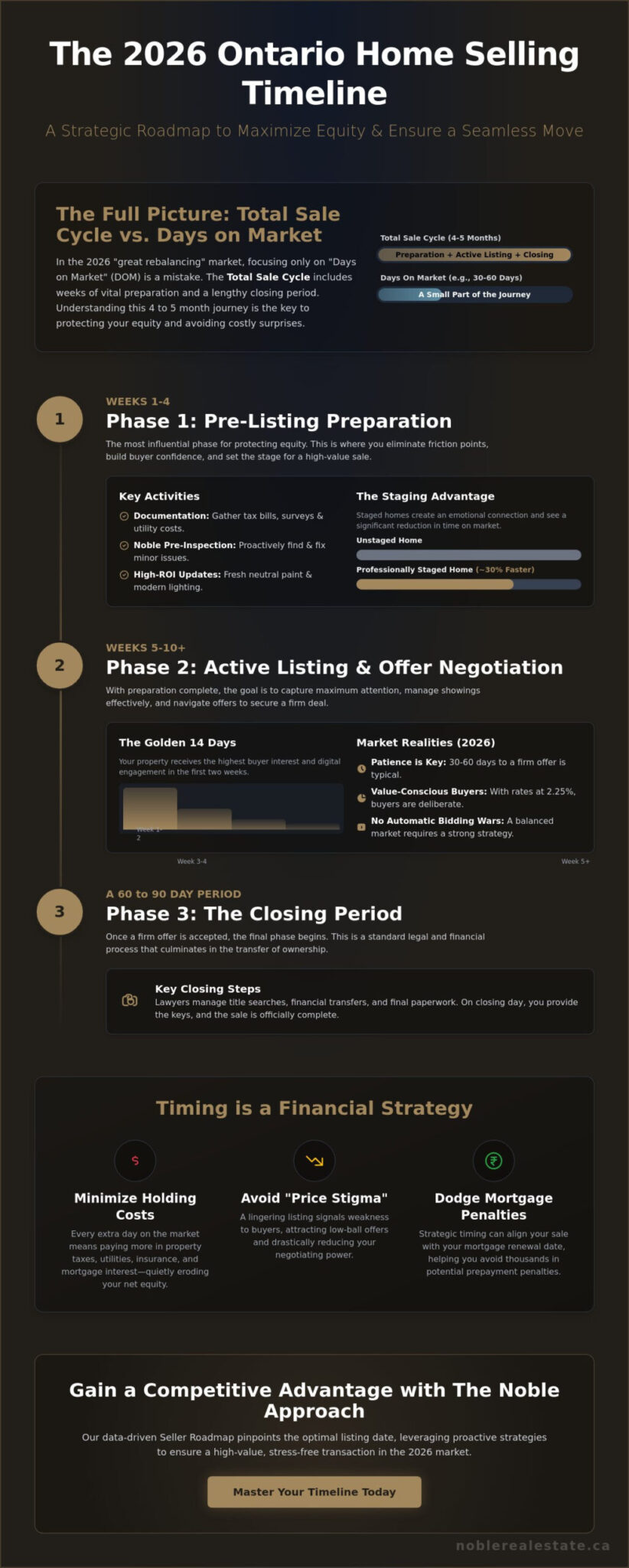
Selling a home is a multi-layered financial operation that requires a clear distinction between two critical metrics. Most homeowners focus exclusively on “Days on Market” (DOM), which represents the time from the initial listing to an accepted offer. However, the true home selling timeline ontario encompasses the “Total Sale Cycle.” This broader view includes the weeks of preparation before the sign hits the lawn and the typical 60 to 90 day closing period that follows. In 2026, the Ontario market has entered what experts call the “great rebalancing.” Buyers are more deliberate, inventory is higher, and the frantic pace of previous years has been replaced by a more structured environment.
Every day your property remains unsold, you’re incurring “holding costs.” These are the cumulative expenses of property taxes, insurance, utilities, and mortgage interest that quietly erode your net equity. In a market where the Bank of Canada has held the policy interest rate at 2.25%, the buyer pool is active but incredibly value-conscious. They aren’t rushing into impulse purchases. Understanding what is a real estate transaction helps you recognize that efficiency is your best tool for protecting your investment. You should plan for a total journey that spans four to five months to ensure a seamless transition.
The CPA Perspective: Why Timing is a Financial Strategy
A stale listing is more than a minor delay; it creates a “price stigma” that invites low-ball offers and weakens your negotiating position. From a financial standpoint, your timeline should also align with mortgage renewal dates to avoid unnecessary prepayment penalties. Strategic timing ensures you capitalize on the “Golden 14 Days,” which is the two-week window when your property receives the highest level of buyer interest and digital engagement. By front-loading the effort, you protect your equity from the “death by a thousand cuts” that comes with a lingering listing.
Setting Realistic Expectations for 2026
The era of automatic bidding wars has largely faded, replaced by a balanced market where buyers have genuine choice. In areas like the Durham Region, securing a firm offer now typically takes between 30 and 60 days. It’s common for sellers to experience an emotional cycle during this first month. You might start with high adrenaline, which can dip into anxiety if an offer doesn’t materialize in the first week. Don’t let the shift in market rhythm rattle you. A balanced market simply requires more patience and a more disciplined approach to pricing and presentation than the “bidding war” era demanded.
Phase 1: The Pre-Listing Preparation (Weeks 1-4)
The foundation of a successful transaction is laid weeks before your property appears on the MLS. In the 2026 Ontario market, the first month of your home selling timeline ontario is dedicated to eliminating friction points that could derail a deal later. This phase isn’t just about cleaning; it’s a strategic period where your home’s equity is either protected or put at risk. A key part of this process involves gathering essential documentation like property tax bills, recent utility costs, and updated surveys to provide total transparency to cautious buyers.
Consulting RECO’s guide to selling a home ensures you understand your legal disclosures and rights from the outset. To further solidify buyer confidence, we employ the “Noble Approach” to pre-listing inspections. By identifying and addressing minor repairs early, you remove the buyer’s ability to negotiate price drops based on inspection findings. This proactive stance positions you as a transparent seller, which is invaluable when buyers have more inventory to choose from and are looking for reasons to move to the next listing.
Strategic Staging and Decluttering
Visual presentation is a primary driver of value. Industry reports suggest that professionally staged homes can see a reduction in “Days on Market” by approximately 30% compared to vacant or unstaged properties. You should focus on high-ROI updates like fresh neutral paint, modern lighting fixtures, and enhancing curb appeal to create an immediate emotional connection. For those in specific local markets, these 5 staging tips to sell your Uxbridge home fast provide a targeted checklist for maximizing your property’s appeal.
Professional Marketing Launch
Once the physical space is ready, the digital launch follows a strict schedule. This includes high-definition photography, 3D virtual tours, and detailed floor plans, which are standard expectations for 2026 buyers. In communities across Durham, a “Coming Soon” strategy can be used to build early momentum and gauge interest before the official launch. The final step of this phase is setting a listing price based on the most recent 2026 comparables, ensuring your entry into the market is both competitive and data-driven. If you’re curious about how your property compares to recent sales, a professional home valuation is the most reliable starting point for your journey.
Phase 2 & 3: From Active Listing to the Firm Offer
Once the listing goes live, the clock starts on the most active portion of the home selling timeline ontario. Usually, the first 14 to 28 days represent the peak showing window. This is when high-intent buyers, who have been monitoring the market for new inventory, schedule their viewings. Managing this schedule doesn’t have to disrupt your life if you establish clear boundaries early. We recommend setting specific showing blocks to maintain a sense of normalcy while ensuring your home remains accessible during high-traffic times like weekends and early evenings. This structured approach keeps the momentum high without causing seller burnout.
In the 2026 market, an Ontario offer is a precise legal document that requires careful analysis. It includes an “irrevocable period,” which is the timeframe the buyer gives you to accept, decline, or counter their proposal. You’ll also see a deposit requirement, often around 5% of the purchase price, which is held in trust as a sign of good faith. The “conditional period” is the next critical hurdle. This phase usually lasts 5 to 7 business days, allowing the buyer to finalize financing and conduct a home inspection. In a balanced market, these conditions are standard. They require a patient, professional approach to ensure the deal doesn’t collapse over minor technicalities.
The Offer Negotiation Process
Negotiating isn’t just about the highest price; it’s about the cleanest terms. While multiple offers are less frequent in the current rebalanced market, they still occur for well-priced properties in high-demand pockets of Durham. A single, strong offer with a significant deposit and few conditions can often be more financially secure than a higher price tag riddled with complex contingencies. The “firm up” date, which is when all conditions are removed and the deal becomes legally binding, is your true milestone for financial planning. For a deeper look at local strategies, see our guide on Navigating Offers on Your Uxbridge Property.
Closing the Gap: The 30-90 Day Window
After the offer becomes firm, you enter the final closing period. While Ontario transactions can range from 30 to 90 days, 60 days is often considered the “sweet spot” for a smooth transition. It provides enough time for you to coordinate your move and for the buyer to finalize mortgage instructions without unnecessary stress. Your real estate lawyer takes the lead during this phase, handling the title transfer and ensuring all financial adjustments for property taxes and utilities are accurate. If a buyer requests a timeline extension, it’s usually due to administrative delays. We manage these requests with a focus on protecting your equity, often requiring additional deposit funds to secure the new date.
Factors That Can Accelerate or Delay Your Ontario Sale
The home selling timeline ontario isn’t a fixed set of dates; it’s a strategic variable influenced by local geography, property type, and market psychology. Seasonality remains a powerful driver, though the “Spring Market” in Ontario often ignites much earlier than homeowners anticipate. Serious buyers typically begin their search in late February or early March to secure a move-in date before the new school year. If you wait until May to list, you might find yourself competing with a surge of inventory that dilutes buyer attention and extends your time on market.
Property type also dictates the rhythm of the sale. While a well-priced townhome in a commuter hub might see a firm offer within 21 days, luxury estates in Durham often require a more patient 60 to 90 day window to find the right qualified buyer. The most significant self-imposed delay, however, is the “Price Trap.” In the balanced 2026 market, overpricing your home by even 5% can immediately add 45 or more days to your timeline. This delay often leads to a stale listing, forcing a price correction that typically results in a lower net return than if the home had been priced accurately from day one.
The Durham Region Advantage
Inventory levels in Uxbridge have stabilized throughout 2026, providing a healthy environment for both sides of the transaction. Demand remains resilient in pockets that offer a unique lifestyle balance, such as the charm found in Goodwood. This area has seen a steady influx of buyers drawn to the community’s character and improved transit links. These infrastructure enhancements have effectively shortened the “commuter belt,” making Durham properties a high-velocity option for those migrating away from the core of downtown Toronto.
Operational Friction Points
Even with a perfect listing, operational hurdles can slow your progress. Delayed appraisals are a common friction point in 2026. If a buyer’s lender contests the valuation, it can jeopardize financing and push your closing date back by weeks. You can mitigate this risk through pre-inspections and by providing a comprehensive “Home Features” dossier that justifies your asking price to the appraiser. Additionally, be prepared for “Sale of Buyer Property” (SBP) conditions. In a rebalanced market, buyers often need to sell their current home before finalizing the purchase of yours. We manage these contingencies with specific “escape clauses” to ensure your timeline remains protected. To see how these factors apply to your specific property, you can request a personalized Seller Roadmap today.
The Noble Approach: Strategic Timing for Maximum Equity
A successful sale in 2026 is never the result of luck; it’s the outcome of a disciplined, data-driven methodology. The Noble Approach treats your home selling timeline ontario as a financial lever, using high-level market analysis to pinpoint the exact window when buyer demand and inventory levels align in your favor. We move beyond generic market averages to look at specific absorption rates in your neighborhood. This analytical rigor ensures we aren’t just listing your home, but launching it with a strategy designed to maximize your net equity and minimize unnecessary holding costs.
Every homeowner’s journey is unique, which is why we provide a personalized Seller Roadmap tailored to your specific relocation goals. This roadmap acts as your master plan, synchronizing the physical preparation of your property with the legal and financial milestones of an Ontario sale. By leveraging deep regional expertise in Durham and Uxbridge, we can identify the specific buyer profiles most likely to value your home’s unique features. This targeted approach, combined with transparent communication, removes the guesswork and provides the reassurance you need for a stress-free transition to your next property.
Your Next Steps for a Successful 2026 Sale
The first step in taking control of your timeline is establishing a baseline through a professional home valuation. This isn’t just a number; it’s a strategic assessment that informs your entire selling strategy. Once you have a clear understanding of your property’s current market position, you can review your long-term financial goals with an advisor who understands the CPA perspective of real estate. Finding the right partner is essential to this process, so we encourage you to explore our guide on Choosing Real Estate Agents Near You to ensure your objectives are handled with the highest standard of care.
Final Preparation Checklist
Staying organized is the most effective way to reduce anxiety during a move. Our clients use the Noble Real Estate seller portal to track these five key milestones in real-time:
- Valuation & Strategy: Establishing the listing price and the optimal “Coming Soon” date.
- The Prep Phase: Completing high-ROI updates and professional staging.
- Market Launch: Executing the 3D tour and digital marketing campaign.
- The Firm Date: Successfully navigating the conditional period to secure a binding agreement.
- Closing Coordination: Finalizing title transfer with your lawyer for a seamless move-out.
Success in the 2026 market requires more than a sign on the lawn; it requires a partner committed to a higher, more principled standard of service. If you’re ready to see how strategic timing can protect your equity, Book a Strategic Consultation with Colin Noble today.
Secure Your Financial Future with Strategic Timing
Success in Ontario’s rebalanced 2026 market isn’t about rushing to the finish line. It’s about recognizing that your greatest financial gains are secured during the initial pre-listing phase. By focusing on high-ROI updates and professional valuation early, you protect your equity from the “price trap” that often catches unprepared sellers. Mastering the home selling timeline ontario means aligning your personal move-out goals with the analytical rigor of a CPA-led financial strategy. This ensures every decision is backed by data rather than emotion.
As an Uxbridge local market expert, I’ve seen how a personalized approach respects both your timeline and your bottom line. You don’t have to navigate these complex legal and financial milestones alone. With the right roadmap, you can move forward with total confidence and clarity. Take the first step toward a stress-free sale by visiting our site to Download Your Custom 2026 Home Selling Timeline Checklist. We’re here to ensure your next chapter starts on the strongest possible financial footing. Your goals are achievable, and we look forward to helping you reach them.
Frequently Asked Questions
How long does it take to sell a house in Ontario on average in 2026?
In 2026, the total home selling timeline ontario typically spans four to five months from the initial consultation to the final closing. While the average time to secure a firm offer is currently between 30 and 60 days, the subsequent closing period usually requires another 60 to 90 days. This balanced market pace allows both parties to conduct thorough due diligence without the frantic pressure seen in previous years.
What is the fastest way to sell my home in the Durham Region?
The fastest way to secure a sale in Durham is through aggressive pre-listing preparation and a data-driven pricing strategy. By addressing repairs before listing and pricing your home based on the most recent 2026 comparables, you avoid the “price trap” that leads to stale listings. Homes that are move-in ready and strategically priced often see firm offers closer to the 30-day mark rather than the 60-day regional average.
Can I sell my house and buy another one at the same time in Ontario?
You can manage a simultaneous sale and purchase, but it requires precise coordination of your closing dates. Most sellers use bridge financing to cover the gap between buying their new property and receiving the funds from their current sale. Including a “Sale of Buyer Property” condition can provide extra security, but many professionals recommend securing a firm sale of your current home before committing to a new purchase to protect your equity.
What happens on the actual closing day in Ontario?
Closing day is the formal process where legal title is transferred from the seller to the buyer and funds are exchanged. Your real estate lawyer handles the electronic registration of the deed and ensures all outstanding property taxes and utilities are adjusted. Once the lender releases the mortgage funds and the transaction is registered, you’ll be notified that the keys are ready for the new owners, usually by late afternoon.
How much time should I allow for home staging and repairs?
You should generally allocate two to four weeks for the pre-listing preparation phase. This window allows enough time for professional staging, minor repairs, and deep cleaning without feeling rushed. Since the first 14 days on the market are the most critical for buyer engagement, front-loading this effort ensures your home makes the strongest possible digital and physical impression from the moment it goes live.
Is the “Days on Market” stat the most important metric for sellers?
While “Days on Market” is a useful indicator of buyer interest, your net equity and the total sale cycle are more vital for your financial health. A quick sale at a lower price point isn’t always superior to a slightly longer timeline that yields a higher sale price. Focus on the overall home selling timeline ontario to ensure your move-out date and financial results align with your long-term objectives.
Does the time of year really affect the home selling timeline?
Seasonality significantly impacts buyer volume, with the spring market from March to May remaining the peak selling window in Ontario. However, the fall market is a strategic choice for sellers because it attracts serious buyers motivated to close before the winter holidays. While spring may offer more showings, the reduced competition in the fall can sometimes lead to a more efficient and predictable transaction process.
What are the legal steps required to finalize a sale in Ontario?
Finalizing a sale involves three primary legal phases: the acceptance of a formal Agreement of Purchase and Sale, the satisfaction of all conditions, and the final title transfer. During the 5 to 7 business day conditional period, buyers typically finalize financing and inspections. Your lawyer then conducts a title search to ensure there are no liens on the property before overseeing the final exchange of funds and legal documents on closing day.
Most homeowners believe the fastest sale is the best sale, but in Ontario’s 2026 “great rebalancing” market, speed without a strategy is the quickest way to leave equity on the table. Understanding the home selling timeline ontario requires more than just picking a date on a calendar; it demands a calculated approach to a landscape where buyers are more deliberate and inventory levels have climbed. You’ve likely felt the weight of uncertainty, wondering if your house might sit on the market or if you’ll end up stuck with overlapping mortgage payments.
It’s natural to feel anxious about the moving parts of a sale, especially when legal requirements and closing dates feel like a moving target. This guide provides a strategic roadmap to master the 2026 real estate calendar, ensuring you protect your equity while securing a predictable move-out date. We’ll walk through the essential phases of the typical four to five month selling journey, from the initial valuation to the final 60 to 90 day closing period, so your next transition is as seamless as possible.
Key Takeaways
- Understand the critical difference between “Days on Market” and the total sale cycle to ensure your move-out date aligns perfectly with your next property.
- Discover why the first four weeks of pre-listing preparation are the most influential phase for protecting your home’s equity and preventing market stagnation.
- Navigate the home selling timeline ontario by identifying the peak two-to-four-week activity window and managing showings without disrupting your daily life.
- Learn how regional nuances and 2026 seasonal shifts can significantly accelerate or delay your closing, requiring a tailored approach for different Ontario communities.
- Gain a competitive advantage using a data-driven Seller Roadmap to pinpoint the optimal listing date for a high-value, stress-free transaction.
Navigating the Home Selling Timeline in Ontario: What to Expect in 2026
Selling a home is a multi-layered financial operation that requires a clear distinction between two critical metrics. Most homeowners focus exclusively on “Days on Market” (DOM), which represents the time from the initial listing to an accepted offer. However, the true home selling timeline ontario encompasses the “Total Sale Cycle.” This broader view includes the weeks of preparation before the sign hits the lawn and the typical 60 to 90 day closing period that follows. In 2026, the Ontario market has entered what experts call the “great rebalancing.” Buyers are more deliberate, inventory is higher, and the frantic pace of previous years has been replaced by a more structured environment.
Every day your property remains unsold, you’re incurring “holding costs.” These are the cumulative expenses of property taxes, insurance, utilities, and mortgage interest that quietly erode your net equity. In a market where the Bank of Canada has held the policy interest rate at 2.25%, the buyer pool is active but incredibly value-conscious. They aren’t rushing into impulse purchases. Understanding what is a real estate transaction helps you recognize that efficiency is your best tool for protecting your investment. You should plan for a total journey that spans four to five months to ensure a seamless transition.
The CPA Perspective: Why Timing is a Financial Strategy
A stale listing is more than a minor delay; it creates a “price stigma” that invites low-ball offers and weakens your negotiating position. From a financial standpoint, your timeline should also align with mortgage renewal dates to avoid unnecessary prepayment penalties. Strategic timing ensures you capitalize on the “Golden 14 Days,” which is the two-week window when your property receives the highest level of buyer interest and digital engagement. By front-loading the effort, you protect your equity from the “death by a thousand cuts” that comes with a lingering listing.
Setting Realistic Expectations for 2026
The era of automatic bidding wars has largely faded, replaced by a balanced market where buyers have genuine choice. In areas like the Durham Region, securing a firm offer now typically takes between 30 and 60 days. It’s common for sellers to experience an emotional cycle during this first month. You might start with high adrenaline, which can dip into anxiety if an offer doesn’t materialize in the first week. Don’t let the shift in market rhythm rattle you. A balanced market simply requires more patience and a more disciplined approach to pricing and presentation than the “bidding war” era demanded.
Phase 1: The Pre-Listing Preparation (Weeks 1-4)
The foundation of a successful transaction is laid weeks before your property appears on the MLS. In the 2026 Ontario market, the first month of your home selling timeline ontario is dedicated to eliminating friction points that could derail a deal later. This phase isn’t just about cleaning; it’s a strategic period where your home’s equity is either protected or put at risk. A key part of this process involves gathering essential documentation like property tax bills, recent utility costs, and updated surveys to provide total transparency to cautious buyers.
Consulting RECO’s guide to selling a home ensures you understand your legal disclosures and rights from the outset. To further solidify buyer confidence, we employ the “Noble Approach” to pre-listing inspections. By identifying and addressing minor repairs early, you remove the buyer’s ability to negotiate price drops based on inspection findings. This proactive stance positions you as a transparent seller, which is invaluable when buyers have more inventory to choose from and are looking for reasons to move to the next listing.
Strategic Staging and Decluttering
Visual presentation is a primary driver of value. Industry reports suggest that professionally staged homes can see a reduction in “Days on Market” by approximately 30% compared to vacant or unstaged properties. You should focus on high-ROI updates like fresh neutral paint, modern lighting fixtures, and enhancing curb appeal to create an immediate emotional connection. For those in specific local markets, these 5 staging tips to sell your Uxbridge home fast provide a targeted checklist for maximizing your property’s appeal.
Professional Marketing Launch
Once the physical space is ready, the digital launch follows a strict schedule. This includes high-definition photography, 3D virtual tours, and detailed floor plans, which are standard expectations for 2026 buyers. In communities across Durham, a “Coming Soon” strategy can be used to build early momentum and gauge interest before the official launch. The final step of this phase is setting a listing price based on the most recent 2026 comparables, ensuring your entry into the market is both competitive and data-driven. If you’re curious about how your property compares to recent sales, a professional home valuation is the most reliable starting point for your journey.
Phase 2 & 3: From Active Listing to the Firm Offer
Once the listing goes live, the clock starts on the most active portion of the home selling timeline ontario. Usually, the first 14 to 28 days represent the peak showing window. This is when high-intent buyers, who have been monitoring the market for new inventory, schedule their viewings. Managing this schedule doesn’t have to disrupt your life if you establish clear boundaries early. We recommend setting specific showing blocks to maintain a sense of normalcy while ensuring your home remains accessible during high-traffic times like weekends and early evenings. This structured approach keeps the momentum high without causing seller burnout.
In the 2026 market, an Ontario offer is a precise legal document that requires careful analysis. It includes an “irrevocable period,” which is the timeframe the buyer gives you to accept, decline, or counter their proposal. You’ll also see a deposit requirement, often around 5% of the purchase price, which is held in trust as a sign of good faith. The “conditional period” is the next critical hurdle. This phase usually lasts 5 to 7 business days, allowing the buyer to finalize financing and conduct a home inspection. In a balanced market, these conditions are standard. They require a patient, professional approach to ensure the deal doesn’t collapse over minor technicalities.
The Offer Negotiation Process
Negotiating isn’t just about the highest price; it’s about the cleanest terms. While multiple offers are less frequent in the current rebalanced market, they still occur for well-priced properties in high-demand pockets of Durham. A single, strong offer with a significant deposit and few conditions can often be more financially secure than a higher price tag riddled with complex contingencies. The “firm up” date, which is when all conditions are removed and the deal becomes legally binding, is your true milestone for financial planning. For a deeper look at local strategies, see our guide on Navigating Offers on Your Uxbridge Property.
Closing the Gap: The 30-90 Day Window
After the offer becomes firm, you enter the final closing period. While Ontario transactions can range from 30 to 90 days, 60 days is often considered the “sweet spot” for a smooth transition. It provides enough time for you to coordinate your move and for the buyer to finalize mortgage instructions without unnecessary stress. Your real estate lawyer takes the lead during this phase, handling the title transfer and ensuring all financial adjustments for property taxes and utilities are accurate. If a buyer requests a timeline extension, it’s usually due to administrative delays. We manage these requests with a focus on protecting your equity, often requiring additional deposit funds to secure the new date.
Factors That Can Accelerate or Delay Your Ontario Sale
The home selling timeline ontario isn’t a fixed set of dates; it’s a strategic variable influenced by local geography, property type, and market psychology. Seasonality remains a powerful driver, though the “Spring Market” in Ontario often ignites much earlier than homeowners anticipate. Serious buyers typically begin their search in late February or early March to secure a move-in date before the new school year. If you wait until May to list, you might find yourself competing with a surge of inventory that dilutes buyer attention and extends your time on market.
Property type also dictates the rhythm of the sale. While a well-priced townhome in a commuter hub might see a firm offer within 21 days, luxury estates in Durham often require a more patient 60 to 90 day window to find the right qualified buyer. The most significant self-imposed delay, however, is the “Price Trap.” In the balanced 2026 market, overpricing your home by even 5% can immediately add 45 or more days to your timeline. This delay often leads to a stale listing, forcing a price correction that typically results in a lower net return than if the home had been priced accurately from day one.
The Durham Region Advantage
Inventory levels in Uxbridge have stabilized throughout 2026, providing a healthy environment for both sides of the transaction. Demand remains resilient in pockets that offer a unique lifestyle balance, such as the charm found in Goodwood. This area has seen a steady influx of buyers drawn to the community’s character and improved transit links. These infrastructure enhancements have effectively shortened the “commuter belt,” making Durham properties a high-velocity option for those migrating away from the core of downtown Toronto.
Operational Friction Points
Even with a perfect listing, operational hurdles can slow your progress. Delayed appraisals are a common friction point in 2026. If a buyer’s lender contests the valuation, it can jeopardize financing and push your closing date back by weeks. You can mitigate this risk through pre-inspections and by providing a comprehensive “Home Features” dossier that justifies your asking price to the appraiser. Additionally, be prepared for “Sale of Buyer Property” (SBP) conditions. In a rebalanced market, buyers often need to sell their current home before finalizing the purchase of yours. We manage these contingencies with specific “escape clauses” to ensure your timeline remains protected. To see how these factors apply to your specific property, you can request a personalized Seller Roadmap today.
The Noble Approach: Strategic Timing for Maximum Equity
A successful sale in 2026 is never the result of luck; it’s the outcome of a disciplined, data-driven methodology. The Noble Approach treats your home selling timeline ontario as a financial lever, using high-level market analysis to pinpoint the exact window when buyer demand and inventory levels align in your favor. We move beyond generic market averages to look at specific absorption rates in your neighborhood. This analytical rigor ensures we aren’t just listing your home, but launching it with a strategy designed to maximize your net equity and minimize unnecessary holding costs.
Every homeowner’s journey is unique, which is why we provide a personalized Seller Roadmap tailored to your specific relocation goals. This roadmap acts as your master plan, synchronizing the physical preparation of your property with the legal and financial milestones of an Ontario sale. By leveraging deep regional expertise in Durham and Uxbridge, we can identify the specific buyer profiles most likely to value your home’s unique features. This targeted approach, combined with transparent communication, removes the guesswork and provides the reassurance you need for a stress-free transition to your next property.
Your Next Steps for a Successful 2026 Sale
The first step in taking control of your timeline is establishing a baseline through a professional home valuation. This isn’t just a number; it’s a strategic assessment that informs your entire selling strategy. Once you have a clear understanding of your property’s current market position, you can review your long-term financial goals with an advisor who understands the CPA perspective of real estate. Finding the right partner is essential to this process, so we encourage you to explore our guide on Choosing Real Estate Agents Near You to ensure your objectives are handled with the highest standard of care.
Final Preparation Checklist
Staying organized is the most effective way to reduce anxiety during a move. Our clients use the Noble Real Estate seller portal to track these five key milestones in real-time:
- Valuation & Strategy: Establishing the listing price and the optimal “Coming Soon” date.
- The Prep Phase: Completing high-ROI updates and professional staging.
- Market Launch: Executing the 3D tour and digital marketing campaign.
- The Firm Date: Successfully navigating the conditional period to secure a binding agreement.
- Closing Coordination: Finalizing title transfer with your lawyer for a seamless move-out.
Success in the 2026 market requires more than a sign on the lawn; it requires a partner committed to a higher, more principled standard of service. If you’re ready to see how strategic timing can protect your equity, Book a Strategic Consultation with Colin Noble today.
Secure Your Financial Future with Strategic Timing
Success in Ontario’s rebalanced 2026 market isn’t about rushing to the finish line. It’s about recognizing that your greatest financial gains are secured during the initial pre-listing phase. By focusing on high-ROI updates and professional valuation early, you protect your equity from the “price trap” that often catches unprepared sellers. Mastering the home selling timeline ontario means aligning your personal move-out goals with the analytical rigor of a CPA-led financial strategy. This ensures every decision is backed by data rather than emotion.
As an Uxbridge local market expert, I’ve seen how a personalized approach respects both your timeline and your bottom line. You don’t have to navigate these complex legal and financial milestones alone. With the right roadmap, you can move forward with total confidence and clarity. Take the first step toward a stress-free sale by visiting our site to Download Your Custom 2026 Home Selling Timeline Checklist. We’re here to ensure your next chapter starts on the strongest possible financial footing. Your goals are achievable, and we look forward to helping you reach them.
Frequently Asked Questions
How long does it take to sell a house in Ontario on average in 2026?
In 2026, the total home selling timeline ontario typically spans four to five months from the initial consultation to the final closing. While the average time to secure a firm offer is currently between 30 and 60 days, the subsequent closing period usually requires another 60 to 90 days. This balanced market pace allows both parties to conduct thorough due diligence without the frantic pressure seen in previous years.
What is the fastest way to sell my home in the Durham Region?
The fastest way to secure a sale in Durham is through aggressive pre-listing preparation and a data-driven pricing strategy. By addressing repairs before listing and pricing your home based on the most recent 2026 comparables, you avoid the “price trap” that leads to stale listings. Homes that are move-in ready and strategically priced often see firm offers closer to the 30-day mark rather than the 60-day regional average.
Can I sell my house and buy another one at the same time in Ontario?
You can manage a simultaneous sale and purchase, but it requires precise coordination of your closing dates. Most sellers use bridge financing to cover the gap between buying their new property and receiving the funds from their current sale. Including a “Sale of Buyer Property” condition can provide extra security, but many professionals recommend securing a firm sale of your current home before committing to a new purchase to protect your equity.
What happens on the actual closing day in Ontario?
Closing day is the formal process where legal title is transferred from the seller to the buyer and funds are exchanged. Your real estate lawyer handles the electronic registration of the deed and ensures all outstanding property taxes and utilities are adjusted. Once the lender releases the mortgage funds and the transaction is registered, you’ll be notified that the keys are ready for the new owners, usually by late afternoon.
How much time should I allow for home staging and repairs?
You should generally allocate two to four weeks for the pre-listing preparation phase. This window allows enough time for professional staging, minor repairs, and deep cleaning without feeling rushed. Since the first 14 days on the market are the most critical for buyer engagement, front-loading this effort ensures your home makes the strongest possible digital and physical impression from the moment it goes live.
Is the “Days on Market” stat the most important metric for sellers?
While “Days on Market” is a useful indicator of buyer interest, your net equity and the total sale cycle are more vital for your financial health. A quick sale at a lower price point isn’t always superior to a slightly longer timeline that yields a higher sale price. Focus on the overall home selling timeline ontario to ensure your move-out date and financial results align with your long-term objectives.
Does the time of year really affect the home selling timeline?
Seasonality significantly impacts buyer volume, with the spring market from March to May remaining the peak selling window in Ontario. However, the fall market is a strategic choice for sellers because it attracts serious buyers motivated to close before the winter holidays. While spring may offer more showings, the reduced competition in the fall can sometimes lead to a more efficient and predictable transaction process.
What are the legal steps required to finalize a sale in Ontario?
Finalizing a sale involves three primary legal phases: the acceptance of a formal Agreement of Purchase and Sale, the satisfaction of all conditions, and the final title transfer. During the 5 to 7 business day conditional period, buyers typically finalize financing and inspections. Your lawyer then conducts a title search to ensure there are no liens on the property before overseeing the final exchange of funds and legal documents on closing day.
Read More Posts



Looking For More Great Content?
Get even more informative Toronto real estate news sent directly to your inbox by signing up for my newsletter here. All it takes is a few easy clicks.
Uxbridge Property Values by Street: A Guide to Local Micro-Markets
05/13/26 Uncategorized
Why did a home on Turner Farm Road sell for $789,900 in April 2026 while a property just a few minutes away fetched a vastly different price? In our local market, the “average price” is often a myth because value is dictated by “Streetscape Integrity,” a unique blend of lot depth, historic preservation, and trail access that varies from one block to the next.
It’s understandable if you feel frustrated by conflicting data from automated valuation sites or the gap between your MPAC tax assessment and actual market reality. You likely recognize that Uxbridge is a very competitive seller’s market, but broad statistics like the April median sale price of $629,990 don’t capture the nuances of your specific neighborhood. This guide will help you accurately assess uxbridge property values by street by identifying the micro-market factors that truly drive your home’s worth. We’ll explore why certain corridors are considered premium, how to interpret the $12.68 residential tax rate, and what recent sales on streets like Chocolog Road mean for your equity. You’ll gain a clear, realistic expectation of your property’s value in today’s shifting landscape through a lens of professional, analytical rigor.
Key Takeaways
- Learn why town-wide averages often fail to reflect your home’s true worth and how “micro-market” factors dictate local pricing.
- Identify the critical impact of lot dimensions and architectural consistency on protecting your long-term equity.
- Discover the unique characteristics of Uxbridge’s premium corridors, from historic estate streets to modern luxury developments.
- Gain a clear methodology for assessing uxbridge property values by street using true comparable sales and lot variance adjustments.
- Understand how blending high-level financial analysis with deep community roots provides a more transparent and stress-reducing valuation experience.
Beyond the Average: Why Uxbridge Property Values Vary by Street
While broad data points like the April 2026 median home sale price of $629,990 provide a helpful starting point, they rarely reflect the reality of your specific driveway. Understanding uxbridge property values by street requires looking past town-wide averages to identify local micro-markets. In the Durham Region, a micro-market is a small, distinct pocket where specific features like mature tree canopies or proximity to the trail system create a pricing ecosystem separate from the rest of the township. You might see a home sell for a premium simply because it sits on a block with a specific “feel” that neighboring streets lack.
Buyers are subconsciously drawn to “Streetscape Integrity.” This refers to how well the homes on a block complement one another. When a street maintains a consistent architectural character and uniform lot maintenance, it builds a sense of permanence that protects your equity. In our current competitive seller’s market, where prices rose 18.4% in March 2026 compared to the previous year, this integrity often acts as the deciding factor between a standard sale and a record-breaking one. Information About Uxbridge shows a rich history that directly influences these values today, as historic designations and geographic constraints limit new supply in high-demand areas.
The “Two-Block” Rule in Uxbridge Real Estate
Crossing a major artery like Brock Street can result in a value shift of 10% to 15%. This isn’t accidental. It’s the result of how historic zoning near the downtown core creates a value “halo” effect. Streets within walking distance of local shops often command a premium because they offer a lifestyle that newer, more isolated subdivisions cannot replicate. Proximity matters. A street located just two blocks closer to the town center often benefits from higher demand, even if the house itself is identical to one further out.
Market Value vs. MPAC Assessment
Don’t confuse your tax bill with your potential sale price. The Township of Uxbridge applies a residential tax rate of $12.68 per $1,000 of assessed value. However, MPAC assessments often lag behind the real-time market. While 41 homes sold in April 2026 with an average of just 23 days on the market, government assessments may still be reflecting data from years prior. Think of your assessment as a baseline for your value, not the ceiling. To get a true sense of uxbridge property values by street, you must look at the sale-to-list price ratio, which recently sat at a healthy 99.1%.
The 4 Key Drivers of Street-Level Value in Uxbridge
Determining uxbridge property values by street requires an analytical look at the specific characteristics that transform a simple address into a high-demand asset. While market trends provide the momentum, street-level drivers provide the stability. In our local market, value is rarely about the structure alone. It’s about the land it sits on and the immediate environment that surrounds it. We see this clearly in how buyers prioritize certain blocks over others, often willing to pay a premium for specific “lifestyle” anchors that don’t appear in a standard tax assessment.
There are four primary drivers that influence these micro-market valuations:
- Lot Dimensions and Topography: In Uxbridge, “depth” is the premium currency. A lot that offers an extra 20 or 30 feet of backyard space provides a level of privacy that is increasingly rare in the Greater Toronto Area.
- Architectural Consistency: A uniform streetscape where homes share a similar scale and aesthetic protects long-term equity. It prevents the “eyesore” effect that can occur when mismatched developments sit side-by-side.
- The “Trailhead” Premium: As the Trail Capital of Canada, direct access to the Uxbridge Trail System is a major value multiplier. Properties that back onto or sit within a short walk of these paths see higher demand.
- School Catchment Zones: Addresses within the Durham District School Board boundaries are highly sought after. Families often target specific streets to ensure their children have access to preferred local schools like Joseph Gould or Uxbridge Secondary.
While the Valuation Office Agency (VOA) provides a global perspective on how government bodies approach property assessment for taxation, local market value is driven by these nuanced, community-specific factors. If you’re curious about how these drivers apply to your own home, a professional home valuation can provide a data-driven look at your specific street’s performance.
Lot Depth and the Oak Ridges Moraine Influence
The Oak Ridges Moraine significantly shapes the north-end streets of Uxbridge. Here, mature tree canopies and rolling topography aren’t just scenic; they’re valuable assets. Ravine-backed lots often command a much higher price than standard lots because they offer permanent privacy. While conservation easements can sometimes limit where you can build a shed or a pool, they also guarantee that your “view” won’t be replaced by a new development. This scarcity of protected land keeps values on these specific streets remarkably resilient.
Infrastructure and Streetscape Amenities
Modern buyers are increasingly sensitive to street-level infrastructure. Streets with buried utilities and no overhead wires feel more open and upscale, which directly impacts buyer psychology. Similarly, the presence of well-maintained sidewalks correlates strongly with demand from young families. Recent road reconstructions in parts of Uxbridge have also provided a noticeable boost to specific street values. New pavement, improved drainage, and updated curbs signal to buyers that the neighborhood is a priority for municipal investment, further solidifying local property values.
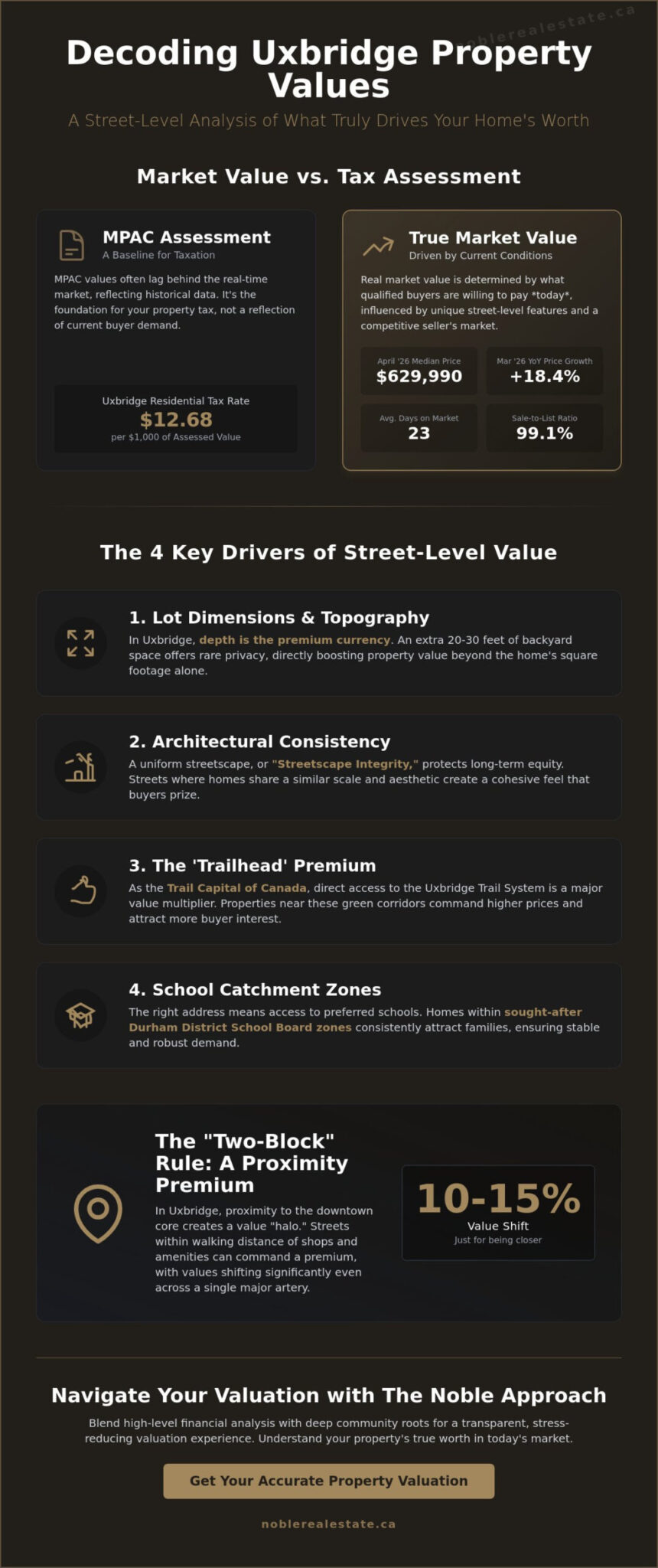
High-Value Corridors: A Look at Uxbridge’s Premium Streets
Identifying uxbridge property values by street requires an eye for both historical significance and future growth potential. In our local market, certain corridors act as value anchors. These streets don’t just follow town trends; they set them. Whether it’s the century-old charm of the downtown core or the gated exclusivity of newer enclaves, these high-value pockets offer stability even when the broader market fluctuates. While the town-wide median sale price reached $629,990 in April 2026, homes on these premium corridors often command significantly higher figures due to their unique “micro-market” status.
The “Noble Approach” to valuation involves more than just looking at recent sales. It’s a method rooted in high-level financial analysis that identifies undervalued pockets before they reach their peak. By examining price-per-square-foot trends and upcoming municipal investments, we can pinpoint streets where values are rising faster than the town average. This analytical rigor ensures that you aren’t just buying a home, but making a sound investment in a street with long-term equity protection. We look for indicators like lot depth and architectural continuity that suggest a street is poised for a value jump.
Historic Downtown vs. Modern Luxury Enclaves
The enduring appeal of the Victoria and Quaker Village areas remains a cornerstone of the local market. These historic “Estate” streets offer a level of character that is impossible to replicate in new developments. It’s why houses for sale in Uxbridge within these specific pockets often see a higher sale-to-list price ratio, which averaged 99.1% across the town in March 2026. In contrast, modern luxury developments like Wyndance and Wooden Sticks offer a different value proposition. These enclaves prioritize lifestyle amenities and large, contemporary floor plans, often resulting in a higher price-per-square-foot than even the most prestigious historic zones.
The Rural-Urban Fringe: Goodwood and Beyond
Property values in Goodwood, Canada and other nearby hamlets offer a unique alternative to Uxbridge proper. These areas have seen a surge in interest, partly fueled by the “Schitt’s Creek” effect which boosted local tourism and brought a new spotlight to the region’s rural charm. Values here are dictated by land size and the privacy afforded by the rural-urban fringe. Street-level trends in these hamlets often show that buyers are willing to trade proximity to the town centre for the expansive lot depths found on the outskirts. This shift has created a robust micro-market where land value often outweighs the value of the structure itself.
How to Estimate Your Property Value at the Curb Level
Discovering the nuances of uxbridge property values by street requires a move away from automated estimates toward a structured, analytical framework. While algorithms provide a broad starting point, they can’t walk your block or see the specific upgrades that set your home apart. To find your home’s true market position, you need to look at the data through a professional lens, focusing on the immediate surroundings that influence buyer psychology. By following a few disciplined steps, you can move past the “average” and find a realistic valuation that reflects current demand.
- Step 1: Identify “True Comps”: Look for recent sales on your exact street or the immediate parallel. With 41 homes sold in Uxbridge in April 2026, there’s fresh data available to help you benchmark your property against similar inventory.
- Step 2: Adjust for Lot Variance: Land is a premium asset here. If a nearby sale had a standard lot but your property features an extra 20 feet of depth or backs onto the Oak Ridges Moraine, your value floor is naturally higher.
- Step 3: Factor in Market Shifts: Stay informed on the local competitive climate. In April 2026, Uxbridge remained a firm seller’s market, where high demand and low inventory created a specific pressure on pricing that broad regional reports often miss.
- Step 4: The Qualitative Audit: Honestly assess your curb appeal, interior upgrades, and environmental factors like street noise. These “curb level” details often explain why one home sells in 23 days while another lingers.
Analyzing “Sold” Data Like a Professional
It’s vital to remember that the “Asking Price” is merely a marketing tactic; the “Sold Price” is the only truth that matters. When you look for recent home sales in your specific neighborhood, you’re looking for the price a buyer was actually willing to pay. Be careful to identify “outlier” sales. A property might sell for an unusually high or low price due to unique circumstances, such as a distressed sale or an off-market deal between family members. These outliers can skew your perception of uxbridge property values by street if you don’t filter them out of your analysis.
The Curb Appeal Multiplier
In a town celebrated for its natural beauty, professional landscaping isn’t just a luxury; it’s a value protector. Buyers in Uxbridge often prioritize homes that feel integrated with the local landscape. Specific upgrades like stone walkways, mature perennial gardens, and updated exterior lighting yield the highest ROI because they create an immediate emotional connection. The Noble Approach prioritizes financial ROI in home staging by focusing exclusively on high-impact aesthetic adjustments that historically correlate with a higher sale-to-list price ratio. If you want to see how your specific street-level features translate into a market-ready figure, you can request a professional home valuation to ground your expectations in real-time data.
Navigating Your Home Valuation with The Noble Approach
A successful real estate strategy starts with data, but it’s finished with insight. Colin Noble brings a background in high-level financial analysis to every client interaction, ensuring that your property isn’t just listed, but strategically positioned. This perspective is vital when assessing uxbridge property values by street, as the differences between a standard lot and a premium corridor can represent significant shifts in equity. Noble Real Estate blends this analytical rigor with deep community roots, creating a valuation process that is both scientifically sound and personally tailored to your objectives.
Our personalized approach goes beyond the standard Comparative Market Analysis. We conduct a thorough audit of the micro-market factors we’ve discussed, from school catchment desirability to the specific topography of the Oak Ridges Moraine. This methodology aims to make complex financial decisions simple and transparent. You deserve a partner who views your home as a significant investment asset, providing a calm, advisory presence that reduces the stress of a high-stakes transaction. We believe that by providing a higher, more principled standard of service, we can elevate your expectations of the industry.
Why a Personal Touch Beats an Algorithm
Algorithms often struggle with the unique variables of the Uxbridge market. AI cannot appreciate the historical significance of a century home near the downtown core or the specific value of a ravine-backed lot on a quiet cul-de-sac. This is why searching for real estate agents near me is about more than finding someone to list a property; it’s about finding a specialist who understands the nuance of street-level pricing. A seasoned advisor recognizes that buyer psychology is influenced by things a computer simply cannot see, such as the “feel” of a uniform streetscape or the value of a specific trailhead proximity.
Your Next Steps in the Uxbridge Market
Taking the next step is straightforward and designed to be stress-free. When you request a Noble Valuation for your specific street address, we begin with a comprehensive data review followed by a professional property walkthrough. We’ll discuss how current market conditions in the Durham Region impact your specific buyer pool and identify which interior upgrades or landscaping features will yield the highest ROI for your specific block. Our goal is to ensure your real estate objectives are achievable and handled with the utmost care, giving you a clear, data-backed path forward in today’s competitive landscape.
Unlock the True Potential of Your Uxbridge Address
Navigating a competitive market requires looking beyond town-wide averages to the specific micro-market factors that define your block. We’ve seen how the “Two-Block Rule,” lot depth, and architectural consistency serve as the true anchors for your equity. Gaining a realistic grasp of uxbridge property values by street ensures you’re making decisions based on real-time demand rather than outdated algorithms or generalized tax assessments.
You deserve a valuation process that mirrors the analytical rigor of a seasoned financial advisor. Led by Colin Noble, our team combines high-level financial expertise with deep roots in the Uxbridge and Durham community. We focus on a personalized, stress-reducing service model that makes the most complex market shifts transparent and manageable for every homeowner we represent.
When you’re ready to move forward with confidence, we’re here to help. Request a Strategic Home Valuation with The Noble Approach to discover the true position of your property in today’s landscape. Your real estate objectives are within reach, and with the right data-driven partnership, your next chapter can be your most successful one yet.
Frequently Asked Questions
How often are property values updated in Uxbridge?
Market values fluctuate with every transaction, but official municipal assessments for tax purposes follow a multi-year cycle managed by MPAC. In a fast-moving environment like April 2026, where 41 homes sold in just 30 days, real-time market value moves much quicker than government records. We recommend reviewing your home’s position annually with a professional to account for these rapid shifts and ensure your equity is protected.
Does living on a cul-de-sac increase my home value in Durham Region?
Living on a cul-de-sac typically commands a premium because it offers enhanced privacy and significantly reduced traffic. Families often prioritize these streets for safety, which drives higher demand and shorter days on market. In the Durham Region, this “quiet-street” premium is a consistent factor when analyzing uxbridge property values by street and can lead to a higher sale-to-list price ratio compared to through-streets.
How do I find out what a house on my street sold for?
You can access specific sale prices through the Uxbridge Assessors’ Office public property record database or by requesting a professional market report. While public records provide the “full and fair cash value” used for taxes, a realtor can provide the vital context behind the sale. This includes whether the home had interior upgrades or if it was an over-ask bid in a competitive seller’s market.
Why is my MPAC assessment lower than what my neighbour just sold for?
MPAC assessments are designed for equitable taxation and often reflect a valuation date from several years in the past. They don’t account for real-time appreciation, which saw Uxbridge prices rise 18.4% in March 2026 compared to the previous year. Your neighbor’s sale price reflects current buyer demand and the competitive nature of the 2026 market, whereas your assessment is a historical baseline for taxes.
Do corner lots have higher property values in Uxbridge?
Corner lots offer more land and visibility, but they don’t always translate to a higher sale price in every micro-market. While the extra square footage is an asset, some buyers avoid them due to increased sidewalk maintenance and a perceived lack of backyard privacy. We evaluate corner lots based on how the specific streetscape utilizes the extra space, such as side-load garages or unique landscaping opportunities that add curb appeal.
What is the most expensive street in Uxbridge, Ontario?
Streets like Turner Farm Road and Chocolog Road frequently see the town’s highest transactions, with sales reaching $789,900 in April 2026. High-end enclaves like Wyndance and Wooden Sticks also consistently set the ceiling for local pricing. These areas are considered premium because they combine large lot depths with modern luxury finishes and exclusive neighborhood amenities that are difficult to replicate in other parts of the township.
How does being near a golf course like Wooden Sticks affect my street value?
Proximity to a prestigious course like Wooden Sticks creates a “prestige halo” that bolsters property values on surrounding blocks. Homes on these streets benefit from “borrowed views” of manicured greens and a perception of exclusivity. This lifestyle factor is a significant driver of uxbridge property values by street, often attracting a specific demographic of buyers who prioritize leisure and scenic environments over downtown proximity.
Will the new development on the edge of town lower my street’s property value?
New developments typically support or even increase existing values by bringing updated infrastructure and new amenities to the area. While construction can be a temporary nuisance, a growing community signals a healthy, high-demand market. Unless a new project significantly obstructs a protected view or increases traffic on a formerly quiet street, the long-term impact on your equity is generally positive as the town’s desirability grows.
Why did a home on Turner Farm Road sell for $789,900 in April 2026 while a property just a few minutes away fetched a vastly different price? In our local market, the “average price” is often a myth because value is dictated by “Streetscape Integrity,” a unique blend of lot depth, historic preservation, and trail access that varies from one block to the next.
It’s understandable if you feel frustrated by conflicting data from automated valuation sites or the gap between your MPAC tax assessment and actual market reality. You likely recognize that Uxbridge is a very competitive seller’s market, but broad statistics like the April median sale price of $629,990 don’t capture the nuances of your specific neighborhood. This guide will help you accurately assess uxbridge property values by street by identifying the micro-market factors that truly drive your home’s worth. We’ll explore why certain corridors are considered premium, how to interpret the $12.68 residential tax rate, and what recent sales on streets like Chocolog Road mean for your equity. You’ll gain a clear, realistic expectation of your property’s value in today’s shifting landscape through a lens of professional, analytical rigor.
Key Takeaways
- Learn why town-wide averages often fail to reflect your home’s true worth and how “micro-market” factors dictate local pricing.
- Identify the critical impact of lot dimensions and architectural consistency on protecting your long-term equity.
- Discover the unique characteristics of Uxbridge’s premium corridors, from historic estate streets to modern luxury developments.
- Gain a clear methodology for assessing uxbridge property values by street using true comparable sales and lot variance adjustments.
- Understand how blending high-level financial analysis with deep community roots provides a more transparent and stress-reducing valuation experience.
Beyond the Average: Why Uxbridge Property Values Vary by Street
While broad data points like the April 2026 median home sale price of $629,990 provide a helpful starting point, they rarely reflect the reality of your specific driveway. Understanding uxbridge property values by street requires looking past town-wide averages to identify local micro-markets. In the Durham Region, a micro-market is a small, distinct pocket where specific features like mature tree canopies or proximity to the trail system create a pricing ecosystem separate from the rest of the township. You might see a home sell for a premium simply because it sits on a block with a specific “feel” that neighboring streets lack.
Buyers are subconsciously drawn to “Streetscape Integrity.” This refers to how well the homes on a block complement one another. When a street maintains a consistent architectural character and uniform lot maintenance, it builds a sense of permanence that protects your equity. In our current competitive seller’s market, where prices rose 18.4% in March 2026 compared to the previous year, this integrity often acts as the deciding factor between a standard sale and a record-breaking one. Information About Uxbridge shows a rich history that directly influences these values today, as historic designations and geographic constraints limit new supply in high-demand areas.
The “Two-Block” Rule in Uxbridge Real Estate
Crossing a major artery like Brock Street can result in a value shift of 10% to 15%. This isn’t accidental. It’s the result of how historic zoning near the downtown core creates a value “halo” effect. Streets within walking distance of local shops often command a premium because they offer a lifestyle that newer, more isolated subdivisions cannot replicate. Proximity matters. A street located just two blocks closer to the town center often benefits from higher demand, even if the house itself is identical to one further out.
Market Value vs. MPAC Assessment
Don’t confuse your tax bill with your potential sale price. The Township of Uxbridge applies a residential tax rate of $12.68 per $1,000 of assessed value. However, MPAC assessments often lag behind the real-time market. While 41 homes sold in April 2026 with an average of just 23 days on the market, government assessments may still be reflecting data from years prior. Think of your assessment as a baseline for your value, not the ceiling. To get a true sense of uxbridge property values by street, you must look at the sale-to-list price ratio, which recently sat at a healthy 99.1%.
The 4 Key Drivers of Street-Level Value in Uxbridge
Determining uxbridge property values by street requires an analytical look at the specific characteristics that transform a simple address into a high-demand asset. While market trends provide the momentum, street-level drivers provide the stability. In our local market, value is rarely about the structure alone. It’s about the land it sits on and the immediate environment that surrounds it. We see this clearly in how buyers prioritize certain blocks over others, often willing to pay a premium for specific “lifestyle” anchors that don’t appear in a standard tax assessment.
There are four primary drivers that influence these micro-market valuations:
- Lot Dimensions and Topography: In Uxbridge, “depth” is the premium currency. A lot that offers an extra 20 or 30 feet of backyard space provides a level of privacy that is increasingly rare in the Greater Toronto Area.
- Architectural Consistency: A uniform streetscape where homes share a similar scale and aesthetic protects long-term equity. It prevents the “eyesore” effect that can occur when mismatched developments sit side-by-side.
- The “Trailhead” Premium: As the Trail Capital of Canada, direct access to the Uxbridge Trail System is a major value multiplier. Properties that back onto or sit within a short walk of these paths see higher demand.
- School Catchment Zones: Addresses within the Durham District School Board boundaries are highly sought after. Families often target specific streets to ensure their children have access to preferred local schools like Joseph Gould or Uxbridge Secondary.
While the Valuation Office Agency (VOA) provides a global perspective on how government bodies approach property assessment for taxation, local market value is driven by these nuanced, community-specific factors. If you’re curious about how these drivers apply to your own home, a professional home valuation can provide a data-driven look at your specific street’s performance.
Lot Depth and the Oak Ridges Moraine Influence
The Oak Ridges Moraine significantly shapes the north-end streets of Uxbridge. Here, mature tree canopies and rolling topography aren’t just scenic; they’re valuable assets. Ravine-backed lots often command a much higher price than standard lots because they offer permanent privacy. While conservation easements can sometimes limit where you can build a shed or a pool, they also guarantee that your “view” won’t be replaced by a new development. This scarcity of protected land keeps values on these specific streets remarkably resilient.
Infrastructure and Streetscape Amenities
Modern buyers are increasingly sensitive to street-level infrastructure. Streets with buried utilities and no overhead wires feel more open and upscale, which directly impacts buyer psychology. Similarly, the presence of well-maintained sidewalks correlates strongly with demand from young families. Recent road reconstructions in parts of Uxbridge have also provided a noticeable boost to specific street values. New pavement, improved drainage, and updated curbs signal to buyers that the neighborhood is a priority for municipal investment, further solidifying local property values.
High-Value Corridors: A Look at Uxbridge’s Premium Streets
Identifying uxbridge property values by street requires an eye for both historical significance and future growth potential. In our local market, certain corridors act as value anchors. These streets don’t just follow town trends; they set them. Whether it’s the century-old charm of the downtown core or the gated exclusivity of newer enclaves, these high-value pockets offer stability even when the broader market fluctuates. While the town-wide median sale price reached $629,990 in April 2026, homes on these premium corridors often command significantly higher figures due to their unique “micro-market” status.
The “Noble Approach” to valuation involves more than just looking at recent sales. It’s a method rooted in high-level financial analysis that identifies undervalued pockets before they reach their peak. By examining price-per-square-foot trends and upcoming municipal investments, we can pinpoint streets where values are rising faster than the town average. This analytical rigor ensures that you aren’t just buying a home, but making a sound investment in a street with long-term equity protection. We look for indicators like lot depth and architectural continuity that suggest a street is poised for a value jump.
Historic Downtown vs. Modern Luxury Enclaves
The enduring appeal of the Victoria and Quaker Village areas remains a cornerstone of the local market. These historic “Estate” streets offer a level of character that is impossible to replicate in new developments. It’s why houses for sale in Uxbridge within these specific pockets often see a higher sale-to-list price ratio, which averaged 99.1% across the town in March 2026. In contrast, modern luxury developments like Wyndance and Wooden Sticks offer a different value proposition. These enclaves prioritize lifestyle amenities and large, contemporary floor plans, often resulting in a higher price-per-square-foot than even the most prestigious historic zones.
The Rural-Urban Fringe: Goodwood and Beyond
Property values in Goodwood, Canada and other nearby hamlets offer a unique alternative to Uxbridge proper. These areas have seen a surge in interest, partly fueled by the “Schitt’s Creek” effect which boosted local tourism and brought a new spotlight to the region’s rural charm. Values here are dictated by land size and the privacy afforded by the rural-urban fringe. Street-level trends in these hamlets often show that buyers are willing to trade proximity to the town centre for the expansive lot depths found on the outskirts. This shift has created a robust micro-market where land value often outweighs the value of the structure itself.
How to Estimate Your Property Value at the Curb Level
Discovering the nuances of uxbridge property values by street requires a move away from automated estimates toward a structured, analytical framework. While algorithms provide a broad starting point, they can’t walk your block or see the specific upgrades that set your home apart. To find your home’s true market position, you need to look at the data through a professional lens, focusing on the immediate surroundings that influence buyer psychology. By following a few disciplined steps, you can move past the “average” and find a realistic valuation that reflects current demand.
- Step 1: Identify “True Comps”: Look for recent sales on your exact street or the immediate parallel. With 41 homes sold in Uxbridge in April 2026, there’s fresh data available to help you benchmark your property against similar inventory.
- Step 2: Adjust for Lot Variance: Land is a premium asset here. If a nearby sale had a standard lot but your property features an extra 20 feet of depth or backs onto the Oak Ridges Moraine, your value floor is naturally higher.
- Step 3: Factor in Market Shifts: Stay informed on the local competitive climate. In April 2026, Uxbridge remained a firm seller’s market, where high demand and low inventory created a specific pressure on pricing that broad regional reports often miss.
- Step 4: The Qualitative Audit: Honestly assess your curb appeal, interior upgrades, and environmental factors like street noise. These “curb level” details often explain why one home sells in 23 days while another lingers.
Analyzing “Sold” Data Like a Professional
It’s vital to remember that the “Asking Price” is merely a marketing tactic; the “Sold Price” is the only truth that matters. When you look for recent home sales in your specific neighborhood, you’re looking for the price a buyer was actually willing to pay. Be careful to identify “outlier” sales. A property might sell for an unusually high or low price due to unique circumstances, such as a distressed sale or an off-market deal between family members. These outliers can skew your perception of uxbridge property values by street if you don’t filter them out of your analysis.
The Curb Appeal Multiplier
In a town celebrated for its natural beauty, professional landscaping isn’t just a luxury; it’s a value protector. Buyers in Uxbridge often prioritize homes that feel integrated with the local landscape. Specific upgrades like stone walkways, mature perennial gardens, and updated exterior lighting yield the highest ROI because they create an immediate emotional connection. The Noble Approach prioritizes financial ROI in home staging by focusing exclusively on high-impact aesthetic adjustments that historically correlate with a higher sale-to-list price ratio. If you want to see how your specific street-level features translate into a market-ready figure, you can request a professional home valuation to ground your expectations in real-time data.
Navigating Your Home Valuation with The Noble Approach
A successful real estate strategy starts with data, but it’s finished with insight. Colin Noble brings a background in high-level financial analysis to every client interaction, ensuring that your property isn’t just listed, but strategically positioned. This perspective is vital when assessing uxbridge property values by street, as the differences between a standard lot and a premium corridor can represent significant shifts in equity. Noble Real Estate blends this analytical rigor with deep community roots, creating a valuation process that is both scientifically sound and personally tailored to your objectives.
Our personalized approach goes beyond the standard Comparative Market Analysis. We conduct a thorough audit of the micro-market factors we’ve discussed, from school catchment desirability to the specific topography of the Oak Ridges Moraine. This methodology aims to make complex financial decisions simple and transparent. You deserve a partner who views your home as a significant investment asset, providing a calm, advisory presence that reduces the stress of a high-stakes transaction. We believe that by providing a higher, more principled standard of service, we can elevate your expectations of the industry.
Why a Personal Touch Beats an Algorithm
Algorithms often struggle with the unique variables of the Uxbridge market. AI cannot appreciate the historical significance of a century home near the downtown core or the specific value of a ravine-backed lot on a quiet cul-de-sac. This is why searching for real estate agents near me is about more than finding someone to list a property; it’s about finding a specialist who understands the nuance of street-level pricing. A seasoned advisor recognizes that buyer psychology is influenced by things a computer simply cannot see, such as the “feel” of a uniform streetscape or the value of a specific trailhead proximity.
Your Next Steps in the Uxbridge Market
Taking the next step is straightforward and designed to be stress-free. When you request a Noble Valuation for your specific street address, we begin with a comprehensive data review followed by a professional property walkthrough. We’ll discuss how current market conditions in the Durham Region impact your specific buyer pool and identify which interior upgrades or landscaping features will yield the highest ROI for your specific block. Our goal is to ensure your real estate objectives are achievable and handled with the utmost care, giving you a clear, data-backed path forward in today’s competitive landscape.
Unlock the True Potential of Your Uxbridge Address
Navigating a competitive market requires looking beyond town-wide averages to the specific micro-market factors that define your block. We’ve seen how the “Two-Block Rule,” lot depth, and architectural consistency serve as the true anchors for your equity. Gaining a realistic grasp of uxbridge property values by street ensures you’re making decisions based on real-time demand rather than outdated algorithms or generalized tax assessments.
You deserve a valuation process that mirrors the analytical rigor of a seasoned financial advisor. Led by Colin Noble, our team combines high-level financial expertise with deep roots in the Uxbridge and Durham community. We focus on a personalized, stress-reducing service model that makes the most complex market shifts transparent and manageable for every homeowner we represent.
When you’re ready to move forward with confidence, we’re here to help. Request a Strategic Home Valuation with The Noble Approach to discover the true position of your property in today’s landscape. Your real estate objectives are within reach, and with the right data-driven partnership, your next chapter can be your most successful one yet.
Frequently Asked Questions
How often are property values updated in Uxbridge?
Market values fluctuate with every transaction, but official municipal assessments for tax purposes follow a multi-year cycle managed by MPAC. In a fast-moving environment like April 2026, where 41 homes sold in just 30 days, real-time market value moves much quicker than government records. We recommend reviewing your home’s position annually with a professional to account for these rapid shifts and ensure your equity is protected.
Does living on a cul-de-sac increase my home value in Durham Region?
Living on a cul-de-sac typically commands a premium because it offers enhanced privacy and significantly reduced traffic. Families often prioritize these streets for safety, which drives higher demand and shorter days on market. In the Durham Region, this “quiet-street” premium is a consistent factor when analyzing uxbridge property values by street and can lead to a higher sale-to-list price ratio compared to through-streets.
How do I find out what a house on my street sold for?
You can access specific sale prices through the Uxbridge Assessors’ Office public property record database or by requesting a professional market report. While public records provide the “full and fair cash value” used for taxes, a realtor can provide the vital context behind the sale. This includes whether the home had interior upgrades or if it was an over-ask bid in a competitive seller’s market.
Why is my MPAC assessment lower than what my neighbour just sold for?
MPAC assessments are designed for equitable taxation and often reflect a valuation date from several years in the past. They don’t account for real-time appreciation, which saw Uxbridge prices rise 18.4% in March 2026 compared to the previous year. Your neighbor’s sale price reflects current buyer demand and the competitive nature of the 2026 market, whereas your assessment is a historical baseline for taxes.
Do corner lots have higher property values in Uxbridge?
Corner lots offer more land and visibility, but they don’t always translate to a higher sale price in every micro-market. While the extra square footage is an asset, some buyers avoid them due to increased sidewalk maintenance and a perceived lack of backyard privacy. We evaluate corner lots based on how the specific streetscape utilizes the extra space, such as side-load garages or unique landscaping opportunities that add curb appeal.
What is the most expensive street in Uxbridge, Ontario?
Streets like Turner Farm Road and Chocolog Road frequently see the town’s highest transactions, with sales reaching $789,900 in April 2026. High-end enclaves like Wyndance and Wooden Sticks also consistently set the ceiling for local pricing. These areas are considered premium because they combine large lot depths with modern luxury finishes and exclusive neighborhood amenities that are difficult to replicate in other parts of the township.
How does being near a golf course like Wooden Sticks affect my street value?
Proximity to a prestigious course like Wooden Sticks creates a “prestige halo” that bolsters property values on surrounding blocks. Homes on these streets benefit from “borrowed views” of manicured greens and a perception of exclusivity. This lifestyle factor is a significant driver of uxbridge property values by street, often attracting a specific demographic of buyers who prioritize leisure and scenic environments over downtown proximity.
Will the new development on the edge of town lower my street’s property value?
New developments typically support or even increase existing values by bringing updated infrastructure and new amenities to the area. While construction can be a temporary nuisance, a growing community signals a healthy, high-demand market. Unless a new project significantly obstructs a protected view or increases traffic on a formerly quiet street, the long-term impact on your equity is generally positive as the town’s desirability grows.
Read More Posts
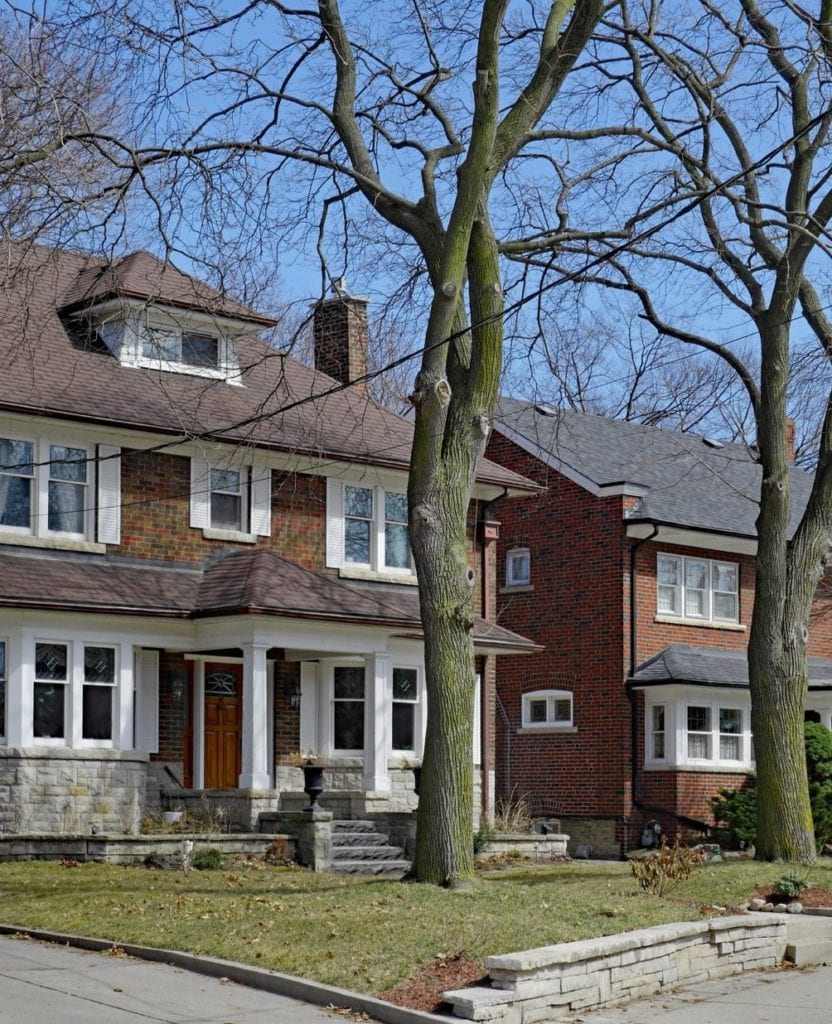



Looking For More Great Content?
Get even more informative Toronto real estate news sent directly to your inbox by signing up for my newsletter here. All it takes is a few easy clicks.

How to Prepare Financially to Buy a Home in Ontario: A 2026 Strategy Guide
05/12/26 Uncategorized
With Ontario’s average home price reaching $749,200 in early 2026, many aspiring buyers are discovering that a standard down payment is only one piece of a much larger puzzle. It’s no longer just about what you save, but how strategically you’ve structured your assets to meet modern lending requirements. Understanding exactly how to prepare financially to buy a home in Ontario is the difference between a rejected application and a successful closing in the Durham Region’s competitive market.
We know that the current financial landscape can feel overwhelming, especially with the 5.25% mortgage stress test floor and the complexity of various tax-advantaged accounts. You deserve a clear, analytical path that replaces uncertainty with a concrete plan of action. This guide shares the Noble Approach to homeownership, offering expert insights on maximizing your $60,000 RRSP Home Buyers’ Plan withdrawal and leveraging the $8,000 annual FHSA limit. We will break down the provincial land transfer tax tiers and hidden closing costs so you can step into your new home with absolute confidence and zero financial surprises.
Key Takeaways
- Understand the critical debt-to-income ratios lenders use and why the 39% housing cost rule is your most important benchmark for mortgage approval.
- Discover how to maximize the First Home Savings Account and the Home Buyers’ Plan to build a larger down payment using tax-free capital.
- Identify often overlooked closing costs, including Ontario’s provincial land transfer tax tiers and the specific rebates available to first-time buyers.
- Learn exactly how to prepare financially to buy a home in ontario by navigating the 2026 mortgage stress test and optimizing your credit profile.
- Apply a professional financial lens to your purchase, moving beyond a simple transaction to manage your home as a strategic real estate investment.
Determining Your Financial Readiness: The 39/44 Rule
Before you start browsing listings in Uxbridge or Pickering, you must understand the mathematical framework that dictates your buying power. Most buyers focus solely on their down payment, but lenders prioritize your ability to service debt over the long term. This is where the 39/44 rule becomes your most important roadmap. These numbers represent the maximum percentage of your income that can go toward debt, and staying within these limits is essential for a stress-free mortgage application. Understanding these benchmarks is a key part of navigating housing affordability in Canada, especially as lending criteria remain strict in 2026.
Learning how to prepare financially to buy a home in ontario starts with a rigorous audit of your current monthly obligations. Lenders use two specific ratios to decide if you’re a safe bet. The first is the Gross Debt Service (GDS) ratio, which covers your housing costs. The second is the Total Debt Service (TDS) ratio, which includes every other debt you carry. If these numbers are too high, even a large down payment might not save your application. You want to walk into a bank with the confidence that your numbers already align with their requirements.
Calculating Your GDS and TDS Ratios
Lenders calculate your GDS by adding up your monthly mortgage payments, property taxes, and heating costs. If you’re buying a condo, they also include 50% of the maintenance fees. You then divide this total by your gross monthly income. The magic number here is 39%. If your housing costs exceed 39% of what you earn before taxes, you’ll likely face a rejection or be asked for a significantly larger down payment.
The TDS ratio goes one step further by adding your other monthly debts to that housing total. This includes car loans, credit card minimums, and student debt. This total should not exceed 44% of your gross income. By performing this calculation yourself, you can see exactly where you stand. It’s often better to pay down a high-interest car loan before applying for a mortgage, as it directly improves your TDS and increases your total borrowing capacity.
The Reality of Gross Income vs. Net Take-Home Pay
One common pitfall for Ontario buyers is budgeting based on gross income rather than net take-home pay. While banks use your gross income for their formulas, you live on what’s left after taxes. In a high-tax province, this discrepancy is significant. With the 2026 interest rate environment still requiring a cautious approach, you don’t want to be “house poor” simply because you met the bank’s maximum threshold.
The Noble Approach emphasizes financial rigour, which means building a “buffer zone” into your personal budget. This extra space accounts for unexpected maintenance and the rising costs of utilities. A successful home purchase isn’t just about getting the keys; it’s about ensuring your lifestyle remains enjoyable after the move. Aiming for ratios slightly lower than the 39/44 maximum provides the flexibility you need to manage your home as a sound investment rather than a financial burden.
Strategic Saving: Maximizing Ontario and Federal Tax Incentives
Building your down payment in 2026 requires more than just discipline; it demands a tactical use of available tax shelters to accelerate your growth. When considering how to prepare financially to buy a home in ontario, the First Home Savings Account (FHSA) stands out as the premier tool for local buyers. With an annual contribution limit of $8,000 and a lifetime cap of $40,000, this account allows your money to grow entirely tax-free while providing a deduction on your income tax return. For a couple buying together, this represents a combined $80,000 in tax-advantaged capital, which is a significant portion of the down payment for the average $749,200 Ontario home.
The Home Buyers’ Plan (HBP) remains a vital secondary pillar, allowing you to withdraw up to $60,000 from your RRSP tax-free. Combined with the FHSA, a single buyer can access $100,000 plus any investment growth to fund their purchase. To reach these goals faster, many clients find success by automating their savings. Setting up a recurring transfer on payday ensures your home fund grows before you have the chance to spend those dollars elsewhere. If you’re looking for clarity on how these savings translate into real-world purchasing power, a professional home valuation of your current assets can provide a clear starting point.
The FHSA vs. RRSP HBP: Which Comes First?
Choosing where to put your first dollar depends on your timeline and tax bracket. The FHSA acts as a powerful hybrid of RRSP and TFSA benefits for 2026 buyers, offering tax-deductible contributions and tax-free withdrawals for your down payment. Unlike the HBP, you don’t have to pay back the funds you withdraw from an FHSA. Most buyers should prioritize the FHSA to capture the $8,000 annual room, then use the RRSP HBP to bridge the remaining gap. You can find more details on these and other Federal home buying incentives to ensure you aren’t leaving money on the table.
Short-Term Investment Options for Your Deposit
As you approach your purchase date, the safety of your principal becomes more important than high returns. While the stock market is tempting, a sudden correction could delay your home purchase by years. In 2026, High-Interest Savings Accounts (HISAs) and short-term GICs are the preferred choices for funds needed within twelve months. It’s also vital to maintain liquidity; when you find the right home in the Durham Region, you’ll often need to produce a deposit within 24 hours of an accepted offer. Ensure your funds are held in an account that allows for immediate electronic transfer or bank draft issuance without multi-day waiting periods.

The ‘Hidden’ Costs: Ontario Land Transfer Tax and Closing Fees
Securing your mortgage pre-approval is a major milestone, but your financial planning isn’t complete until you account for the costs that arise on closing day. These expenses typically range from 1.5% to 4% of the purchase price and must be paid in cash; they cannot be rolled into your mortgage. Understanding how to prepare financially to buy a home in ontario means looking beyond the deposit to the line items that your lawyer will present in the final statement of adjustments. From provincial taxes to title insurance, these figures require the same analytical rigour as your initial savings plan.
At Noble Real Estate, we believe that transparency is the best way to reduce the stress of homeownership. By identifying these costs early, you can ensure your transition into a new home is straightforward and successful. We treat your purchase with the same care a CPA applies to a financial audit, ensuring no “hidden” fee catches you off guard when you’re ready to collect your keys.
The Land Transfer Tax Breakdown
Ontario’s Land Transfer Tax (LTT) operates on a sliding scale. You pay 0.5% on the first $55,000, 1.0% on the portion between $55,001 and $250,000, 1.5% up to $400,000, and 2.0% on the remaining amount up to $2 million. For a home at the March 2026 Ontario average price of $749,200, the LTT would be approximately $11,459. One of the greatest financial advantages of buying in Uxbridge or the surrounding Durham Region is the absence of a municipal land transfer tax. Unlike buyers in the City of Toronto, who pay a second tax of equal value, our local clients keep thousands of dollars in their pockets.
First-time home buyers can access a provincial rebate of up to $4,000. This effectively offsets the full tax for homes valued at $368,000 or less and provides a welcome reduction for more expensive properties. Your lawyer typically applies for this rebate during the closing phase, so you won’t need to wait for a tax refund check. It’s a simple process that helps make homeownership more achievable for those entering the market.
Beyond the Purchase Price: Day One Expenses
Title insurance is a critical, one-time expense that protects you against mortgage fraud, zoning non-compliance, and existing liens on the property. It’s a non-negotiable for most lenders and provides vital protection for you as the owner. You also need to budget for legal fees, which generally fall between $1,500 and $2,500 depending on the complexity of the transaction. These professionals handle the title search and ensure the deed is registered correctly in your name.
Be prepared for “adjustments” on closing day. If the seller has already paid the property taxes in Uxbridge for the full year, you’ll need to reimburse them for the portion of the year you will own the home. The same applies to utilities or pre-filled fuel tanks. We recommend maintaining a dedicated ‘closing cost fund’ separate from your down payment. This ensures that when moving day arrives, every detail is handled with the precision and care it deserves.
Navigating the Mortgage Roadmap: Pre-Approval to Closing
Securing a mortgage in 2026 is a process that demands both early preparation and ongoing discipline. While the previous sections focused on saving and debt ratios, the mortgage roadmap is where those efforts are verified by a lender. Learning how to prepare financially to buy a home in ontario requires a clear understanding of the difference between a casual pre-qualification and a formal pre-approval. A pre-qualification is merely a surface-level estimate based on unverified data, whereas a formal pre-approval involves a rigorous review of your credit history and income, providing a specific price range and a rate hold that protects you from market fluctuations.
To move through this stage successfully, you must have your documentation ready for scrutiny. Lenders typically require your last two years of T4s, recent pay stubs, and a letter of employment confirming your status and salary. If you are receiving financial help from family, you will also need a signed gift letter stating that the funds are not a loan. Having these documents organized in advance ensures your application moves quickly when you find the right property. If you are just beginning your search, reviewing Buying a Home in Uxbridge: The Complete Guide can help you align your mortgage expectations with the local market reality.
Passing the Stress Test in 2026
The mortgage stress test remains a significant hurdle for many Ontario buyers. To pass, you must prove you can afford payments at a qualifying rate, which is currently the greater of your mortgage contract rate plus 2% or the floor rate of 5.25%. This regulation ensures that homeowners can still manage their debt if interest rates rise in the future. One effective way to boost your borrowing power before applying is through debt consolidation. By paying off or merging high-interest credit cards into a lower-interest personal loan, you improve your debt-service ratios and present a lower risk to the bank.
You also have choices in how you secure your financing. While a big bank offers the convenience of an existing relationship, a mortgage broker can shop multiple lenders to find the most competitive terms for your specific situation. Regardless of the path you choose, the goal is to secure a commitment that fits your long-term financial strategy. For personalized guidance on how your financing impacts your search, our buyer representation services provide the expert oversight you need to navigate these decisions with confidence.
Finalizing the Approval
Once you have a pre-approval, your financial profile must remain frozen until the day you close. A common mistake is making a large purchase, such as a new car or expensive furniture on credit, during the period between the offer and the closing date. These actions change your debt-to-income ratios and can lead a lender to revoke your approval at the last minute. The final hurdle is the appraisal. The lender will send a professional to verify that the home’s value matches the purchase price, ensuring the property is sufficient collateral for the loan. By maintaining a stable financial profile and choosing a home with sound investment potential, you ensure a stress-free transition to homeownership.
The Noble Approach: Financial Rigour Meets Local Real Estate
Mastering how to prepare financially to buy a home in ontario is a significant achievement, but the final step is ensuring that your financial preparation translates into a sound long-term investment. At Noble Real Estate, we believe that real estate is more than a transaction; it’s a strategic asset in your financial portfolio. This is where “The Noble Approach” provides a unique advantage. By blending professional buyer representation with a deep background in finance as a CPA and CA, we offer a level of analytical rigour that goes far beyond the standard home tour.
We help you move from the mindset of simply “buying a house” to “managing a real estate investment.” In a market like 2026, where interest rates and inventory levels require careful navigation, having an advisor who understands the underlying numbers is critical. Whether you’re looking at a heritage home in Uxbridge or a modern build in Pickering, we look at the historical appreciation data, local tax trends, and potential maintenance liabilities. This ensures your purchase supports your overall financial health and long-term goals.
The Advantage of Analytical Expertise
Choosing the right partner for this journey is about finding a fit that prioritizes your peace of mind and financial security. When Choosing Real Estate Agents Near You, consider how an advisor evaluates a property’s future value. In a fluctuating market, we don’t just look at what a home is worth today. We evaluate the long-term ROI of different Durham Region neighbourhoods, helping you identify areas with strong growth potential and resilient infrastructure. This data-driven perspective ensures you aren’t just winning a bidding war, but making a choice that benefits your family for years to come.
Next Steps: Starting Your Journey
The path to homeownership in Ontario can feel complex, but it doesn’t have to be stressful. Your next step is to align your verified financial readiness with the current opportunities in the market. We invite you to book a discovery call for a tailored financial readiness assessment. This isn’t a high-pressure sales pitch; it’s a strategic conversation to define your goals and build a clear roadmap for your search.
You don’t have to navigate the Ontario market alone. With the right guidance and a commitment to your success, we can make your transition to a new home straightforward, enjoyable, and financially rewarding. Redefine your expectations of what a real estate service can be and step into your new home with the confidence that every detail has been handled with the utmost care.
Your Path to a Confident Home Purchase
Understanding how to prepare financially to buy a home in ontario involves more than just hitting a savings target. It’s about mastering the 39/44 debt-service rule and maximizing every tax incentive available to you in 2026. By prioritizing accounts like the FHSA and accounting for provincial land transfer taxes early, you transform a complex transaction into a manageable investment. You’ve done the research; now it’s time to apply that knowledge to your specific goals in Uxbridge and the Durham Region.
Led by Colin Noble, a consummate professional with a background as a CPA and CA, Noble Real Estate provides the analytical rigour and local expertise you need for a successful move. We specialize in making the transition to homeownership stress-free and straightforward through the Noble Approach. If you’re ready to redefine your real estate expectations, Book a Financial Strategy Session with Noble Real Estate today. We’re here to ensure your journey is as rewarding as the destination itself. Your future home is within reach, and we look forward to helping you secure it with confidence.
Frequently Asked Questions
How much money should I save for a down payment in Ontario?
The minimum down payment depends on the purchase price of the home. For properties up to $500,000, you need 5%. For the portion between $500,000 and $999,999, you must provide 10%, and any home priced at $1 million or more requires a full 20% down payment. For a home at the March 2026 average price of $749,200, your minimum down payment would be approximately $49,920.
What is the First-Time Home Buyer Land Transfer Tax Rebate in 2026?
In 2026, the Ontario provincial land transfer tax rebate for first-time buyers remains capped at a maximum of $4,000. This amount fully offsets the tax for homes priced at $368,000 or less. For homes above this price point, you’ll pay the remaining balance. This rebate is a key factor when calculating how to prepare financially to buy a home in ontario, as it reduces your immediate cash requirements on closing day.
Can I use my RRSP for a down payment if I’m not a first-time buyer?
You can use the Home Buyers’ Plan (HBP) again if you meet the four-year “non-homeowner” replacement rule. This means you haven’t occupied a home that you or your current spouse owned in the last four years. If you qualify, the 2026 withdrawal limit is $60,000 per person. This tax-free withdrawal must be repaid to your RRSP over a 15-year period starting the second year after your withdrawal.
How does the mortgage stress test work for Ontario buyers?
The stress test determines your borrowing limit by seeing if you can handle higher interest rates. Lenders calculate your debt ratios using a qualifying rate, which is either your actual mortgage contract rate plus 2% or the floor rate of 5.25%, whichever is higher. This ensures you can maintain your payments even if market conditions change. It’s a vital step in the Noble Approach to ensure your investment remains sustainable.
What are the average closing costs in the Durham Region?
You should budget between 1.5% and 4% of the home’s purchase price for closing costs. In the Durham Region, your primary expenses will be the provincial land transfer tax, legal fees, and title insurance. One significant advantage of buying in areas like Uxbridge is that you avoid the additional municipal land transfer tax found in Toronto, which can save you thousands of dollars in upfront cash.
Is the First Home Savings Account (FHSA) better than a TFSA for home savings?
The FHSA is generally the superior tool for home savings because it offers a double tax advantage. Contributions are tax-deductible, which lowers your annual income tax bill, and qualifying withdrawals for your down payment are tax-free. While a TFSA offers tax-free growth, it doesn’t provide the initial tax deduction. Maximizing your $8,000 annual FHSA limit is a highly effective way to accelerate your savings for an Ontario home.
What happens if my mortgage pre-approval expires before I find a home?
Most pre-approvals are valid for 90 to 120 days. If yours expires, you’ll need to provide your lender with updated financial documents, such as recent pay stubs and bank statements, to renew it. It’s important to know that if interest rates have risen or your credit score has changed during that time, your new pre-approval amount might be lower than the original one.
Do I need a 20% down payment to avoid mortgage insurance in Canada?
Yes, a down payment of at least 20% is required to avoid paying CMHC mortgage loan insurance premiums. If you put down between 5% and 19.99%, the insurance premium is added to your mortgage balance, increasing your total debt. However, for any home priced over $1 million, a 20% down payment is a legal requirement in Canada, meaning you won’t have the option for an insured mortgage at that price point.
With Ontario’s average home price reaching $749,200 in early 2026, many aspiring buyers are discovering that a standard down payment is only one piece of a much larger puzzle. It’s no longer just about what you save, but how strategically you’ve structured your assets to meet modern lending requirements. Understanding exactly how to prepare financially to buy a home in Ontario is the difference between a rejected application and a successful closing in the Durham Region’s competitive market.
We know that the current financial landscape can feel overwhelming, especially with the 5.25% mortgage stress test floor and the complexity of various tax-advantaged accounts. You deserve a clear, analytical path that replaces uncertainty with a concrete plan of action. This guide shares the Noble Approach to homeownership, offering expert insights on maximizing your $60,000 RRSP Home Buyers’ Plan withdrawal and leveraging the $8,000 annual FHSA limit. We will break down the provincial land transfer tax tiers and hidden closing costs so you can step into your new home with absolute confidence and zero financial surprises.
Key Takeaways
- Understand the critical debt-to-income ratios lenders use and why the 39% housing cost rule is your most important benchmark for mortgage approval.
- Discover how to maximize the First Home Savings Account and the Home Buyers’ Plan to build a larger down payment using tax-free capital.
- Identify often overlooked closing costs, including Ontario’s provincial land transfer tax tiers and the specific rebates available to first-time buyers.
- Learn exactly how to prepare financially to buy a home in ontario by navigating the 2026 mortgage stress test and optimizing your credit profile.
- Apply a professional financial lens to your purchase, moving beyond a simple transaction to manage your home as a strategic real estate investment.
Determining Your Financial Readiness: The 39/44 Rule
Before you start browsing listings in Uxbridge or Pickering, you must understand the mathematical framework that dictates your buying power. Most buyers focus solely on their down payment, but lenders prioritize your ability to service debt over the long term. This is where the 39/44 rule becomes your most important roadmap. These numbers represent the maximum percentage of your income that can go toward debt, and staying within these limits is essential for a stress-free mortgage application. Understanding these benchmarks is a key part of navigating housing affordability in Canada, especially as lending criteria remain strict in 2026.
Learning how to prepare financially to buy a home in ontario starts with a rigorous audit of your current monthly obligations. Lenders use two specific ratios to decide if you’re a safe bet. The first is the Gross Debt Service (GDS) ratio, which covers your housing costs. The second is the Total Debt Service (TDS) ratio, which includes every other debt you carry. If these numbers are too high, even a large down payment might not save your application. You want to walk into a bank with the confidence that your numbers already align with their requirements.
Calculating Your GDS and TDS Ratios
Lenders calculate your GDS by adding up your monthly mortgage payments, property taxes, and heating costs. If you’re buying a condo, they also include 50% of the maintenance fees. You then divide this total by your gross monthly income. The magic number here is 39%. If your housing costs exceed 39% of what you earn before taxes, you’ll likely face a rejection or be asked for a significantly larger down payment.
The TDS ratio goes one step further by adding your other monthly debts to that housing total. This includes car loans, credit card minimums, and student debt. This total should not exceed 44% of your gross income. By performing this calculation yourself, you can see exactly where you stand. It’s often better to pay down a high-interest car loan before applying for a mortgage, as it directly improves your TDS and increases your total borrowing capacity.
The Reality of Gross Income vs. Net Take-Home Pay
One common pitfall for Ontario buyers is budgeting based on gross income rather than net take-home pay. While banks use your gross income for their formulas, you live on what’s left after taxes. In a high-tax province, this discrepancy is significant. With the 2026 interest rate environment still requiring a cautious approach, you don’t want to be “house poor” simply because you met the bank’s maximum threshold.
The Noble Approach emphasizes financial rigour, which means building a “buffer zone” into your personal budget. This extra space accounts for unexpected maintenance and the rising costs of utilities. A successful home purchase isn’t just about getting the keys; it’s about ensuring your lifestyle remains enjoyable after the move. Aiming for ratios slightly lower than the 39/44 maximum provides the flexibility you need to manage your home as a sound investment rather than a financial burden.
Strategic Saving: Maximizing Ontario and Federal Tax Incentives
Building your down payment in 2026 requires more than just discipline; it demands a tactical use of available tax shelters to accelerate your growth. When considering how to prepare financially to buy a home in ontario, the First Home Savings Account (FHSA) stands out as the premier tool for local buyers. With an annual contribution limit of $8,000 and a lifetime cap of $40,000, this account allows your money to grow entirely tax-free while providing a deduction on your income tax return. For a couple buying together, this represents a combined $80,000 in tax-advantaged capital, which is a significant portion of the down payment for the average $749,200 Ontario home.
The Home Buyers’ Plan (HBP) remains a vital secondary pillar, allowing you to withdraw up to $60,000 from your RRSP tax-free. Combined with the FHSA, a single buyer can access $100,000 plus any investment growth to fund their purchase. To reach these goals faster, many clients find success by automating their savings. Setting up a recurring transfer on payday ensures your home fund grows before you have the chance to spend those dollars elsewhere. If you’re looking for clarity on how these savings translate into real-world purchasing power, a professional home valuation of your current assets can provide a clear starting point.
The FHSA vs. RRSP HBP: Which Comes First?
Choosing where to put your first dollar depends on your timeline and tax bracket. The FHSA acts as a powerful hybrid of RRSP and TFSA benefits for 2026 buyers, offering tax-deductible contributions and tax-free withdrawals for your down payment. Unlike the HBP, you don’t have to pay back the funds you withdraw from an FHSA. Most buyers should prioritize the FHSA to capture the $8,000 annual room, then use the RRSP HBP to bridge the remaining gap. You can find more details on these and other Federal home buying incentives to ensure you aren’t leaving money on the table.
Short-Term Investment Options for Your Deposit
As you approach your purchase date, the safety of your principal becomes more important than high returns. While the stock market is tempting, a sudden correction could delay your home purchase by years. In 2026, High-Interest Savings Accounts (HISAs) and short-term GICs are the preferred choices for funds needed within twelve months. It’s also vital to maintain liquidity; when you find the right home in the Durham Region, you’ll often need to produce a deposit within 24 hours of an accepted offer. Ensure your funds are held in an account that allows for immediate electronic transfer or bank draft issuance without multi-day waiting periods.
The ‘Hidden’ Costs: Ontario Land Transfer Tax and Closing Fees
Securing your mortgage pre-approval is a major milestone, but your financial planning isn’t complete until you account for the costs that arise on closing day. These expenses typically range from 1.5% to 4% of the purchase price and must be paid in cash; they cannot be rolled into your mortgage. Understanding how to prepare financially to buy a home in ontario means looking beyond the deposit to the line items that your lawyer will present in the final statement of adjustments. From provincial taxes to title insurance, these figures require the same analytical rigour as your initial savings plan.
At Noble Real Estate, we believe that transparency is the best way to reduce the stress of homeownership. By identifying these costs early, you can ensure your transition into a new home is straightforward and successful. We treat your purchase with the same care a CPA applies to a financial audit, ensuring no “hidden” fee catches you off guard when you’re ready to collect your keys.
The Land Transfer Tax Breakdown
Ontario’s Land Transfer Tax (LTT) operates on a sliding scale. You pay 0.5% on the first $55,000, 1.0% on the portion between $55,001 and $250,000, 1.5% up to $400,000, and 2.0% on the remaining amount up to $2 million. For a home at the March 2026 Ontario average price of $749,200, the LTT would be approximately $11,459. One of the greatest financial advantages of buying in Uxbridge or the surrounding Durham Region is the absence of a municipal land transfer tax. Unlike buyers in the City of Toronto, who pay a second tax of equal value, our local clients keep thousands of dollars in their pockets.
First-time home buyers can access a provincial rebate of up to $4,000. This effectively offsets the full tax for homes valued at $368,000 or less and provides a welcome reduction for more expensive properties. Your lawyer typically applies for this rebate during the closing phase, so you won’t need to wait for a tax refund check. It’s a simple process that helps make homeownership more achievable for those entering the market.
Beyond the Purchase Price: Day One Expenses
Title insurance is a critical, one-time expense that protects you against mortgage fraud, zoning non-compliance, and existing liens on the property. It’s a non-negotiable for most lenders and provides vital protection for you as the owner. You also need to budget for legal fees, which generally fall between $1,500 and $2,500 depending on the complexity of the transaction. These professionals handle the title search and ensure the deed is registered correctly in your name.
Be prepared for “adjustments” on closing day. If the seller has already paid the property taxes in Uxbridge for the full year, you’ll need to reimburse them for the portion of the year you will own the home. The same applies to utilities or pre-filled fuel tanks. We recommend maintaining a dedicated ‘closing cost fund’ separate from your down payment. This ensures that when moving day arrives, every detail is handled with the precision and care it deserves.
Navigating the Mortgage Roadmap: Pre-Approval to Closing
Securing a mortgage in 2026 is a process that demands both early preparation and ongoing discipline. While the previous sections focused on saving and debt ratios, the mortgage roadmap is where those efforts are verified by a lender. Learning how to prepare financially to buy a home in ontario requires a clear understanding of the difference between a casual pre-qualification and a formal pre-approval. A pre-qualification is merely a surface-level estimate based on unverified data, whereas a formal pre-approval involves a rigorous review of your credit history and income, providing a specific price range and a rate hold that protects you from market fluctuations.
To move through this stage successfully, you must have your documentation ready for scrutiny. Lenders typically require your last two years of T4s, recent pay stubs, and a letter of employment confirming your status and salary. If you are receiving financial help from family, you will also need a signed gift letter stating that the funds are not a loan. Having these documents organized in advance ensures your application moves quickly when you find the right property. If you are just beginning your search, reviewing Buying a Home in Uxbridge: The Complete Guide can help you align your mortgage expectations with the local market reality.
Passing the Stress Test in 2026
The mortgage stress test remains a significant hurdle for many Ontario buyers. To pass, you must prove you can afford payments at a qualifying rate, which is currently the greater of your mortgage contract rate plus 2% or the floor rate of 5.25%. This regulation ensures that homeowners can still manage their debt if interest rates rise in the future. One effective way to boost your borrowing power before applying is through debt consolidation. By paying off or merging high-interest credit cards into a lower-interest personal loan, you improve your debt-service ratios and present a lower risk to the bank.
You also have choices in how you secure your financing. While a big bank offers the convenience of an existing relationship, a mortgage broker can shop multiple lenders to find the most competitive terms for your specific situation. Regardless of the path you choose, the goal is to secure a commitment that fits your long-term financial strategy. For personalized guidance on how your financing impacts your search, our buyer representation services provide the expert oversight you need to navigate these decisions with confidence.
Finalizing the Approval
Once you have a pre-approval, your financial profile must remain frozen until the day you close. A common mistake is making a large purchase, such as a new car or expensive furniture on credit, during the period between the offer and the closing date. These actions change your debt-to-income ratios and can lead a lender to revoke your approval at the last minute. The final hurdle is the appraisal. The lender will send a professional to verify that the home’s value matches the purchase price, ensuring the property is sufficient collateral for the loan. By maintaining a stable financial profile and choosing a home with sound investment potential, you ensure a stress-free transition to homeownership.
The Noble Approach: Financial Rigour Meets Local Real Estate
Mastering how to prepare financially to buy a home in ontario is a significant achievement, but the final step is ensuring that your financial preparation translates into a sound long-term investment. At Noble Real Estate, we believe that real estate is more than a transaction; it’s a strategic asset in your financial portfolio. This is where “The Noble Approach” provides a unique advantage. By blending professional buyer representation with a deep background in finance as a CPA and CA, we offer a level of analytical rigour that goes far beyond the standard home tour.
We help you move from the mindset of simply “buying a house” to “managing a real estate investment.” In a market like 2026, where interest rates and inventory levels require careful navigation, having an advisor who understands the underlying numbers is critical. Whether you’re looking at a heritage home in Uxbridge or a modern build in Pickering, we look at the historical appreciation data, local tax trends, and potential maintenance liabilities. This ensures your purchase supports your overall financial health and long-term goals.
The Advantage of Analytical Expertise
Choosing the right partner for this journey is about finding a fit that prioritizes your peace of mind and financial security. When Choosing Real Estate Agents Near You, consider how an advisor evaluates a property’s future value. In a fluctuating market, we don’t just look at what a home is worth today. We evaluate the long-term ROI of different Durham Region neighbourhoods, helping you identify areas with strong growth potential and resilient infrastructure. This data-driven perspective ensures you aren’t just winning a bidding war, but making a choice that benefits your family for years to come.
Next Steps: Starting Your Journey
The path to homeownership in Ontario can feel complex, but it doesn’t have to be stressful. Your next step is to align your verified financial readiness with the current opportunities in the market. We invite you to book a discovery call for a tailored financial readiness assessment. This isn’t a high-pressure sales pitch; it’s a strategic conversation to define your goals and build a clear roadmap for your search.
You don’t have to navigate the Ontario market alone. With the right guidance and a commitment to your success, we can make your transition to a new home straightforward, enjoyable, and financially rewarding. Redefine your expectations of what a real estate service can be and step into your new home with the confidence that every detail has been handled with the utmost care.
Your Path to a Confident Home Purchase
Understanding how to prepare financially to buy a home in ontario involves more than just hitting a savings target. It’s about mastering the 39/44 debt-service rule and maximizing every tax incentive available to you in 2026. By prioritizing accounts like the FHSA and accounting for provincial land transfer taxes early, you transform a complex transaction into a manageable investment. You’ve done the research; now it’s time to apply that knowledge to your specific goals in Uxbridge and the Durham Region.
Led by Colin Noble, a consummate professional with a background as a CPA and CA, Noble Real Estate provides the analytical rigour and local expertise you need for a successful move. We specialize in making the transition to homeownership stress-free and straightforward through the Noble Approach. If you’re ready to redefine your real estate expectations, Book a Financial Strategy Session with Noble Real Estate today. We’re here to ensure your journey is as rewarding as the destination itself. Your future home is within reach, and we look forward to helping you secure it with confidence.
Frequently Asked Questions
How much money should I save for a down payment in Ontario?
The minimum down payment depends on the purchase price of the home. For properties up to $500,000, you need 5%. For the portion between $500,000 and $999,999, you must provide 10%, and any home priced at $1 million or more requires a full 20% down payment. For a home at the March 2026 average price of $749,200, your minimum down payment would be approximately $49,920.
What is the First-Time Home Buyer Land Transfer Tax Rebate in 2026?
In 2026, the Ontario provincial land transfer tax rebate for first-time buyers remains capped at a maximum of $4,000. This amount fully offsets the tax for homes priced at $368,000 or less. For homes above this price point, you’ll pay the remaining balance. This rebate is a key factor when calculating how to prepare financially to buy a home in ontario, as it reduces your immediate cash requirements on closing day.
Can I use my RRSP for a down payment if I’m not a first-time buyer?
You can use the Home Buyers’ Plan (HBP) again if you meet the four-year “non-homeowner” replacement rule. This means you haven’t occupied a home that you or your current spouse owned in the last four years. If you qualify, the 2026 withdrawal limit is $60,000 per person. This tax-free withdrawal must be repaid to your RRSP over a 15-year period starting the second year after your withdrawal.
How does the mortgage stress test work for Ontario buyers?
The stress test determines your borrowing limit by seeing if you can handle higher interest rates. Lenders calculate your debt ratios using a qualifying rate, which is either your actual mortgage contract rate plus 2% or the floor rate of 5.25%, whichever is higher. This ensures you can maintain your payments even if market conditions change. It’s a vital step in the Noble Approach to ensure your investment remains sustainable.
What are the average closing costs in the Durham Region?
You should budget between 1.5% and 4% of the home’s purchase price for closing costs. In the Durham Region, your primary expenses will be the provincial land transfer tax, legal fees, and title insurance. One significant advantage of buying in areas like Uxbridge is that you avoid the additional municipal land transfer tax found in Toronto, which can save you thousands of dollars in upfront cash.
Is the First Home Savings Account (FHSA) better than a TFSA for home savings?
The FHSA is generally the superior tool for home savings because it offers a double tax advantage. Contributions are tax-deductible, which lowers your annual income tax bill, and qualifying withdrawals for your down payment are tax-free. While a TFSA offers tax-free growth, it doesn’t provide the initial tax deduction. Maximizing your $8,000 annual FHSA limit is a highly effective way to accelerate your savings for an Ontario home.
What happens if my mortgage pre-approval expires before I find a home?
Most pre-approvals are valid for 90 to 120 days. If yours expires, you’ll need to provide your lender with updated financial documents, such as recent pay stubs and bank statements, to renew it. It’s important to know that if interest rates have risen or your credit score has changed during that time, your new pre-approval amount might be lower than the original one.
Do I need a 20% down payment to avoid mortgage insurance in Canada?
Yes, a down payment of at least 20% is required to avoid paying CMHC mortgage loan insurance premiums. If you put down between 5% and 19.99%, the insurance premium is added to your mortgage balance, increasing your total debt. However, for any home priced over $1 million, a 20% down payment is a legal requirement in Canada, meaning you won’t have the option for an insured mortgage at that price point.
Read More Posts



Looking For More Great Content?
Get even more informative Toronto real estate news sent directly to your inbox by signing up for my newsletter here. All it takes is a few easy clicks.

Real Estate Agent Commission Explained: An Ontario Seller’s Guide for 2026
05/11/26 Uncategorized
On an $800,000 home sale, a 5% commission effectively costs you 5.65% once the 13% HST is factored in, yet data shows full-service representation often yields a 3% to 5% higher final sale price. It’s understandable to feel a sense of hesitation when looking at those numbers. You’ve worked hard to build equity in your home, and the thought of high fees or hidden costs can make the selling process feel more stressful than it should be.
This real estate agent commission explained ontario guide provides a transparent look at the current 2026 landscape. I’ll show you exactly where your money goes, how the split between brokerages works, and why commission is a negotiable investment rather than a fixed tax. We’ll explore how the Trust in Real Estate Services Act (TRESA) protects your interests and how The Noble Approach uses financial precision to maximize your return. By the end of this article, you’ll have the confidence to ensure your agent is earning their fee while protecting your hard-earned equity.
Key Takeaways
- Understand the mechanics of the commission split to see how your investment covers both the listing strategy and the buyer’s professional representation.
- Learn why there are no legally mandated rates in 2026 and how this real estate agent commission explained ontario guide empowers you to negotiate based on market conditions.
- Discover how full-service marketing, including professional staging and high-end videography, works to drive your final sale price above local benchmarks.
- Gain clarity on the “No Sale, No Fee” model and how The Noble Approach ensures your agent carries the financial risk of marketing your property.
- Identify why local expertise in Uxbridge and Durham Region is essential for protecting your equity through precise valuation and expert negotiation.
What is Real Estate Agent Commission in Ontario? The 2026 Fundamentals
At its core, Real estate agent commission is a professional service fee paid to a brokerage for successfully facilitating the sale of your property. In Ontario, this fee isn’t just a cost of doing business; it’s a success-based payment model that ensures your interests are aligned with your agent’s performance. Under the Trust in Real Estate Services Act (TRESA), these structures must be clearly disclosed, providing you with a transparent view of how your equity is being utilized. This real estate agent commission explained ontario guide highlights that you aren’t just paying for a listing on the MLS; you’re paying for a legally regulated professional to manage your largest financial asset.
Many sellers don’t realize that their agent carries a significant financial risk through the “No Sale, No Fee” model. When you list your home, your agent often invests thousands of dollars upfront in professional staging, high-end videography, and targeted marketing campaigns. If the home doesn’t sell, the agent absorbs these costs entirely. This risk-mitigation is a central pillar of the industry. It ensures that your representative is financially motivated to secure the best possible outcome, as they only recoup their investment and earn their fee once the deal is finalized.
As of May 2026, the average total commission in Ontario typically ranges from 3.5% to 5% of the final sale price. While 5% remains a common benchmark for full-service representation, competitive urban markets often see transactions closing closer to 4%. This variability is why The Noble Approach focuses on value rather than just the percentage. It’s about what that investment actually returns to your bottom line through expert negotiation and strategic positioning.
Common Commission Structures in Ontario
- Percentage-based: This is the most prevalent model, where the fee is calculated as a direct percentage of the final sale price. If the home sells for more, the fee increases, but so does your net equity.
- Flat Fee: A set dollar amount agreed upon at the start, regardless of the final price. This is often seen with limited-service or discount brokerages.
- Hybrid models: These combine a lower base percentage with a flat fee to cover specific premium services like professional staging or extended marketing reach.
The Role of HST (Harmonized Sales Tax)
Commission is a GST/HST taxable service under Canadian law. In Ontario, you must add 13% HST to the total commission amount. For example, if you sell a home for $1,000,000 at a 5% commission rate, the fee is $50,000. However, the HST adds an additional $6,500, bringing your total professional fee to $56,500. This tax is mandatory and is paid by the seller upon the closing of the transaction. Understanding this “real” cost is essential for accurate financial planning during your move, ensuring there are no surprises when you receive your final statement of adjustments.
How the Commission Split Works Between Listing and Buyer Agents
When you look at the total fee on a listing agreement, it’s easy to assume that entire amount goes to the person standing in your kitchen. In reality, the Ontario real estate market operates on a “Co-operating Brokerage” system. This means the total commission you agree upon is typically shared between two separate companies: the listing brokerage that markets your home and the buyer’s brokerage that brings the successful purchaser. While the total amount is established during the initial stage of negotiating commission, the split is what determines how much each professional receives for their specific role in the transaction.
A common arrangement in 2026 is a 50/50 split. For a 5% total commission, 2.5% is allocated to the listing side and 2.5% to the buyer’s side. This isn’t just a tradition; it’s a strategic incentive. By offering a competitive 2.5% to co-operating agents, you ensure your property remains highly attractive to the professionals who are currently working with qualified, motivated buyers. If you’re curious about how this impacts your specific property value, a professional home valuation can provide the necessary context for these financial decisions.
Transparency is now a legal requirement under the Trust in Real Estate Services Act (TRESA). Your listing agreement must explicitly state how much of the total fee is being offered to the buyer’s brokerage. This prevents any confusion and ensures you know exactly how your equity is being used to drive traffic to your front door. The Noble Approach prioritizes this clarity, making sure you feel confident that every dollar is working toward a successful sale.
Who Actually Pays the Commission?
In the traditional Ontario model, the seller pays the entire commission from the proceeds of the sale at the time of closing. It’s a “top-line” expense. When I prepare a “Net Sheet” for clients, we subtract the commission and the 13% HST from the expected sale price to see the actual cash you’ll take home. While the seller technically writes the check, the cost is effectively baked into the market value of the home. It is a shared investment in a secure, legally protected transfer of property.
The Buyer Representation Agreement (BRA)
The relationship between a buyer and their agent is governed by a Buyer Representation Agreement. This contract specifies the commission the buyer’s agent is entitled to receive. If a seller offers a lower commission than what is listed in the BRA, the buyer may be contractually obligated to pay the difference to their agent. This is why clear communication is vital. Understanding these nuances helps in finding the right fit for your representation, ensuring everyone is aligned on fees before an offer is even signed. This real estate agent commission explained ontario perspective ensures that both parties enter the deal with full financial awareness.
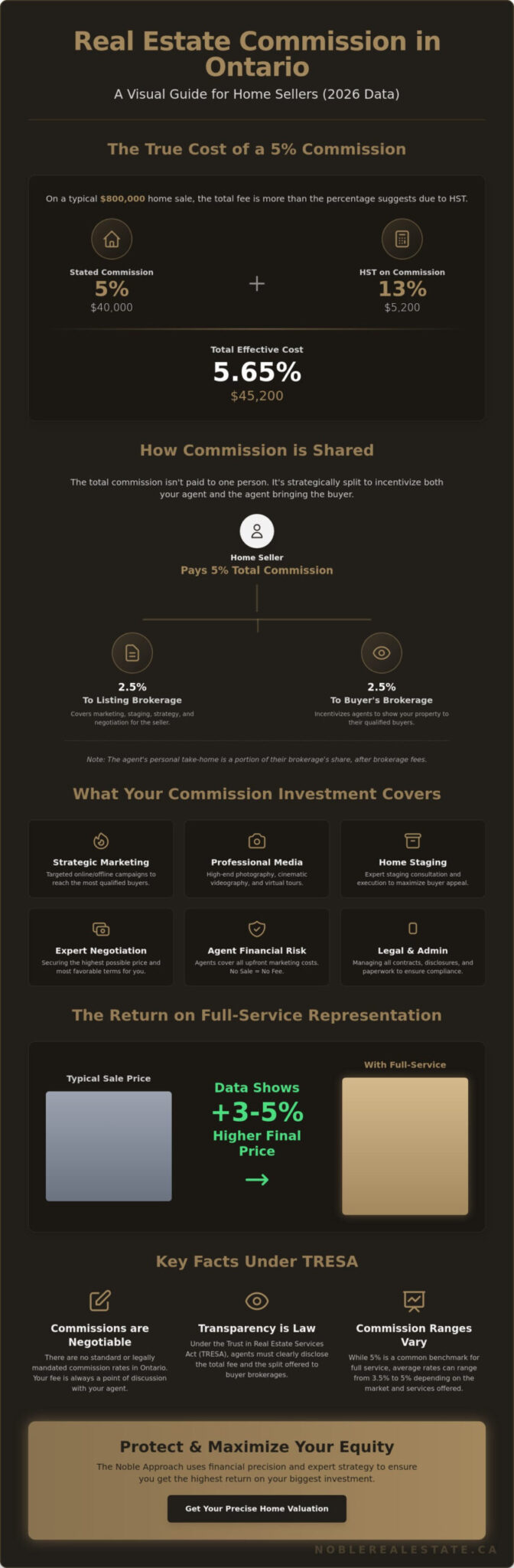
Is Real Estate Commission Negotiable? Understanding Your Options
Under Canada’s Competition Act and the guidelines set by the Real Estate Council of Ontario (RECO), commission rates are fully negotiable. There’s no such thing as a “standard” or “fixed” rate mandated by law. This real estate agent commission explained ontario guide emphasizes that while a 5% total fee is a historical benchmark, your specific rate is a private agreement between you and your listing brokerage. Your leverage in these negotiations often depends on current market conditions. In May 2026, sellers in highly competitive urban areas often negotiate closer to a 4% total commission because the rapid pace of sales reduces the agent’s time-on-market risk.
It is vital to understand that RECO prohibits agents from using certain fee structures that could be considered predatory. For instance, an agent cannot charge a commission that increases as the sale price goes up. This ensures the agent’s compensation remains transparent and fair based on the initial agreement. When we discuss your listing, we look at the specific needs of your property and the current inventory levels in your neighbourhood to find a rate that reflects the work required to secure a premium result.
Pros and Cons of Negotiating Lower Commissions
Negotiating a lower fee offers the immediate benefit of saving thousands of dollars on your final closing statement. However, it’s often a double-edged sword. A reduced commission typically leads to a smaller marketing budget. This might mean you miss out on professional staging, which data shows helps homes sell 14% faster than those that aren’t staged. Additionally, if you choose to reduce the buyer agent’s portion of the split, you risk lower engagement from co-operating agents. In a crowded market where agents have dozens of listings to show their clients, a competitive commission ensures your home stays at the top of their list.
The Value of a CPA-Led Negotiation
The Noble Approach views commission through a rigorous financial lens. With my background as a CPA and CA, I focus on your “Net Proceeds” rather than just the “Commission Rate.” A 1% savings on commission is a poor trade if it results in a 5% lower sale price due to inadequate marketing or weak negotiation. My deep expertise in uxbridge real estate allows for a precision-based strategy that justifies the investment in full-service representation. We don’t just list your home; we manage the investment of your equity to ensure the highest possible return in your final bank balance.
Beyond the Fee: What Does Your Commission Actually Pay For?
Commission is often viewed as a deduction from your final check, but it’s more accurate to see it as the fuel for your home’s marketing engine. When looking at real estate agent commission explained ontario, the value lies in the upfront capital and professional expertise your agent provides long before a “Sold” sign appears. This fee covers a comprehensive suite of services designed to mitigate your risk and maximize your return, including high-end videography, targeted social media campaigns, and the coordination of every technical detail from listing to closing.
Effective transaction management is another critical component. Your agent acts as the central hub, coordinating with lawyers, home inspectors, and appraisers to ensure the deal remains on track. This oversight prevents the common pitfalls that can derail a sale or lead to post-closing litigation. By managing the complex paperwork required by the Ontario Real Estate Association (OREA), your representative ensures that every disclosure is accurate and every deadline is met, providing you with essential legal protection during the transfer of your property.
The Noble Approach to Marketing
We believe in redefining expectations through high-impact listing presentations. The cost of choosing a “cheap” alternative often manifests in poor photography and generic descriptions, which can lead to significantly longer days on market. For houses for sale in uxbridge, a localized strategy is vital. We don’t just post a listing; we tell the story of the community. This tailored approach, combined with professional staging that helps homes sell 14% faster, ensures your property stands out in a competitive digital landscape. If you’re ready to see how this strategy applies to your home, consider booking a professional home valuation today.
Risk Management and Financial Oversight
Fiduciary duty is an agent’s legal obligation to put your financial and personal interests above their own at all times. This duty is especially important during the negotiation phase. In a multiple-offer scenario, the “highest” offer isn’t always the “best” offer. We meticulously vet every buyer, verifying pre-approvals and assessing the strength of their conditions to ensure the deal actually closes. My background as a CPA and CA allows for a level of financial oversight that most agents cannot provide. We analyze the tax implications of your sale and look for ways to protect your net equity, ensuring that the 3% to 5% higher sale price typically achieved through full-service representation ends up in your pocket.
The Noble Approach: Maximising Your Equity in Uxbridge and Durham Region
Selling a home in Uxbridge or the wider Durham Region requires more than just a sign on the lawn; it requires a strategy that respects the significant equity you’ve built. While this real estate agent commission explained ontario guide provides the structural basics, the real value of representation is found in the execution. The Noble Approach combines the analytical rigour of a CPA and CA background with a deep, personal investment in our local community. We don’t just see a transaction; we see a pivotal financial milestone that deserves a stress-free, end-to-end management style.
Our methodology ensures that every dollar of the commission you invest is working to protect your bottom line. By leveraging financial precision, we move beyond simple gut feelings to provide data-driven pricing and negotiation strategies. This approach is designed to redefine your expectations of what a real estate partner should provide, shifting the focus from the cost of the fee to the net proceeds in your bank account after the sale is finalized in May 2026.
Why Experience Matters in the Durham Market
The Durham Region features a diverse range of property types that each require a specific marketing lens. Navigating the sale of a downtown Uxbridge gem is vastly different from representing luxury estates in Goodwood canada. Rural properties often involve complexities like well and septic inspections, zoning nuances, and conservation easements that urban sales simply don’t face. A full-service partner understands these distinctions and prepares for them long before the home hits the market.
In the shifting landscape of 2026, local expertise is your greatest hedge against market volatility. We understand the specific buyer profiles looking to move to the area, allowing us to tailor our high-impact marketing to the right audience. Whether it’s a century home or a modern rural retreat, our localized strategy ensures your property is positioned as a premium offering, justifying the investment in professional representation.
Your Path to a Successful Sale
The first step in our journey together is an initial consultation where we set clear, realistic expectations. We provide you with a custom “Net Sheet” that breaks down all anticipated costs, including commissions, legal fees, and HST. This document allows you to see your exact walk-away numbers before you ever sign a listing agreement. Transparency is the foundation of trust, and we want you to feel confident in the financial roadmap we’ve created for your sale.
Success in real estate shouldn’t be a source of stress. By choosing a partner who prioritizes your experience and your equity, you can focus on your next chapter while we handle the complexities of the sale. If you’re ready to see the difference that financial expertise and local passion can make, it is time to take the next step. Redefine your real estate expectations—contact Colin Noble today to begin your custom home valuation and commission breakdown.
Secure Your Equity with Financial Precision
Understanding your financial obligations is the first step toward a successful sale. As this real estate agent commission explained ontario guide has shown, the fee you pay is a strategic investment in professional marketing, legal protection, and expert negotiation. By focusing on the net proceeds of your sale rather than just the initial percentage, you ensure that your home’s equity is managed with the analytical rigour it deserves.
The Noble Approach removes the guesswork from the selling process. Led by a professional with a background as a CPA and CA, our team provides the financial precision needed to navigate the 2026 market in Uxbridge and the Durham Region. We handle every detail, from the initial valuation to the final statement of adjustments, making your journey entirely stress-free. You deserve a partner who prioritizes your interests and understands the local community as deeply as you do.
Discover the Noble Approach: Get Your Custom Equity Analysis
Your real estate goals are within reach, and with the right guidance, the path forward is clear and rewarding.
Frequently Asked Questions
Is real estate commission in Ontario subject to HST?
Yes, all real estate commissions in Ontario are subject to a mandatory 13% Harmonized Sales Tax (HST). This tax is calculated on top of the agreed commission percentage or flat fee. If your total commission is $40,000, you’ll pay an additional $5,200 in HST at the time of closing. This is a standard legal requirement for professional services throughout the province.
Can I pay a flat fee instead of a percentage in Ontario?
You can choose a flat fee model rather than a percentage based structure. While percentage based fees are the most common in 2026, some brokerages offer flat fees for specific service levels. It’s vital to evaluate what marketing and negotiation support is included in a flat fee arrangement. You don’t want to sacrifice a higher final sale price for a smaller upfront service fee.
What is the average real estate commission in Uxbridge for 2026?
In May 2026, the average total commission in Uxbridge and the Durham Region typically ranges from 3.5% to 5% of the sale price. This real estate agent commission explained ontario data reflects the current balance of local market demand and service levels. High value properties or unique rural estates often involve different negotiated rates depending on the complexity of the specialized marketing required to find the right buyer.
Do I have to pay the buyer’s agent commission myself?
Standard practice in Ontario is for the seller to pay the total commission, which is then split between the listing and buyer brokerages. Under the Trust in Real Estate Services Act (TRESA), you can decide whether to offer a co-operating commission. Offering a competitive fee to the buyer’s side remains the most effective way to attract the largest pool of qualified, professionally represented purchasers to your property.
What happens to the commission if my house doesn’t sell?
Under the standard “No Sale, No Fee” model, you don’t pay a commission if your home doesn’t sell during the listing period. Your agent absorbs the upfront costs for professional staging, high end photography, and digital marketing. This structure ensures your representative is financially motivated to secure a successful result. Always check your specific listing agreement for any clauses regarding the reimbursement of out of pocket marketing expenses.
Can I negotiate the commission split between the two agents?
Yes, you can negotiate how the total commission is allocated between the listing brokerage and the buyer’s brokerage. This split is clearly documented in your listing agreement before the property hits the market. While a 50/50 split is a common benchmark, you can discuss different ratios with your agent. The goal is to ensure the buyer’s side stays incentivized to prioritize showing your home to their clients.
Are real estate commissions tax-deductible in Ontario?
Real estate commissions aren’t usually tax deductible for the sale of a primary residence. However, if you’re selling an investment property, the commission is a cost of sale that reduces your capital gains tax. If you’re moving at least 40 kilometres closer to a new work location, you might be able to deduct these fees as moving expenses under specific Canada Revenue Agency (CRA) guidelines.
Is commission paid on the listing price or the final sale price?
Commission is always calculated on the final sale price of the property, not the initial listing price. This ensures your agent’s compensation is tied to the actual market value they achieve for you. Whether your home sells for $50,000 over or under the asking price, the agreed percentage applies only to the final number recorded on the legal transfer of the home.
On an $800,000 home sale, a 5% commission effectively costs you 5.65% once the 13% HST is factored in, yet data shows full-service representation often yields a 3% to 5% higher final sale price. It’s understandable to feel a sense of hesitation when looking at those numbers. You’ve worked hard to build equity in your home, and the thought of high fees or hidden costs can make the selling process feel more stressful than it should be.
This real estate agent commission explained ontario guide provides a transparent look at the current 2026 landscape. I’ll show you exactly where your money goes, how the split between brokerages works, and why commission is a negotiable investment rather than a fixed tax. We’ll explore how the Trust in Real Estate Services Act (TRESA) protects your interests and how The Noble Approach uses financial precision to maximize your return. By the end of this article, you’ll have the confidence to ensure your agent is earning their fee while protecting your hard-earned equity.
Key Takeaways
- Understand the mechanics of the commission split to see how your investment covers both the listing strategy and the buyer’s professional representation.
- Learn why there are no legally mandated rates in 2026 and how this real estate agent commission explained ontario guide empowers you to negotiate based on market conditions.
- Discover how full-service marketing, including professional staging and high-end videography, works to drive your final sale price above local benchmarks.
- Gain clarity on the “No Sale, No Fee” model and how The Noble Approach ensures your agent carries the financial risk of marketing your property.
- Identify why local expertise in Uxbridge and Durham Region is essential for protecting your equity through precise valuation and expert negotiation.
What is Real Estate Agent Commission in Ontario? The 2026 Fundamentals
At its core, Real estate agent commission is a professional service fee paid to a brokerage for successfully facilitating the sale of your property. In Ontario, this fee isn’t just a cost of doing business; it’s a success-based payment model that ensures your interests are aligned with your agent’s performance. Under the Trust in Real Estate Services Act (TRESA), these structures must be clearly disclosed, providing you with a transparent view of how your equity is being utilized. This real estate agent commission explained ontario guide highlights that you aren’t just paying for a listing on the MLS; you’re paying for a legally regulated professional to manage your largest financial asset.
Many sellers don’t realize that their agent carries a significant financial risk through the “No Sale, No Fee” model. When you list your home, your agent often invests thousands of dollars upfront in professional staging, high-end videography, and targeted marketing campaigns. If the home doesn’t sell, the agent absorbs these costs entirely. This risk-mitigation is a central pillar of the industry. It ensures that your representative is financially motivated to secure the best possible outcome, as they only recoup their investment and earn their fee once the deal is finalized.
As of May 2026, the average total commission in Ontario typically ranges from 3.5% to 5% of the final sale price. While 5% remains a common benchmark for full-service representation, competitive urban markets often see transactions closing closer to 4%. This variability is why The Noble Approach focuses on value rather than just the percentage. It’s about what that investment actually returns to your bottom line through expert negotiation and strategic positioning.
Common Commission Structures in Ontario
- Percentage-based: This is the most prevalent model, where the fee is calculated as a direct percentage of the final sale price. If the home sells for more, the fee increases, but so does your net equity.
- Flat Fee: A set dollar amount agreed upon at the start, regardless of the final price. This is often seen with limited-service or discount brokerages.
- Hybrid models: These combine a lower base percentage with a flat fee to cover specific premium services like professional staging or extended marketing reach.
The Role of HST (Harmonized Sales Tax)
Commission is a GST/HST taxable service under Canadian law. In Ontario, you must add 13% HST to the total commission amount. For example, if you sell a home for $1,000,000 at a 5% commission rate, the fee is $50,000. However, the HST adds an additional $6,500, bringing your total professional fee to $56,500. This tax is mandatory and is paid by the seller upon the closing of the transaction. Understanding this “real” cost is essential for accurate financial planning during your move, ensuring there are no surprises when you receive your final statement of adjustments.
How the Commission Split Works Between Listing and Buyer Agents
When you look at the total fee on a listing agreement, it’s easy to assume that entire amount goes to the person standing in your kitchen. In reality, the Ontario real estate market operates on a “Co-operating Brokerage” system. This means the total commission you agree upon is typically shared between two separate companies: the listing brokerage that markets your home and the buyer’s brokerage that brings the successful purchaser. While the total amount is established during the initial stage of negotiating commission, the split is what determines how much each professional receives for their specific role in the transaction.
A common arrangement in 2026 is a 50/50 split. For a 5% total commission, 2.5% is allocated to the listing side and 2.5% to the buyer’s side. This isn’t just a tradition; it’s a strategic incentive. By offering a competitive 2.5% to co-operating agents, you ensure your property remains highly attractive to the professionals who are currently working with qualified, motivated buyers. If you’re curious about how this impacts your specific property value, a professional home valuation can provide the necessary context for these financial decisions.
Transparency is now a legal requirement under the Trust in Real Estate Services Act (TRESA). Your listing agreement must explicitly state how much of the total fee is being offered to the buyer’s brokerage. This prevents any confusion and ensures you know exactly how your equity is being used to drive traffic to your front door. The Noble Approach prioritizes this clarity, making sure you feel confident that every dollar is working toward a successful sale.
Who Actually Pays the Commission?
In the traditional Ontario model, the seller pays the entire commission from the proceeds of the sale at the time of closing. It’s a “top-line” expense. When I prepare a “Net Sheet” for clients, we subtract the commission and the 13% HST from the expected sale price to see the actual cash you’ll take home. While the seller technically writes the check, the cost is effectively baked into the market value of the home. It is a shared investment in a secure, legally protected transfer of property.
The Buyer Representation Agreement (BRA)
The relationship between a buyer and their agent is governed by a Buyer Representation Agreement. This contract specifies the commission the buyer’s agent is entitled to receive. If a seller offers a lower commission than what is listed in the BRA, the buyer may be contractually obligated to pay the difference to their agent. This is why clear communication is vital. Understanding these nuances helps in finding the right fit for your representation, ensuring everyone is aligned on fees before an offer is even signed. This real estate agent commission explained ontario perspective ensures that both parties enter the deal with full financial awareness.
Is Real Estate Commission Negotiable? Understanding Your Options
Under Canada’s Competition Act and the guidelines set by the Real Estate Council of Ontario (RECO), commission rates are fully negotiable. There’s no such thing as a “standard” or “fixed” rate mandated by law. This real estate agent commission explained ontario guide emphasizes that while a 5% total fee is a historical benchmark, your specific rate is a private agreement between you and your listing brokerage. Your leverage in these negotiations often depends on current market conditions. In May 2026, sellers in highly competitive urban areas often negotiate closer to a 4% total commission because the rapid pace of sales reduces the agent’s time-on-market risk.
It is vital to understand that RECO prohibits agents from using certain fee structures that could be considered predatory. For instance, an agent cannot charge a commission that increases as the sale price goes up. This ensures the agent’s compensation remains transparent and fair based on the initial agreement. When we discuss your listing, we look at the specific needs of your property and the current inventory levels in your neighbourhood to find a rate that reflects the work required to secure a premium result.
Pros and Cons of Negotiating Lower Commissions
Negotiating a lower fee offers the immediate benefit of saving thousands of dollars on your final closing statement. However, it’s often a double-edged sword. A reduced commission typically leads to a smaller marketing budget. This might mean you miss out on professional staging, which data shows helps homes sell 14% faster than those that aren’t staged. Additionally, if you choose to reduce the buyer agent’s portion of the split, you risk lower engagement from co-operating agents. In a crowded market where agents have dozens of listings to show their clients, a competitive commission ensures your home stays at the top of their list.
The Value of a CPA-Led Negotiation
The Noble Approach views commission through a rigorous financial lens. With my background as a CPA and CA, I focus on your “Net Proceeds” rather than just the “Commission Rate.” A 1% savings on commission is a poor trade if it results in a 5% lower sale price due to inadequate marketing or weak negotiation. My deep expertise in uxbridge real estate allows for a precision-based strategy that justifies the investment in full-service representation. We don’t just list your home; we manage the investment of your equity to ensure the highest possible return in your final bank balance.
Beyond the Fee: What Does Your Commission Actually Pay For?
Commission is often viewed as a deduction from your final check, but it’s more accurate to see it as the fuel for your home’s marketing engine. When looking at real estate agent commission explained ontario, the value lies in the upfront capital and professional expertise your agent provides long before a “Sold” sign appears. This fee covers a comprehensive suite of services designed to mitigate your risk and maximize your return, including high-end videography, targeted social media campaigns, and the coordination of every technical detail from listing to closing.
Effective transaction management is another critical component. Your agent acts as the central hub, coordinating with lawyers, home inspectors, and appraisers to ensure the deal remains on track. This oversight prevents the common pitfalls that can derail a sale or lead to post-closing litigation. By managing the complex paperwork required by the Ontario Real Estate Association (OREA), your representative ensures that every disclosure is accurate and every deadline is met, providing you with essential legal protection during the transfer of your property.
The Noble Approach to Marketing
We believe in redefining expectations through high-impact listing presentations. The cost of choosing a “cheap” alternative often manifests in poor photography and generic descriptions, which can lead to significantly longer days on market. For houses for sale in uxbridge, a localized strategy is vital. We don’t just post a listing; we tell the story of the community. This tailored approach, combined with professional staging that helps homes sell 14% faster, ensures your property stands out in a competitive digital landscape. If you’re ready to see how this strategy applies to your home, consider booking a professional home valuation today.
Risk Management and Financial Oversight
Fiduciary duty is an agent’s legal obligation to put your financial and personal interests above their own at all times. This duty is especially important during the negotiation phase. In a multiple-offer scenario, the “highest” offer isn’t always the “best” offer. We meticulously vet every buyer, verifying pre-approvals and assessing the strength of their conditions to ensure the deal actually closes. My background as a CPA and CA allows for a level of financial oversight that most agents cannot provide. We analyze the tax implications of your sale and look for ways to protect your net equity, ensuring that the 3% to 5% higher sale price typically achieved through full-service representation ends up in your pocket.
The Noble Approach: Maximising Your Equity in Uxbridge and Durham Region
Selling a home in Uxbridge or the wider Durham Region requires more than just a sign on the lawn; it requires a strategy that respects the significant equity you’ve built. While this real estate agent commission explained ontario guide provides the structural basics, the real value of representation is found in the execution. The Noble Approach combines the analytical rigour of a CPA and CA background with a deep, personal investment in our local community. We don’t just see a transaction; we see a pivotal financial milestone that deserves a stress-free, end-to-end management style.
Our methodology ensures that every dollar of the commission you invest is working to protect your bottom line. By leveraging financial precision, we move beyond simple gut feelings to provide data-driven pricing and negotiation strategies. This approach is designed to redefine your expectations of what a real estate partner should provide, shifting the focus from the cost of the fee to the net proceeds in your bank account after the sale is finalized in May 2026.
Why Experience Matters in the Durham Market
The Durham Region features a diverse range of property types that each require a specific marketing lens. Navigating the sale of a downtown Uxbridge gem is vastly different from representing luxury estates in Goodwood canada. Rural properties often involve complexities like well and septic inspections, zoning nuances, and conservation easements that urban sales simply don’t face. A full-service partner understands these distinctions and prepares for them long before the home hits the market.
In the shifting landscape of 2026, local expertise is your greatest hedge against market volatility. We understand the specific buyer profiles looking to move to the area, allowing us to tailor our high-impact marketing to the right audience. Whether it’s a century home or a modern rural retreat, our localized strategy ensures your property is positioned as a premium offering, justifying the investment in professional representation.
Your Path to a Successful Sale
The first step in our journey together is an initial consultation where we set clear, realistic expectations. We provide you with a custom “Net Sheet” that breaks down all anticipated costs, including commissions, legal fees, and HST. This document allows you to see your exact walk-away numbers before you ever sign a listing agreement. Transparency is the foundation of trust, and we want you to feel confident in the financial roadmap we’ve created for your sale.
Success in real estate shouldn’t be a source of stress. By choosing a partner who prioritizes your experience and your equity, you can focus on your next chapter while we handle the complexities of the sale. If you’re ready to see the difference that financial expertise and local passion can make, it is time to take the next step. Redefine your real estate expectations—contact Colin Noble today to begin your custom home valuation and commission breakdown.
Secure Your Equity with Financial Precision
Understanding your financial obligations is the first step toward a successful sale. As this real estate agent commission explained ontario guide has shown, the fee you pay is a strategic investment in professional marketing, legal protection, and expert negotiation. By focusing on the net proceeds of your sale rather than just the initial percentage, you ensure that your home’s equity is managed with the analytical rigour it deserves.
The Noble Approach removes the guesswork from the selling process. Led by a professional with a background as a CPA and CA, our team provides the financial precision needed to navigate the 2026 market in Uxbridge and the Durham Region. We handle every detail, from the initial valuation to the final statement of adjustments, making your journey entirely stress-free. You deserve a partner who prioritizes your interests and understands the local community as deeply as you do.
Discover the Noble Approach: Get Your Custom Equity Analysis
Your real estate goals are within reach, and with the right guidance, the path forward is clear and rewarding.
Frequently Asked Questions
Is real estate commission in Ontario subject to HST?
Yes, all real estate commissions in Ontario are subject to a mandatory 13% Harmonized Sales Tax (HST). This tax is calculated on top of the agreed commission percentage or flat fee. If your total commission is $40,000, you’ll pay an additional $5,200 in HST at the time of closing. This is a standard legal requirement for professional services throughout the province.
Can I pay a flat fee instead of a percentage in Ontario?
You can choose a flat fee model rather than a percentage based structure. While percentage based fees are the most common in 2026, some brokerages offer flat fees for specific service levels. It’s vital to evaluate what marketing and negotiation support is included in a flat fee arrangement. You don’t want to sacrifice a higher final sale price for a smaller upfront service fee.
What is the average real estate commission in Uxbridge for 2026?
In May 2026, the average total commission in Uxbridge and the Durham Region typically ranges from 3.5% to 5% of the sale price. This real estate agent commission explained ontario data reflects the current balance of local market demand and service levels. High value properties or unique rural estates often involve different negotiated rates depending on the complexity of the specialized marketing required to find the right buyer.
Do I have to pay the buyer’s agent commission myself?
Standard practice in Ontario is for the seller to pay the total commission, which is then split between the listing and buyer brokerages. Under the Trust in Real Estate Services Act (TRESA), you can decide whether to offer a co-operating commission. Offering a competitive fee to the buyer’s side remains the most effective way to attract the largest pool of qualified, professionally represented purchasers to your property.
What happens to the commission if my house doesn’t sell?
Under the standard “No Sale, No Fee” model, you don’t pay a commission if your home doesn’t sell during the listing period. Your agent absorbs the upfront costs for professional staging, high end photography, and digital marketing. This structure ensures your representative is financially motivated to secure a successful result. Always check your specific listing agreement for any clauses regarding the reimbursement of out of pocket marketing expenses.
Can I negotiate the commission split between the two agents?
Yes, you can negotiate how the total commission is allocated between the listing brokerage and the buyer’s brokerage. This split is clearly documented in your listing agreement before the property hits the market. While a 50/50 split is a common benchmark, you can discuss different ratios with your agent. The goal is to ensure the buyer’s side stays incentivized to prioritize showing your home to their clients.
Are real estate commissions tax-deductible in Ontario?
Real estate commissions aren’t usually tax deductible for the sale of a primary residence. However, if you’re selling an investment property, the commission is a cost of sale that reduces your capital gains tax. If you’re moving at least 40 kilometres closer to a new work location, you might be able to deduct these fees as moving expenses under specific Canada Revenue Agency (CRA) guidelines.
Is commission paid on the listing price or the final sale price?
Commission is always calculated on the final sale price of the property, not the initial listing price. This ensures your agent’s compensation is tied to the actual market value they achieve for you. Whether your home sells for $50,000 over or under the asking price, the agreed percentage applies only to the final number recorded on the legal transfer of the home.
Read More Posts




Looking For More Great Content?
Get even more informative Toronto real estate news sent directly to your inbox by signing up for my newsletter here. All it takes is a few easy clicks.

Homes for Sale Near Lake Scugog: Your 2026 Waterfront & Rural Lifestyle Guide
05/10/26 Uncategorized
In May 2026, the median price for detached homes in Scugog has reached $1,146,000, which means the margin for error in your lifestyle investment is thinner than ever. You’ve likely spent hours browsing homes for sale near lake scugog, dreaming of sunset views and quiet mornings by the water. It’s natural to feel a sense of hesitation when you consider the complexities of septic systems, shoreline erosion, or the 4.12% property tax increase projected for the Township this year.
You deserve a transition that’s as serene as the lake itself, and that starts with having a financially savvy advisor in your corner. This guide will replace your uncertainty with clarity by applying a rigorous analytical lens to the local market. We’ll examine the latest 2026 development charges, compare current mortgage rates like the 3.94% five year fixed, and provide a framework for evaluating waterfront versus rural residential lots. By the end, you’ll understand how “The Noble Approach” turns complex financial variables into a straightforward path toward your ideal home.
Key Takeaways
- Identify the unique characteristics of local micro-markets, from the historic charm of Port Perry to the secluded waterfront retreats of Scugog Island.
- Learn to evaluate homes for sale near lake scugog using a “structural-first” lens that prioritizes long-term integrity over surface-level aesthetics.
- Apply analytical rigour to your purchase by understanding how 2026 market dynamics and local development charges impact your total investment.
- Master the essential due diligence required for waterfront living, including navigating complex shoreline regulations and non-urban utility systems.
- Discover how a financially sophisticated, end-to-end approach can remove the stress from complex rural and lakefront property transactions.
Exploring the Allure of Lake Scugog Real Estate
Lake Scugog is a unique man-made marvel with a history that sets it apart from the glacial lakes of the nearby Kawarthas. Originally a marshy river valley, it was transformed in 1834 when a dam was constructed at Lindsay, creating the expansive body of water we enjoy today. As a vital link in the Trent-Severn Waterway, the lake provides boaters with access to a vast network of interconnected canals and lakes stretching across Ontario. When you begin your search for homes for sale near lake scugog, you’re looking at a diverse geographical area. The market encompasses the historic Victorian streets of Port Perry, the quiet pastoral stretches of Scugog Island, and the expansive agricultural lands of Rural Scugog.
In 2026, the Durham Region real estate landscape has evolved. We’ve seen a clear shift toward “hybrid-ready” homes. Buyers are no longer just looking for a weekend escape; they want properties that offer high-speed infrastructure and dedicated professional spaces to support a remote or flexible work life. Learn about Lake Scugog’s history and geography to better understand how this evolving ecosystem supports both modern residential needs and traditional recreational pursuits. This region perfectly balances the sophisticated charm of Port Perry’s heritage architecture with the secluded, rugged nature found in the lake’s northern reaches.
The Geography of the Scugog Basin
Understanding the lake’s physical profile is essential for any prospective buyer. Lake Scugog is notably shallow, with an average depth of approximately 1.4 metres. This characteristic significantly influences how you’ll use your property, particularly regarding boat draft and dock placement. The western shores near Port Perry are famous for their sunrise views, while the eastern side of Scugog Island is the place to be for those who prioritize evening sunsets. Proximity to the GTA remains a primary driver for value here; Scugog offers a genuine rural lifestyle while staying within a manageable 60 to 90 minute drive of downtown Toronto.
Lifestyle and Recreational Benefits
The allure of this area extends far beyond the summer months. It’s a true year-round destination where ice fishing huts and snowmobile trails replace boats and jet skis as the temperature drops. Port Perry serves as the region’s cultural and commercial hub, offering a refined mix of boutique shopping, local dining, and the Great Blue Heron Casino. For those who crave quiet, the Lake Scugog Conservation Area (LSCA) protects the local biodiversity and provides a peaceful escape for hikers and birdwatchers. Finding the right property here means finding a balance between these vibrant community amenities and the quiet, natural solitude that only a lakefront or rural lot can provide.
Property Types and Key Communities Around the Lake
The variety of homes for sale near lake scugog is one of the region’s most compelling features. You’ll find a spectrum that ranges from 19th-century Victorian estates in the heart of Port Perry to sleek, glass-fronted modern cottages on the water’s edge. While a home’s aesthetic appeal is often what first captures a buyer’s attention, “The Noble Approach” focuses on looking past the surface. My goal is to help you evaluate the structural integrity and long-term financial viability of every property. It’s about ensuring your investment is as sound as it is beautiful, whether you’re looking for a primary residence or a seasonal retreat.
Scugog Island offers a unique micro-market where the sense of community is palpable. It’s an area where accessibility meets a true “getaway” feel. If you’re curious about how these properties compare to other high-value areas in North Durham, a professional home valuation can provide the analytical rigour needed to make an informed decision.
Port Perry: The Historic Heart
Port Perry is renowned for its well-preserved heritage architecture. These Victorian homes offer immense character, but they require a sophisticated understanding of older building systems and maintenance. If you’re weighing these heritage options against other local markets, you might also want to explore houses for sale in Uxbridge to see how different historic cores compare. For those who prefer a lower-maintenance lifestyle, the growth of luxury condo developments near the waterfront provides modern amenities just steps from the downtown core. You can find detailed zoning and community planning updates on the official Township of Scugog website.
Waterfront vs. Water-Access Properties
Direct waterfront properties command a premium because of their private shorelines, but water-access homes shouldn’t be overlooked. These properties often feature deeded rights to a shared dock or beach, offering the lake lifestyle at a more accessible entry point. Identifying these “indirect” opportunities requires a keen eye for value. When evaluating direct lakefront, pay close attention to shoreline protection and the condition of private docks. A sturdy retaining wall or a well-maintained dock adds significant value and protects against the natural erosion common in the Scugog basin.
Rural Scugog and Agricultural Estates
Moving inland, Rural Scugog offers expansive acreage and hobby farms that appeal to those seeking privacy and space. These properties are increasingly popular for buyers interested in secondary suites or farm-related businesses. Zoning By-law 14-14, which received “housekeeping” updates as recently as May 2025 under By-law 23-25, governs what you can build on these lots. Large parcels in North Durham also represent a strategic land-banking opportunity as the region’s population continues to expand.
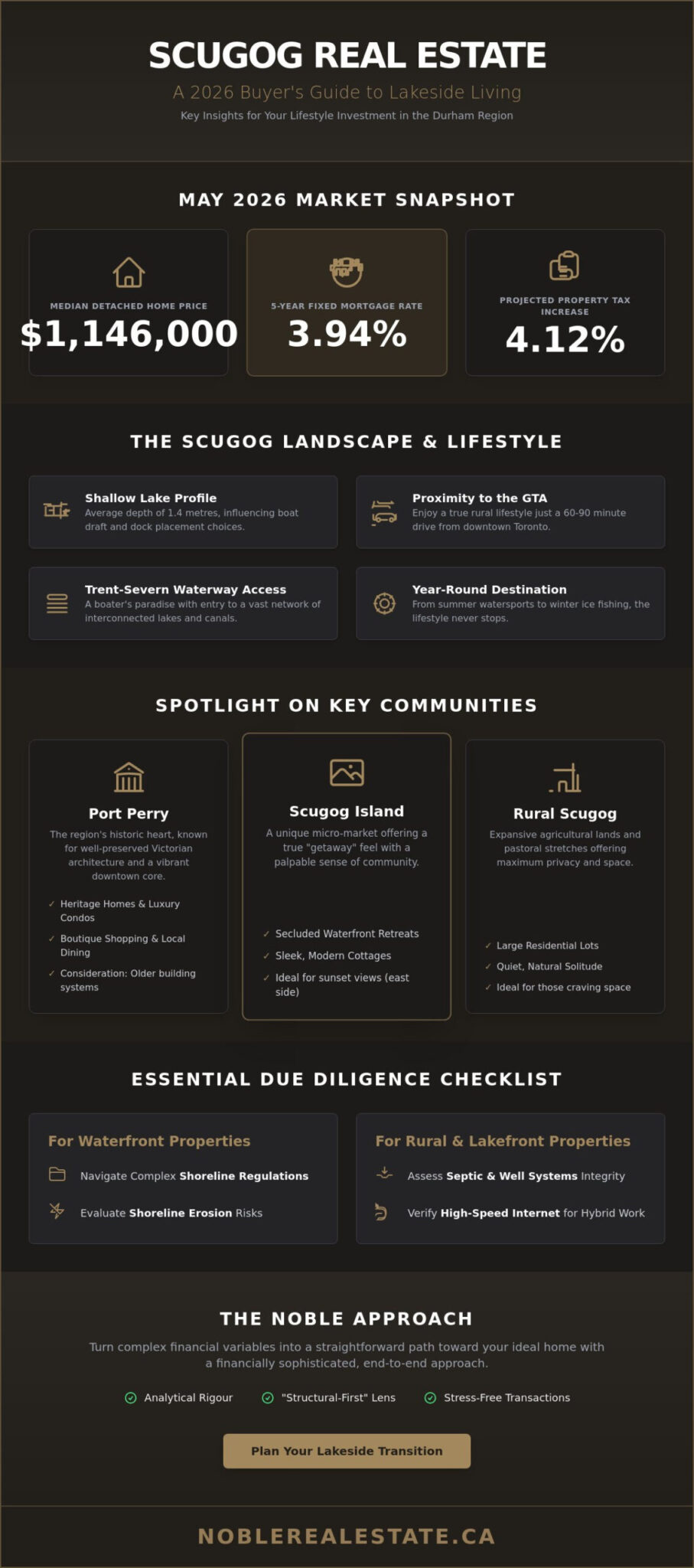
Market Dynamics: Navigating Scugog Property Values in 2026
The 2026 real estate climate in the Durham Region reflects a period of recalibration. While the benchmark price for the area has seen a -4.8% change over the last year, detached homes in Scugog maintain a robust median price of $1,146,000. This data suggests that while the broader market fluctuates, high-value assets near the water remain resilient. Inventory levels currently show that homes stay on the market for an average of 37 days. This creates a balanced environment where buyers have more room to breathe than in previous years, yet sellers of premium properties still see consistent demand. When you’re searching for homes for sale near lake scugog, understanding these macro-trends is the first step in making a confident offer.
Interest rate stability has also played a significant role in shaping this year’s acquisitions. With the prime rate sitting at 4.45% as of May 2026, buyers are finding more predictable carrying costs for high-value rural and waterfront estates. However, a successful purchase requires looking beyond the sticker price. My background as a CPA allows me to apply analytical rigour to every transaction, ensuring we account for the total cost of ownership before you sign on the dotted line.
The CPA Advantage in Real Estate
Applying a financial lens to real estate means identifying undervalued assets that others might miss. We don’t just look at “comparables” from the last six months; we analyze the true cost of ownership, including utilities for rural systems and specialized insurance for waterfront dwellings. Property tax assessments in the Township of Scugog are unique because the 4.12% projected increase for 2026 is heavily weighted toward a 4% infrastructure levy, a structure quite different from the general operations focus found in urban Toronto assessments. This distinction is vital for long-term budgeting and understanding how your tax dollars are reinvested into the local community.
Investment Potential and Resale Value
Lake Scugog waterfront properties have historically shown strong appreciation, but not all lots are created equal. Factors that protect your resale value include the quality of the shoreline, consistent road maintenance, and the availability of high-speed internet connectivity. For those looking at homes for sale near lake scugog as part of a broader portfolio, it’s helpful to compare this market to other regions. You might find it useful to read our guide on Bancroft real estate to see how Scugog’s proximity to the GTA provides a different value proposition than deeper cottage country. By focusing on properties with “hybrid-ready” features and sustainable environmental footprints, you’re not just buying a home; you’re securing a financially sound future.
Essential Considerations for Waterfront and Rural Properties
Purchasing homes for sale near lake scugog involves a layer of due diligence that differs significantly from urban transactions. While a standard home inspection covers the basics, waterfront and rural properties require a specialized assessment of environmental and mechanical systems. I utilize a comprehensive “Noble Checklist” to ensure no detail is overlooked. This includes verifying the status of shoreline permits and assessing the integrity of non-municipal services. My goal is to make these technical hurdles feel straightforward and manageable, allowing you to focus on the excitement of your new lifestyle.
Environmental regulations are particularly stringent near the water to protect the delicate ecosystem of the Scugog basin. Both Kawartha Conservation and the Lake Scugog Conservation Authority (LSCA) play active roles in monitoring property development. Understanding their requirements before you make an offer is essential for any buyer planning future renovations or shoreline improvements.
Water and Waste: The Rural Reality
When you move away from city sewers, the septic system becomes your most critical infrastructure. A professional inspection must verify the tank’s condition and the leaching bed’s functionality. “Working order” means more than just a recent pump-out; it means the system can handle your family’s specific water load without environmental risk. Similarly, well water requires rigorous testing for potability and flow rates. In 2026, most savvy buyers prioritize properties with modern UV filtration and water softening systems already in place. Upgrading an antiquated system to meet current standards can be a significant investment, so identifying these needs early is a key part of my financial analysis for you.
Navigating Shoreline Regulations
The shoreline of Lake Scugog is a protected environment. Any in-water work, such as installing a permanent dock or boathouse, falls under the jurisdiction of the Trent-Severn Waterway (Parks Canada). Meanwhile, Kawartha Conservation regulates work on the land-based portion of the shoreline and floodplain. It’s vital to understand where your property line ends and the “high water mark” begins. Maintaining a natural shoreline isn’t just an environmental preference; it’s often a regulatory requirement that protects your property from the erosion common in shallow basins. If you’re feeling overwhelmed by these regulations, my buyer representation services provide the expert guidance needed to navigate these authorities with confidence.
Seasonal vs. Year-Round Access
Accessibility is a major factor in property value and daily convenience. Many homes near the lake are located on private roads. Unlike municipally serviced routes, private roads require residents to manage their own snow removal and grading. This often involves annual maintenance fees or a formal road association agreement. If you’re looking at an older cottage-style home for year-round use, we must evaluate its winterization. This includes looking at insulation levels, heat tracing for water lines, and the efficiency of the primary heating source. Ensuring your home is prepared for an Ontario winter is essential for protecting your comfort and your long-term investment value.
Finding Your Perfect Lakefront Home with The Noble Approach
Securing your place among the homes for sale near lake scugog is an exciting milestone, but it’s also a significant financial commitment that benefits from a structured, analytical perspective. “The Noble Approach” isn’t just a marketing slogan; it’s a methodology built on my background as a CPA, CA. This financial sophistication allows me to look at a property not just as a residence, but as a critical piece of your investment portfolio. By combining this analytical rigour with deep local expertise in Port Perry and the surrounding areas, I help you identify opportunities that others might overlook, including sourcing off-market properties that never reach the public MLS system.
Transitioning from an urban environment to a rural or waterfront setting involves unique logistics. Whether you’re moving from downtown Toronto or a nearby Durham suburb, managing the move to Scugog requires careful coordination. I oversee the end-to-end process, from the initial search to the final hand-over of keys. This comprehensive knowledge ensures that technical details like septic clearances and shoreline permits are handled long before they can become stressors. My goal is to provide a supportive, advisory experience that makes the complex journey toward lakefront living feel entirely straightforward.
A Stress-Free Buying Experience
The “Noble Approach” to offer negotiations and closing is designed to reduce buyer anxiety by providing absolute clarity. In a market where detached homes have a median price of $1,146,000, having a seasoned professional who understands the nuances of valuation is essential. I provide the data-driven insights you need to make confident decisions under pressure. If you’re still early in your journey, you may find it helpful to read our guide on choosing a real estate agent to better understand how our philosophy of transparency and analytical rigour sets us apart in the Durham Region.
Your Next Steps in Scugog
Finding the right home starts with being the first to know when new inventory hits the market. I can help you set up a custom MLS alert specifically for waterfront and rural homes for sale near lake scugog, ensuring you never miss a property that fits your criteria. Once we’ve identified potential matches, we can book a private tour of the diverse communities around the lake, from the heritage streets of Port Perry to the quiet shores of Scugog Island. This hands-on exploration is the best way to feel the “vibe” of the different micro-markets we’ve discussed. When you’re ready to start your journey with a partner who prioritizes your financial well-being and peace of mind, Redefine your expectations and contact Colin Noble today.
Secure Your Future on the Shores of Lake Scugog
Finding the right balance between a serene lifestyle and a sound financial investment requires a specialized perspective. As we’ve explored, navigating the 4.12% property tax increases and the technical nuances of shoreline regulations is essential for long-term success in this market. When you search for homes for sale near lake scugog, you’re looking for more than a house. You’re looking for a property that maintains its value while providing the peaceful escape you’ve worked hard to achieve.
The Noble Approach simplifies this transition by applying the analytical rigour of a CPA, CA to every transaction. Colin Noble combines this financial background with deep local expertise in Uxbridge and the Durham Region to ensure your purchase is both enjoyable and secure. Whether you’re evaluating a Victorian estate in Port Perry or a modern cottage on Scugog Island, our end-to-end service protects your interests at every step. Explore Current Homes for Sale Near Lake Scugog and discover how a professional, client-centric approach can redefine your real estate expectations. Your new chapter in Scugog starts with a partner you can trust.
Frequently Asked Questions
Are homes for sale near Lake Scugog a good investment in 2026?
Yes, Scugog properties remain a resilient investment, particularly detached homes which hold a median price of $1,146,000 as of May 2026. While the broader market saw a -4.8% benchmark price change over the last year, the 37 day average on market suggests steady demand. Buyers can find value by focusing on “hybrid-ready” properties that support the growing trend of remote work in the Durham Region.
What are the property tax rates in Scugog compared to Uxbridge?
The Township of Scugog has a projected property tax increase of 4.12% for 2026, which applies to the Scugog portion of your bill. This local portion accounts for 33% of the total, with the remainder allocated to Durham Region and education. While rates are comparable to Uxbridge, Scugog’s specific 4% infrastructure levy ensures that tax dollars are directly reinvested into local roads and shoreline protections.
Can I build a new dock on a Lake Scugog waterfront property?
You can build a dock, but you must secure permits from the Trent-Severn Waterway, managed by Parks Canada, for any in-water work. Shoreline and floodplain projects are regulated by Kawartha Conservation. These authorities prioritize the maintenance of natural shorelines to protect the lake’s ecosystem, so it’s essential to review By-law 23-25 for the latest provisions on accessory structures before starting construction.
Is Lake Scugog deep enough for large motorboats?
Lake Scugog is a shallow body of water with an average depth of approximately 1.4 metres, which influences the type of watercraft you can use. While large motorboats can navigate the deeper channels of the Trent-Severn Waterway, property owners must be mindful of their boat’s draft when approaching private docks. Selecting a property with good water depth at the dock is a key factor in maximizing the utility of homes for sale near lake scugog.
What is the commute time from Port Perry to downtown Toronto?
The commute from Port Perry to downtown Toronto typically takes between 60 and 90 minutes. This range depends on your departure time and whether you utilize the Highway 407 extension or Highway 12. This manageable distance is a primary reason why many professionals choose the Scugog area for a permanent residence rather than a seasonal cottage.
Do I need a special inspection for a house with a septic system?
A specialized septic inspection is vital for any rural property purchase to ensure the system is in proper working order. A standard home inspection rarely covers the structural integrity of the tank or the absorption capacity of the leaching bed. Verifying these components helps you avoid the significant costs associated with upgrading older systems to meet 2026 environmental standards.
What are the most popular neighbourhoods near Lake Scugog?
Port Perry remains the most popular destination for its historic Victorian architecture and vibrant downtown core. Scugog Island is highly sought after by those looking for a community-oriented lifestyle with excellent sunset views on the western shore. For buyers seeking privacy, the rural estates in North Scugog offer large acreage and hobby farm opportunities that are increasingly rare in the GTA.
How does the Trent-Severn Waterway affect Lake Scugog homeowners?
The Trent-Severn Waterway manages the water levels and regulates all in-water construction on Lake Scugog. For homeowners, this means that any dock or boathouse project requires federal approval from Parks Canada. This connection also provides residents with boat access to a 386 kilometre system of lakes and canals, significantly enhancing the recreational value of homes for sale near lake scugog.
In May 2026, the median price for detached homes in Scugog has reached $1,146,000, which means the margin for error in your lifestyle investment is thinner than ever. You’ve likely spent hours browsing homes for sale near lake scugog, dreaming of sunset views and quiet mornings by the water. It’s natural to feel a sense of hesitation when you consider the complexities of septic systems, shoreline erosion, or the 4.12% property tax increase projected for the Township this year.
You deserve a transition that’s as serene as the lake itself, and that starts with having a financially savvy advisor in your corner. This guide will replace your uncertainty with clarity by applying a rigorous analytical lens to the local market. We’ll examine the latest 2026 development charges, compare current mortgage rates like the 3.94% five year fixed, and provide a framework for evaluating waterfront versus rural residential lots. By the end, you’ll understand how “The Noble Approach” turns complex financial variables into a straightforward path toward your ideal home.
Key Takeaways
- Identify the unique characteristics of local micro-markets, from the historic charm of Port Perry to the secluded waterfront retreats of Scugog Island.
- Learn to evaluate homes for sale near lake scugog using a “structural-first” lens that prioritizes long-term integrity over surface-level aesthetics.
- Apply analytical rigour to your purchase by understanding how 2026 market dynamics and local development charges impact your total investment.
- Master the essential due diligence required for waterfront living, including navigating complex shoreline regulations and non-urban utility systems.
- Discover how a financially sophisticated, end-to-end approach can remove the stress from complex rural and lakefront property transactions.
Exploring the Allure of Lake Scugog Real Estate
Lake Scugog is a unique man-made marvel with a history that sets it apart from the glacial lakes of the nearby Kawarthas. Originally a marshy river valley, it was transformed in 1834 when a dam was constructed at Lindsay, creating the expansive body of water we enjoy today. As a vital link in the Trent-Severn Waterway, the lake provides boaters with access to a vast network of interconnected canals and lakes stretching across Ontario. When you begin your search for homes for sale near lake scugog, you’re looking at a diverse geographical area. The market encompasses the historic Victorian streets of Port Perry, the quiet pastoral stretches of Scugog Island, and the expansive agricultural lands of Rural Scugog.
In 2026, the Durham Region real estate landscape has evolved. We’ve seen a clear shift toward “hybrid-ready” homes. Buyers are no longer just looking for a weekend escape; they want properties that offer high-speed infrastructure and dedicated professional spaces to support a remote or flexible work life. Learn about Lake Scugog’s history and geography to better understand how this evolving ecosystem supports both modern residential needs and traditional recreational pursuits. This region perfectly balances the sophisticated charm of Port Perry’s heritage architecture with the secluded, rugged nature found in the lake’s northern reaches.
The Geography of the Scugog Basin
Understanding the lake’s physical profile is essential for any prospective buyer. Lake Scugog is notably shallow, with an average depth of approximately 1.4 metres. This characteristic significantly influences how you’ll use your property, particularly regarding boat draft and dock placement. The western shores near Port Perry are famous for their sunrise views, while the eastern side of Scugog Island is the place to be for those who prioritize evening sunsets. Proximity to the GTA remains a primary driver for value here; Scugog offers a genuine rural lifestyle while staying within a manageable 60 to 90 minute drive of downtown Toronto.
Lifestyle and Recreational Benefits
The allure of this area extends far beyond the summer months. It’s a true year-round destination where ice fishing huts and snowmobile trails replace boats and jet skis as the temperature drops. Port Perry serves as the region’s cultural and commercial hub, offering a refined mix of boutique shopping, local dining, and the Great Blue Heron Casino. For those who crave quiet, the Lake Scugog Conservation Area (LSCA) protects the local biodiversity and provides a peaceful escape for hikers and birdwatchers. Finding the right property here means finding a balance between these vibrant community amenities and the quiet, natural solitude that only a lakefront or rural lot can provide.
Property Types and Key Communities Around the Lake
The variety of homes for sale near lake scugog is one of the region’s most compelling features. You’ll find a spectrum that ranges from 19th-century Victorian estates in the heart of Port Perry to sleek, glass-fronted modern cottages on the water’s edge. While a home’s aesthetic appeal is often what first captures a buyer’s attention, “The Noble Approach” focuses on looking past the surface. My goal is to help you evaluate the structural integrity and long-term financial viability of every property. It’s about ensuring your investment is as sound as it is beautiful, whether you’re looking for a primary residence or a seasonal retreat.
Scugog Island offers a unique micro-market where the sense of community is palpable. It’s an area where accessibility meets a true “getaway” feel. If you’re curious about how these properties compare to other high-value areas in North Durham, a professional home valuation can provide the analytical rigour needed to make an informed decision.
Port Perry: The Historic Heart
Port Perry is renowned for its well-preserved heritage architecture. These Victorian homes offer immense character, but they require a sophisticated understanding of older building systems and maintenance. If you’re weighing these heritage options against other local markets, you might also want to explore houses for sale in Uxbridge to see how different historic cores compare. For those who prefer a lower-maintenance lifestyle, the growth of luxury condo developments near the waterfront provides modern amenities just steps from the downtown core. You can find detailed zoning and community planning updates on the official Township of Scugog website.
Waterfront vs. Water-Access Properties
Direct waterfront properties command a premium because of their private shorelines, but water-access homes shouldn’t be overlooked. These properties often feature deeded rights to a shared dock or beach, offering the lake lifestyle at a more accessible entry point. Identifying these “indirect” opportunities requires a keen eye for value. When evaluating direct lakefront, pay close attention to shoreline protection and the condition of private docks. A sturdy retaining wall or a well-maintained dock adds significant value and protects against the natural erosion common in the Scugog basin.
Rural Scugog and Agricultural Estates
Moving inland, Rural Scugog offers expansive acreage and hobby farms that appeal to those seeking privacy and space. These properties are increasingly popular for buyers interested in secondary suites or farm-related businesses. Zoning By-law 14-14, which received “housekeeping” updates as recently as May 2025 under By-law 23-25, governs what you can build on these lots. Large parcels in North Durham also represent a strategic land-banking opportunity as the region’s population continues to expand.
Market Dynamics: Navigating Scugog Property Values in 2026
The 2026 real estate climate in the Durham Region reflects a period of recalibration. While the benchmark price for the area has seen a -4.8% change over the last year, detached homes in Scugog maintain a robust median price of $1,146,000. This data suggests that while the broader market fluctuates, high-value assets near the water remain resilient. Inventory levels currently show that homes stay on the market for an average of 37 days. This creates a balanced environment where buyers have more room to breathe than in previous years, yet sellers of premium properties still see consistent demand. When you’re searching for homes for sale near lake scugog, understanding these macro-trends is the first step in making a confident offer.
Interest rate stability has also played a significant role in shaping this year’s acquisitions. With the prime rate sitting at 4.45% as of May 2026, buyers are finding more predictable carrying costs for high-value rural and waterfront estates. However, a successful purchase requires looking beyond the sticker price. My background as a CPA allows me to apply analytical rigour to every transaction, ensuring we account for the total cost of ownership before you sign on the dotted line.
The CPA Advantage in Real Estate
Applying a financial lens to real estate means identifying undervalued assets that others might miss. We don’t just look at “comparables” from the last six months; we analyze the true cost of ownership, including utilities for rural systems and specialized insurance for waterfront dwellings. Property tax assessments in the Township of Scugog are unique because the 4.12% projected increase for 2026 is heavily weighted toward a 4% infrastructure levy, a structure quite different from the general operations focus found in urban Toronto assessments. This distinction is vital for long-term budgeting and understanding how your tax dollars are reinvested into the local community.
Investment Potential and Resale Value
Lake Scugog waterfront properties have historically shown strong appreciation, but not all lots are created equal. Factors that protect your resale value include the quality of the shoreline, consistent road maintenance, and the availability of high-speed internet connectivity. For those looking at homes for sale near lake scugog as part of a broader portfolio, it’s helpful to compare this market to other regions. You might find it useful to read our guide on Bancroft real estate to see how Scugog’s proximity to the GTA provides a different value proposition than deeper cottage country. By focusing on properties with “hybrid-ready” features and sustainable environmental footprints, you’re not just buying a home; you’re securing a financially sound future.
Essential Considerations for Waterfront and Rural Properties
Purchasing homes for sale near lake scugog involves a layer of due diligence that differs significantly from urban transactions. While a standard home inspection covers the basics, waterfront and rural properties require a specialized assessment of environmental and mechanical systems. I utilize a comprehensive “Noble Checklist” to ensure no detail is overlooked. This includes verifying the status of shoreline permits and assessing the integrity of non-municipal services. My goal is to make these technical hurdles feel straightforward and manageable, allowing you to focus on the excitement of your new lifestyle.
Environmental regulations are particularly stringent near the water to protect the delicate ecosystem of the Scugog basin. Both Kawartha Conservation and the Lake Scugog Conservation Authority (LSCA) play active roles in monitoring property development. Understanding their requirements before you make an offer is essential for any buyer planning future renovations or shoreline improvements.
Water and Waste: The Rural Reality
When you move away from city sewers, the septic system becomes your most critical infrastructure. A professional inspection must verify the tank’s condition and the leaching bed’s functionality. “Working order” means more than just a recent pump-out; it means the system can handle your family’s specific water load without environmental risk. Similarly, well water requires rigorous testing for potability and flow rates. In 2026, most savvy buyers prioritize properties with modern UV filtration and water softening systems already in place. Upgrading an antiquated system to meet current standards can be a significant investment, so identifying these needs early is a key part of my financial analysis for you.
Navigating Shoreline Regulations
The shoreline of Lake Scugog is a protected environment. Any in-water work, such as installing a permanent dock or boathouse, falls under the jurisdiction of the Trent-Severn Waterway (Parks Canada). Meanwhile, Kawartha Conservation regulates work on the land-based portion of the shoreline and floodplain. It’s vital to understand where your property line ends and the “high water mark” begins. Maintaining a natural shoreline isn’t just an environmental preference; it’s often a regulatory requirement that protects your property from the erosion common in shallow basins. If you’re feeling overwhelmed by these regulations, my buyer representation services provide the expert guidance needed to navigate these authorities with confidence.
Seasonal vs. Year-Round Access
Accessibility is a major factor in property value and daily convenience. Many homes near the lake are located on private roads. Unlike municipally serviced routes, private roads require residents to manage their own snow removal and grading. This often involves annual maintenance fees or a formal road association agreement. If you’re looking at an older cottage-style home for year-round use, we must evaluate its winterization. This includes looking at insulation levels, heat tracing for water lines, and the efficiency of the primary heating source. Ensuring your home is prepared for an Ontario winter is essential for protecting your comfort and your long-term investment value.
Finding Your Perfect Lakefront Home with The Noble Approach
Securing your place among the homes for sale near lake scugog is an exciting milestone, but it’s also a significant financial commitment that benefits from a structured, analytical perspective. “The Noble Approach” isn’t just a marketing slogan; it’s a methodology built on my background as a CPA, CA. This financial sophistication allows me to look at a property not just as a residence, but as a critical piece of your investment portfolio. By combining this analytical rigour with deep local expertise in Port Perry and the surrounding areas, I help you identify opportunities that others might overlook, including sourcing off-market properties that never reach the public MLS system.
Transitioning from an urban environment to a rural or waterfront setting involves unique logistics. Whether you’re moving from downtown Toronto or a nearby Durham suburb, managing the move to Scugog requires careful coordination. I oversee the end-to-end process, from the initial search to the final hand-over of keys. This comprehensive knowledge ensures that technical details like septic clearances and shoreline permits are handled long before they can become stressors. My goal is to provide a supportive, advisory experience that makes the complex journey toward lakefront living feel entirely straightforward.
A Stress-Free Buying Experience
The “Noble Approach” to offer negotiations and closing is designed to reduce buyer anxiety by providing absolute clarity. In a market where detached homes have a median price of $1,146,000, having a seasoned professional who understands the nuances of valuation is essential. I provide the data-driven insights you need to make confident decisions under pressure. If you’re still early in your journey, you may find it helpful to read our guide on choosing a real estate agent to better understand how our philosophy of transparency and analytical rigour sets us apart in the Durham Region.
Your Next Steps in Scugog
Finding the right home starts with being the first to know when new inventory hits the market. I can help you set up a custom MLS alert specifically for waterfront and rural homes for sale near lake scugog, ensuring you never miss a property that fits your criteria. Once we’ve identified potential matches, we can book a private tour of the diverse communities around the lake, from the heritage streets of Port Perry to the quiet shores of Scugog Island. This hands-on exploration is the best way to feel the “vibe” of the different micro-markets we’ve discussed. When you’re ready to start your journey with a partner who prioritizes your financial well-being and peace of mind, Redefine your expectations and contact Colin Noble today.
Secure Your Future on the Shores of Lake Scugog
Finding the right balance between a serene lifestyle and a sound financial investment requires a specialized perspective. As we’ve explored, navigating the 4.12% property tax increases and the technical nuances of shoreline regulations is essential for long-term success in this market. When you search for homes for sale near lake scugog, you’re looking for more than a house. You’re looking for a property that maintains its value while providing the peaceful escape you’ve worked hard to achieve.
The Noble Approach simplifies this transition by applying the analytical rigour of a CPA, CA to every transaction. Colin Noble combines this financial background with deep local expertise in Uxbridge and the Durham Region to ensure your purchase is both enjoyable and secure. Whether you’re evaluating a Victorian estate in Port Perry or a modern cottage on Scugog Island, our end-to-end service protects your interests at every step. Explore Current Homes for Sale Near Lake Scugog and discover how a professional, client-centric approach can redefine your real estate expectations. Your new chapter in Scugog starts with a partner you can trust.
Frequently Asked Questions
Are homes for sale near Lake Scugog a good investment in 2026?
Yes, Scugog properties remain a resilient investment, particularly detached homes which hold a median price of $1,146,000 as of May 2026. While the broader market saw a -4.8% benchmark price change over the last year, the 37 day average on market suggests steady demand. Buyers can find value by focusing on “hybrid-ready” properties that support the growing trend of remote work in the Durham Region.
What are the property tax rates in Scugog compared to Uxbridge?
The Township of Scugog has a projected property tax increase of 4.12% for 2026, which applies to the Scugog portion of your bill. This local portion accounts for 33% of the total, with the remainder allocated to Durham Region and education. While rates are comparable to Uxbridge, Scugog’s specific 4% infrastructure levy ensures that tax dollars are directly reinvested into local roads and shoreline protections.
Can I build a new dock on a Lake Scugog waterfront property?
You can build a dock, but you must secure permits from the Trent-Severn Waterway, managed by Parks Canada, for any in-water work. Shoreline and floodplain projects are regulated by Kawartha Conservation. These authorities prioritize the maintenance of natural shorelines to protect the lake’s ecosystem, so it’s essential to review By-law 23-25 for the latest provisions on accessory structures before starting construction.
Is Lake Scugog deep enough for large motorboats?
Lake Scugog is a shallow body of water with an average depth of approximately 1.4 metres, which influences the type of watercraft you can use. While large motorboats can navigate the deeper channels of the Trent-Severn Waterway, property owners must be mindful of their boat’s draft when approaching private docks. Selecting a property with good water depth at the dock is a key factor in maximizing the utility of homes for sale near lake scugog.
What is the commute time from Port Perry to downtown Toronto?
The commute from Port Perry to downtown Toronto typically takes between 60 and 90 minutes. This range depends on your departure time and whether you utilize the Highway 407 extension or Highway 12. This manageable distance is a primary reason why many professionals choose the Scugog area for a permanent residence rather than a seasonal cottage.
Do I need a special inspection for a house with a septic system?
A specialized septic inspection is vital for any rural property purchase to ensure the system is in proper working order. A standard home inspection rarely covers the structural integrity of the tank or the absorption capacity of the leaching bed. Verifying these components helps you avoid the significant costs associated with upgrading older systems to meet 2026 environmental standards.
What are the most popular neighbourhoods near Lake Scugog?
Port Perry remains the most popular destination for its historic Victorian architecture and vibrant downtown core. Scugog Island is highly sought after by those looking for a community-oriented lifestyle with excellent sunset views on the western shore. For buyers seeking privacy, the rural estates in North Scugog offer large acreage and hobby farm opportunities that are increasingly rare in the GTA.
How does the Trent-Severn Waterway affect Lake Scugog homeowners?
The Trent-Severn Waterway manages the water levels and regulates all in-water construction on Lake Scugog. For homeowners, this means that any dock or boathouse project requires federal approval from Parks Canada. This connection also provides residents with boat access to a 386 kilometre system of lakes and canals, significantly enhancing the recreational value of homes for sale near lake scugog.
Read More Posts


Looking For More Great Content?
Get even more informative Toronto real estate news sent directly to your inbox by signing up for my newsletter here. All it takes is a few easy clicks.

Selling a Rural Property in Ontario: The Strategic 2026 Guide
05/9/26 Uncategorized
A rural property isn’t just a home; it’s a complex portfolio of environmental systems and land-use rights that requires a financial auditor’s eye to value correctly. You’ve likely felt the weight of uncertainty regarding your septic compliance or how to price unique acreage when selling a rural property in Ontario, especially with active listings at their highest level in over a decade. It’s natural to worry that a failing septic system, which can cost $60,000 or more to replace, might derail your sale or lead to long days on the market. I understand these anxieties, and I’m here to provide the clarity you need.
Using “The Noble Approach,” I’ll show you how to transform these complexities into a strategic advantage. This guide provides a professional, financially-backed roadmap to maximize your property value while ensuring a stress-free transition. We’ll explore how the 2.25% Bank of Canada policy rate is shaping this year’s buyer’s market, the latest 2026 capital gains inclusion rates, and the specific steps to find a buyer who truly appreciates your land’s lifestyle and investment potential.
Key Takeaways
- Understand how 2026 market shifts and the latest Ontario land transfer tax rates impact your bottom line when preparing to list.
- Navigate the technical hurdles of selling a rural property in Ontario by mastering septic inspections and well water recovery tests before your property hits the market.
- Apply a financially-backed “CPA lens” to your land valuation to ensure outbuildings and unique zoning features are priced for maximum ROI.
- Learn why high-altitude drone photography and lifestyle storytelling are essential tools to capture the attention of premium buyers seeking the Ontario countryside.
- Discover how a pre-listing audit can eliminate the fear of long days-on-market and ensure a stress-free, straightforward transaction.
The Unique Landscape of Selling Rural Property in Ontario (2026)
Selling a rural property in Ontario involves a layer of complexity that urban sellers rarely encounter. While a city transaction might focus on square footage and transit access, a country sale hinges on land-specific contingencies. These include private utility systems, environmental setbacks, and the specific nuances of Land ownership in Canada. By May 2026, the market has undergone a “great rebalancing.” We’ve moved past the frantic bidding wars of the early 2020s into a period where active listings are at their highest level in over a decade. This inventory surge means your property needs a precise, financially-backed strategy to stand out among the current provincial landscape.
The shift from “commuter homes” to “lifestyle investments” is the defining trend of 2026. Buyers in the Durham Region and Uxbridge are no longer just looking for a place to sleep between office days. They’re seeking properties that offer on-farm diversified uses, such as small-scale agricultural ventures or event spaces. This requires a higher level of due diligence from sellers. You must be prepared to prove the utility of every acre you own, moving beyond the house to the potential of the soil and the integrity of the outbuildings. It’s about demonstrating how the land functions as a productive asset.
Urban vs. Rural: Why Your Strategy Must Change
Urban marketing relies heavily on “walk-scores” and neighborhood prestige. In contrast, rural marketing is built on “acreage-utility.” A buyer in the countryside cares less about the nearest subway and more about the recovery rate of your well. While the buyer pool for rural estates is smaller than for downtown condos, these individuals are significantly more targeted and informed. They prioritize internet connectivity for remote work, which has become a non-negotiable value driver in 2026. If your property lacks verified high-speed access, its marketability drops regardless of its aesthetic appeal. We focus on these technical strengths to build buyer confidence early.
Local Expertise in Uxbridge and Durham Region
The Greater Toronto Area’s fringe has its own economic heartbeat. Understanding uxbridge real estate dynamics is essential because the buyer profile here differs sharply from the downtown Toronto core. These buyers are often looking for tax-efficient ways to hold land or are interested in the latest legislative shifts, such as the “Protecting Ontario’s Food Independence Act, 2026,” and how it restricts foreign acquisition of provincial farmland. A local specialist doesn’t just show the house; they explain the property’s financial trajectory. Using “The Noble Approach,” we treat your sale as a sophisticated divestment of a complex asset, ensuring that your property’s unique features are quantified and defended during negotiations.
Technical Due Diligence: Septic Systems, Wells, and Zoning
A rural transaction is often won or lost during the technical due diligence phase. Unlike urban homes, where services are provided by the municipality, rural properties rely on complex private systems that represent significant financial liability. When selling a rural property in Ontario, the condition of your septic system is often the first hurdle. With replacement costs ranging from $15,000 to over $60,000 in 2026, a failing system can easily stall a sale. Municipalities are increasingly implementing mandatory inspection programs, especially near water sources. Proactively securing a ‘Use Permit’ or a recent inspection report eliminates this uncertainty for potential buyers.
Well water is the second pillar of rural technical health. Beyond potability, which Public Health Ontario continues to test for free to identify bacterial contaminants, buyers are increasingly focused on the recovery rate. A 24-hour flow test provides the data needed to prove that your well can sustain a modern household’s needs. This level of transparency is a core part of “The Noble Approach,” where we address potential deal breakers before the property even hits the market. If you’re unsure where your property stands, a professional home valuation can help identify which technical audits will yield the highest return.
Zoning designations like Agricultural or Rural Residential dictate what a buyer can actually do with the land. Properties within the Oak Ridges Moraine or the Greenbelt face even stricter regulations from Conservation Authorities like the TRCA. These bodies have the power to restrict development or expansion to protect the watershed. Understanding how Ontario’s public land sale policy influences adjacent land values can also help in positioning your acreage correctly against provincial benchmarks. We ensure every environmental restriction is clearly communicated to prevent last-minute legal complications.
Ensuring Water and Waste Compliance
If a septic system fails a pre-listing inspection, it doesn’t have to end the sale. You can often negotiate a financial holdback or complete the repair before closing to maintain your asking price. For former agricultural lands, a ‘Record of Site Condition’ might be necessary to prove the soil is free from contaminants. Common well issues, such as high mineral content or bacterial spikes, are usually remediable with modern UV filtration or softening systems. Addressing these early protects your ROI and reduces buyer anxiety.
Navigating Environmental Restrictions
Selling within a protected zone requires specialized disclosure. If your land benefits from a ‘Managed Forest’ tax credit, you must explain how this reduces the buyer’s future taxes while requiring a long-term commitment to forest management. We also carefully audit easements and right-of-ways. These are common when selling a rural property in Ontario and can impact where a buyer builds a secondary dwelling or a fence. Clear documentation ensures the buyer appreciates the land’s utility without fear of hidden restrictions.
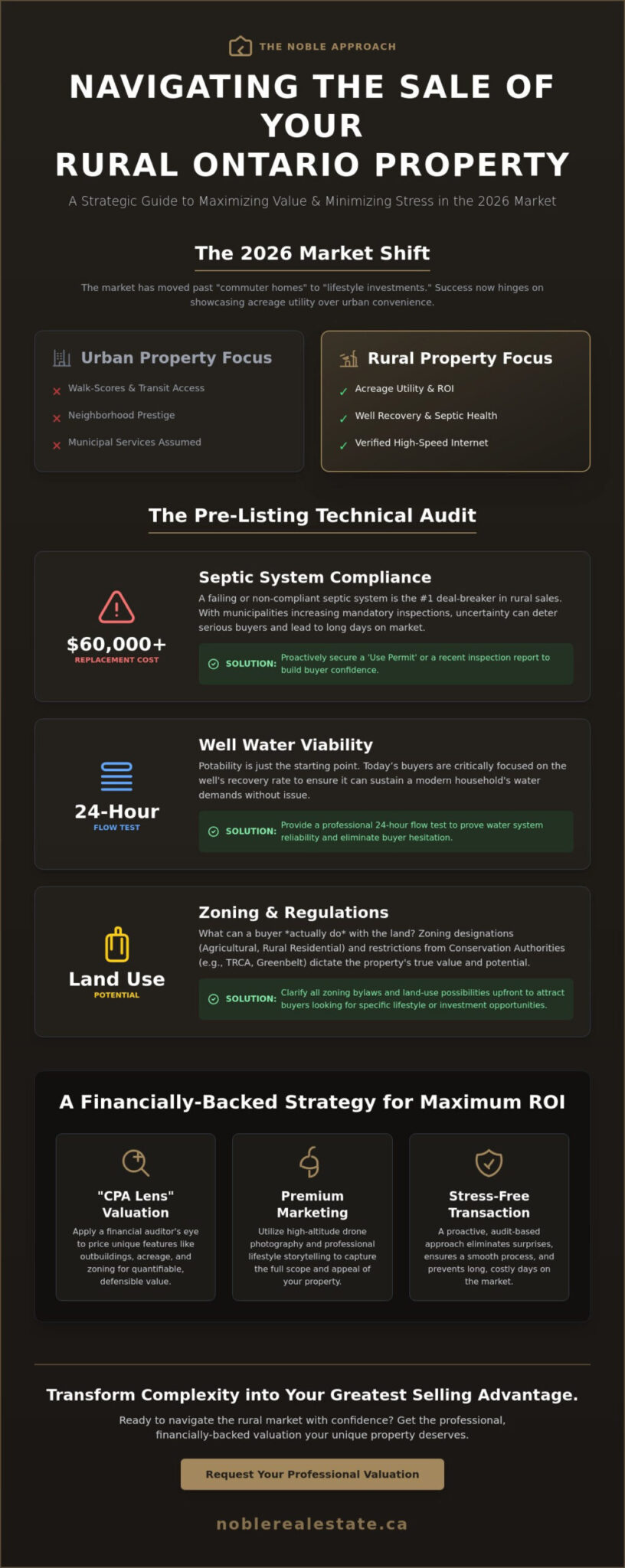
Valuing Rural Real Estate: Land Use and Financial Considerations
Valuation in the countryside requires a departure from the standard “comparable sales” model used in suburban neighborhoods. When selling a rural property in Ontario, the value is distributed across the entire acreage, not just the four walls of the home. Outbuildings, refurbished barns, and even established ponds carry quantifiable weight in a 2026 appraisal. A well-maintained barn might serve as a hobbyist’s workshop or a potential cidery, while a pond adds significant lifestyle appeal that can be defended with the right data. We categorize these features as capital assets rather than mere “extras.”
Using “The Noble Approach” means looking at your property through a CPA’s lens. We distinguish between “hobby” value, which appeals to lifestyle buyers, and “commercial” agricultural value, which attracts those looking for productive land. This distinction is vital for accurate pricing. While Uxbridge offers a unique market, looking at the broader trends in bancroft real estate helps us understand how land value scales across different Ontario regions. We ensure that your water source meets the latest well requirements and best practices, as technical compliance is the foundation of any premium price tag.
The CPA Advantage in Real Estate
Financial rigour is your strongest shield during negotiations. When a buyer questions an asking price, we provide an investment-grade analysis of your property’s improvements. This includes calculating the ROI on modern upgrades like geothermal heating systems, which have become highly desirable as energy costs fluctuate. Analytical rigour is the cornerstone of securing the full market value for high-value rural estates. We don’t just state a price; we prove it with data that satisfies even the most analytical buyer.
Tax Implications of Selling Rural Land
The financial complexity of a rural sale extends to your tax obligations. Many sellers believe their entire property is covered by the Principal Residence Exemption. However, the Canada Revenue Agency generally limits this exemption to the house and up to 0.5 hectares of land unless you can prove the additional land is necessary for the use and enjoyment of the home. In 2026, the capital gains inclusion rate for individuals is 66.67% for annual gains exceeding $250,000. This makes it essential to consult with financial professionals to understand how the “excess land” portion of your sale will be taxed. We help you prepare for these conversations early, ensuring your net proceeds align with your long-term financial goals.
Marketing Your Country Home: From Drone Footage to Targeted Reach
Selling a rural property in Ontario requires a marketing engine that operates on two levels: emotional appeal and technical precision. In a 2026 market where active listings have hit a ten-year peak, simply posting a photo of the front door won’t suffice. We use high-altitude drone photography to provide a birds-eye perspective of your entire investment. This isn’t just for aesthetics. It’s a functional tool that clarifies property lines, shows the proximity of outbuildings, and highlights the health of your forest or pond. Buyers need to see the scope of the land before they ever set foot on the soil.
Lifestyle storytelling is about selling the dream of the Ontario countryside while grounding it in reality. We don’t just list the number of bedrooms; we describe the quiet mornings on the porch and the utility of the acreage. This narrative is backed by the financial rigour established in earlier audits, ensuring the dream feels like a sound investment. If you’re looking for a partner to manage this complex process, my seller representation services provide the end-to-end support you need to succeed.
Visual Storytelling and Virtual Tours
We move beyond basic photos to immersive 3D technology. This allows city-based buyers to virtually walk your trail systems or inspect the structural integrity of your outbuildings from their desktop. Since most rural sales happen in one season but buyers want to know what the land looks like year-round, we curate a four-season visual portfolio. We stage the interior to emphasize the country escape while ensuring utility spaces, like mudrooms and workshops, feel organized and efficient. It’s about showing that the home is as practical as it is beautiful.
Strategic Listing Exposure
Reaching the right buyer means looking toward the Greater Toronto Area. With the Bank of Canada holding interest rates at 2.25% through 2026, city-to-country buyers are returning to the market with renewed confidence. We target these individuals through social media campaigns and specialized mls listings uxbridge ontario to ensure your property isn’t buried in generic search results. Our feature sheets act as a technical prospectus, detailing everything from septic “Use Permits” to geothermal ROI. This data-heavy approach filters out casual viewers and attracts serious, qualified buyers who respect the analytical depth of your listing.
The Noble Approach to a Stress-Free Rural Sale
Selling a rural property in Ontario shouldn’t feel like a gamble. While the market in May 2026 presents specific challenges, including high inventory levels and a 6.4% year-over-year provincial price decrease, these factors are manageable with a structured methodology. “The Noble Approach” is designed to replace uncertainty with analytical rigour. We treat your property as a significant financial asset, ensuring every technical detail and land feature is positioned to maximize your return on investment. It’s a process built on transparency, local expertise, and a commitment to making your transition as straightforward as possible.
Success begins with an initial consultation where we align your lifestyle goals with current market realities. We don’t just look at what the neighbor’s house sold for. We analyze the broader economic climate, including the Bank of Canada’s 2.25% policy rate and the specific buyer demographics moving into the Durham Region. This ensures that when we set an asking price, it’s backed by a solid financial foundation that can withstand the scrutiny of informed buyers and their appraisers.
Your Roadmap to Success
- Step 1: Financial and lifestyle goal setting. We define what a successful sale looks like for you, considering the 2026 capital gains inclusion rates and the logistics of your next move.
- Step 2: Technical inspections and property “polishing.” We clear regulatory hurdles by securing septic “Use Permits” and well water tests before the first showing. This prevents technical issues from becoming negotiation leverage for the buyer.
- Step 3: Bespoke marketing launch and buyer vetting. We deploy high-impact drone footage and targeted digital reach to attract qualified buyers who appreciate the rural lifestyle and have the financial backing to close.
Redefining Your Real Estate Expectations
My background as a CPA and CA provides a layer of professional oversight that is rare in the real estate industry. This financial expertise means I understand the tax implications and investment nuances of your sale better than a traditional agent. I manage the complex moving parts of your transaction, from environmental setbacks to final closing documents, so you don’t have to worry about the details. This is my “Stress-Free” guarantee to you. If you’re ready to start your journey with a partner who values precision and personal service, contact Noble Real Estate today for a comprehensive home valuation.
Redefine Your Real Estate Expectations in 2026
Success when selling a rural property in Ontario requires a strategy that bridges technical compliance with financial clarity. We’ve explored how the 2.25% Bank of Canada interest rate and record-high inventory levels in May 2026 necessitate a “Financial-First” methodology. By proactively managing septic inspections and well water tests, you’ll eliminate the hurdles that often stall country transactions. Leveraging my CPA and CA designation ensures that every acre of your land is treated as a high-value investment asset, from the soil quality to the ROI of your recent geothermal upgrades.
My specialized expertise in Uxbridge and the surrounding Durham Region allows me to provide end-to-end management of the entire sales process. I handle the complex technical audits and lifestyle marketing so you can focus on your next chapter. When you’re ready to move forward with a partner who prioritizes your financial success and peace of mind, it’s time to take the next step. Your transition to a new lifestyle can be both profitable and enjoyable with the right professional guidance.
Discover The Noble Approach to Selling Your Rural Property
Frequently Asked Questions
Do I need a special septic inspection to sell my rural home in Ontario?
Yes, while not a provincial requirement for every home, most buyers and lenders will insist on a septic inspection as a condition of the sale. In 2026, many Ontario municipalities have implemented mandatory inspection programs for properties near water sources to protect the environment. Securing a “Use Permit” or a recent inspection report proactively helps ensure a stress-free transaction and protects your asking price from last-minute negotiations.
How much land is included in the Principal Residence Exemption?
The Canada Revenue Agency typically limits the Principal Residence Exemption to the housing unit and up to 0.5 hectares of land, which is approximately 1.24 acres. If your property exceeds this size, the “excess land” may be subject to capital gains tax unless you can prove the additional acreage is necessary for the use and enjoyment of the home. Consulting with a financial professional is essential for high-value estates to understand your specific tax liability.
What is the Oak Ridges Moraine and how does it affect my sale?
The Oak Ridges Moraine is a protected environmental landform in Southern Ontario with strict zoning regulations designed to protect the provincial watershed. When selling a rural property in Ontario within this zone, you must disclose specific development restrictions to potential buyers. These regulations often limit where new structures can be built, which directly impacts the land’s perceived utility and its long-term investment value in the eyes of a savvy buyer.
Can I sell my rural property if the well water fails a potability test?
You can certainly sell the property, but a failed potability test will likely become a major negotiation point or a condition in the offer. Most buyers will require the installation of a UV filtration system or a chlorination treatment before they agree to close. Addressing these bacterial issues before listing ensures your property remains competitive in a 2026 market characterized by high inventory levels and increased buyer scrutiny.
How long does it typically take to sell a rural property compared to city homes?
Rural properties generally stay on the market longer than urban homes because the buyer pool is smaller and more targeted. In May 2026, with active listings at their highest level in over a decade, the process requires more patience and a precise marketing strategy. A well-prepared property with cleared technical hurdles and high-quality drone footage typically sells faster than those with lingering septic or well uncertainties.
Should I get a survey done before listing my acreage?
Having an up-to-date survey is highly recommended to confirm property boundaries and identify any existing easements or right-of-ways that could affect the sale. Rural buyers in 2026 are increasingly analytical and want to verify exactly what they are purchasing before committing. Providing a survey early in the process builds trust and prevents legal complications regarding fence lines or building setbacks during the final closing phase.
What are the common closing costs for selling a rural property in Ontario?
Common costs include legal fees, real estate commissions, and adjustments for property taxes or propane fuel tanks. Sellers should also account for the costs of technical inspections, such as septic pumping or well recovery tests, which are standard for selling a rural property in Ontario. While buyers pay the Land Transfer Tax, which ranges from 0.5% to 2.5% in 2026, sellers must ensure all technical compliance costs are settled to finalize the transaction.
A rural property isn’t just a home; it’s a complex portfolio of environmental systems and land-use rights that requires a financial auditor’s eye to value correctly. You’ve likely felt the weight of uncertainty regarding your septic compliance or how to price unique acreage when selling a rural property in Ontario, especially with active listings at their highest level in over a decade. It’s natural to worry that a failing septic system, which can cost $60,000 or more to replace, might derail your sale or lead to long days on the market. I understand these anxieties, and I’m here to provide the clarity you need.
Using “The Noble Approach,” I’ll show you how to transform these complexities into a strategic advantage. This guide provides a professional, financially-backed roadmap to maximize your property value while ensuring a stress-free transition. We’ll explore how the 2.25% Bank of Canada policy rate is shaping this year’s buyer’s market, the latest 2026 capital gains inclusion rates, and the specific steps to find a buyer who truly appreciates your land’s lifestyle and investment potential.
Key Takeaways
- Understand how 2026 market shifts and the latest Ontario land transfer tax rates impact your bottom line when preparing to list.
- Navigate the technical hurdles of selling a rural property in Ontario by mastering septic inspections and well water recovery tests before your property hits the market.
- Apply a financially-backed “CPA lens” to your land valuation to ensure outbuildings and unique zoning features are priced for maximum ROI.
- Learn why high-altitude drone photography and lifestyle storytelling are essential tools to capture the attention of premium buyers seeking the Ontario countryside.
- Discover how a pre-listing audit can eliminate the fear of long days-on-market and ensure a stress-free, straightforward transaction.
The Unique Landscape of Selling Rural Property in Ontario (2026)
Selling a rural property in Ontario involves a layer of complexity that urban sellers rarely encounter. While a city transaction might focus on square footage and transit access, a country sale hinges on land-specific contingencies. These include private utility systems, environmental setbacks, and the specific nuances of Land ownership in Canada. By May 2026, the market has undergone a “great rebalancing.” We’ve moved past the frantic bidding wars of the early 2020s into a period where active listings are at their highest level in over a decade. This inventory surge means your property needs a precise, financially-backed strategy to stand out among the current provincial landscape.
The shift from “commuter homes” to “lifestyle investments” is the defining trend of 2026. Buyers in the Durham Region and Uxbridge are no longer just looking for a place to sleep between office days. They’re seeking properties that offer on-farm diversified uses, such as small-scale agricultural ventures or event spaces. This requires a higher level of due diligence from sellers. You must be prepared to prove the utility of every acre you own, moving beyond the house to the potential of the soil and the integrity of the outbuildings. It’s about demonstrating how the land functions as a productive asset.
Urban vs. Rural: Why Your Strategy Must Change
Urban marketing relies heavily on “walk-scores” and neighborhood prestige. In contrast, rural marketing is built on “acreage-utility.” A buyer in the countryside cares less about the nearest subway and more about the recovery rate of your well. While the buyer pool for rural estates is smaller than for downtown condos, these individuals are significantly more targeted and informed. They prioritize internet connectivity for remote work, which has become a non-negotiable value driver in 2026. If your property lacks verified high-speed access, its marketability drops regardless of its aesthetic appeal. We focus on these technical strengths to build buyer confidence early.
Local Expertise in Uxbridge and Durham Region
The Greater Toronto Area’s fringe has its own economic heartbeat. Understanding uxbridge real estate dynamics is essential because the buyer profile here differs sharply from the downtown Toronto core. These buyers are often looking for tax-efficient ways to hold land or are interested in the latest legislative shifts, such as the “Protecting Ontario’s Food Independence Act, 2026,” and how it restricts foreign acquisition of provincial farmland. A local specialist doesn’t just show the house; they explain the property’s financial trajectory. Using “The Noble Approach,” we treat your sale as a sophisticated divestment of a complex asset, ensuring that your property’s unique features are quantified and defended during negotiations.
Technical Due Diligence: Septic Systems, Wells, and Zoning
A rural transaction is often won or lost during the technical due diligence phase. Unlike urban homes, where services are provided by the municipality, rural properties rely on complex private systems that represent significant financial liability. When selling a rural property in Ontario, the condition of your septic system is often the first hurdle. With replacement costs ranging from $15,000 to over $60,000 in 2026, a failing system can easily stall a sale. Municipalities are increasingly implementing mandatory inspection programs, especially near water sources. Proactively securing a ‘Use Permit’ or a recent inspection report eliminates this uncertainty for potential buyers.
Well water is the second pillar of rural technical health. Beyond potability, which Public Health Ontario continues to test for free to identify bacterial contaminants, buyers are increasingly focused on the recovery rate. A 24-hour flow test provides the data needed to prove that your well can sustain a modern household’s needs. This level of transparency is a core part of “The Noble Approach,” where we address potential deal breakers before the property even hits the market. If you’re unsure where your property stands, a professional home valuation can help identify which technical audits will yield the highest return.
Zoning designations like Agricultural or Rural Residential dictate what a buyer can actually do with the land. Properties within the Oak Ridges Moraine or the Greenbelt face even stricter regulations from Conservation Authorities like the TRCA. These bodies have the power to restrict development or expansion to protect the watershed. Understanding how Ontario’s public land sale policy influences adjacent land values can also help in positioning your acreage correctly against provincial benchmarks. We ensure every environmental restriction is clearly communicated to prevent last-minute legal complications.
Ensuring Water and Waste Compliance
If a septic system fails a pre-listing inspection, it doesn’t have to end the sale. You can often negotiate a financial holdback or complete the repair before closing to maintain your asking price. For former agricultural lands, a ‘Record of Site Condition’ might be necessary to prove the soil is free from contaminants. Common well issues, such as high mineral content or bacterial spikes, are usually remediable with modern UV filtration or softening systems. Addressing these early protects your ROI and reduces buyer anxiety.
Navigating Environmental Restrictions
Selling within a protected zone requires specialized disclosure. If your land benefits from a ‘Managed Forest’ tax credit, you must explain how this reduces the buyer’s future taxes while requiring a long-term commitment to forest management. We also carefully audit easements and right-of-ways. These are common when selling a rural property in Ontario and can impact where a buyer builds a secondary dwelling or a fence. Clear documentation ensures the buyer appreciates the land’s utility without fear of hidden restrictions.
Valuing Rural Real Estate: Land Use and Financial Considerations
Valuation in the countryside requires a departure from the standard “comparable sales” model used in suburban neighborhoods. When selling a rural property in Ontario, the value is distributed across the entire acreage, not just the four walls of the home. Outbuildings, refurbished barns, and even established ponds carry quantifiable weight in a 2026 appraisal. A well-maintained barn might serve as a hobbyist’s workshop or a potential cidery, while a pond adds significant lifestyle appeal that can be defended with the right data. We categorize these features as capital assets rather than mere “extras.”
Using “The Noble Approach” means looking at your property through a CPA’s lens. We distinguish between “hobby” value, which appeals to lifestyle buyers, and “commercial” agricultural value, which attracts those looking for productive land. This distinction is vital for accurate pricing. While Uxbridge offers a unique market, looking at the broader trends in bancroft real estate helps us understand how land value scales across different Ontario regions. We ensure that your water source meets the latest well requirements and best practices, as technical compliance is the foundation of any premium price tag.
The CPA Advantage in Real Estate
Financial rigour is your strongest shield during negotiations. When a buyer questions an asking price, we provide an investment-grade analysis of your property’s improvements. This includes calculating the ROI on modern upgrades like geothermal heating systems, which have become highly desirable as energy costs fluctuate. Analytical rigour is the cornerstone of securing the full market value for high-value rural estates. We don’t just state a price; we prove it with data that satisfies even the most analytical buyer.
Tax Implications of Selling Rural Land
The financial complexity of a rural sale extends to your tax obligations. Many sellers believe their entire property is covered by the Principal Residence Exemption. However, the Canada Revenue Agency generally limits this exemption to the house and up to 0.5 hectares of land unless you can prove the additional land is necessary for the use and enjoyment of the home. In 2026, the capital gains inclusion rate for individuals is 66.67% for annual gains exceeding $250,000. This makes it essential to consult with financial professionals to understand how the “excess land” portion of your sale will be taxed. We help you prepare for these conversations early, ensuring your net proceeds align with your long-term financial goals.
Marketing Your Country Home: From Drone Footage to Targeted Reach
Selling a rural property in Ontario requires a marketing engine that operates on two levels: emotional appeal and technical precision. In a 2026 market where active listings have hit a ten-year peak, simply posting a photo of the front door won’t suffice. We use high-altitude drone photography to provide a birds-eye perspective of your entire investment. This isn’t just for aesthetics. It’s a functional tool that clarifies property lines, shows the proximity of outbuildings, and highlights the health of your forest or pond. Buyers need to see the scope of the land before they ever set foot on the soil.
Lifestyle storytelling is about selling the dream of the Ontario countryside while grounding it in reality. We don’t just list the number of bedrooms; we describe the quiet mornings on the porch and the utility of the acreage. This narrative is backed by the financial rigour established in earlier audits, ensuring the dream feels like a sound investment. If you’re looking for a partner to manage this complex process, my seller representation services provide the end-to-end support you need to succeed.
Visual Storytelling and Virtual Tours
We move beyond basic photos to immersive 3D technology. This allows city-based buyers to virtually walk your trail systems or inspect the structural integrity of your outbuildings from their desktop. Since most rural sales happen in one season but buyers want to know what the land looks like year-round, we curate a four-season visual portfolio. We stage the interior to emphasize the country escape while ensuring utility spaces, like mudrooms and workshops, feel organized and efficient. It’s about showing that the home is as practical as it is beautiful.
Strategic Listing Exposure
Reaching the right buyer means looking toward the Greater Toronto Area. With the Bank of Canada holding interest rates at 2.25% through 2026, city-to-country buyers are returning to the market with renewed confidence. We target these individuals through social media campaigns and specialized mls listings uxbridge ontario to ensure your property isn’t buried in generic search results. Our feature sheets act as a technical prospectus, detailing everything from septic “Use Permits” to geothermal ROI. This data-heavy approach filters out casual viewers and attracts serious, qualified buyers who respect the analytical depth of your listing.
The Noble Approach to a Stress-Free Rural Sale
Selling a rural property in Ontario shouldn’t feel like a gamble. While the market in May 2026 presents specific challenges, including high inventory levels and a 6.4% year-over-year provincial price decrease, these factors are manageable with a structured methodology. “The Noble Approach” is designed to replace uncertainty with analytical rigour. We treat your property as a significant financial asset, ensuring every technical detail and land feature is positioned to maximize your return on investment. It’s a process built on transparency, local expertise, and a commitment to making your transition as straightforward as possible.
Success begins with an initial consultation where we align your lifestyle goals with current market realities. We don’t just look at what the neighbor’s house sold for. We analyze the broader economic climate, including the Bank of Canada’s 2.25% policy rate and the specific buyer demographics moving into the Durham Region. This ensures that when we set an asking price, it’s backed by a solid financial foundation that can withstand the scrutiny of informed buyers and their appraisers.
Your Roadmap to Success
- Step 1: Financial and lifestyle goal setting. We define what a successful sale looks like for you, considering the 2026 capital gains inclusion rates and the logistics of your next move.
- Step 2: Technical inspections and property “polishing.” We clear regulatory hurdles by securing septic “Use Permits” and well water tests before the first showing. This prevents technical issues from becoming negotiation leverage for the buyer.
- Step 3: Bespoke marketing launch and buyer vetting. We deploy high-impact drone footage and targeted digital reach to attract qualified buyers who appreciate the rural lifestyle and have the financial backing to close.
Redefining Your Real Estate Expectations
My background as a CPA and CA provides a layer of professional oversight that is rare in the real estate industry. This financial expertise means I understand the tax implications and investment nuances of your sale better than a traditional agent. I manage the complex moving parts of your transaction, from environmental setbacks to final closing documents, so you don’t have to worry about the details. This is my “Stress-Free” guarantee to you. If you’re ready to start your journey with a partner who values precision and personal service, contact Noble Real Estate today for a comprehensive home valuation.
Redefine Your Real Estate Expectations in 2026
Success when selling a rural property in Ontario requires a strategy that bridges technical compliance with financial clarity. We’ve explored how the 2.25% Bank of Canada interest rate and record-high inventory levels in May 2026 necessitate a “Financial-First” methodology. By proactively managing septic inspections and well water tests, you’ll eliminate the hurdles that often stall country transactions. Leveraging my CPA and CA designation ensures that every acre of your land is treated as a high-value investment asset, from the soil quality to the ROI of your recent geothermal upgrades.
My specialized expertise in Uxbridge and the surrounding Durham Region allows me to provide end-to-end management of the entire sales process. I handle the complex technical audits and lifestyle marketing so you can focus on your next chapter. When you’re ready to move forward with a partner who prioritizes your financial success and peace of mind, it’s time to take the next step. Your transition to a new lifestyle can be both profitable and enjoyable with the right professional guidance.
Discover The Noble Approach to Selling Your Rural Property
Frequently Asked Questions
Do I need a special septic inspection to sell my rural home in Ontario?
Yes, while not a provincial requirement for every home, most buyers and lenders will insist on a septic inspection as a condition of the sale. In 2026, many Ontario municipalities have implemented mandatory inspection programs for properties near water sources to protect the environment. Securing a “Use Permit” or a recent inspection report proactively helps ensure a stress-free transaction and protects your asking price from last-minute negotiations.
How much land is included in the Principal Residence Exemption?
The Canada Revenue Agency typically limits the Principal Residence Exemption to the housing unit and up to 0.5 hectares of land, which is approximately 1.24 acres. If your property exceeds this size, the “excess land” may be subject to capital gains tax unless you can prove the additional acreage is necessary for the use and enjoyment of the home. Consulting with a financial professional is essential for high-value estates to understand your specific tax liability.
What is the Oak Ridges Moraine and how does it affect my sale?
The Oak Ridges Moraine is a protected environmental landform in Southern Ontario with strict zoning regulations designed to protect the provincial watershed. When selling a rural property in Ontario within this zone, you must disclose specific development restrictions to potential buyers. These regulations often limit where new structures can be built, which directly impacts the land’s perceived utility and its long-term investment value in the eyes of a savvy buyer.
Can I sell my rural property if the well water fails a potability test?
You can certainly sell the property, but a failed potability test will likely become a major negotiation point or a condition in the offer. Most buyers will require the installation of a UV filtration system or a chlorination treatment before they agree to close. Addressing these bacterial issues before listing ensures your property remains competitive in a 2026 market characterized by high inventory levels and increased buyer scrutiny.
How long does it typically take to sell a rural property compared to city homes?
Rural properties generally stay on the market longer than urban homes because the buyer pool is smaller and more targeted. In May 2026, with active listings at their highest level in over a decade, the process requires more patience and a precise marketing strategy. A well-prepared property with cleared technical hurdles and high-quality drone footage typically sells faster than those with lingering septic or well uncertainties.
Should I get a survey done before listing my acreage?
Having an up-to-date survey is highly recommended to confirm property boundaries and identify any existing easements or right-of-ways that could affect the sale. Rural buyers in 2026 are increasingly analytical and want to verify exactly what they are purchasing before committing. Providing a survey early in the process builds trust and prevents legal complications regarding fence lines or building setbacks during the final closing phase.
What are the common closing costs for selling a rural property in Ontario?
Common costs include legal fees, real estate commissions, and adjustments for property taxes or propane fuel tanks. Sellers should also account for the costs of technical inspections, such as septic pumping or well recovery tests, which are standard for selling a rural property in Ontario. While buyers pay the Land Transfer Tax, which ranges from 0.5% to 2.5% in 2026, sellers must ensure all technical compliance costs are settled to finalize the transaction.
Read More Posts

Looking For More Great Content?
Get even more informative Toronto real estate news sent directly to your inbox by signing up for my newsletter here. All it takes is a few easy clicks.

Navigating a Conditional Offer in Real Estate: The 2026 Guide for Uxbridge Homeowners
05/8/26 Uncategorized
With Uxbridge homes now averaging 33 days on the market and selling at 94% of their list price, the era of “firm or nothing” offers has officially ended. In this 2026 buyer’s market, navigating a conditional offer real estate process has transformed from a stressful hurdle into your most valuable strategic advantage. We understand the anxiety that comes with seeing a “Sold Conditionally” sign. It’s natural to worry about the deal collapsing or feel overwhelmed by the strict five to seven business day timelines for financing and inspections.
By applying “The Noble Approach,” you’ll learn how to master these complexities with the precision of a seasoned financial advisor, ensuring your investment is protected from the start. We’ll show you how to turn these legal requirements into a stress-free path toward a binding agreement. This guide breaks down the essential 2026 timelines, the nuances of the “escape clause,” and how to negotiate inspection results without losing the deal or over-conceding on price. You’ll gain the clarity needed to transition to closing with total confidence in your financial future.
Key Takeaways
- Understand how navigating a conditional offer real estate process provides a necessary safety net in a 2026 market where conditions have become the standard for financial security.
- Learn to view home inspections as maintenance roadmaps and financing conditions as critical appraisal safeguards to protect your equity during the due diligence period.
- Identify the specific requirements for Uxbridge rural properties, including the essential timelines and standards for septic inspections and well water potability testing.
- Use “The Noble Approach” to strategically manage escape clauses and vet the financial strength of potential buyers beyond just the initial offer price.
- Master the legal nuances of fulfilling versus waiving conditions to ensure your path to closing is firm, binding, and entirely stress-free.
What is a Conditional Offer in the 2026 Real Estate Market?
A conditional offer is a legally binding contract that only becomes “firm” once specific terms are satisfied within a set timeframe. Think of it as a “yes, if” agreement. For homeowners in the Durham Region, understanding What is a Conditional Offer represents a shift toward a more protected and analytical transaction process. Successfully navigating a conditional offer real estate transaction requires a clear understanding that while the price is agreed upon, the deal isn’t finalized until the buyer provides a Notice of Fulfillment (NOF). This document serves as formal proof that the conditions, such as financing or a home inspection, have been met. Unlike a firm offer, which is binding the moment both parties sign, a conditional offer gives both sides a window to ensure the investment is sound.
In May 2026, the Uxbridge market has shifted significantly from the frantic bidding wars of the early 2020s. With a current sale-to-list price ratio of 94%, buyers are no longer forced to waive their right to due diligence. “The Noble Approach” treats these conditions not as hurdles, but as essential financial milestones. In a market where the average home price sits at $1,090,015, ensuring that every structural and financial detail is verified isn’t just cautious; it’s a requirement for a successful long term investment.
Why Conditions are Making a Comeback
The return of conditions is driven by a more balanced and predictable market environment. As of May 1, 2026, the Bank of Canada has stabilized the policy interest rate at 2.25%, which has calmed the volatility that previously drove “panic buying.” In Uxbridge, inventory has grown to 86 new listings in the last 28 days, giving buyers the luxury of time. With homes now sitting on the market for a median of 33 days, the power dynamic has leveled out. This environment empowers buyers to prioritize safety over speed, making conditions the new standard for residential transactions across the Durham Region.
The Legal Timeline: How Long Does a Condition Last?
Most conditional periods in Ontario typically last between five and seven business days. This timeframe is critical for coordinating with lenders and professional inspectors. It’s vital to remember that these deadlines are strict. If a buyer fails to deliver a Notice of Fulfillment or a Waiver by the expiry time, the agreement typically becomes null and void. The deal dies, and the deposit is returned to the buyer. When navigating a conditional offer real estate timeline, you must account for bank holidays and weekends, as these don’t count toward your business day count. Precision in these dates is where professional, financially savvy guidance becomes your greatest asset.
The ‘Big Three’ Conditions and Their Financial Implications
When you’re navigating a conditional offer real estate transaction in Uxbridge, you’re essentially managing three primary pillars of risk. These are financing, home inspections, and the sale of the buyer’s property. From a professional financial perspective, these clauses aren’t just legal formalities. They’re critical safeguards for your net worth. Understanding the legal definition of a conditional sale is the first step in realizing that your home isn’t truly sold until every “if” is converted into a “yes.” As a CPA, I view these conditions as variables in a liquidity equation. If one variable fails to satisfy the lender or the inspector, the entire transaction structure can collapse, potentially affecting your ability to move forward with your next purchase.
Financing and the Appraisal Gap Risk
Many buyers enter the market with a 4.04% five year fixed rate pre-approval and assume their funding is guaranteed. It isn’t. A lender’s commitment is always subject to a satisfactory appraisal of the property. In a balanced 2026 market where the average sale-to-list price ratio is 94%, an “appraisal gap” represents a significant threat. If the bank’s appraiser values your $1.1 million home at only $1.05 million, the buyer must bridge that $50,000 gap with their own cash. At Noble Real Estate, we apply analytical rigour to vet buyer financing before you accept an offer. We look for proof of additional capital to ensure that an appraisal shortfall won’t derail your closing or leave you scrambling at the eleventh hour.
Inspections: Protecting Your Investment
A standard home inspection in Ontario typically costs between $300 and $600, but its value in a million dollar transaction is immeasurable. The goal is to distinguish between structural “must-fixes,” such as foundation issues or outdated electrical systems, and cosmetic “nice-to-haves.” If a major issue is uncovered, you face a strategic choice: perform the repairs yourself or offer a price reduction. From a tax and liquidity standpoint, a price reduction is often the more efficient path for sellers. It avoids the stress of managing contractors while you’re trying to pack. To stay ahead of the curve, I often recommend that sellers invest in a pre-listing inspection. This allows you to address issues on your own terms and price your home with total transparency.
The final common hurdle is the Sale of Buyer’s Property (SBP) condition. This creates a chain reaction where your success depends on another homeowner’s transaction. With the median days on market in Uxbridge currently at 33 days, this condition requires careful management through an “escape clause.” This clause allows you to continue marketing your home to other buyers while the original buyer works to firm up their own sale. If you’re ready to see how these market dynamics affect your specific property, a professional home valuation can provide the clarity you need to plan your next move with confidence.
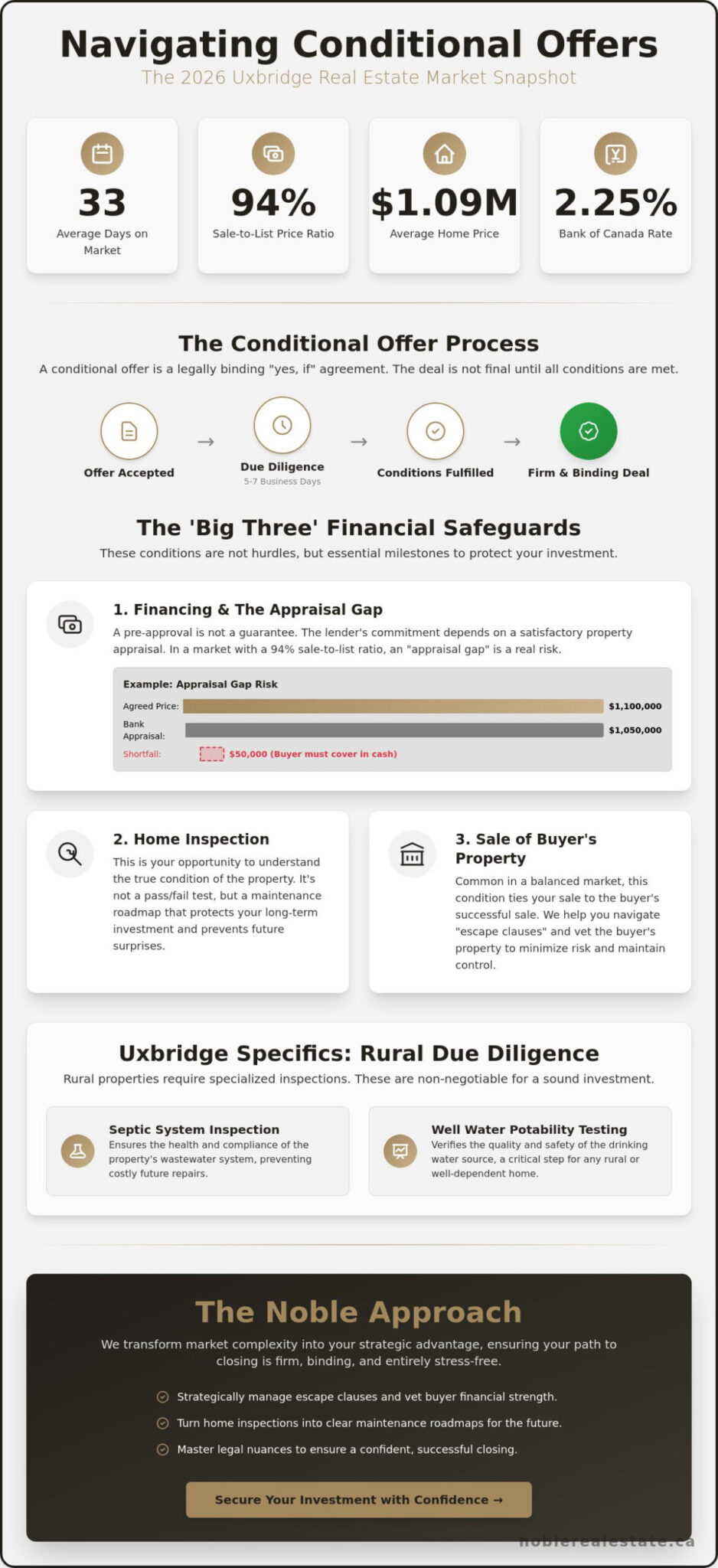
Uxbridge Specifics: Conditions for Rural and Luxury Properties
Rural properties in Uxbridge and Goodwood come with unique responsibilities that differ significantly from urban townhomes. Navigating a conditional offer real estate in these community pockets means looking beyond the four walls of the house. You’re effectively purchasing a personal utility system. “The Noble Approach” emphasizes that rural due diligence is non-negotiable for protecting your long-term liquidity and your family’s health. When a property isn’t connected to municipal services, the conditions in your offer must reflect the specialized inspections required to verify the home’s infrastructure.
Rural Infrastructure Due Diligence
For many houses for sale in Uxbridge, well water potability is the first major hurdle. A standard condition includes testing for coliforms and E. coli, but we also strongly recommend checking the flow rate. You don’t want to discover your well can’t keep up with a family of four after you’ve moved in. These tests provide the analytical rigour needed to ensure your water source is both safe and reliable.
Septic systems are equally critical. In the Durham Region, it’s standard practice for sellers to have the tank pumped and inspected by a licensed professional prior to closing. This isn’t just a courtesy; it’s a vital financial safeguard. Replacing a failed leaching bed can cost tens of thousands of dollars. It’s a massive expense that no homeowner should face shortly after paying the average Uxbridge price of $1,090,015. We ensure these septic certificates are part of the fulfillment process to keep your transition stress-free.
Luxury Property Conditions
High-value estates in North Durham often feature wood-burning fireplaces or pellet stoves that require WETT (Wood Energy Technology Transfer) certification. Without this specific certification, securing home insurance in 2026 can be nearly impossible. When we represent luxury sellers or buyers, we make sure these certifications are current, preventing last-minute closing delays that could jeopardize the entire deal.
Larger rural lots also frequently fall under the jurisdiction of the Toronto and Region Conservation Authority (TRCA) or the Lake Simcoe Region Conservation Authority (LSRCA). Navigating a conditional offer real estate on these lands requires a thorough review of development setbacks and regulated zones. Whether you’re planning a tennis court, a new pool, or a detached outbuilding, knowing the conservation boundaries is essential for preserving the property’s future valuation. Carrying costs for these estates are also a factor, especially with the Township of Uxbridge’s 1.26% property tax increase for 2026. Understanding the full financial picture, from conservation restrictions to tax obligations, ensures your real estate goals are handled with the utmost care.
The Noble Approach: Strategies for Navigating the Offer Period
The conditional period shouldn’t be a time of passive waiting. It’s a strategic window where we actively solidify your transaction’s foundation. Successfully navigating a conditional offer real estate period requires a proactive framework that protects your interests while keeping the momentum of the sale alive. “The Noble Approach” transforms this typically anxious time into a structured sequence of verification. We don’t just hope the buyer fulfills their conditions; we actively vet their progress to ensure your closing is as secure as possible. This stage is about shifting from a tentative agreement to a firm, binding commitment through clear communication and expert oversight.
Managing the ‘Escape Clause’ and 48-Hour Notice
One of the most powerful tools for sellers in a balanced market is the “escape clause.” This clause allows you to keep your property active on the market even after accepting a conditional offer. If a second, more attractive offer arrives, you can trigger a 24 or 48-hour notice. This gives the first buyer a short window to either waive their conditions and go firm or step aside so you can accept the new offer. This mechanism is vital for maintaining leverage, especially when homes in Uxbridge are averaging 33 days on the market as of May 2026. It ensures your Uxbridge real estate journey doesn’t stall because of a hesitant buyer or a complicated chain of conditions.
The Financial Vetting Process
As a CPA, I bring a level of analytical rigour to the vetting process that goes beyond standard real estate practice. We look closely at the buyer’s deposit. A significant deposit isn’t just a down payment; it’s a strong signal of financial stability and serious intent. We also coordinate with the buyer’s representatives to gauge the feasibility of their financing condition. By predicting potential “appraisal gaps” or lender hurdles early, we prevent deal-breakers before they arise. This end-to-end approach reduces the stress of the unknown, giving you a clear, data-backed path to a firm agreement. We treat navigating a conditional offer real estate deal as a financial audit where every detail must be verified for accuracy.
The transition from a conditional agreement to a firm sale is officially marked by the Notice of Fulfillment (NOF). This is the moment the “Sold” sign finally goes up and the deal becomes legally binding. Our role is to ensure every communication between lawyers and agents is precise, timely, and supportive. We manage the rhythm of the deal so you can focus on your next chapter. If you’re ready to experience a more principled standard of service and redefine your expectations, get in touch to discuss how we can secure your next transaction.
Turning a Conditional Offer into a Successful Closing
The journey of navigating a conditional offer real estate transaction reaches its climax when the “Sold” sign is finally hammered into the lawn. This transition from a tentative agreement to a firm, binding contract requires meticulous attention to legal documentation. In Ontario, this is handled through two primary instruments: the Notice of Fulfillment (NOF) and the Waiver. While they achieve the same end result of making the deal firm, their legal implications differ. A Notice of Fulfillment confirms that a specific condition, such as obtaining a 4.04% five year fixed mortgage rate, has been successfully met. A Waiver, on the other hand, legally removes the condition even if it hasn’t been strictly satisfied, effectively telling the seller you’re moving forward regardless.
Precision is paramount during this final stage. Missing a deadline by even a few minutes can result in the deal being null and void; this is why we ensure all documents reach the lawyers well before the five to seven business day expiry. Once the paperwork is synchronized, we schedule your final walkthrough. This isn’t just a casual visit. It’s a critical opportunity to verify that any negotiated repairs from the home inspection were completed to a professional standard. We check that the property remains in the same condition as when you signed the offer, ensuring no new issues have emerged during the conditional period.
The Final Paperwork: NOFs and Waivers
Choosing between an NOF and a Waiver is a strategic decision we make based on the specific wording of your contract. If a condition was written for the “sole and absolute benefit” of the buyer, a Waiver is often the cleaner path to firming up the deal. However, for conditions that require proof of action, like a septic inspection certificate or a well potability test, the Notice of Fulfillment is the standard. We manage this flow of information between all parties to ensure that by the time the file reaches the solicitor, every “i” is dotted and every “t” is crossed. This level of detail is what prevents last-minute closing delays and protects your deposit.
Your Next Chapter in Uxbridge
Securing a firm agreement is the ultimate goal of the Noble Approach. With the average house price in Uxbridge sitting at $1,090,015 and a median of 33 days on market as of May 2026, the stakes are high. We don’t just stop at the signature. We guide you through the logistical transition of your move, from coordinating with movers to ensuring your lawyer has everything required for a seamless closing. This end-to-end support is what makes the process feel stress-free and straightforward.
Professional representation is the key to managing these final hurdles without the typical anxiety of real estate. We treat your transaction with the analytical rigour of a CPA and the personal care of a local neighbor. Whether you’re selling a luxury estate in Goodwood or buying your first home near the town center, we ensure your financial interests are protected at every turn. Ready to navigate your next move? Get in touch with Colin Noble today to start your journey with confidence.
Redefine Your Real Estate Expectations
Your transition from a listed property to a firm sale should be a milestone worth celebrating. By shifting your perspective, you can view conditions as essential tools for financial protection rather than sources of anxiety. Successfully navigating a conditional offer real estate transaction requires more than just legal paperwork; it demands the analytical rigour of a financial expert and the deep-rooted knowledge of the Uxbridge community. We’ve explored how “The Noble Approach” prioritizes your security through meticulous vetting and proactive communication during those critical conditional windows.
Led by Colin Noble, a consummate professional with a background as a CPA and CA, our team brings a high standard of analytical precision to the Durham Region market. We focus on making complex processes feel stress-free and straightforward, ensuring you move toward your closing date with absolute clarity. Whether you’re managing rural infrastructure checks or luxury estate valuations, you deserve a partner who treats your investment with the utmost care. Discover The Noble Approach to Selling Your Home and see how we can turn your real estate goals into a successful reality. Your next chapter in Uxbridge is waiting, and it starts with a plan you can trust.
Frequently Asked Questions
Can a seller back out of a conditional offer in Ontario?
No, a seller cannot unilaterally back out once they’ve signed an acceptance. The contract is legally binding. The only way a seller can move to another buyer is if the current buyer fails to fulfill their conditions by the deadline or if the seller triggers a specific escape clause after receiving a superior secondary offer.
What happens to the deposit if a condition isn’t met?
The deposit is typically returned to the buyer in full if a condition isn’t satisfied, provided the buyer acted in good faith. In Ontario, both parties usually sign a mutual release form. This document authorizes the real estate brokerage to release the funds from their trust account, ensuring a fair resolution for everyone involved.
How many conditions are too many in a balanced market?
In the 2026 Uxbridge market, where homes sell at 94% of their list price, two to three conditions are standard. Financing and a home inspection are almost always expected. Adding a third for rural specifics, such as a septic or well test, is perfectly acceptable and won’t usually weaken your position in a balanced environment.
Is a home inspection condition mandatory in Uxbridge?
No condition is legally mandatory, but skipping one is risky when the average house price in Uxbridge is $1,090,015. For local rural properties, a professional inspection is an essential safeguard. It identifies structural or system issues that could cost you thousands in repairs shortly after you’ve moved into your new home.
What is an escape clause in a real estate contract?
An escape clause allows a seller to continue marketing their property while under a conditional agreement. If the seller receives a better offer, they give the original buyer a set window, usually 24 or 48 hours, to either go firm or walk away. It’s a vital tool for navigating a conditional offer real estate transaction.
How long does a buyer have to secure financing?
Buyers typically have five to seven business days to finalize their financing. This window gives the lender enough time to conduct an appraisal and confirm the property’s value. With 2026 mortgage rates at 4.04% for a five-year fixed term, ensuring the bank’s valuation matches the purchase price is a critical financial milestone.
Can I still show my house if I’ve accepted a conditional offer?
Yes, you can continue to show your home and even accept backup offers while the primary deal is conditional. This strategy keeps your options open and maintains momentum if the first buyer’s conditions aren’t met. It’s a common and effective part of navigating a conditional offer real estate journey in the Durham Region.
What is the difference between a condition and a term?
A condition is a requirement that must be satisfied for the contract to become binding; if it’s not met, the deal can end. A term is a detail or obligation both parties agree to perform, like including specific appliances. If a term is breached, the deal usually still closes, though legal compensation may follow.
With Uxbridge homes now averaging 33 days on the market and selling at 94% of their list price, the era of “firm or nothing” offers has officially ended. In this 2026 buyer’s market, navigating a conditional offer real estate process has transformed from a stressful hurdle into your most valuable strategic advantage. We understand the anxiety that comes with seeing a “Sold Conditionally” sign. It’s natural to worry about the deal collapsing or feel overwhelmed by the strict five to seven business day timelines for financing and inspections.
By applying “The Noble Approach,” you’ll learn how to master these complexities with the precision of a seasoned financial advisor, ensuring your investment is protected from the start. We’ll show you how to turn these legal requirements into a stress-free path toward a binding agreement. This guide breaks down the essential 2026 timelines, the nuances of the “escape clause,” and how to negotiate inspection results without losing the deal or over-conceding on price. You’ll gain the clarity needed to transition to closing with total confidence in your financial future.
Key Takeaways
- Understand how navigating a conditional offer real estate process provides a necessary safety net in a 2026 market where conditions have become the standard for financial security.
- Learn to view home inspections as maintenance roadmaps and financing conditions as critical appraisal safeguards to protect your equity during the due diligence period.
- Identify the specific requirements for Uxbridge rural properties, including the essential timelines and standards for septic inspections and well water potability testing.
- Use “The Noble Approach” to strategically manage escape clauses and vet the financial strength of potential buyers beyond just the initial offer price.
- Master the legal nuances of fulfilling versus waiving conditions to ensure your path to closing is firm, binding, and entirely stress-free.
What is a Conditional Offer in the 2026 Real Estate Market?
A conditional offer is a legally binding contract that only becomes “firm” once specific terms are satisfied within a set timeframe. Think of it as a “yes, if” agreement. For homeowners in the Durham Region, understanding What is a Conditional Offer represents a shift toward a more protected and analytical transaction process. Successfully navigating a conditional offer real estate transaction requires a clear understanding that while the price is agreed upon, the deal isn’t finalized until the buyer provides a Notice of Fulfillment (NOF). This document serves as formal proof that the conditions, such as financing or a home inspection, have been met. Unlike a firm offer, which is binding the moment both parties sign, a conditional offer gives both sides a window to ensure the investment is sound.
In May 2026, the Uxbridge market has shifted significantly from the frantic bidding wars of the early 2020s. With a current sale-to-list price ratio of 94%, buyers are no longer forced to waive their right to due diligence. “The Noble Approach” treats these conditions not as hurdles, but as essential financial milestones. In a market where the average home price sits at $1,090,015, ensuring that every structural and financial detail is verified isn’t just cautious; it’s a requirement for a successful long term investment.
Why Conditions are Making a Comeback
The return of conditions is driven by a more balanced and predictable market environment. As of May 1, 2026, the Bank of Canada has stabilized the policy interest rate at 2.25%, which has calmed the volatility that previously drove “panic buying.” In Uxbridge, inventory has grown to 86 new listings in the last 28 days, giving buyers the luxury of time. With homes now sitting on the market for a median of 33 days, the power dynamic has leveled out. This environment empowers buyers to prioritize safety over speed, making conditions the new standard for residential transactions across the Durham Region.
The Legal Timeline: How Long Does a Condition Last?
Most conditional periods in Ontario typically last between five and seven business days. This timeframe is critical for coordinating with lenders and professional inspectors. It’s vital to remember that these deadlines are strict. If a buyer fails to deliver a Notice of Fulfillment or a Waiver by the expiry time, the agreement typically becomes null and void. The deal dies, and the deposit is returned to the buyer. When navigating a conditional offer real estate timeline, you must account for bank holidays and weekends, as these don’t count toward your business day count. Precision in these dates is where professional, financially savvy guidance becomes your greatest asset.
The ‘Big Three’ Conditions and Their Financial Implications
When you’re navigating a conditional offer real estate transaction in Uxbridge, you’re essentially managing three primary pillars of risk. These are financing, home inspections, and the sale of the buyer’s property. From a professional financial perspective, these clauses aren’t just legal formalities. They’re critical safeguards for your net worth. Understanding the legal definition of a conditional sale is the first step in realizing that your home isn’t truly sold until every “if” is converted into a “yes.” As a CPA, I view these conditions as variables in a liquidity equation. If one variable fails to satisfy the lender or the inspector, the entire transaction structure can collapse, potentially affecting your ability to move forward with your next purchase.
Financing and the Appraisal Gap Risk
Many buyers enter the market with a 4.04% five year fixed rate pre-approval and assume their funding is guaranteed. It isn’t. A lender’s commitment is always subject to a satisfactory appraisal of the property. In a balanced 2026 market where the average sale-to-list price ratio is 94%, an “appraisal gap” represents a significant threat. If the bank’s appraiser values your $1.1 million home at only $1.05 million, the buyer must bridge that $50,000 gap with their own cash. At Noble Real Estate, we apply analytical rigour to vet buyer financing before you accept an offer. We look for proof of additional capital to ensure that an appraisal shortfall won’t derail your closing or leave you scrambling at the eleventh hour.
Inspections: Protecting Your Investment
A standard home inspection in Ontario typically costs between $300 and $600, but its value in a million dollar transaction is immeasurable. The goal is to distinguish between structural “must-fixes,” such as foundation issues or outdated electrical systems, and cosmetic “nice-to-haves.” If a major issue is uncovered, you face a strategic choice: perform the repairs yourself or offer a price reduction. From a tax and liquidity standpoint, a price reduction is often the more efficient path for sellers. It avoids the stress of managing contractors while you’re trying to pack. To stay ahead of the curve, I often recommend that sellers invest in a pre-listing inspection. This allows you to address issues on your own terms and price your home with total transparency.
The final common hurdle is the Sale of Buyer’s Property (SBP) condition. This creates a chain reaction where your success depends on another homeowner’s transaction. With the median days on market in Uxbridge currently at 33 days, this condition requires careful management through an “escape clause.” This clause allows you to continue marketing your home to other buyers while the original buyer works to firm up their own sale. If you’re ready to see how these market dynamics affect your specific property, a professional home valuation can provide the clarity you need to plan your next move with confidence.
Uxbridge Specifics: Conditions for Rural and Luxury Properties
Rural properties in Uxbridge and Goodwood come with unique responsibilities that differ significantly from urban townhomes. Navigating a conditional offer real estate in these community pockets means looking beyond the four walls of the house. You’re effectively purchasing a personal utility system. “The Noble Approach” emphasizes that rural due diligence is non-negotiable for protecting your long-term liquidity and your family’s health. When a property isn’t connected to municipal services, the conditions in your offer must reflect the specialized inspections required to verify the home’s infrastructure.
Rural Infrastructure Due Diligence
For many houses for sale in Uxbridge, well water potability is the first major hurdle. A standard condition includes testing for coliforms and E. coli, but we also strongly recommend checking the flow rate. You don’t want to discover your well can’t keep up with a family of four after you’ve moved in. These tests provide the analytical rigour needed to ensure your water source is both safe and reliable.
Septic systems are equally critical. In the Durham Region, it’s standard practice for sellers to have the tank pumped and inspected by a licensed professional prior to closing. This isn’t just a courtesy; it’s a vital financial safeguard. Replacing a failed leaching bed can cost tens of thousands of dollars. It’s a massive expense that no homeowner should face shortly after paying the average Uxbridge price of $1,090,015. We ensure these septic certificates are part of the fulfillment process to keep your transition stress-free.
Luxury Property Conditions
High-value estates in North Durham often feature wood-burning fireplaces or pellet stoves that require WETT (Wood Energy Technology Transfer) certification. Without this specific certification, securing home insurance in 2026 can be nearly impossible. When we represent luxury sellers or buyers, we make sure these certifications are current, preventing last-minute closing delays that could jeopardize the entire deal.
Larger rural lots also frequently fall under the jurisdiction of the Toronto and Region Conservation Authority (TRCA) or the Lake Simcoe Region Conservation Authority (LSRCA). Navigating a conditional offer real estate on these lands requires a thorough review of development setbacks and regulated zones. Whether you’re planning a tennis court, a new pool, or a detached outbuilding, knowing the conservation boundaries is essential for preserving the property’s future valuation. Carrying costs for these estates are also a factor, especially with the Township of Uxbridge’s 1.26% property tax increase for 2026. Understanding the full financial picture, from conservation restrictions to tax obligations, ensures your real estate goals are handled with the utmost care.
The Noble Approach: Strategies for Navigating the Offer Period
The conditional period shouldn’t be a time of passive waiting. It’s a strategic window where we actively solidify your transaction’s foundation. Successfully navigating a conditional offer real estate period requires a proactive framework that protects your interests while keeping the momentum of the sale alive. “The Noble Approach” transforms this typically anxious time into a structured sequence of verification. We don’t just hope the buyer fulfills their conditions; we actively vet their progress to ensure your closing is as secure as possible. This stage is about shifting from a tentative agreement to a firm, binding commitment through clear communication and expert oversight.
Managing the ‘Escape Clause’ and 48-Hour Notice
One of the most powerful tools for sellers in a balanced market is the “escape clause.” This clause allows you to keep your property active on the market even after accepting a conditional offer. If a second, more attractive offer arrives, you can trigger a 24 or 48-hour notice. This gives the first buyer a short window to either waive their conditions and go firm or step aside so you can accept the new offer. This mechanism is vital for maintaining leverage, especially when homes in Uxbridge are averaging 33 days on the market as of May 2026. It ensures your Uxbridge real estate journey doesn’t stall because of a hesitant buyer or a complicated chain of conditions.
The Financial Vetting Process
As a CPA, I bring a level of analytical rigour to the vetting process that goes beyond standard real estate practice. We look closely at the buyer’s deposit. A significant deposit isn’t just a down payment; it’s a strong signal of financial stability and serious intent. We also coordinate with the buyer’s representatives to gauge the feasibility of their financing condition. By predicting potential “appraisal gaps” or lender hurdles early, we prevent deal-breakers before they arise. This end-to-end approach reduces the stress of the unknown, giving you a clear, data-backed path to a firm agreement. We treat navigating a conditional offer real estate deal as a financial audit where every detail must be verified for accuracy.
The transition from a conditional agreement to a firm sale is officially marked by the Notice of Fulfillment (NOF). This is the moment the “Sold” sign finally goes up and the deal becomes legally binding. Our role is to ensure every communication between lawyers and agents is precise, timely, and supportive. We manage the rhythm of the deal so you can focus on your next chapter. If you’re ready to experience a more principled standard of service and redefine your expectations, get in touch to discuss how we can secure your next transaction.
Turning a Conditional Offer into a Successful Closing
The journey of navigating a conditional offer real estate transaction reaches its climax when the “Sold” sign is finally hammered into the lawn. This transition from a tentative agreement to a firm, binding contract requires meticulous attention to legal documentation. In Ontario, this is handled through two primary instruments: the Notice of Fulfillment (NOF) and the Waiver. While they achieve the same end result of making the deal firm, their legal implications differ. A Notice of Fulfillment confirms that a specific condition, such as obtaining a 4.04% five year fixed mortgage rate, has been successfully met. A Waiver, on the other hand, legally removes the condition even if it hasn’t been strictly satisfied, effectively telling the seller you’re moving forward regardless.
Precision is paramount during this final stage. Missing a deadline by even a few minutes can result in the deal being null and void; this is why we ensure all documents reach the lawyers well before the five to seven business day expiry. Once the paperwork is synchronized, we schedule your final walkthrough. This isn’t just a casual visit. It’s a critical opportunity to verify that any negotiated repairs from the home inspection were completed to a professional standard. We check that the property remains in the same condition as when you signed the offer, ensuring no new issues have emerged during the conditional period.
The Final Paperwork: NOFs and Waivers
Choosing between an NOF and a Waiver is a strategic decision we make based on the specific wording of your contract. If a condition was written for the “sole and absolute benefit” of the buyer, a Waiver is often the cleaner path to firming up the deal. However, for conditions that require proof of action, like a septic inspection certificate or a well potability test, the Notice of Fulfillment is the standard. We manage this flow of information between all parties to ensure that by the time the file reaches the solicitor, every “i” is dotted and every “t” is crossed. This level of detail is what prevents last-minute closing delays and protects your deposit.
Your Next Chapter in Uxbridge
Securing a firm agreement is the ultimate goal of the Noble Approach. With the average house price in Uxbridge sitting at $1,090,015 and a median of 33 days on market as of May 2026, the stakes are high. We don’t just stop at the signature. We guide you through the logistical transition of your move, from coordinating with movers to ensuring your lawyer has everything required for a seamless closing. This end-to-end support is what makes the process feel stress-free and straightforward.
Professional representation is the key to managing these final hurdles without the typical anxiety of real estate. We treat your transaction with the analytical rigour of a CPA and the personal care of a local neighbor. Whether you’re selling a luxury estate in Goodwood or buying your first home near the town center, we ensure your financial interests are protected at every turn. Ready to navigate your next move? Get in touch with Colin Noble today to start your journey with confidence.
Redefine Your Real Estate Expectations
Your transition from a listed property to a firm sale should be a milestone worth celebrating. By shifting your perspective, you can view conditions as essential tools for financial protection rather than sources of anxiety. Successfully navigating a conditional offer real estate transaction requires more than just legal paperwork; it demands the analytical rigour of a financial expert and the deep-rooted knowledge of the Uxbridge community. We’ve explored how “The Noble Approach” prioritizes your security through meticulous vetting and proactive communication during those critical conditional windows.
Led by Colin Noble, a consummate professional with a background as a CPA and CA, our team brings a high standard of analytical precision to the Durham Region market. We focus on making complex processes feel stress-free and straightforward, ensuring you move toward your closing date with absolute clarity. Whether you’re managing rural infrastructure checks or luxury estate valuations, you deserve a partner who treats your investment with the utmost care. Discover The Noble Approach to Selling Your Home and see how we can turn your real estate goals into a successful reality. Your next chapter in Uxbridge is waiting, and it starts with a plan you can trust.
Frequently Asked Questions
Can a seller back out of a conditional offer in Ontario?
No, a seller cannot unilaterally back out once they’ve signed an acceptance. The contract is legally binding. The only way a seller can move to another buyer is if the current buyer fails to fulfill their conditions by the deadline or if the seller triggers a specific escape clause after receiving a superior secondary offer.
What happens to the deposit if a condition isn’t met?
The deposit is typically returned to the buyer in full if a condition isn’t satisfied, provided the buyer acted in good faith. In Ontario, both parties usually sign a mutual release form. This document authorizes the real estate brokerage to release the funds from their trust account, ensuring a fair resolution for everyone involved.
How many conditions are too many in a balanced market?
In the 2026 Uxbridge market, where homes sell at 94% of their list price, two to three conditions are standard. Financing and a home inspection are almost always expected. Adding a third for rural specifics, such as a septic or well test, is perfectly acceptable and won’t usually weaken your position in a balanced environment.
Is a home inspection condition mandatory in Uxbridge?
No condition is legally mandatory, but skipping one is risky when the average house price in Uxbridge is $1,090,015. For local rural properties, a professional inspection is an essential safeguard. It identifies structural or system issues that could cost you thousands in repairs shortly after you’ve moved into your new home.
What is an escape clause in a real estate contract?
An escape clause allows a seller to continue marketing their property while under a conditional agreement. If the seller receives a better offer, they give the original buyer a set window, usually 24 or 48 hours, to either go firm or walk away. It’s a vital tool for navigating a conditional offer real estate transaction.
How long does a buyer have to secure financing?
Buyers typically have five to seven business days to finalize their financing. This window gives the lender enough time to conduct an appraisal and confirm the property’s value. With 2026 mortgage rates at 4.04% for a five-year fixed term, ensuring the bank’s valuation matches the purchase price is a critical financial milestone.
Can I still show my house if I’ve accepted a conditional offer?
Yes, you can continue to show your home and even accept backup offers while the primary deal is conditional. This strategy keeps your options open and maintains momentum if the first buyer’s conditions aren’t met. It’s a common and effective part of navigating a conditional offer real estate journey in the Durham Region.
What is the difference between a condition and a term?
A condition is a requirement that must be satisfied for the contract to become binding; if it’s not met, the deal can end. A term is a detail or obligation both parties agree to perform, like including specific appliances. If a term is breached, the deal usually still closes, though legal compensation may follow.
Read More Posts




Looking For More Great Content?
Get even more informative Toronto real estate news sent directly to your inbox by signing up for my newsletter here. All it takes is a few easy clicks.

How to Market Your Home for Sale: A Strategic 2026 Guide
05/8/26 Uncategorized
Did you know that listings with professional photography sell 32% faster than those without? In a market where active inventory reached 1,002,935 listings in April 2026, simply putting a sign on the lawn is no longer a viable financial strategy. You’ve worked hard to build equity in your property, and the fear of leaving money on the table is a valid concern. Understanding how to market your home for sale in this balanced environment requires more than just luck. It requires a data-driven approach that treats your home as the significant investment it is.
We believe the selling process should be both successful and straightforward. It’s natural to feel anxious about the disruption of showings or the technical aspects of modern digital marketing. This guide provides the exact strategic framework used by top experts to maximize value and minimize your time on the market. We’ll preview a step-by-step plan to identify your ideal buyer and showcase the high-end visuals that drive results. By the end, you’ll have the confidence to move forward with a plan that puts your needs first and redefines your real estate expectations.
Key Takeaways
- Master the critical 14-day pricing window to capture peak interest and establish a strong financial position from the start.
- Elevate your property’s digital presence with 4K HDR photography and immersive 3D tours that cater to high-intent, out-of-town buyers.
- Discover how to market your home for sale using a multi-channel strategy that combines the power of the MLS with precision social media targeting.
- Implement high-ROI preparations and neutral staging to create an aspirational environment that resonates with your ideal buyer profile.
- Experience a stress-free transition by leveraging a full-service approach that integrates professional financial rigour with expert local guidance.
The Strategic Foundation: Positioning and Pricing for 2026
Effective marketing is not just a collection of brochures and social media posts. It’s the strategic intersection of property presentation, digital reach, and precise financial positioning. When you consider how to market your home for sale in 2026, you must view your home as a financial asset that needs to be positioned against a backdrop of 1,002,935 active listings nationwide. This environment requires a level of analytical rigour that goes beyond traditional real estate advice. It’s about understanding how your property fits into the current economic landscape where the national median home price reached $404,300 in the first quarter of the year.
The first 14 days of your listing are critical. During this window, your home is “new” to the market, and buyer interest is at its peak. Pricing is your most powerful marketing tool during this time. By identifying the “Sweet Spot”, which is a price point that balances maximum value with market velocity, we trigger automated MLS algorithm alerts for active buyers. This ensures your home appears at the top of search results and in the inboxes of high-intent purchasers immediately. This data-backed entry strategy is a core component of The Noble Approach, where we prioritize your financial outcome through disciplined planning and market analysis.
Analysing Market Data and Buyer Personas
Success in Uxbridge starts with understanding who is looking. We analyze recent local sales data to build an Ideal Buyer Profile. For instance, we determine if we are targeting local downsizers seeking a low-maintenance lifestyle or GTA families moving from the city to find more green space. Positioning is the strategic alignment of a home’s features with a specific buyer’s highest priorities. Staying ahead of real estate marketing trends means knowing that 71% of metro areas saw price increases in early 2026, and applying that macro data to our local micro-market to attract the right profile.
The Role of a Financial Mindset in Real Estate
A background in finance, specifically as a CPA, CA, allows for a more sophisticated interpretation of market indicators. We don’t just look at what sold; we evaluate absorption rates in the Durham Region to dictate how aggressively we should push our marketing. If inventory is rising, as seen in the 4.6% year-over-year national increase in April 2026, our marketing intensity must increase to match. This financial mindset ensures your marketing budget isn’t wasted on broad, ineffective tactics. Instead, we allocate resources to high-impact channels that reach the right buyer at the right time, making the process both stress-free and straightforward for you.
High-Impact Visuals: Beyond Professional Photography
In a digital-first environment, your property’s online presence is its most significant asset. When you’re determining how to market your home for sale, 4K HDR photography is no longer a luxury; it’s the minimum standard for entry. High dynamic range imaging ensures that every detail, from the texture of the quartz countertops to the view through the window, is perfectly exposed. This clarity is essential because listings with high-quality visuals sell 32% faster. For properties in Uxbridge and the surrounding areas, we take this a step further. Matterport 3D tours allow out-of-town buyers from the GTA to walk through your home from their current residence, reducing unnecessary disruptions while increasing the quality of in-person visits.
Drone cinematography is another essential tool, especially for the sprawling acreage often found in the Durham Region. It provides perspective on property boundaries and proximity to local greenbelts that ground-level photos simply cannot capture. We complement these visuals with lifestyle video content. A mid-range real estate video, which typically costs between $400 and $800, focuses on the experience of living in the home. It’s about showing the morning light in the breakfast nook or the quiet elegance of the outdoor living space. We sell the lifestyle, not just the floor plan.
The Digital First Impression
Most buyers discover your home on mobile platforms like Instagram or TikTok. We apply the “Three-Second Rule” to every listing: your primary cover photo must stop the scroll immediately. Usually, this is a high-impact kitchen image or a stunning dusk exterior shot. We also integrate interactive floor plans with embedded photos. This helps buyers navigate the space mentally before they ever step foot on the driveway. If you’re curious about how your property’s specific features impact its marketability, a professional home valuation can provide the clarity you need.
Narrative Copywriting for Listings
The Noble Approach replaces generic adjectives like “charming” or “spacious” with benefit-driven storytelling. We describe the feeling of hosting a summer dinner party or the convenience of a short commute to local landmarks. For example, we might highlight how close a property is to Wooden Sticks Golf Club or the scenic trails of the Oak Ridges Moraine. When you master how to market your home for sale through narrative, you transform a listing into a destination. This local flavour builds an emotional connection with the buyer, positioning your home as a gateway to the Uxbridge community.
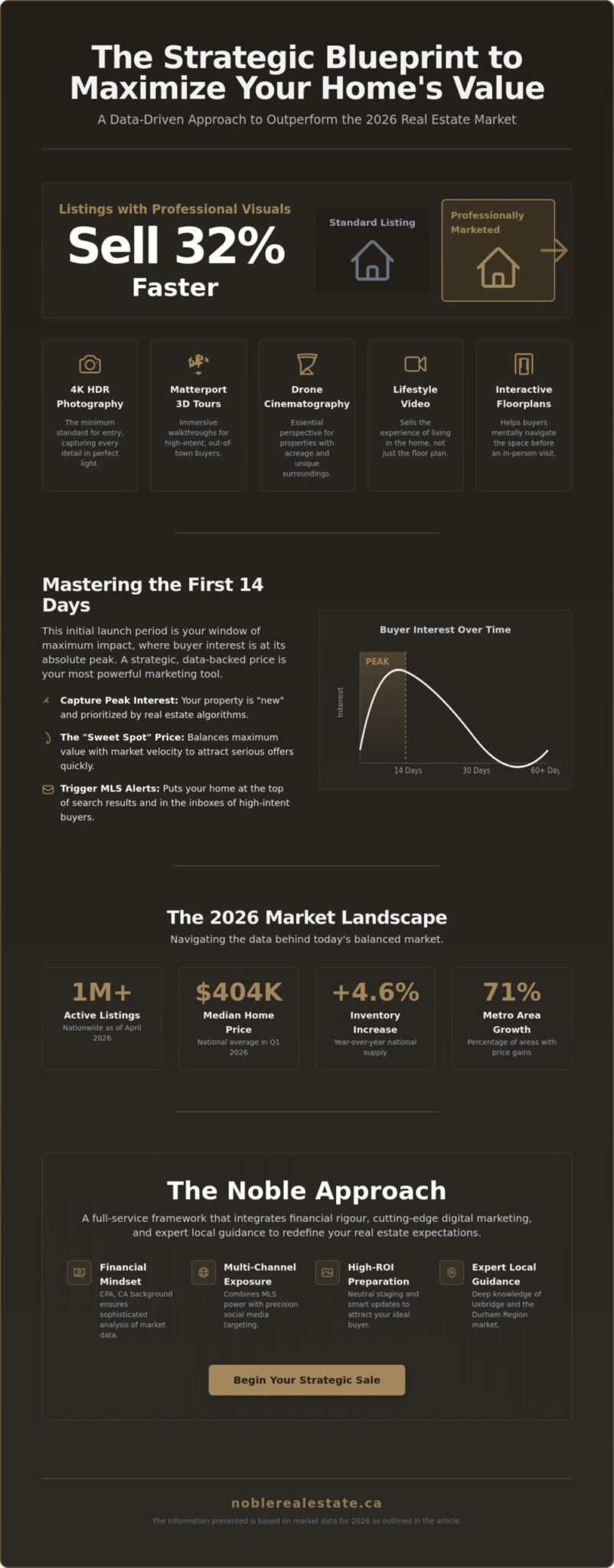
Multi-Channel Exposure: Reaching Buyers Where They Live
Exposure is the engine that drives a successful real estate transaction. While the Multiple Listing Service (MLS) remains the primary vehicle for visibility, simply appearing on the portal isn’t enough in a market with 1,002,935 active listings. To stand out, your property requires a layered distribution strategy that reaches buyers through both digital and personal channels. It’s about ensuring that when people ask how to market your home for sale effectively, the answer involves a proactive search for the buyer rather than a passive wait for them to find you. We use the “Coming Soon” phase to build whisper interest, creating a sense of exclusivity among our internal network before the official launch.
Strategic social media advertising allows us to move beyond basic posts. We utilize high-level targeting to reach specific demographics based on age, household income, and interests. For example, if your home is a luxury estate, we target individuals with an affinity for high-end lifestyle brands and specific investment profiles. This financial precision ensures that your marketing dollars are spent on the most probable purchasers. By the time your listing goes live, we’ve already primed a curated list of active local realtors and their clients, often generating inquiries before the sign even hits the lawn.
Digital Ad Strategy for the Durham Region
We take a localized approach to digital advertising by using geo-fencing. This technology allows us to serve ads specifically to people searching for houses for sale in Uxbridge or those visiting high-traffic areas in the GTA. Once a potential buyer engages with your listing, we use retargeting ads to keep your property top-of-mind as they continue their search. This persistent, professional presence builds familiarity and trust, making the transition from a digital click to a physical showing feel like a natural next step.
Traditional Marketing in a Digital Age
Traditional methods still hold value when they’re executed with a premium touch. We provide high-quality, heavy-stock feature sheets that act as a tangible reminder of your home’s value after a showing. Our signage is placed strategically to capture local traffic, ensuring it looks polished and professional. We view the modern open house as a curated event, not just a passive viewing. It’s a chance to showcase the lifestyle we’ve marketed online, providing a stress-free environment where buyers can truly experience the property. This comprehensive, end-to-end approach is what we call The Noble Approach, designed to redefine your expectations of what a real estate partner can achieve.
Staging and Preparation for Maximum ROI
Preparation is where your financial strategy becomes tangible. As national active housing inventory rose 4.6% year-over-year in April 2026, buyers have become more selective, often gravitating toward properties that require zero immediate work. When you’re evaluating how to market your home for sale, the physical state of the property must match the high-end digital visuals we’ve created. The Noble Approach to staging isn’t about simply decorating; it’s about creating a neutral, aspirational environment that allows potential purchasers to envision their own future within the walls. This process reduces seller stress by providing a clear, prioritized checklist of high-ROI improvements, such as fresh neutral paint and updated lighting fixtures.
Decluttering and depersonalizing are the most cost-effective steps you can take to increase perceived value. By removing personal items and excess furniture, we maximize the sense of square footage and flow. We also pay close attention to curb appeal, which sets the tone for the entire showing. The first 30 seconds of a buyer’s arrival are critical. A tidy walkway, manicured greenery, and a polished front door create an immediate sense of care and quality that carries through the rest of the tour.
The Staging ROI Framework
We treat staging as a calculated investment rather than an expense. In the Uxbridge market, professional staging often yields a 1-5% higher sale price compared to non-staged homes. We focus our resources on the “impact rooms,” primarily the kitchen and the primary bedroom, where buyers make their most emotional decisions. This targeted approach ensures that every dollar spent on preparation contributes directly to a higher final offer and fewer days on the market.
Pre-Listing Inspections and Transparency
Transparency is a powerful marketing tool. We often recommend a pre-listing home inspection to identify and address potential objections before they become deal-breakers during negotiations. We compile these reports, along with utility costs and recent upgrades, into a “Home Highlights” binder left on the kitchen island. This level of detail builds immediate trust with buyers and their agents, positioning you as a prepared and professional seller. If you’re ready to see how these strategies apply to your specific property, you can request a professional home valuation to begin the process with confidence.
The Noble Approach: Redefining Your Real Estate Expectations
Choosing how to market your home for sale is ultimately a decision about who you trust to manage your most significant financial asset. The Noble Approach is designed to take the complexity out of this process, replacing uncertainty with a structured, data-driven plan. By integrating high-end marketing with professional financial oversight, we ensure that every decision is backed by analytical rigour. This full-service, end-to-end approach is specifically designed to reduce seller stress, allowing you to focus on your move while we handle the technical and tactical details of the transaction.
Why a CPA Background Matters in Marketing
A CPA background provides a unique advantage when evaluating market timing and offer structures. In May 2026, with the 30-year fixed mortgage rate sitting at 6.37%, buyer affordability remains a primary driver of market behavior. We apply financial discipline to interpret these trends, ensuring your equity is protected through strategic investment in marketing rather than reactive price drops. Our commitment to transparency means you’ll always have a clear understanding of the data behind every recommendation, from the initial valuation to the final negotiation. We treat your home sale as a serious investment, applying the same level of scrutiny a chief financial officer would bring to a corporate merger.
Partnering with Noble Real Estate
Deep expertise in uxbridge real estate translates directly to better negotiation outcomes. We understand the nuances of the local community and how to navigate recent NAR settlement changes to your advantage. Since sellers are no longer required to offer buyer’s agent compensation in the MLS, having a seasoned advisor who can navigate these negotiations with precision is essential. This ensures the national average commission rate of 5.70% is managed effectively to maximize your net proceeds. Our promise is a personalized journey that is as successful as it is enjoyable. Redefine your expectations and book your home valuation today to see how a strategic, financially savvy marketing plan can work for you.
Secure Your Successful Sale in Uxbridge
Selling your home in 2026 requires a shift from traditional listing tactics to a comprehensive financial strategy. You’ve learned that listings with professional photography sell 32% faster, and that the initial 14-day pricing window is your most powerful marketing tool. As active inventory levels rose 4.6% year-over-year in April 2026, the need for a precise, multi-channel approach has never been greater. Understanding how to market your home for sale is about more than just visibility; it’s about aligning your property’s unique value with the specific needs of high-intent buyers across the Durham Region.
The Noble Approach combines a CPA, CA background with deep community roots to ensure your equity is protected at every turn. We handle the technical complexities and digital targeting so you can focus on your next chapter with total peace of mind. It’s time to move beyond generic advice and embrace a full-service partnership built on transparency and analytical rigour. Redefine Your Expectations: Get a Strategic Marketing Plan from Noble Real Estate. We look forward to making your real estate goals a straightforward and exciting reality.
Frequently Asked Questions
How much does it cost to market a home for sale in Ontario?
Most marketing costs are typically included in the agent’s commission, which averaged 5.70% nationally as of April 24, 2026. If you’re paying for services out-of-pocket, professional photography for a standard home usually costs between $200 and $500. Advanced tools like Matterport 3D tours or high-end video tours can range from $200 to $800 each, depending on the property’s size.
Is professional photography really necessary for selling a house?
Yes, professional photography is essential because it acts as your property’s digital front door. Listings with professional photos sell 32% faster than those with amateur shots, as they capture the attention of buyers scrolling through thousands of listings. High-quality visuals ensure your home stands out among the 1,002,935 active listings currently available across the country.
How do I market my home to out-of-town buyers?
Targeting out-of-town buyers requires a robust digital strategy that includes 3D virtual walkthroughs and high-definition drone footage. We use specific digital targeting to reach buyers in the GTA who are looking for the lifestyle Uxbridge offers. This allows them to experience the home’s layout and the surrounding community’s beauty before they ever commit to a physical drive.
What is the best month to list my home for sale in Uxbridge?
While the spring months of March and April are traditionally busy, the best time to list depends on current local inventory levels and absorption rates. In early 2026, 71% of metro areas saw price increases, suggesting that market momentum can occur outside of traditional seasons. We analyze real-time data to identify windows where buyer demand is high but competing listings are low.
Should I stage my home if it is already well-furnished?
Staging is often still necessary to transform a “lived-in” space into an “aspirational” one that appeals to a broad range of buyers. Even high-quality furniture may need to be rearranged or supplemented to highlight the home’s architectural features and improve photo quality. This strategic positioning can lead to a sale price that is 1% to 5% higher than non-staged homes.
How long does the marketing process take before a home goes live on MLS?
The preparation and marketing setup usually takes between 7 and 14 days from the initial consultation. This time is used to complete staging, professional photography, and the production of high-end video assets. Having everything ready before the launch ensures you make the biggest possible impact during the critical first two weeks on the market.
What happens if my home isn’t getting enough showings after the first week?
If traffic is low, we immediately review how to market your home for sale by analyzing digital engagement data and agent feedback. We look at whether current mortgage rates, such as the 6.37% 30-year fixed rate, are impacting your specific buyer demographic. This allows us to make data-driven adjustments to our pricing or advertising strategy rather than relying on guesswork.
Can I market my home myself without a real estate agent?
You can list your home independently, but you may miss out on the broad exposure and analytical rigour a professional provides. Managing the complexities of modern digital ads and the recent changes to commission negotiations requires significant time and expertise. A full-service partner handles the end-to-end process, making the journey successful while keeping it stress-free and straightforward for you.
Did you know that listings with professional photography sell 32% faster than those without? In a market where active inventory reached 1,002,935 listings in April 2026, simply putting a sign on the lawn is no longer a viable financial strategy. You’ve worked hard to build equity in your property, and the fear of leaving money on the table is a valid concern. Understanding how to market your home for sale in this balanced environment requires more than just luck. It requires a data-driven approach that treats your home as the significant investment it is.
We believe the selling process should be both successful and straightforward. It’s natural to feel anxious about the disruption of showings or the technical aspects of modern digital marketing. This guide provides the exact strategic framework used by top experts to maximize value and minimize your time on the market. We’ll preview a step-by-step plan to identify your ideal buyer and showcase the high-end visuals that drive results. By the end, you’ll have the confidence to move forward with a plan that puts your needs first and redefines your real estate expectations.
Key Takeaways
- Master the critical 14-day pricing window to capture peak interest and establish a strong financial position from the start.
- Elevate your property’s digital presence with 4K HDR photography and immersive 3D tours that cater to high-intent, out-of-town buyers.
- Discover how to market your home for sale using a multi-channel strategy that combines the power of the MLS with precision social media targeting.
- Implement high-ROI preparations and neutral staging to create an aspirational environment that resonates with your ideal buyer profile.
- Experience a stress-free transition by leveraging a full-service approach that integrates professional financial rigour with expert local guidance.
The Strategic Foundation: Positioning and Pricing for 2026
Effective marketing is not just a collection of brochures and social media posts. It’s the strategic intersection of property presentation, digital reach, and precise financial positioning. When you consider how to market your home for sale in 2026, you must view your home as a financial asset that needs to be positioned against a backdrop of 1,002,935 active listings nationwide. This environment requires a level of analytical rigour that goes beyond traditional real estate advice. It’s about understanding how your property fits into the current economic landscape where the national median home price reached $404,300 in the first quarter of the year.
The first 14 days of your listing are critical. During this window, your home is “new” to the market, and buyer interest is at its peak. Pricing is your most powerful marketing tool during this time. By identifying the “Sweet Spot”, which is a price point that balances maximum value with market velocity, we trigger automated MLS algorithm alerts for active buyers. This ensures your home appears at the top of search results and in the inboxes of high-intent purchasers immediately. This data-backed entry strategy is a core component of The Noble Approach, where we prioritize your financial outcome through disciplined planning and market analysis.
Analysing Market Data and Buyer Personas
Success in Uxbridge starts with understanding who is looking. We analyze recent local sales data to build an Ideal Buyer Profile. For instance, we determine if we are targeting local downsizers seeking a low-maintenance lifestyle or GTA families moving from the city to find more green space. Positioning is the strategic alignment of a home’s features with a specific buyer’s highest priorities. Staying ahead of real estate marketing trends means knowing that 71% of metro areas saw price increases in early 2026, and applying that macro data to our local micro-market to attract the right profile.
The Role of a Financial Mindset in Real Estate
A background in finance, specifically as a CPA, CA, allows for a more sophisticated interpretation of market indicators. We don’t just look at what sold; we evaluate absorption rates in the Durham Region to dictate how aggressively we should push our marketing. If inventory is rising, as seen in the 4.6% year-over-year national increase in April 2026, our marketing intensity must increase to match. This financial mindset ensures your marketing budget isn’t wasted on broad, ineffective tactics. Instead, we allocate resources to high-impact channels that reach the right buyer at the right time, making the process both stress-free and straightforward for you.
High-Impact Visuals: Beyond Professional Photography
In a digital-first environment, your property’s online presence is its most significant asset. When you’re determining how to market your home for sale, 4K HDR photography is no longer a luxury; it’s the minimum standard for entry. High dynamic range imaging ensures that every detail, from the texture of the quartz countertops to the view through the window, is perfectly exposed. This clarity is essential because listings with high-quality visuals sell 32% faster. For properties in Uxbridge and the surrounding areas, we take this a step further. Matterport 3D tours allow out-of-town buyers from the GTA to walk through your home from their current residence, reducing unnecessary disruptions while increasing the quality of in-person visits.
Drone cinematography is another essential tool, especially for the sprawling acreage often found in the Durham Region. It provides perspective on property boundaries and proximity to local greenbelts that ground-level photos simply cannot capture. We complement these visuals with lifestyle video content. A mid-range real estate video, which typically costs between $400 and $800, focuses on the experience of living in the home. It’s about showing the morning light in the breakfast nook or the quiet elegance of the outdoor living space. We sell the lifestyle, not just the floor plan.
The Digital First Impression
Most buyers discover your home on mobile platforms like Instagram or TikTok. We apply the “Three-Second Rule” to every listing: your primary cover photo must stop the scroll immediately. Usually, this is a high-impact kitchen image or a stunning dusk exterior shot. We also integrate interactive floor plans with embedded photos. This helps buyers navigate the space mentally before they ever step foot on the driveway. If you’re curious about how your property’s specific features impact its marketability, a professional home valuation can provide the clarity you need.
Narrative Copywriting for Listings
The Noble Approach replaces generic adjectives like “charming” or “spacious” with benefit-driven storytelling. We describe the feeling of hosting a summer dinner party or the convenience of a short commute to local landmarks. For example, we might highlight how close a property is to Wooden Sticks Golf Club or the scenic trails of the Oak Ridges Moraine. When you master how to market your home for sale through narrative, you transform a listing into a destination. This local flavour builds an emotional connection with the buyer, positioning your home as a gateway to the Uxbridge community.
Multi-Channel Exposure: Reaching Buyers Where They Live
Exposure is the engine that drives a successful real estate transaction. While the Multiple Listing Service (MLS) remains the primary vehicle for visibility, simply appearing on the portal isn’t enough in a market with 1,002,935 active listings. To stand out, your property requires a layered distribution strategy that reaches buyers through both digital and personal channels. It’s about ensuring that when people ask how to market your home for sale effectively, the answer involves a proactive search for the buyer rather than a passive wait for them to find you. We use the “Coming Soon” phase to build whisper interest, creating a sense of exclusivity among our internal network before the official launch.
Strategic social media advertising allows us to move beyond basic posts. We utilize high-level targeting to reach specific demographics based on age, household income, and interests. For example, if your home is a luxury estate, we target individuals with an affinity for high-end lifestyle brands and specific investment profiles. This financial precision ensures that your marketing dollars are spent on the most probable purchasers. By the time your listing goes live, we’ve already primed a curated list of active local realtors and their clients, often generating inquiries before the sign even hits the lawn.
Digital Ad Strategy for the Durham Region
We take a localized approach to digital advertising by using geo-fencing. This technology allows us to serve ads specifically to people searching for houses for sale in Uxbridge or those visiting high-traffic areas in the GTA. Once a potential buyer engages with your listing, we use retargeting ads to keep your property top-of-mind as they continue their search. This persistent, professional presence builds familiarity and trust, making the transition from a digital click to a physical showing feel like a natural next step.
Traditional Marketing in a Digital Age
Traditional methods still hold value when they’re executed with a premium touch. We provide high-quality, heavy-stock feature sheets that act as a tangible reminder of your home’s value after a showing. Our signage is placed strategically to capture local traffic, ensuring it looks polished and professional. We view the modern open house as a curated event, not just a passive viewing. It’s a chance to showcase the lifestyle we’ve marketed online, providing a stress-free environment where buyers can truly experience the property. This comprehensive, end-to-end approach is what we call The Noble Approach, designed to redefine your expectations of what a real estate partner can achieve.
Staging and Preparation for Maximum ROI
Preparation is where your financial strategy becomes tangible. As national active housing inventory rose 4.6% year-over-year in April 2026, buyers have become more selective, often gravitating toward properties that require zero immediate work. When you’re evaluating how to market your home for sale, the physical state of the property must match the high-end digital visuals we’ve created. The Noble Approach to staging isn’t about simply decorating; it’s about creating a neutral, aspirational environment that allows potential purchasers to envision their own future within the walls. This process reduces seller stress by providing a clear, prioritized checklist of high-ROI improvements, such as fresh neutral paint and updated lighting fixtures.
Decluttering and depersonalizing are the most cost-effective steps you can take to increase perceived value. By removing personal items and excess furniture, we maximize the sense of square footage and flow. We also pay close attention to curb appeal, which sets the tone for the entire showing. The first 30 seconds of a buyer’s arrival are critical. A tidy walkway, manicured greenery, and a polished front door create an immediate sense of care and quality that carries through the rest of the tour.
The Staging ROI Framework
We treat staging as a calculated investment rather than an expense. In the Uxbridge market, professional staging often yields a 1-5% higher sale price compared to non-staged homes. We focus our resources on the “impact rooms,” primarily the kitchen and the primary bedroom, where buyers make their most emotional decisions. This targeted approach ensures that every dollar spent on preparation contributes directly to a higher final offer and fewer days on the market.
Pre-Listing Inspections and Transparency
Transparency is a powerful marketing tool. We often recommend a pre-listing home inspection to identify and address potential objections before they become deal-breakers during negotiations. We compile these reports, along with utility costs and recent upgrades, into a “Home Highlights” binder left on the kitchen island. This level of detail builds immediate trust with buyers and their agents, positioning you as a prepared and professional seller. If you’re ready to see how these strategies apply to your specific property, you can request a professional home valuation to begin the process with confidence.
The Noble Approach: Redefining Your Real Estate Expectations
Choosing how to market your home for sale is ultimately a decision about who you trust to manage your most significant financial asset. The Noble Approach is designed to take the complexity out of this process, replacing uncertainty with a structured, data-driven plan. By integrating high-end marketing with professional financial oversight, we ensure that every decision is backed by analytical rigour. This full-service, end-to-end approach is specifically designed to reduce seller stress, allowing you to focus on your move while we handle the technical and tactical details of the transaction.
Why a CPA Background Matters in Marketing
A CPA background provides a unique advantage when evaluating market timing and offer structures. In May 2026, with the 30-year fixed mortgage rate sitting at 6.37%, buyer affordability remains a primary driver of market behavior. We apply financial discipline to interpret these trends, ensuring your equity is protected through strategic investment in marketing rather than reactive price drops. Our commitment to transparency means you’ll always have a clear understanding of the data behind every recommendation, from the initial valuation to the final negotiation. We treat your home sale as a serious investment, applying the same level of scrutiny a chief financial officer would bring to a corporate merger.
Partnering with Noble Real Estate
Deep expertise in uxbridge real estate translates directly to better negotiation outcomes. We understand the nuances of the local community and how to navigate recent NAR settlement changes to your advantage. Since sellers are no longer required to offer buyer’s agent compensation in the MLS, having a seasoned advisor who can navigate these negotiations with precision is essential. This ensures the national average commission rate of 5.70% is managed effectively to maximize your net proceeds. Our promise is a personalized journey that is as successful as it is enjoyable. Redefine your expectations and book your home valuation today to see how a strategic, financially savvy marketing plan can work for you.
Secure Your Successful Sale in Uxbridge
Selling your home in 2026 requires a shift from traditional listing tactics to a comprehensive financial strategy. You’ve learned that listings with professional photography sell 32% faster, and that the initial 14-day pricing window is your most powerful marketing tool. As active inventory levels rose 4.6% year-over-year in April 2026, the need for a precise, multi-channel approach has never been greater. Understanding how to market your home for sale is about more than just visibility; it’s about aligning your property’s unique value with the specific needs of high-intent buyers across the Durham Region.
The Noble Approach combines a CPA, CA background with deep community roots to ensure your equity is protected at every turn. We handle the technical complexities and digital targeting so you can focus on your next chapter with total peace of mind. It’s time to move beyond generic advice and embrace a full-service partnership built on transparency and analytical rigour. Redefine Your Expectations: Get a Strategic Marketing Plan from Noble Real Estate. We look forward to making your real estate goals a straightforward and exciting reality.
Frequently Asked Questions
How much does it cost to market a home for sale in Ontario?
Most marketing costs are typically included in the agent’s commission, which averaged 5.70% nationally as of April 24, 2026. If you’re paying for services out-of-pocket, professional photography for a standard home usually costs between $200 and $500. Advanced tools like Matterport 3D tours or high-end video tours can range from $200 to $800 each, depending on the property’s size.
Is professional photography really necessary for selling a house?
Yes, professional photography is essential because it acts as your property’s digital front door. Listings with professional photos sell 32% faster than those with amateur shots, as they capture the attention of buyers scrolling through thousands of listings. High-quality visuals ensure your home stands out among the 1,002,935 active listings currently available across the country.
How do I market my home to out-of-town buyers?
Targeting out-of-town buyers requires a robust digital strategy that includes 3D virtual walkthroughs and high-definition drone footage. We use specific digital targeting to reach buyers in the GTA who are looking for the lifestyle Uxbridge offers. This allows them to experience the home’s layout and the surrounding community’s beauty before they ever commit to a physical drive.
What is the best month to list my home for sale in Uxbridge?
While the spring months of March and April are traditionally busy, the best time to list depends on current local inventory levels and absorption rates. In early 2026, 71% of metro areas saw price increases, suggesting that market momentum can occur outside of traditional seasons. We analyze real-time data to identify windows where buyer demand is high but competing listings are low.
Should I stage my home if it is already well-furnished?
Staging is often still necessary to transform a “lived-in” space into an “aspirational” one that appeals to a broad range of buyers. Even high-quality furniture may need to be rearranged or supplemented to highlight the home’s architectural features and improve photo quality. This strategic positioning can lead to a sale price that is 1% to 5% higher than non-staged homes.
How long does the marketing process take before a home goes live on MLS?
The preparation and marketing setup usually takes between 7 and 14 days from the initial consultation. This time is used to complete staging, professional photography, and the production of high-end video assets. Having everything ready before the launch ensures you make the biggest possible impact during the critical first two weeks on the market.
What happens if my home isn’t getting enough showings after the first week?
If traffic is low, we immediately review how to market your home for sale by analyzing digital engagement data and agent feedback. We look at whether current mortgage rates, such as the 6.37% 30-year fixed rate, are impacting your specific buyer demographic. This allows us to make data-driven adjustments to our pricing or advertising strategy rather than relying on guesswork.
Can I market my home myself without a real estate agent?
You can list your home independently, but you may miss out on the broad exposure and analytical rigour a professional provides. Managing the complexities of modern digital ads and the recent changes to commission negotiations requires significant time and expertise. A full-service partner handles the end-to-end process, making the journey successful while keeping it stress-free and straightforward for you.