



Looking For More Great Content?
Get even more informative Toronto real estate news sent directly to your inbox by signing up for my newsletter here. All it takes is a few easy clicks.

Durham Region Commuter Towns to Toronto: The 2026 Definitive Guide
04/15/26 Uncategorized
What if your monthly housing costs dropped by 20 percent while your access to private green space tripled? It is exhausting to watch Toronto real estate prices climb while your living space feels increasingly cramped. You probably agree that the daily crawl on the 401 is a high price to pay for a smaller home. This guide identifies the premier durham region commuter towns to toronto where you can secure a spacious backyard and a reliable 55-minute journey to Union Station. By applying a financially savvy lens to local market data, I will show you how to find a community that balances property value with lifestyle quality. We will explore the latest GO Transit schedules and neighborhood amenities to ensure your move is stress-free and strategically sound. Our analysis focuses on the 2026 infrastructure updates that make these towns the smartest choice for your family’s future.
Key Takeaways
- Evaluate the strategic shift from urban density to lifestyle-focused living by identifying the top durham region commuter towns to toronto for your specific needs.
- Navigate the Lakeshore Corridor’s transit advantages to find the ideal balance between shorter commute times and long-term property appreciation.
- Explore the unique appeal of “lifestyle commuting” in communities like Uxbridge, where nature and small-town charm meet professional accessibility.
- Apply a financially savvy lens to calculate the “true cost” of your relocation, looking beyond the purchase price to ensure a high return on investment.
- Implement a practical, step-by-step strategy for a stress-free move, including how to conduct an effective “trial commute” before you commit.
Why Durham Region is Toronto’s Primary Commuter Choice in 2026
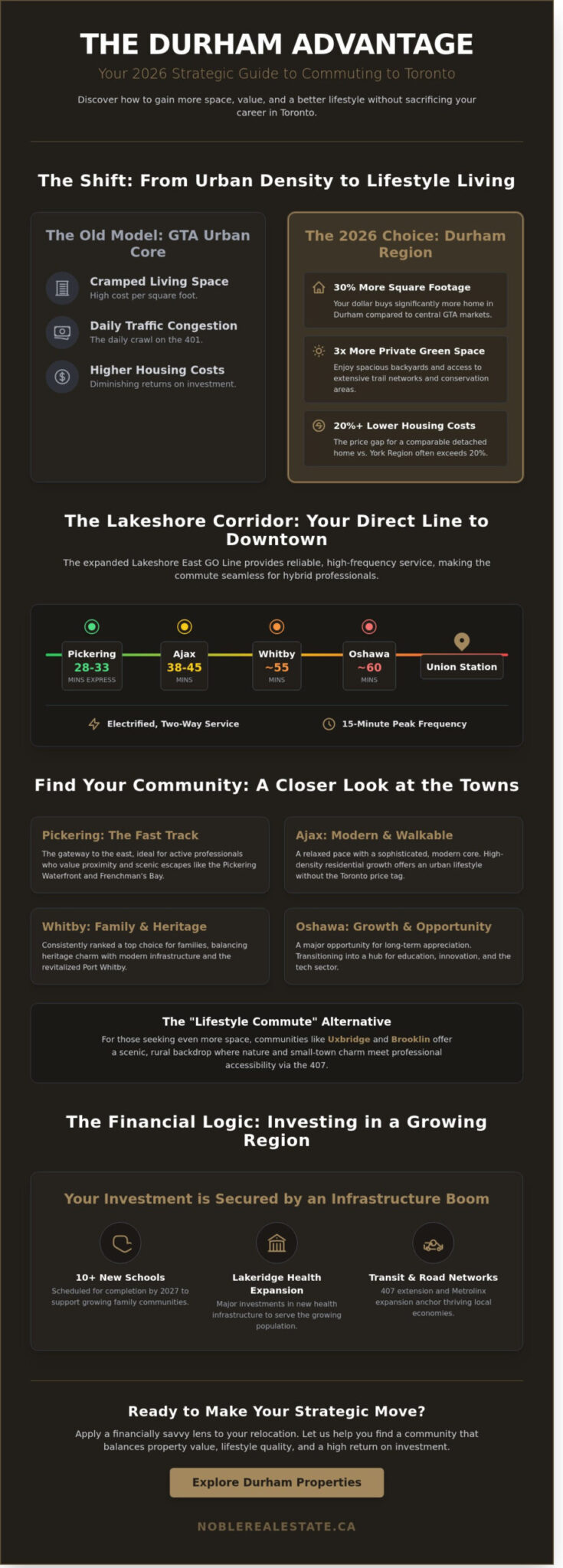
By 2026, the Greater Toronto Area has moved past the “density at all costs” mindset that defined the previous decade. Families are now prioritizing square footage, air quality, and backyard access over a short walk to a downtown office. The Regional Municipality of Durham has emerged as the clear winner in this transition. This shift is driven by the realization that a structured commute is a fair trade for a detached home and a genuine sense of community.
The hybrid work model is now the standard for most GTA professionals. With the average office requirement sitting at two or three days per week, the geographic radius for viable housing has expanded. This makes durham region commuter towns to toronto more attractive than they were even five years ago. You’re no longer just buying a house; you’re investing in a lifestyle that balances career ambition with personal space. We see two distinct paths for residents: the Lakeshore corridor offers established urban centers like Pickering and Whitby, while the Highway 407 and North corridor provides a scenic, rural backdrop for towns like Uxbridge.
The Property Value Gap
Analytical data from early 2026 shows that Durham remains significantly more accessible than York Region or Toronto. The price gap for a detached home between Durham and York Region often exceeds 20% for comparable lot sizes. This is where “The Noble Approach” provides its greatest value. We help you identify emerging pockets where your dollar buys roughly 30% more square footage than central GTA markets. Durham is currently the most reliable region for finding a detached home without sacrificing proximity to the city’s core.
The Infrastructure Boom
Accessibility has been transformed by the 407 extension and the Metrolinx expansion projects. GO Transit now provides two-way, all-day service on the Lakeshore East line, with trains running every 15 minutes during peak hours. Local investments are also surging to meet the population growth. The new Lakeridge Health infrastructure and the 10 plus new schools scheduled for completion by 2027 are driving long-term ROI for homeowners. These aren’t just transit stops; they’re anchors for thriving local economies that ensure your property value remains resilient. It’s about building a future in a region that’s actively growing its own services rather than just serving as a bedroom community.
The Lakeshore Corridor: Pickering, Ajax, Whitby, and Oshawa
The Lakeshore East GO line acts as the vital backbone for durham region commuter towns to toronto. As we move through 2026, the expansion of the regional rail network has transformed these southern hubs into high-frequency transit corridors. These municipalities offer a strategic advantage for professionals who prioritize a predictable morning routine. The shift toward electrified, 15-minute service frequencies means you spend less time on a platform and more time where it matters most.
Pickering and Ajax: The Fast Track
Pickering remains the gateway to the east. A trip from Pickering GO to Union Station typically takes 28 to 33 minutes on an express train. This proximity makes it a favorite for active professionals who value the Pickering Waterfront. Frenchman’s Bay provides a scenic escape with over 5 kilometers of trails and boardwalks. Just east, Ajax offers a slightly more relaxed pace while maintaining a 38 to 45 minute commute. The Ajax “Downtown” core, centered around Pat Bayly Square, has seen a 15% increase in high-density residential units since 2021. This urban shift provides a sophisticated lifestyle for those moving away from the Toronto core without sacrificing walkability or modern amenities.
Whitby and Oshawa: Community and Growth
Whitby consistently ranks as a top choice for families due to its balance of heritage and modern infrastructure. The town has maintained its charm while integrating the Port Whitby revitalization project, creating a community that feels both established and fresh. For those looking at long-term appreciation, Oshawa represents a significant opportunity. These durham region commuter towns to toronto have evolved. Oshawa has transitioned from its industrial roots into a hub for education and innovation. According to Durham Region’s Economic Development Plan, the area is prioritizing tech-sector job creation, which supports the local housing market’s resilience and investment potential.
Commuting by car involves a choice between the 401 and the 407. While the 401 is the direct route, the 407 ETR offers a reliable bypass for those in North Whitby or North Oshawa, often saving 20 minutes during peak hours. Understanding these logistical nuances is part of the Noble Approach to finding your ideal home. If you’re weighing the pros and cons of specific neighborhoods, you can view my listings to see how current inventory aligns with your transit needs. Choosing the right town requires looking beyond the house to the daily rhythm of the commute itself.
The Lifestyle Commuter: Uxbridge and Brooklin
Families choosing the north end of the region often prioritize space and serenity over proximity to Union Station. We call these individuals “lifestyle commuters.” They view the 60 to 90-minute journey as a fair exchange for living among the rolling hills of the Oak Ridges Moraine. Among the diverse durham region commuter towns to toronto, Uxbridge and Brooklin stand out for their distinct blend of historic charm and modern convenience. This choice represents a shift in perspective where the home is a sanctuary rather than just a place to sleep between shifts.
Uxbridge: The Premium Choice
Uxbridge is often called the “hidden gem” of the GTA. It officially holds the title of Trail Capital of Canada, boasting over 200 kilometers of managed trails that weave through protected forests. This draws Toronto expats who want a sophisticated rural lifestyle without feeling isolated. Commuting requires a bit more strategy here. Most residents use the GO Bus connections or take a 15-minute drive to the Lincolnville or Stouffville GO stations to catch the train. If you’re exploring this area, our Houses for Sale in Uxbridge guide provides specific insights into local micro-markets. This is where The Noble Approach helps clients weigh the financial investment against long-term lifestyle gains, ensuring the transition from the city is seamless.
Goodwood and Rural Durham
Just west of Uxbridge lies Goodwood. It gained international fame as the primary filming location for “Schitt’s Creek,” but locals know it for its quiet roads and immediate access to Highway 407. You can learn more about the area’s unique character in our Goodwood Canada lifestyle guide. Transitioning to rural Durham involves managing specific logistics that city dwellers might find new. You’ll need to consider:
- Connectivity: Reliable high-speed internet options like Starlink or local fiber providers are now widely available.
- Utilities: Understanding private septic system maintenance and regular well water testing.
- Seasonality: Winter readiness, including professional snow removal services for longer driveways and the necessity of winter tires.
Brooklin offers a different pace. It maintains a “modern village” feel with a historic downtown, yet it sits directly on the 407 corridor. This makes it one of the most accessible durham region commuter towns to toronto for those who prefer driving over taking the train. Since the 407 extension reached Highway 35/115 in 2019, Brooklin has become a primary hub for professionals who work in the northern parts of the GTA. The trade-off is clear; you’ll spend more time in transit, but your weekends will be spent in a peaceful, high-quality environment that feels worlds away from the city’s core.
The Financial Logic: Analyzing the ROI of the Move
Relocating to Durham Region isn’t just a lifestyle choice; it’s a strategic financial pivot. Applying a CPA’s lens to these transactions reveals that the value lies far beyond the initial purchase price. When evaluating durham region commuter towns to toronto, you have to look at the total cost of ownership. This includes the delta between mortgage interest savings and the “true cost of commuting.” By 2026, with GO Transit’s expansion and the integration of fare systems, the math has shifted in favor of the suburban investor.
While property tax rates in municipalities like Whitby or Oshawa typically sit between 1.1% and 1.3%, significantly higher than Toronto’s 0.7%, the entry price for detached homes remains substantially lower. A buyer often saves enough on the principal to offset the tax difference within the first three years. Additionally, Durham residents avoid the Toronto Municipal Land Transfer Tax, which can save a buyer between $15,000 and $35,000 on a single transaction. These upfront savings provide immediate liquidity for renovations or debt reduction.
The Mortgage vs. Transit Trade-off
Consider a practical comparison for 2026. A 700-square-foot condo in downtown Toronto often carries a price tag similar to a three-bedroom detached home in a Durham commuter hub. The “Noble Approach” focuses on identifying properties where the renovation-to-value potential is highest. If you’re saving $1,200 a month in mortgage interest by moving east, a $500 monthly budget for GO Transit or 407 ETR tolls still leaves you with a $700 monthly surplus. We help clients analyze these cash flow realities to ensure the move supports long-term wealth creation rather than just temporary relief.
Resale Value in Commuter Towns
Resale premiums in Durham are increasingly driven by “transit-oriented development.” Properties within a 10-minute radius of a GO Station or a 407 on-ramp consistently outperform the broader market. We’ve seen specific market trends for Uxbridge real estate show that “walkability to transit” and proximity to top-tier school catchments are the most resilient predictors of value. As Metrolinx moves toward 15-minute two-way service on the Lakeshore East line, these towns are no longer just “bedroom communities”; they’re high-demand hubs with limited inventory.
- LTT Savings: No municipal land transfer tax outside of Toronto.
- Appreciation: Proximity to the 407 extension continues to drive land value.
- Quality of Life: Lower density often correlates with better long-term structural maintenance.
If you’re ready to see how the numbers stack up for your specific situation, connect with our team for a comprehensive financial consultation.
Planning Your Move: From City Dweller to Durham Resident
Transitioning from the dense core of Toronto to the expansive landscapes of Durham Region requires a strategic approach. It’s more than just a change of address; it’s a shift in lifestyle that demands careful planning. To ensure a successful transition to one of the durham region commuter towns to toronto, follow these four essential steps.
- Step 1: Conduct a “Trial Commute” during peak hours. Don’t rely on digital map estimates. Drive from your potential new driveway to your Toronto office at 7:45 AM on a Tuesday. If you’re using the GO Train, test the 2026 schedule from the Whitby or Oshawa stations to Union Station. Experience the reality of the 45 to 60-minute journey before you commit.
- Step 2: Identify your non-negotiables. Decide if you prioritize immediate access to the 407 or 401 over having a backyard that borders the Oak Ridges Moraine. In 2025, 62% of buyers moving to Durham cited “larger outdoor space” as their primary motivator, while 38% prioritized “proximity to transit hubs.”
- Step 3: Get a professional home valuation for your current property. Before you can buy, you need to know exactly what your current city property is worth in the current market. This provides the financial clarity needed to set a realistic budget for your Durham purchase.
- Step 4: Partner with a local expert. You need a partner who understands the micro-markets of Durham, from the quiet pockets of Uxbridge to the developing sectors of North Oshawa.
Finding the Right Neighbourhood
Evaluating a community goes beyond a Sunday afternoon drive. Use local data from the Fraser Institute to vet school rankings and review Durham Regional Police statistics for community safety trends. It’s vital to work with real estate agents near you who actually live in these communities. A local Realtor can often spot “quiet” listings. These are properties that haven’t hit the MLS yet, giving you a competitive advantage in a market where the average days-on-market fell to 14 days in early 2026.
Next Steps with Noble Real Estate
The Noble Approach redefines what you should expect from a real estate partner. Colin Noble’s background as a CPA and CA provides a layer of analytical rigour that helps you make smarter, data-driven offers. He views your move as a major investment, not just a transaction. Whether you want a personalized tour of Uxbridge or want to explore the hidden gems among durham region commuter towns to toronto, the process is designed to be stress-free. Ready to find your perfect balance? Book a consultation with Colin Noble today.
Secure Your Future in Durham Region
Choosing the right community among the durham region commuter towns to toronto requires more than a casual search. It demands a strategic look at the 2026 infrastructure landscape and a deep dive into the financial long game. You’ve seen how the Lakeshore corridor offers unmatched connectivity; meanwhile, areas like Uxbridge provide a lifestyle that’s increasingly rare in the Greater Toronto Area. This transition is a significant milestone that deserves a high standard of professional care.
Led by Colin Noble, a CPA and CA, our team provides the analytical rigour and specialized local knowledge you need to navigate this market. We use the Noble Approach to ensure your buying experience is straightforward and successful. We’re here to help you redefine your expectations and secure a home that aligns with your financial goals. You don’t have to manage this complex process on your own.
Start your stress-free move to Durham with The Noble Approach
Your new chapter in Durham is within reach, and we’re excited to help you get there.
Frequently Asked Questions
Which town in Durham Region has the shortest commute to Toronto?
Pickering offers the shortest commute to Toronto because it borders the city’s eastern edge. A GO Train trip from Pickering Station to Union Station typically takes 33 to 42 minutes depending on the service. By car, the 35 kilometer drive via Highway 401 can take 40 minutes in light traffic. This proximity makes it a top choice among durham region commuter towns to toronto for those prioritizing time.
Is it better to take the GO Train or drive from Durham to downtown Toronto?
Taking the GO Train is the most efficient option for downtown professionals to avoid the unpredictable congestion of Highway 401. The Lakeshore East line provides 15 to 30 minute service frequencies during peak hours. Driving offers more flexibility for those working outside the core, but parking costs at Union Station can exceed $30 per day. Most residents find the train provides a more stress-free, productive start to their morning.
What are the property tax rates like in Durham Region compared to Toronto?
In 2024, Toronto’s residential tax rate is approximately 0.71 percent, while Whitby and Oshawa range between 1.15 percent and 1.35 percent. While the tax percentage is higher, the lower purchase price of homes in durham region commuter towns to toronto often results in a comparable total monthly carrying cost. Analyzing these financial nuances is a key part of our consummate professional service to ensure your investment is sound.
Is Uxbridge considered a commutable distance for a daily Toronto job?
Uxbridge is a viable daily commute for those who value a rural lifestyle, though it requires more planning. The drive to downtown Toronto covers roughly 65 kilometers and takes 60 to 90 minutes during rush hour. Many residents use the Mount Joy or Lincolnville GO Stations in nearby Stouffville to access the city. The Noble Approach focuses on finding a balance between this longer travel time and the exceptional quality of life found in Uxbridge.
Are there good schools in Durham Region for families moving from the city?
Durham Region features several top tier schools that consistently perform well in Fraser Institute rankings. For example, within the Durham District School Board, many elementary schools in Brooklin and North Whitby score above 8.0 out of 10. Families moving from the city find that these institutions offer modern facilities and smaller class sizes. We provide comprehensive knowledge of local catchments to ensure your move aligns with your children’s educational needs.
How much does it cost to use the 407 for a daily commute from Oshawa or Whitby?
Using the 407 ETR for a daily commute from Oshawa or Whitby involves costs based on the time of day and distance traveled. For a standard vehicle with a transponder, peak rates in 2024 can reach 60 cents per kilometer. A round trip from Harmony Road in Oshawa to Highway 404 can cost over $25 during morning and evening rushes. It’s an investment that saves approximately 20 to 30 minutes compared to the 401.

What if your monthly housing costs dropped by 20 percent while your access to private green space tripled? It is exhausting to watch Toronto real estate prices climb while your living space feels increasingly cramped. You probably agree that the daily crawl on the 401 is a high price to pay for a smaller home. This guide identifies the premier durham region commuter towns to toronto where you can secure a spacious backyard and a reliable 55-minute journey to Union Station. By applying a financially savvy lens to local market data, I will show you how to find a community that balances property value with lifestyle quality. We will explore the latest GO Transit schedules and neighborhood amenities to ensure your move is stress-free and strategically sound. Our analysis focuses on the 2026 infrastructure updates that make these towns the smartest choice for your family’s future.
Key Takeaways
- Evaluate the strategic shift from urban density to lifestyle-focused living by identifying the top durham region commuter towns to toronto for your specific needs.
- Navigate the Lakeshore Corridor’s transit advantages to find the ideal balance between shorter commute times and long-term property appreciation.
- Explore the unique appeal of “lifestyle commuting” in communities like Uxbridge, where nature and small-town charm meet professional accessibility.
- Apply a financially savvy lens to calculate the “true cost” of your relocation, looking beyond the purchase price to ensure a high return on investment.
- Implement a practical, step-by-step strategy for a stress-free move, including how to conduct an effective “trial commute” before you commit.
Why Durham Region is Toronto’s Primary Commuter Choice in 2026
By 2026, the Greater Toronto Area has moved past the “density at all costs” mindset that defined the previous decade. Families are now prioritizing square footage, air quality, and backyard access over a short walk to a downtown office. The Regional Municipality of Durham has emerged as the clear winner in this transition. This shift is driven by the realization that a structured commute is a fair trade for a detached home and a genuine sense of community.
The hybrid work model is now the standard for most GTA professionals. With the average office requirement sitting at two or three days per week, the geographic radius for viable housing has expanded. This makes durham region commuter towns to toronto more attractive than they were even five years ago. You’re no longer just buying a house; you’re investing in a lifestyle that balances career ambition with personal space. We see two distinct paths for residents: the Lakeshore corridor offers established urban centers like Pickering and Whitby, while the Highway 407 and North corridor provides a scenic, rural backdrop for towns like Uxbridge.
The Property Value Gap
Analytical data from early 2026 shows that Durham remains significantly more accessible than York Region or Toronto. The price gap for a detached home between Durham and York Region often exceeds 20% for comparable lot sizes. This is where “The Noble Approach” provides its greatest value. We help you identify emerging pockets where your dollar buys roughly 30% more square footage than central GTA markets. Durham is currently the most reliable region for finding a detached home without sacrificing proximity to the city’s core.
The Infrastructure Boom
Accessibility has been transformed by the 407 extension and the Metrolinx expansion projects. GO Transit now provides two-way, all-day service on the Lakeshore East line, with trains running every 15 minutes during peak hours. Local investments are also surging to meet the population growth. The new Lakeridge Health infrastructure and the 10 plus new schools scheduled for completion by 2027 are driving long-term ROI for homeowners. These aren’t just transit stops; they’re anchors for thriving local economies that ensure your property value remains resilient. It’s about building a future in a region that’s actively growing its own services rather than just serving as a bedroom community.
The Lakeshore Corridor: Pickering, Ajax, Whitby, and Oshawa
The Lakeshore East GO line acts as the vital backbone for durham region commuter towns to toronto. As we move through 2026, the expansion of the regional rail network has transformed these southern hubs into high-frequency transit corridors. These municipalities offer a strategic advantage for professionals who prioritize a predictable morning routine. The shift toward electrified, 15-minute service frequencies means you spend less time on a platform and more time where it matters most.
Pickering and Ajax: The Fast Track
Pickering remains the gateway to the east. A trip from Pickering GO to Union Station typically takes 28 to 33 minutes on an express train. This proximity makes it a favorite for active professionals who value the Pickering Waterfront. Frenchman’s Bay provides a scenic escape with over 5 kilometers of trails and boardwalks. Just east, Ajax offers a slightly more relaxed pace while maintaining a 38 to 45 minute commute. The Ajax “Downtown” core, centered around Pat Bayly Square, has seen a 15% increase in high-density residential units since 2021. This urban shift provides a sophisticated lifestyle for those moving away from the Toronto core without sacrificing walkability or modern amenities.
Whitby and Oshawa: Community and Growth
Whitby consistently ranks as a top choice for families due to its balance of heritage and modern infrastructure. The town has maintained its charm while integrating the Port Whitby revitalization project, creating a community that feels both established and fresh. For those looking at long-term appreciation, Oshawa represents a significant opportunity. These durham region commuter towns to toronto have evolved. Oshawa has transitioned from its industrial roots into a hub for education and innovation. According to Durham Region’s Economic Development Plan, the area is prioritizing tech-sector job creation, which supports the local housing market’s resilience and investment potential.
Commuting by car involves a choice between the 401 and the 407. While the 401 is the direct route, the 407 ETR offers a reliable bypass for those in North Whitby or North Oshawa, often saving 20 minutes during peak hours. Understanding these logistical nuances is part of the Noble Approach to finding your ideal home. If you’re weighing the pros and cons of specific neighborhoods, you can view my listings to see how current inventory aligns with your transit needs. Choosing the right town requires looking beyond the house to the daily rhythm of the commute itself.
The Lifestyle Commuter: Uxbridge and Brooklin
Families choosing the north end of the region often prioritize space and serenity over proximity to Union Station. We call these individuals “lifestyle commuters.” They view the 60 to 90-minute journey as a fair exchange for living among the rolling hills of the Oak Ridges Moraine. Among the diverse durham region commuter towns to toronto, Uxbridge and Brooklin stand out for their distinct blend of historic charm and modern convenience. This choice represents a shift in perspective where the home is a sanctuary rather than just a place to sleep between shifts.
Uxbridge: The Premium Choice
Uxbridge is often called the “hidden gem” of the GTA. It officially holds the title of Trail Capital of Canada, boasting over 200 kilometers of managed trails that weave through protected forests. This draws Toronto expats who want a sophisticated rural lifestyle without feeling isolated. Commuting requires a bit more strategy here. Most residents use the GO Bus connections or take a 15-minute drive to the Lincolnville or Stouffville GO stations to catch the train. If you’re exploring this area, our Houses for Sale in Uxbridge guide provides specific insights into local micro-markets. This is where The Noble Approach helps clients weigh the financial investment against long-term lifestyle gains, ensuring the transition from the city is seamless.
Goodwood and Rural Durham
Just west of Uxbridge lies Goodwood. It gained international fame as the primary filming location for “Schitt’s Creek,” but locals know it for its quiet roads and immediate access to Highway 407. You can learn more about the area’s unique character in our Goodwood Canada lifestyle guide. Transitioning to rural Durham involves managing specific logistics that city dwellers might find new. You’ll need to consider:
- Connectivity: Reliable high-speed internet options like Starlink or local fiber providers are now widely available.
- Utilities: Understanding private septic system maintenance and regular well water testing.
- Seasonality: Winter readiness, including professional snow removal services for longer driveways and the necessity of winter tires.
Brooklin offers a different pace. It maintains a “modern village” feel with a historic downtown, yet it sits directly on the 407 corridor. This makes it one of the most accessible durham region commuter towns to toronto for those who prefer driving over taking the train. Since the 407 extension reached Highway 35/115 in 2019, Brooklin has become a primary hub for professionals who work in the northern parts of the GTA. The trade-off is clear; you’ll spend more time in transit, but your weekends will be spent in a peaceful, high-quality environment that feels worlds away from the city’s core.
The Financial Logic: Analyzing the ROI of the Move
Relocating to Durham Region isn’t just a lifestyle choice; it’s a strategic financial pivot. Applying a CPA’s lens to these transactions reveals that the value lies far beyond the initial purchase price. When evaluating durham region commuter towns to toronto, you have to look at the total cost of ownership. This includes the delta between mortgage interest savings and the “true cost of commuting.” By 2026, with GO Transit’s expansion and the integration of fare systems, the math has shifted in favor of the suburban investor.
While property tax rates in municipalities like Whitby or Oshawa typically sit between 1.1% and 1.3%, significantly higher than Toronto’s 0.7%, the entry price for detached homes remains substantially lower. A buyer often saves enough on the principal to offset the tax difference within the first three years. Additionally, Durham residents avoid the Toronto Municipal Land Transfer Tax, which can save a buyer between $15,000 and $35,000 on a single transaction. These upfront savings provide immediate liquidity for renovations or debt reduction.
The Mortgage vs. Transit Trade-off
Consider a practical comparison for 2026. A 700-square-foot condo in downtown Toronto often carries a price tag similar to a three-bedroom detached home in a Durham commuter hub. The “Noble Approach” focuses on identifying properties where the renovation-to-value potential is highest. If you’re saving $1,200 a month in mortgage interest by moving east, a $500 monthly budget for GO Transit or 407 ETR tolls still leaves you with a $700 monthly surplus. We help clients analyze these cash flow realities to ensure the move supports long-term wealth creation rather than just temporary relief.
Resale Value in Commuter Towns
Resale premiums in Durham are increasingly driven by “transit-oriented development.” Properties within a 10-minute radius of a GO Station or a 407 on-ramp consistently outperform the broader market. We’ve seen specific market trends for Uxbridge real estate show that “walkability to transit” and proximity to top-tier school catchments are the most resilient predictors of value. As Metrolinx moves toward 15-minute two-way service on the Lakeshore East line, these towns are no longer just “bedroom communities”; they’re high-demand hubs with limited inventory.
- LTT Savings: No municipal land transfer tax outside of Toronto.
- Appreciation: Proximity to the 407 extension continues to drive land value.
- Quality of Life: Lower density often correlates with better long-term structural maintenance.
If you’re ready to see how the numbers stack up for your specific situation, connect with our team for a comprehensive financial consultation.
Planning Your Move: From City Dweller to Durham Resident
Transitioning from the dense core of Toronto to the expansive landscapes of Durham Region requires a strategic approach. It’s more than just a change of address; it’s a shift in lifestyle that demands careful planning. To ensure a successful transition to one of the durham region commuter towns to toronto, follow these four essential steps.
- Step 1: Conduct a “Trial Commute” during peak hours. Don’t rely on digital map estimates. Drive from your potential new driveway to your Toronto office at 7:45 AM on a Tuesday. If you’re using the GO Train, test the 2026 schedule from the Whitby or Oshawa stations to Union Station. Experience the reality of the 45 to 60-minute journey before you commit.
- Step 2: Identify your non-negotiables. Decide if you prioritize immediate access to the 407 or 401 over having a backyard that borders the Oak Ridges Moraine. In 2025, 62% of buyers moving to Durham cited “larger outdoor space” as their primary motivator, while 38% prioritized “proximity to transit hubs.”
- Step 3: Get a professional home valuation for your current property. Before you can buy, you need to know exactly what your current city property is worth in the current market. This provides the financial clarity needed to set a realistic budget for your Durham purchase.
- Step 4: Partner with a local expert. You need a partner who understands the micro-markets of Durham, from the quiet pockets of Uxbridge to the developing sectors of North Oshawa.
Finding the Right Neighbourhood
Evaluating a community goes beyond a Sunday afternoon drive. Use local data from the Fraser Institute to vet school rankings and review Durham Regional Police statistics for community safety trends. It’s vital to work with real estate agents near you who actually live in these communities. A local Realtor can often spot “quiet” listings. These are properties that haven’t hit the MLS yet, giving you a competitive advantage in a market where the average days-on-market fell to 14 days in early 2026.
Next Steps with Noble Real Estate
The Noble Approach redefines what you should expect from a real estate partner. Colin Noble’s background as a CPA and CA provides a layer of analytical rigour that helps you make smarter, data-driven offers. He views your move as a major investment, not just a transaction. Whether you want a personalized tour of Uxbridge or want to explore the hidden gems among durham region commuter towns to toronto, the process is designed to be stress-free. Ready to find your perfect balance? Book a consultation with Colin Noble today.
Secure Your Future in Durham Region
Choosing the right community among the durham region commuter towns to toronto requires more than a casual search. It demands a strategic look at the 2026 infrastructure landscape and a deep dive into the financial long game. You’ve seen how the Lakeshore corridor offers unmatched connectivity; meanwhile, areas like Uxbridge provide a lifestyle that’s increasingly rare in the Greater Toronto Area. This transition is a significant milestone that deserves a high standard of professional care.
Led by Colin Noble, a CPA and CA, our team provides the analytical rigour and specialized local knowledge you need to navigate this market. We use the Noble Approach to ensure your buying experience is straightforward and successful. We’re here to help you redefine your expectations and secure a home that aligns with your financial goals. You don’t have to manage this complex process on your own.
Start your stress-free move to Durham with The Noble Approach
Your new chapter in Durham is within reach, and we’re excited to help you get there.
Frequently Asked Questions
Which town in Durham Region has the shortest commute to Toronto?
Pickering offers the shortest commute to Toronto because it borders the city’s eastern edge. A GO Train trip from Pickering Station to Union Station typically takes 33 to 42 minutes depending on the service. By car, the 35 kilometer drive via Highway 401 can take 40 minutes in light traffic. This proximity makes it a top choice among durham region commuter towns to toronto for those prioritizing time.
Is it better to take the GO Train or drive from Durham to downtown Toronto?
Taking the GO Train is the most efficient option for downtown professionals to avoid the unpredictable congestion of Highway 401. The Lakeshore East line provides 15 to 30 minute service frequencies during peak hours. Driving offers more flexibility for those working outside the core, but parking costs at Union Station can exceed $30 per day. Most residents find the train provides a more stress-free, productive start to their morning.
What are the property tax rates like in Durham Region compared to Toronto?
In 2024, Toronto’s residential tax rate is approximately 0.71 percent, while Whitby and Oshawa range between 1.15 percent and 1.35 percent. While the tax percentage is higher, the lower purchase price of homes in durham region commuter towns to toronto often results in a comparable total monthly carrying cost. Analyzing these financial nuances is a key part of our consummate professional service to ensure your investment is sound.
Is Uxbridge considered a commutable distance for a daily Toronto job?
Uxbridge is a viable daily commute for those who value a rural lifestyle, though it requires more planning. The drive to downtown Toronto covers roughly 65 kilometers and takes 60 to 90 minutes during rush hour. Many residents use the Mount Joy or Lincolnville GO Stations in nearby Stouffville to access the city. The Noble Approach focuses on finding a balance between this longer travel time and the exceptional quality of life found in Uxbridge.
Are there good schools in Durham Region for families moving from the city?
Durham Region features several top tier schools that consistently perform well in Fraser Institute rankings. For example, within the Durham District School Board, many elementary schools in Brooklin and North Whitby score above 8.0 out of 10. Families moving from the city find that these institutions offer modern facilities and smaller class sizes. We provide comprehensive knowledge of local catchments to ensure your move aligns with your children’s educational needs.
How much does it cost to use the 407 for a daily commute from Oshawa or Whitby?
Using the 407 ETR for a daily commute from Oshawa or Whitby involves costs based on the time of day and distance traveled. For a standard vehicle with a transponder, peak rates in 2024 can reach 60 cents per kilometer. A round trip from Harmony Road in Oshawa to Highway 404 can cost over $25 during morning and evening rushes. It’s an investment that saves approximately 20 to 30 minutes compared to the 401.