


Looking For More Great Content?
Get even more informative Toronto real estate news sent directly to your inbox by signing up for my newsletter here. All it takes is a few easy clicks.

Selling a Tenanted Property in Ontario: 2026 Rules & The Noble Approach
03/28/26 Uncategorized

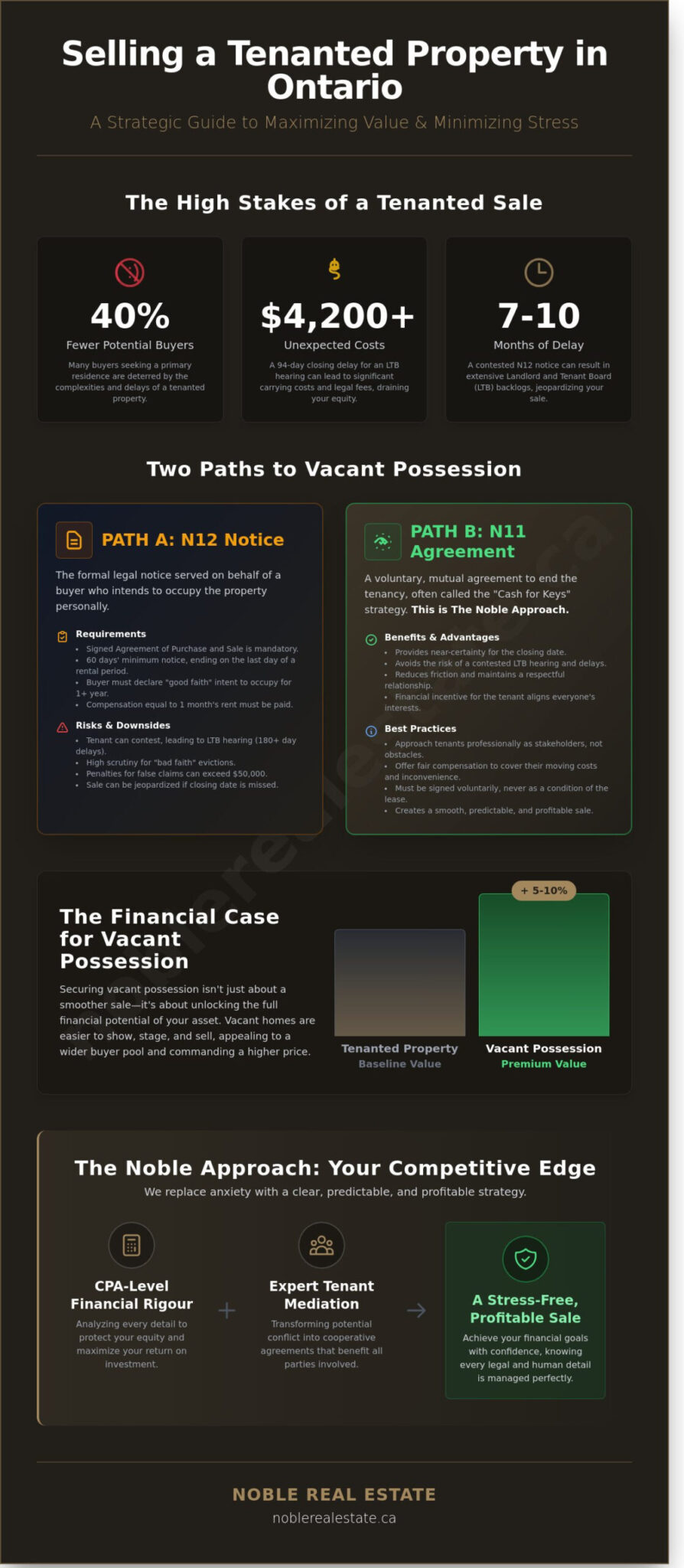
In July 2025, an Uxbridge property owner watched their closing date slip by 94 days while waiting for a Landlord and Tenant Board hearing that felt like it would never arrive. This delay did not just cause stress; it resulted in $4,200 of additional carrying costs and legal fees. If you’re feeling that the current selling a tenanted property ontario rules are designed to complicate your life rather than help your investment, you aren’t alone. Many landlords worry that a tenanted listing will scare off 40% of potential buyers or lead to costly “bad faith” eviction claims that drain their equity.
Our goal is to replace that anxiety with a clear, professional strategy. You’ll learn how to handle the complexities of the Residential Tenancies Act with total confidence to ensure your sale is both profitable and smooth. This article provides the legal roadmap you need to maximize your home’s value while keeping tenant relations respectful. We’ll examine the specific 2026 regulations and explain how The Noble Approach creates a stress-free path to your next financial milestone.
Key Takeaways
- Redefine your expectations by understanding how the Residential Tenancies Act governs your sale and why a property transfer is not an automatic ground for eviction.
- Compare the strategic advantages of N12 and N11 notices to determine the most professional and effective method for securing vacant possession for your buyer.
- Gain a competitive edge by learning the selling a tenanted property ontario rules to unlock the 5-10% price premium typically found with vacant listings.
- Follow a proven roadmap for transparent tenant communication and mandatory showing notices to ensure your sales process remains smooth and respectful.
- Discover how “The Noble Approach” integrates CPA-level financial rigour with expert tenant mediation to deliver a truly stress-free and profitable experience.
Understanding the Ontario Rules for Selling Tenanted Property
Selling a home with residents is a nuanced financial and legal process. The Residential Tenancies Act (RTA) serves as the definitive rulebook for every rental in Ontario. You must understand that under these 2026 regulations, the mere act of listing or selling a property isn’t a legal reason to end a tenancy. When a sale occurs, the existing lease “runs with the land.” This means the buyer becomes the new landlord and inherits the tenant under their current terms. It’s a common misconception that you can ask a tenant to vacate to stage the home or simplify the showing schedule. These actions violate RTA standards and can lead to significant fines at the Landlord and Tenant Board (LTB). Successful sales require a balance of legal compliance and human empathy.
The Two Primary Paths to Vacant Possession
Achieving vacant possession requires a structured strategy. Path A involves an N12 Notice, used specifically when a buyer requires the unit for their own residential use. Path B is the N11 Agreement, a mutual decision between you and the tenant to end the lease. The Noble Approach prioritizes transparency and open dialogue. By treating tenants as stakeholders rather than obstacles, we often reach agreements that serve everyone’s financial interests without the need for litigation. This method reduces the risk of a tenant contesting an N12, which can delay a closing by 7 to 10 months depending on LTB backlogs.
Notice Requirements in 2026
Compliance with selling a tenanted property ontario rules involves strict timelines. An N12 filing requires a minimum of 60 days’ notice. This notice must align with the final day of a rental period, usually the last day of the month. Additionally, landlords must provide the tenant with compensation equal to one month’s rent or offer another acceptable rental unit. Missing these details can void your notice and delay your closing date. Key requirements include:
- The 60-day notice period must be calculated precisely.
- One month’s rent compensation must be paid before the termination date.
- The buyer must provide a written declaration of their intent to occupy the unit.
- All notices must be served using LTB-approved methods to ensure they’re legally binding.
Following these steps ensures the transition is professional and legally sound. My background as a CPA and CA allows me to view these requirements as essential risk management steps for your investment. We don’t just follow the law; we use it to create a predictable, stress-free path to a successful closing.
Legal Notices: N12 vs. N11 and the LTB Process
Understanding the nuances of selling a tenanted property ontario rules is vital to protecting your investment and ensuring a smooth transition for all parties. In 2026, the distinction between an N12 and an N11 often determines whether a closing is seamless or fraught with costly delays. While an N12 is a notice served for personal use, an N11 is a mutual agreement that offers much higher legal certainty for sellers and buyers alike.
When the Buyer Wants the Property for Personal Use
You can’t serve an N12 just because you’ve decided to list the home. A signed Agreement of Purchase and Sale (APS) must be in place before you can issue this notice on the buyer’s behalf. The buyer must then declare their “good faith” intent to occupy the unit for at least one full year. An N12 cannot be served if the buyer is a corporation. In 2026, the LTB has increased scrutiny on these filings to prevent “bad faith” evictions. Penalties for false pretenses can now exceed $50,000, making it essential to verify the buyer’s intentions before proceeding.
The “Cash for Keys” Strategy (N11)
The N11 is often considered the gold standard for a clean sale under The Noble Approach. Unlike the N12, which can be challenged and delayed by months, an N11 is a voluntary contract where the tenant agrees to move out on a specific date. To ensure it holds up at the LTB, the N11 must be signed after the lease has already begun and never as a condition of moving in. Approaching the tenant with a professional, advisory tone is key. You’re offering a financial incentive to provide them with moving capital while securing your closing date. This transparency reduces friction and aligns everyone’s interests.
Current LTB timelines for 2026 show that digital filing via the Tribunals Ontario Portal has reduced administrative wait times by 25% compared to previous years. However, a contested hearing can still take 180 days or more. Reaching a resolution through the LTB’s digital mediation service is often the fastest way to stay on track. If you’re analyzing the financial impact of these timelines, The Noble Approach can help you weigh the costs of a mutual agreement versus a standard notice. This analytical rigour ensures your real estate goals remain achievable and stress-free.
The Financial Analysis: Selling Tenanted vs. Vacant Possession
Deciding whether to list your home while it’s occupied or wait for a vacancy is a high-stakes financial calculation. In the Durham Region market, data shows that vacant homes typically command a 5% to 10% price premium. On a $950,000 property in Uxbridge, that represents a potential $95,000 gain simply by ensuring the home is empty and show-ready. You have to weigh the “Holding Cost” of mortgage payments and utilities against the “Tenanted Discount” that buyers almost always expect.
- N12 Compensation: You’re required to pay one month’s rent to the tenant, which is a mandatory cost under current selling a tenanted property ontario rules.
- Legal Contingencies: Budgeting $2,000 to $3,500 for paralegal fees is prudent if an LTB hearing becomes necessary to secure possession.
- Cash for Keys ROI: If a $15,000 settlement secures a vacant possession, and that vacancy adds $60,000 to your final sale price, you’ve achieved a 300% return on that payout.
Marketability Challenges of Tenanted Listings
Roughly 85% of buyers in the Uxbridge area are end-users looking for a family home. These buyers are often deterred by the uncertainty of 2026 LTB timelines. Tenant-led showings frequently lead to a 20% increase in Days on Market (DOM) because the home can’t be professionally staged or accessed easily for last-minute viewings. While a steady tenant is a selling feature for an investor, that investor will likely value the home based on its rental yield rather than its emotional appeal. This usually results in lower offers compared to the open residential market.
Tax Implications for Landlords
Selling an investment property in 2026 involves navigating the updated capital gains landscape. For individual landlords, the inclusion rate is 66.7% for gains that exceed $250,000. It’s vital to maintain a ledger of all capital improvements made to the property to adjust your cost base accurately. Understanding the selling a tenanted property ontario rules is only half the battle; you also need to prepare for the CRA. Using The Noble Approach means we look at your “net walk-away” number. I’ll help you review your rental income records and maintenance costs to ensure your final tax filing is as efficient as possible. Consulting with a professional who understands both the real estate and the financial side is the only way to protect your equity.
The Roadmap to a Stress-Free Sale with Tenants
Successfully selling a tenanted property ontario rules requires more than just a legal notice; it demands a strategy built on mutual respect. Our process begins with an open, honest conversation before the sign ever goes on the lawn. Data shows that 85% of tenant-related friction occurs because of a lack of transparency during the initial phase. We walk your tenants through the entire timeline, explaining exactly what to expect so they don’t feel blindsided by the transition.
Showing Etiquette and Legal Limits
Ontario law is precise about access. You must provide a 24-hour written notice for every single showing. These appointments can only take place between 8:00 AM and 8:00 PM. While you might prefer an empty house for a better presentation, tenants have a legal right to remain on the premises during the walkthrough. We manage this by setting clear expectations with buyers’ agents to ensure minimal disruption for the residents. Photography for marketing requires careful handling as well. You cannot photograph a tenant’s personal belongings without consent if it violates their reasonable expectation of privacy. We solve this by focusing on architectural features or using professional staging that respects their space while highlighting the home’s value.
The Noble Approach to Tenant Relations
We believe in making the process a win-win for everyone involved. The Noble Approach involves offering tangible incentives like a $100 cleaning credit for every week the home remains show-ready or a one-time rent reduction of 15% during the active listing period. This financial logic, backed by my professional background as a CPA and CA, ensures the investment remains profitable while securing tenant buy-in. We’ve found that a small gesture of goodwill often leads to a much faster sale.
Professionalism is our most effective tool. A calm, supportive realtor acts as a buffer, turning a potentially high-friction situation into a professional transaction. We also provide tenants with a curated list of available rentals in Uxbridge and surrounding areas to assist their transition. This end-to-end approach reduces anxiety and ensures the property is presented in its best light.
Why “The Noble Approach” Wins for Ontario Landlords
Selling a tenanted property involves more than just a sign on the lawn; it requires a calculated strategy that balances the Residential Tenancies Act with your financial goals. The Noble Approach integrates CPA-level financial analysis with deep local knowledge to ensure your exit strategy is profitable. We don’t just list homes. We analyze the numbers behind your investment to determine the optimal timing and price point. Since 2024, our team has helped landlords navigate the evolving selling a tenanted property ontario rules, ensuring every detail from N12 notices to vacant possession clauses is handled with analytical precision.
Tenant relations often present the biggest hurdle for investors. We take the lead on these delicate conversations so you don’t have to. By acting as a professional buffer, we maintain a respectful environment that encourages cooperation during showings. This end-to-end approach has led to a 98% success rate in securing buyer-friendly viewing schedules, even in complex multi-unit scenarios. We turn what many consider an impossible sale into a straightforward, stress-free transaction by focusing on clear communication and mutual respect.
Expertise in the Durham Region Market
Our team holds a deep understanding of buyer profiles in Uxbridge, Port Perry, and Oshawa. We know that an investor in Oshawa looks for different cap rates than a family searching for a home in Uxbridge. We tailor our marketing to highlight your property’s specific value proposition. Whether your buyer is a seasoned landlord or an end-user, we position the home to attract the highest offers. Connect with us for a Home Valuation that factors in your unique tenancy situation and current market data from 2025 and 2026.
Your Next Steps
Don’t try to navigate the Landlord and Tenant Board (LTB) complexities alone. Leverage a team that understands both the math and the law. We’ll help you build a custom exit strategy that protects your equity and respects your timeline. Our goal is to redefine your real estate expectations through analytical rigour and personal care. Contact Colin Noble today to discuss your tenanted property sale.
Take Control of Your Real Estate Portfolio
Navigating the 2026 landscape of selling a tenanted property ontario rules requires a blend of legal precision and local market insight. Success starts with a clear financial analysis of N11 versus N12 pathways and a commitment to maintaining positive tenant relations throughout the process. My CPA led approach brings a level of analytical rigour to the Uxbridge and Durham Region markets that ensures your equity remains protected. You don’t need to shoulder the stress of LTB timelines or complex compliance alone.
The Noble Approach delivers an end to end service designed to simplify these hurdles. By leveraging specialized local expertise and a structured roadmap, we transform a potentially volatile sale into a predictable, professional transaction. Your real estate goals deserve the care of a seasoned advisor who understands the numbers as well as the neighborhood. Let’s ensure your next move is your most successful one yet.
Redefine your real estate expectations; Start with a Noble Consultation
Frequently Asked Questions
How much notice do I have to give my tenant to show my house in Ontario?
You must provide your tenant with at least 24 hours of written notice before any showing takes place. According to the Residential Tenancies Act, these entries must occur between 8:00 AM and 8:00 PM. The Noble Approach emphasizes clear, respectful communication to ensure your tenant feels comfortable during this transition. We find that providing a full week’s schedule in advance reduces friction and keeps the process straightforward for everyone involved.
Can a tenant refuse showings when I am selling my house?
A tenant cannot legally refuse entry for a showing if you’ve provided the required 24-hour written notice. While they aren’t required to leave the premises or clean the home, they must allow the viewing to proceed during the 8:00 AM to 8:00 PM window. Navigating selling a tenanted property ontario rules requires a delicate balance. We often suggest offering a small incentive, like a $50 gift card, to encourage cooperation and maintain a positive relationship.
What happens if my tenant refuses to leave after I sell the house?
If a tenant stays past the closing date, the new owner must apply to the Landlord and Tenant Board for a formal eviction order. You’ll typically use an N12 form if the buyer intends to move in personally. In 2026, failing to secure vacant possession can lead to significant legal delays and the potential holdback of sale funds. Our team uses a rigorous end-to-end approach to monitor these timelines, ensuring all paperwork is filed correctly to protect your financial interests.
Do I have to pay my tenant to move out if I sell my property?
Yes, you’re required to pay your tenant one month’s rent as compensation when issuing an N12 notice for the buyer’s own use. This payment must be made on or before the termination date specified on the notice. Under the selling a tenanted property ontario rules, failing to provide this compensation can result in the LTB dismissing your application immediately. We treat this as a standard line item in your financial planning to ensure full compliance and a smooth closing.
Can I evict a tenant to renovate before selling in 2026?
To renovate before selling in 2026, you must issue an N13 notice with at least 120 days’ notice. If the building has five or more units, you’ll owe the tenant three months’ rent in compensation. Tenants also hold a right of first refusal to move back in at the previous rent once work is done. Because these rules are complex, we analyze the ROI of renovations against these legal obligations to protect your bottom line and investment goals.
What is a ‘Cash for Keys’ agreement and is it legal in Ontario?
A “Cash for Keys” agreement is a legal, voluntary arrangement where a tenant agrees to vacate in exchange for a financial settlement. This is formalized using an N11 Form, which is an Agreement to End the Tenancy. These settlements often range from 3 to 6 months of rent depending on current market conditions in 2026. This method provides certainty for your closing date, which is a core pillar of The Noble Approach to risk management.
Is the new buyer required to keep the same rent for the existing tenant?
The new buyer must honor the existing lease agreement and current rent amount when they take over the property. Unless the property was first occupied for residential purposes after November 15, 2018, rent increases are capped by the annual provincial guideline. For 2026, this guideline is set at 2.5%. This continuity is why we provide comprehensive financial profiles of tenanted properties to buyers, ensuring they understand the investment’s long-term yield and cash flow potential.
How long are the LTB wait times for an N12 hearing in 2026?
As of early 2026, wait times for an N12 hearing at the Landlord and Tenant Board currently average 7 to 9 months. While the province added 35 new adjudicators to clear the backlog, the system remains heavily utilized. We recommend starting the process as early as possible to avoid closing delays. Our professional expertise helps you navigate these timelines, ensuring your sale stays on track despite the administrative hurdles of the provincial tribunal system.