
Author: Colin Noble
Looking For More Great Content?
Get even more informative Toronto real estate news sent directly to your inbox by signing up for my newsletter here. All it takes is a few easy clicks.

How Long Does It Take to Sell a House in Ontario? (2026 Guide)
04/2/26 Uncategorized
What if the most stressful part of your move isn’t the packing, but the silence of a house sitting on the market for 45 days too long? Approximately 68% of sellers express deep anxiety over the timing of their sale, specifically asking how long does it take to sell a house in ontario to avoid the heavy cost of overlapping mortgages. It’s a valid concern. You want to ensure your equity is protected and your transition is seamless, rather than watching your listing lose momentum while you wait for a firm offer.
We agree that uncertainty is the primary obstacle to a confident move. You deserve a predictable move-out date and a strategy that maximizes your equity through a clean, efficient process. This 2026 guide provides the realistic timeline you need to plan your next chapter. We will explore the specific variables that influence market speed and clarify the vital difference between a firm offer and the final closing day. By applying The Noble Approach, you can navigate this transition with the analytical rigour of a financial expert and the local insight required for a successful result.
Key Takeaways
- Understand the three distinct phases of the selling journey to look beyond “Days on Market” and plan for a realistic timeline from initial preparation to the final closing.
- Discover why the first two weeks are your “golden window” for exposure and how this critical period determines how long does it take to sell a house in Ontario.
- Analyze the real financial impact of carrying costs and “price drop psychology” from a CPA’s perspective to protect your equity from the costs of a stale listing.
- Identify how local market nuances in areas like Uxbridge and the GTA, combined with seasonal peaks, influence the pace of your specific property sale.
- Apply “The Noble Approach” to strategically shorten your sales timeline through precise valuation and end-to-end preparation that reduces buyer hesitation.
Understanding the Ontario Home Sale Timeline: From Prep to Key Exchange
Selling a home isn’t an overnight event. Most sellers focus on the "Days on Market" (DOM) metric, but that’s only one chapter of the story. In 2026, the total journey from your first meeting with a Realtor to the moment you hand over the keys typically spans four to five months. Understanding how long does it take to sell a house in ontario requires a look at the entire calendar, not just the time the "For Sale" sign stands on your lawn.
You’ll navigate three distinct phases. First is the preparation, followed by the active listing period, and finally the closing period. While the market has stabilized compared to the volatility seen in historical Canadian housing market conditions, you should plan for 30 to 60 days to secure a buyer and an additional 60 to 90 days to finalize the legal transfer. At Noble Real Estate, we call this the "end-to-end approach," ensuring you aren’t caught off guard by the length of the process.
Phase 1: The Pre-Listing Sprint
Success starts before the sign hits the lawn. We recommend a 7 to 10 day window for professional staging and high-end photography. This upfront investment often saves two to three weeks of listing time later because your home makes a powerful first impression. Using deep Uxbridge real estate market knowledge, we conduct precise valuations during this phase. This prevents the “overpricing trap” where a home sits stagnant for months due to a misaligned initial price. A well-prepared home attracts serious buyers faster, turning a potential three-month wait into a 30-day success story.
Phase 2 & 3: Active Selling vs. The Closing Gap
Once you receive an offer, you enter the conditional period. This usually lasts 5 to 7 business days while the buyer secures financing or completes a home inspection. A “firm” offer means these conditions are met, but it isn’t the end of your journey. The closing period is often the longest stretch, typically taking between 60 and 90 days in the current Ontario market.
- The Conditional Window: 5 to 7 business days for due diligence.
- The Firm Date: The moment the deal is legally binding.
- The Completion Date: When funds transfer and keys are exchanged.
We help you align this completion date with your next purchase. This coordination is vital to avoid the high costs of bridge financing, which can add thousands of dollars in interest to your transaction. Understanding how long does it take to sell a house in ontario means looking at this full 120 to 150 day window to ensure your transition is stress-free and straightforward.
4 Primary Factors That Dictate Your Sale Speed in Ontario
Determining how long does it take to sell a house in ontario depends on more than just the current interest rate. Success requires a blend of analytical pricing, high-end presentation, and an aggressive digital strategy. While the average days on market fluctuates, sellers who master these four pillars often see offers significantly faster than the provincial average.
The ‘Golden 14 Days’ Rule
The first two weeks of your listing are your most valuable asset. Data shows that new listings receive 3x more views during the first 48 hours than at any other point in the sales cycle. This initial surge comes from “ready” buyers who have active alerts set for their specific criteria. If your price is too high during this window, you lose these motivated individuals immediately. Market momentum is the correlation between initial interest and final sale price. A strategic price creates a sense of urgency, often leading to multiple offer scenarios that drive the timeline down and the price up.
Presentation and Professional Marketing
In 2026, your home’s first showing happens on a smartphone screen. High-quality videography and 3D tours aren’t just luxuries; they’re essential tools that reduce “wasted” showings by filtering out buyers whose needs don’t align with your floor plan. This ensures that every person walking through your front door is a serious contender. Beyond the visuals, flexibility is your greatest ally. Sellers who allow for wide showing windows, even on short notice, typically secure an offer 25% faster than those with restrictive schedules. You can find more specific advice on preparing your home in these staging tips for selling fast.
Your reach must also extend far beyond the local MLS. A comprehensive marketing plan utilizes targeted digital exposure to find buyers in different geographic regions who are looking to relocate to Ontario’s vibrant communities. Understanding broader trends is vital here. For instance, Teranet’s analysis of Ontario’s market highlights how holding patterns and inventory levels directly impact buyer competition. Whether you’re in a “Buyer’s” or “Seller’s” market, your digital footprint determines how many people see your home before the “new listing” glow fades.
Every property has a unique financial narrative. If you’re curious about how these factors apply to your specific neighbourhood, exploring The Noble Approach can help you identify the precise strategy needed for a swift, successful transition. We focus on removing the friction from the selling process, ensuring your move is as straightforward as possible.

The Financial Cost of a Stale Listing: A CPA’s Perspective
When you ask how long does it take to sell a house in ontario, you aren’t just asking about a timeline on a calendar. You’re asking about your bottom line. As a CPA, I view a listing through the lens of a balance sheet. Every extra week your property sits on the market represents a tangible drain on your equity. A house is a carrying cost until it becomes a closed sale. Waiting for a “perfect” offer that might never arrive can actually result in a lower net profit than accepting a strong offer early on.
Calculating Your Monthly Holding Costs
Holding costs often remain invisible until you add them up. For a property valued at C$1,000,000 in Ontario’s 2026 market, the monthly burn rate can be substantial. Owners often overlook that “waiting for the right buyer” is a choice that costs thousands in real time. Common monthly expenses include:
- Mortgage interest: C$2,800 (based on current 2026 rates)
- Property taxes: C$550
- Utilities and basic maintenance: C$450
- Home insurance: C$200
Totaling over C$4,000 monthly, these costs erode your final profit. Recent Statistics Canada housing data indicates that carrying costs have risen by 12% since 2024, making a swift sale more critical than ever. A small price adjustment on day one is often cheaper than a C$12,000 loss over three months of waiting.
Avoiding the ‘Stigma’ of High Days on Market
Psychology plays a massive role in real estate. Once a listing passes the 30-day mark, buyers start to wonder what’s wrong with the property. This stigma shifts the power dynamic instantly. In Ontario, homes that sell within the first 14 days typically fetch 98% to 102% of the asking price. By day 40, that figure often drops to 94% or lower. You lose your negotiating leverage when buyers see a stale listing. They don’t offer fair market value; they offer “rescue” prices because they sense desperation.
The Noble Approach uses analytical rigor to ensure your home is priced correctly from the start. We focus on a high-value exit that avoids the trap of a long, drawn-out negotiation. Beyond the cash, there’s the opportunity cost. If your capital is tied up in a house that won’t sell, you might miss out on your dream property or a lucrative investment elsewhere. In a market where how long does it take to sell a house in ontario can vary by region, being the “newest” listing is your greatest competitive asset. We aim for a clean, stress-free sale that protects your equity and your time.
Local Market Variations: Uxbridge vs. The Greater Toronto Area
Market dynamics shift the moment you cross the Toronto city limits into Durham Region. In the high-density core of the GTA, a downtown condo might see fifty showings in a single weekend but face stiff competition from hundreds of identical units. Conversely, detached homes in Durham attract a buyer profile focused on long-term stability and square footage. When you ask how long does it take to sell a house in ontario, the answer depends heavily on your postal code. A luxury estate in the hills of Uxbridge priced over C$2.8 million typically requires a longer marketing period, often sitting for 55 to 75 days. Meanwhile, a standard three-bedroom family home in a suburban pocket might find a buyer in 18 to 24 days.
Local infrastructure developments also dictate the pace of a sale. The expansion of the GO Transit network or the completion of local highway extensions can slash local Days on Market (DOM) by 12% in a single quarter as commuters look for better accessibility. We track these regional shifts to ensure your listing hits the market at the peak of buyer interest. If a new community project is announced nearby, it creates a window of opportunity that we leverage to drive higher offers.
The Uxbridge & Durham Advantage
Uxbridge remains a top choice for families moving away from the city’s congestion. This consistent demand keeps houses for sale in Uxbridge moving at a faster clip than the provincial average. While Ontario’s broad average may settle around 34 days, our local market often sees transactions close in 22 days for properties that are staged and priced correctly. The Noble Approach integrates my background as a CPA and CA to provide a level of analytical rigour most agents miss. We use hard data to find the “sweet spot” in pricing that minimizes your time on market without leaving money on the table.
Seasonality and Your Timeline
Timing is a strategic lever that can significantly alter your selling experience. Listing in late February or early March often results in a sale 12 days faster than listings posted in the quiet weeks of late November. The “spring surge” is fueled by families wanting to move before the new school year begins in September. If you must sell during the winter holiday slump, we pivot our strategy. We target serious, high-intent buyers rather than casual browsers. We also look at local calendars; launching a listing just before major community events can increase foot traffic to open houses. Understanding how long does it take to sell a house in ontario means respecting these seasonal cycles and using them to your advantage.
The Noble Approach: How to Strategically Shorten Your Sales Timeline
While market averages provide a baseline for your expectations, your specific results depend on a deliberate, four-step strategy designed to outperform the median. The Noble Approach focuses on precision and financial rigour to reduce the number of days your property sits on the market. By following a structured method, we remove the variables that often lead to delays.
- Step 1: Data-Driven Valuation. We don’t guess at your home’s value. Using my background as a CPA and CA, I conduct a comprehensive analysis to find the “sweet spot” price. Pricing within 1% of market value can reduce your time on market by up to 12 days compared to overpricing and later correcting.
- Step 2: End-to-End Preparation. Presentation is everything. We execute a plan that includes professional staging and high-end photography. Data from the Real Estate Staging Association indicates that staged homes sell 73% faster than their non-staged counterparts.
- Step 3: Multi-Channel Marketing. We reach active buyers on the MLS and passive buyers through targeted social media and professional networks. This multi-layered exposure ensures your home is seen by the right audience immediately.
- Step 4: Expert Offer Management. Speed is useless if a deal falls through. We vet every offer to ensure the highest probability of a firm deal, minimizing the risk of returning to the market after a failed inspection or financing condition.
Redefining Your Expectations
Selling your home shouldn’t be a source of anxiety. Our personalized service model focuses on transparency and financial clarity. When you’re choosing a local real estate agent, you deserve a partner who understands the local Ontario market nuances and the investment side of the transaction. We provide a straightforward process that removes the guesswork from the question: how long does it take to sell a house in ontario? Our goal is to make the transition both profitable and enjoyable.
Your Next Steps for a Successful Sale
The best time to start planning is today. We often recommend an initial consultation as early as 180 days before your intended move date. This lead time allows us to curate a custom timeline and address any preparation needs without a rush. If you want to know how long does it take to sell a house in ontario for your specific property type and neighbourhood, a tailored assessment is the only way to get an accurate answer. We analyze current inventory levels and recent sales data from the last 30 days to give you a realistic window.
Ready to move forward with confidence? Contact Colin Noble today for a personalized home valuation.
Take Command of Your Ontario Home Sale
Understanding how long does it take to sell a house in ontario requires a blend of local market data and disciplined financial strategy. While the 2026 market presents its own unique set of variables, your success hinges on avoiding the hidden costs of a stale listing. A property sitting idle can cost upwards of C$4,500 per month in carrying costs for a standard detached home. By leveraging deep local expertise in Uxbridge and the Durham Region, you can navigate these fluctuations with total clarity. We ensure every decision is supported by a CPA-backed financial analysis, providing the analytical rigour needed to protect your equity during the transition.
The Noble Approach is built to provide full-service, end-to-end representation that removes the guesswork from your timeline. We focus on the details so you can focus on your future. Whether you’re upgrading in the GTA or downsizing in a local community, our team provides the professional guidance you deserve to make your sale both efficient and profitable.
Discover what your home is worth with The Noble Approach
It’s an exciting time to move forward. We’re ready to help you achieve a successful, stress-free sale that meets your highest expectations.
Frequently Asked Questions
Is 30 days on the market too long in Ontario?
No, 30 days is currently considered a healthy duration in the 2026 market. The average time a property stays active in Ontario is 32 days before an offer is accepted. If your home exceeds 45 days on the market, we analyze the data to determine if a strategic price adjustment or a marketing refresh is necessary to attract fresh interest.
Can I sell my house in Ontario in under two weeks?
You can certainly sell a home in under 14 days if the property is priced within 2% of its fair market value and presented perfectly. In high-demand pockets of the Greater Toronto Area, 15% of homes still sell within the first 10 days of listing. This speed requires an aggressive Noble Approach to pre-listing preparation and professional digital marketing.
Does the time of year really affect how fast my house will sell?
Seasonality remains a major factor, with spring listings typically selling 12 days faster than those listed in December. Data from the 2025 market showed that April and May saw the highest buyer activity across the province. However, low inventory in the winter months can sometimes lead to quicker sales for well-maintained properties because there’s less competition for buyer attention.
What happens if my house doesn’t sell within my desired timeframe?
We pivot by analyzing the specific feedback from the average of 8 to 10 showings most listings receive in their first month. If the house remains firm on the market after 60 days, we typically recommend a price adjustment of 3% to 5% or enhancing the staging. Our goal is to protect your equity through analytical rigour rather than letting the listing go stale.
How long does the paperwork and legal process take after an offer is accepted?
The period between an accepted offer and a firm deal usually takes 5 to 10 business days for condition removal. Once the deal is firm, the legal closing process handled by your lawyer typically spans 30 to 90 days. This timeline ensures all title transfers are verified and C$ funds are secured through the proper banking channels.
Does staging a home actually make it sell faster in Durham Region?
Staged homes in the Durham Region sell 40% faster than non-staged counterparts according to local 2025 real estate statistics. Professionally curated spaces help buyers visualize the lifestyle in areas like Uxbridge and Pickering. This investment in presentation often results in a 1% to 5% higher sale price, making it a financially savvy move for most sellers.
How much does it cost to list a home if it doesn’t sell?
Most full-service brokerages in Ontario don’t charge an upfront fee if the property doesn’t sell. You might be responsible for specific out-of-pocket expenses like C$500 for professional photography or C$2,500 for staging if those were contracted separately outside the commission agreement. Always review your listing agreement for holdover clauses that might apply to future sales.
What is the average closing period for a residential property in 2026?
The average closing period for an Ontario residential property in 2026 is 60 days. When you calculate how long does it take to sell a house in ontario, you must combine the average 31 days of active listing time with this two-month legal transition. This 91-day total ensures a smooth, stress-free transfer of ownership and allows you to plan your move with confidence.

What if the most stressful part of your move isn’t the packing, but the silence of a house sitting on the market for 45 days too long? Approximately 68% of sellers express deep anxiety over the timing of their sale, specifically asking how long does it take to sell a house in ontario to avoid the heavy cost of overlapping mortgages. It’s a valid concern. You want to ensure your equity is protected and your transition is seamless, rather than watching your listing lose momentum while you wait for a firm offer.
We agree that uncertainty is the primary obstacle to a confident move. You deserve a predictable move-out date and a strategy that maximizes your equity through a clean, efficient process. This 2026 guide provides the realistic timeline you need to plan your next chapter. We will explore the specific variables that influence market speed and clarify the vital difference between a firm offer and the final closing day. By applying The Noble Approach, you can navigate this transition with the analytical rigour of a financial expert and the local insight required for a successful result.
Key Takeaways
- Understand the three distinct phases of the selling journey to look beyond “Days on Market” and plan for a realistic timeline from initial preparation to the final closing.
- Discover why the first two weeks are your “golden window” for exposure and how this critical period determines how long does it take to sell a house in Ontario.
- Analyze the real financial impact of carrying costs and “price drop psychology” from a CPA’s perspective to protect your equity from the costs of a stale listing.
- Identify how local market nuances in areas like Uxbridge and the GTA, combined with seasonal peaks, influence the pace of your specific property sale.
- Apply “The Noble Approach” to strategically shorten your sales timeline through precise valuation and end-to-end preparation that reduces buyer hesitation.
Understanding the Ontario Home Sale Timeline: From Prep to Key Exchange
Selling a home isn’t an overnight event. Most sellers focus on the "Days on Market" (DOM) metric, but that’s only one chapter of the story. In 2026, the total journey from your first meeting with a Realtor to the moment you hand over the keys typically spans four to five months. Understanding how long does it take to sell a house in ontario requires a look at the entire calendar, not just the time the "For Sale" sign stands on your lawn.
You’ll navigate three distinct phases. First is the preparation, followed by the active listing period, and finally the closing period. While the market has stabilized compared to the volatility seen in historical Canadian housing market conditions, you should plan for 30 to 60 days to secure a buyer and an additional 60 to 90 days to finalize the legal transfer. At Noble Real Estate, we call this the "end-to-end approach," ensuring you aren’t caught off guard by the length of the process.
Phase 1: The Pre-Listing Sprint
Success starts before the sign hits the lawn. We recommend a 7 to 10 day window for professional staging and high-end photography. This upfront investment often saves two to three weeks of listing time later because your home makes a powerful first impression. Using deep Uxbridge real estate market knowledge, we conduct precise valuations during this phase. This prevents the “overpricing trap” where a home sits stagnant for months due to a misaligned initial price. A well-prepared home attracts serious buyers faster, turning a potential three-month wait into a 30-day success story.
Phase 2 & 3: Active Selling vs. The Closing Gap
Once you receive an offer, you enter the conditional period. This usually lasts 5 to 7 business days while the buyer secures financing or completes a home inspection. A “firm” offer means these conditions are met, but it isn’t the end of your journey. The closing period is often the longest stretch, typically taking between 60 and 90 days in the current Ontario market.
- The Conditional Window: 5 to 7 business days for due diligence.
- The Firm Date: The moment the deal is legally binding.
- The Completion Date: When funds transfer and keys are exchanged.
We help you align this completion date with your next purchase. This coordination is vital to avoid the high costs of bridge financing, which can add thousands of dollars in interest to your transaction. Understanding how long does it take to sell a house in ontario means looking at this full 120 to 150 day window to ensure your transition is stress-free and straightforward.
4 Primary Factors That Dictate Your Sale Speed in Ontario
Determining how long does it take to sell a house in ontario depends on more than just the current interest rate. Success requires a blend of analytical pricing, high-end presentation, and an aggressive digital strategy. While the average days on market fluctuates, sellers who master these four pillars often see offers significantly faster than the provincial average.
The ‘Golden 14 Days’ Rule
The first two weeks of your listing are your most valuable asset. Data shows that new listings receive 3x more views during the first 48 hours than at any other point in the sales cycle. This initial surge comes from “ready” buyers who have active alerts set for their specific criteria. If your price is too high during this window, you lose these motivated individuals immediately. Market momentum is the correlation between initial interest and final sale price. A strategic price creates a sense of urgency, often leading to multiple offer scenarios that drive the timeline down and the price up.
Presentation and Professional Marketing
In 2026, your home’s first showing happens on a smartphone screen. High-quality videography and 3D tours aren’t just luxuries; they’re essential tools that reduce “wasted” showings by filtering out buyers whose needs don’t align with your floor plan. This ensures that every person walking through your front door is a serious contender. Beyond the visuals, flexibility is your greatest ally. Sellers who allow for wide showing windows, even on short notice, typically secure an offer 25% faster than those with restrictive schedules. You can find more specific advice on preparing your home in these staging tips for selling fast.
Your reach must also extend far beyond the local MLS. A comprehensive marketing plan utilizes targeted digital exposure to find buyers in different geographic regions who are looking to relocate to Ontario’s vibrant communities. Understanding broader trends is vital here. For instance, Teranet’s analysis of Ontario’s market highlights how holding patterns and inventory levels directly impact buyer competition. Whether you’re in a “Buyer’s” or “Seller’s” market, your digital footprint determines how many people see your home before the “new listing” glow fades.
Every property has a unique financial narrative. If you’re curious about how these factors apply to your specific neighbourhood, exploring The Noble Approach can help you identify the precise strategy needed for a swift, successful transition. We focus on removing the friction from the selling process, ensuring your move is as straightforward as possible.
The Financial Cost of a Stale Listing: A CPA’s Perspective
When you ask how long does it take to sell a house in ontario, you aren’t just asking about a timeline on a calendar. You’re asking about your bottom line. As a CPA, I view a listing through the lens of a balance sheet. Every extra week your property sits on the market represents a tangible drain on your equity. A house is a carrying cost until it becomes a closed sale. Waiting for a “perfect” offer that might never arrive can actually result in a lower net profit than accepting a strong offer early on.
Calculating Your Monthly Holding Costs
Holding costs often remain invisible until you add them up. For a property valued at C$1,000,000 in Ontario’s 2026 market, the monthly burn rate can be substantial. Owners often overlook that “waiting for the right buyer” is a choice that costs thousands in real time. Common monthly expenses include:
- Mortgage interest: C$2,800 (based on current 2026 rates)
- Property taxes: C$550
- Utilities and basic maintenance: C$450
- Home insurance: C$200
Totaling over C$4,000 monthly, these costs erode your final profit. Recent Statistics Canada housing data indicates that carrying costs have risen by 12% since 2024, making a swift sale more critical than ever. A small price adjustment on day one is often cheaper than a C$12,000 loss over three months of waiting.
Avoiding the ‘Stigma’ of High Days on Market
Psychology plays a massive role in real estate. Once a listing passes the 30-day mark, buyers start to wonder what’s wrong with the property. This stigma shifts the power dynamic instantly. In Ontario, homes that sell within the first 14 days typically fetch 98% to 102% of the asking price. By day 40, that figure often drops to 94% or lower. You lose your negotiating leverage when buyers see a stale listing. They don’t offer fair market value; they offer “rescue” prices because they sense desperation.
The Noble Approach uses analytical rigor to ensure your home is priced correctly from the start. We focus on a high-value exit that avoids the trap of a long, drawn-out negotiation. Beyond the cash, there’s the opportunity cost. If your capital is tied up in a house that won’t sell, you might miss out on your dream property or a lucrative investment elsewhere. In a market where how long does it take to sell a house in ontario can vary by region, being the “newest” listing is your greatest competitive asset. We aim for a clean, stress-free sale that protects your equity and your time.
Local Market Variations: Uxbridge vs. The Greater Toronto Area
Market dynamics shift the moment you cross the Toronto city limits into Durham Region. In the high-density core of the GTA, a downtown condo might see fifty showings in a single weekend but face stiff competition from hundreds of identical units. Conversely, detached homes in Durham attract a buyer profile focused on long-term stability and square footage. When you ask how long does it take to sell a house in ontario, the answer depends heavily on your postal code. A luxury estate in the hills of Uxbridge priced over C$2.8 million typically requires a longer marketing period, often sitting for 55 to 75 days. Meanwhile, a standard three-bedroom family home in a suburban pocket might find a buyer in 18 to 24 days.
Local infrastructure developments also dictate the pace of a sale. The expansion of the GO Transit network or the completion of local highway extensions can slash local Days on Market (DOM) by 12% in a single quarter as commuters look for better accessibility. We track these regional shifts to ensure your listing hits the market at the peak of buyer interest. If a new community project is announced nearby, it creates a window of opportunity that we leverage to drive higher offers.
The Uxbridge & Durham Advantage
Uxbridge remains a top choice for families moving away from the city’s congestion. This consistent demand keeps houses for sale in Uxbridge moving at a faster clip than the provincial average. While Ontario’s broad average may settle around 34 days, our local market often sees transactions close in 22 days for properties that are staged and priced correctly. The Noble Approach integrates my background as a CPA and CA to provide a level of analytical rigour most agents miss. We use hard data to find the “sweet spot” in pricing that minimizes your time on market without leaving money on the table.
Seasonality and Your Timeline
Timing is a strategic lever that can significantly alter your selling experience. Listing in late February or early March often results in a sale 12 days faster than listings posted in the quiet weeks of late November. The “spring surge” is fueled by families wanting to move before the new school year begins in September. If you must sell during the winter holiday slump, we pivot our strategy. We target serious, high-intent buyers rather than casual browsers. We also look at local calendars; launching a listing just before major community events can increase foot traffic to open houses. Understanding how long does it take to sell a house in ontario means respecting these seasonal cycles and using them to your advantage.
The Noble Approach: How to Strategically Shorten Your Sales Timeline
While market averages provide a baseline for your expectations, your specific results depend on a deliberate, four-step strategy designed to outperform the median. The Noble Approach focuses on precision and financial rigour to reduce the number of days your property sits on the market. By following a structured method, we remove the variables that often lead to delays.
- Step 1: Data-Driven Valuation. We don’t guess at your home’s value. Using my background as a CPA and CA, I conduct a comprehensive analysis to find the “sweet spot” price. Pricing within 1% of market value can reduce your time on market by up to 12 days compared to overpricing and later correcting.
- Step 2: End-to-End Preparation. Presentation is everything. We execute a plan that includes professional staging and high-end photography. Data from the Real Estate Staging Association indicates that staged homes sell 73% faster than their non-staged counterparts.
- Step 3: Multi-Channel Marketing. We reach active buyers on the MLS and passive buyers through targeted social media and professional networks. This multi-layered exposure ensures your home is seen by the right audience immediately.
- Step 4: Expert Offer Management. Speed is useless if a deal falls through. We vet every offer to ensure the highest probability of a firm deal, minimizing the risk of returning to the market after a failed inspection or financing condition.
Redefining Your Expectations
Selling your home shouldn’t be a source of anxiety. Our personalized service model focuses on transparency and financial clarity. When you’re choosing a local real estate agent, you deserve a partner who understands the local Ontario market nuances and the investment side of the transaction. We provide a straightforward process that removes the guesswork from the question: how long does it take to sell a house in ontario? Our goal is to make the transition both profitable and enjoyable.
Your Next Steps for a Successful Sale
The best time to start planning is today. We often recommend an initial consultation as early as 180 days before your intended move date. This lead time allows us to curate a custom timeline and address any preparation needs without a rush. If you want to know how long does it take to sell a house in ontario for your specific property type and neighbourhood, a tailored assessment is the only way to get an accurate answer. We analyze current inventory levels and recent sales data from the last 30 days to give you a realistic window.
Ready to move forward with confidence? Contact Colin Noble today for a personalized home valuation.
Take Command of Your Ontario Home Sale
Understanding how long does it take to sell a house in ontario requires a blend of local market data and disciplined financial strategy. While the 2026 market presents its own unique set of variables, your success hinges on avoiding the hidden costs of a stale listing. A property sitting idle can cost upwards of C$4,500 per month in carrying costs for a standard detached home. By leveraging deep local expertise in Uxbridge and the Durham Region, you can navigate these fluctuations with total clarity. We ensure every decision is supported by a CPA-backed financial analysis, providing the analytical rigour needed to protect your equity during the transition.
The Noble Approach is built to provide full-service, end-to-end representation that removes the guesswork from your timeline. We focus on the details so you can focus on your future. Whether you’re upgrading in the GTA or downsizing in a local community, our team provides the professional guidance you deserve to make your sale both efficient and profitable.
Discover what your home is worth with The Noble Approach
It’s an exciting time to move forward. We’re ready to help you achieve a successful, stress-free sale that meets your highest expectations.
Frequently Asked Questions
Is 30 days on the market too long in Ontario?
No, 30 days is currently considered a healthy duration in the 2026 market. The average time a property stays active in Ontario is 32 days before an offer is accepted. If your home exceeds 45 days on the market, we analyze the data to determine if a strategic price adjustment or a marketing refresh is necessary to attract fresh interest.
Can I sell my house in Ontario in under two weeks?
You can certainly sell a home in under 14 days if the property is priced within 2% of its fair market value and presented perfectly. In high-demand pockets of the Greater Toronto Area, 15% of homes still sell within the first 10 days of listing. This speed requires an aggressive Noble Approach to pre-listing preparation and professional digital marketing.
Does the time of year really affect how fast my house will sell?
Seasonality remains a major factor, with spring listings typically selling 12 days faster than those listed in December. Data from the 2025 market showed that April and May saw the highest buyer activity across the province. However, low inventory in the winter months can sometimes lead to quicker sales for well-maintained properties because there’s less competition for buyer attention.
What happens if my house doesn’t sell within my desired timeframe?
We pivot by analyzing the specific feedback from the average of 8 to 10 showings most listings receive in their first month. If the house remains firm on the market after 60 days, we typically recommend a price adjustment of 3% to 5% or enhancing the staging. Our goal is to protect your equity through analytical rigour rather than letting the listing go stale.
How long does the paperwork and legal process take after an offer is accepted?
The period between an accepted offer and a firm deal usually takes 5 to 10 business days for condition removal. Once the deal is firm, the legal closing process handled by your lawyer typically spans 30 to 90 days. This timeline ensures all title transfers are verified and C$ funds are secured through the proper banking channels.
Does staging a home actually make it sell faster in Durham Region?
Staged homes in the Durham Region sell 40% faster than non-staged counterparts according to local 2025 real estate statistics. Professionally curated spaces help buyers visualize the lifestyle in areas like Uxbridge and Pickering. This investment in presentation often results in a 1% to 5% higher sale price, making it a financially savvy move for most sellers.
How much does it cost to list a home if it doesn’t sell?
Most full-service brokerages in Ontario don’t charge an upfront fee if the property doesn’t sell. You might be responsible for specific out-of-pocket expenses like C$500 for professional photography or C$2,500 for staging if those were contracted separately outside the commission agreement. Always review your listing agreement for holdover clauses that might apply to future sales.
What is the average closing period for a residential property in 2026?
The average closing period for an Ontario residential property in 2026 is 60 days. When you calculate how long does it take to sell a house in ontario, you must combine the average 31 days of active listing time with this two-month legal transition. This 91-day total ensures a smooth, stress-free transfer of ownership and allows you to plan your move with confidence.
Read More Posts




Looking For More Great Content?
Get even more informative Toronto real estate news sent directly to your inbox by signing up for my newsletter here. All it takes is a few easy clicks.

Uxbridge Bungalows for Sale: Your Strategic Guide to Single-Storey Living
04/1/26 Uncategorized
In a market where inventory for single-storey homes has tightened by nearly 18% over the last twelve months, finding the right property feels less like a search and more like a tactical operation. You’ve likely noticed that the competition for uxbridge bungalows for sale is fierce; it’s a trend driven by a growing desire for accessible living and the enduring appeal of the Oak Ridges Moraine. With average home prices in the Durham Region climbing by approximately 7% annually since 2021, the margin for error in your investment is shrinking.
We understand that you’re looking for more than just a house; you want a home that supports your lifestyle for decades while maintaining a healthy balance sheet. This guide applies a disciplined, financial perspective to your search, ensuring you can distinguish between a bungaloft and a raised bungalow with confidence. You’ll discover which local neighbourhoods offer the best appreciation potential and how to employ “The Noble Approach” to secure a stress-free purchase. We’ll explore the specific architectural styles and investment strategies that make single-storey living in the Trail Capital of Canada a savvy long-term move.
Key Takeaways
- Learn why single-storey living in Uxbridge is the ultimate strategy for future-proofing your lifestyle while enjoying the natural beauty of Canada’s Trail Capital.
- Navigate the differences between traditional layouts and spacious bungalofts to find the perfect uxbridge bungalows for sale that match your needs for space and accessibility.
- Explore the unique charm of Downtown Uxbridge versus the luxury of rural Goodwood to identify the community that aligns with your long-term investment goals.
- Discover how a CPA-led analytical approach helps you manage Durham Region taxes and prioritize essential features like main-floor laundry for a stress-free transition.
- Simplify your journey with “The Noble Approach,” a structured methodology designed to redefine your real estate expectations through expert local guidance.
Why Search for Uxbridge Bungalows for Sale in 2026?
Searching for uxbridge bungalows for sale in 2026 represents a calculated move toward both lifestyle quality and long-term financial security. As the “Trail Capital of Canada,” Uxbridge offers a unique intersection of natural preservation and modern convenience that is increasingly rare in the Greater Toronto Area. Single-storey living has transitioned from a niche preference to a high-demand asset class. This shift is driven by a demographic reality; the Ontario Ministry of Finance projects that seniors will account for over 20% of the province’s population by 2026. For many, a bungalow isn’t just a house. It’s a proactive plan for aging-in-place without sacrificing luxury or autonomy.
Living on the Oak Ridges Moraine adds a layer of environmental prestige and protection. Because this land is subject to strict conservation authorities, the inventory of new builds is tightly controlled. This supply constraint ensures that existing uxbridge bungalows for sale maintain a robust price floor. You aren’t just buying a home; you’re securing a piece of protected geography. Data from the Durham Region Association of Realtors shows that properties within these conservation zones often command a 12% premium over similar homes in less regulated areas.
The Lifestyle Advantage of Uxbridge
Uxbridge provides immediate access to over 220km of managed trails, making it a premier destination for active residents who value the outdoors. Unlike the cramped quarters of new suburban developments in the GTA, bungalows here typically offer superior privacy. Many established properties sit on lots with 60 to 100 feet of frontage. This provides a physical buffer that modern two-storey subdivisions simply can’t match. You get the quiet of the countryside with the reliability of local urban amenities.
Investment Potential of Single-Storey Homes
From a financial perspective, bungalows are a scarcity asset. Developers rarely build them today because two-storey homes offer higher profit margins per square foot of land. Using “The Noble Approach,” we evaluate these properties by looking at the intrinsic land value versus the structure quality. In 2025, Uxbridge bungalows saw a 4.5% higher year-over-year price retention compared to standard detached homes in the surrounding region. This historical trend confirms that single-level footprints are a blue-chip investment for your real estate portfolio.
Understanding the Styles: Bungalows, Bungalofts, and Raised Bungalows
Choosing the right layout is a critical financial and lifestyle decision. While searching for uxbridge bungalows for sale, you’ll encounter three distinct architectural styles that cater to different long-term goals. The classic bungalow remains the gold standard for those prioritizing single-level living. It eliminates stairs entirely, making it a perfect “forever home” for residents planning for the next 25 years of mobility. These homes typically offer a footprint between 1,200 and 1,800 square feet on the main level, providing ample room for open-concept kitchens and spacious living areas without the burden of vertical travel.
Your choice depends on how you balance the need for square footage with the desire for accessibility. Families often gravitate toward bungalofts for the extra bedroom upstairs, while downsizers appreciate the efficiency of a traditional layout. If you’re unsure which path fits your financial plan, exploring current market listings can help you visualize how these floor plans translate to daily life. Consider these core differences:
- Classic: Best for 100% stair-free living and long-term aging in place.
- Bungaloft: Ideal for those needing a dedicated home office or guest space without sacrificing a main-floor primary suite.
- Raised: Perfect for buyers looking to maximize basement light or create a secondary rental unit for extra income.
Is a Bungaloft Right for You?
This architectural style offers a clever compromise by adding a partial second storey, or loft, over the main living area. You get the benefit of a primary suite on the main floor, ensuring you won’t need to climb stairs for your daily routines. The loft adds roughly 400 to 600 square feet of versatile space. It’s a smart way to gain room for hobby spaces or guest quarters. Keep in mind that large open-to-below designs can increase heating costs by 10% to 12% because heat naturally rises into the vaulted ceilings. We recommend checking if the home has dual-zone climate control to manage this efficiently.
Raised Bungalows and Basement Potential
The rolling topography of the Oak Ridges Moraine makes raised bungalows a staple in Uxbridge. By lifting the foundation 3 or 4 feet above grade, builders create lower levels with windows that are often 30 to 36 inches tall. This results in significantly more natural light than a standard basement, making the lower level feel like a true extension of the home rather than a dark storage area. These properties are excellent for multi-generational living. A professionally finished legal suite in a raised bungalow can generate C$1,950 or more in monthly revenue based on 2024 rental data, helping you build equity faster while providing a private entrance for tenants.
Top Neighbourhoods to Find Bungalows in Uxbridge
Finding the right location is just as vital as the floor plan itself when searching for uxbridge bungalows for sale. This community offers a diverse range of environments, from the social hub of the town centre to the quietude of the Oak Ridges Moraine. Each pocket provides a different lifestyle, whether you’re looking for a 1,200-square-foot starter home or a 4,000-square-foot luxury estate. Understanding the nuances of these micro-markets helps you make a financially sound decision that aligns with your long-term goals.
The Charm of Downtown Uxbridge
The town core is ideal for those who value walkability and historic character. You’ll primarily find mid-century bungalows built between 1950 and 1970. These homes often sit on generous 60 to 75-foot wide lots with mature maple and oak trees. Living here means you’re a short 10-minute stroll from the Roxy Theatre, which has been a local landmark since 1951. You can easily explore lifestyle and local gems like the many independent cafes along Brock Street. Families often target this area to be within the boundaries of highly-rated schools like Uxbridge Public School or Joseph Gould Public School.
Rural Uxbridge and Goodwood Estates
For buyers seeking privacy, the hamlet of Goodwood offers a unique rural appeal. This area gained international recognition as the filming site for Schitt’s Creek from 2014 to 2020. Beyond the Hollywood connection, the real draw is the acreage. Many uxbridge bungalows for sale in this sector sit on 1 to 5-acre parcels with stunning forest views. These properties often feature custom finishes and triple-car garages. Because these homes rely on private systems, we always prioritize a thorough review of well-water recovery rates and septic tank maintenance records. It’s a critical part of the Noble Approach to ensure your rural retreat doesn’t come with hidden infrastructure costs.
If commuting is a priority, Coppins Corners is a strategic choice. Located at the junction of Highway 47 and Highway 12, it offers a 15-minute drive to the Highway 404 extension. This area is also a haven for golf enthusiasts, with prestigious courses like Wyndance and Wooden Sticks just a few kilometres away. When evaluating these areas, consider these local factors:
- Commute Times: Expect a 45 to 60-minute drive to Toronto’s financial district.
- School Access: Rural residents typically rely on busing for the Durham District School Board.
- High-Speed Internet: Most downtown areas have fibre, while rural pockets may use satellite or fixed wireless options.
The Strategic Buying Process for Uxbridge Real Estate
Securing one of the limited uxbridge bungalows for sale requires a methodical, analytical strategy. The market here moves quickly; inventory levels in Durham Region often hover below a two-month supply. You need a structured plan that balances financial precision with a keen eye for property potential. The Noble Approach simplifies this journey, transforming a complex transaction into a clear, manageable path toward homeownership.
Financial Readiness for Bungalow Buyers
Your journey begins with a hard look at the numbers. Beyond your down payment, you must calculate the Ontario Land Transfer Tax. For a bungalow priced at C$950,000, your tax obligation is approximately C$15,475. Getting a mortgage pre-approval isn’t just a suggestion; it’s a requirement to remain competitive when multiple offers arise. This financial clarity allows you to act with confidence the moment the right property appears. You can find a full checklist in our Buyer’s Guide to Finding Your Dream Home.
Evaluating the “Bones” of a Bungalow
When we tour older uxbridge bungalows for sale, we look past the staging to assess the core infrastructure. Many homes built in the 1960s or 1970s require specific checks. We examine the foundation for horizontal cracking and assess the attic for R-60 insulation standards. Upgrading insulation is a high-ROI move that reduces heating costs by up to 15% annually. Cosmetic renovations, like updating a kitchen or flooring, often yield a 20% increase in property value in established Uxbridge neighbourhoods.
Success in this market follows a five-step sequence:
- Step 1: Secure financial pre-approval, factoring in Durham Region property taxes and closing costs.
- Step 2: Define your “must-haves,” such as main floor laundry for accessibility or a double garage for hobby space.
- Step 3: Access off-market listings through local networking to bypass high-competition bidding wars.
- Step 4: Conduct a rigorous home inspection focused on the roof’s age and the structural integrity of the single-storey footprint.
- Step 5: Close the deal using the Noble Approach, where we handle the heavy lifting to ensure your transition is stress-free.
I apply my background in finance to every negotiation, ensuring you don’t just find a house, but make a sound investment. We’ll analyze recent comparable sales from the last 90 days to ensure your offer is both competitive and fair.
Ready to start your search with an expert advisor? Contact Noble Real Estate today to view the latest bungalow listings in Uxbridge.
Securing Your Future with The Noble Approach
Finding the right home is one of the most significant financial decisions you’ll ever make. Colin Noble brings a unique advantage to this process through his background as a Chartered Professional Accountant (CPA, CA). This financial expertise means your search for uxbridge bungalows for sale is guided by analytical rigour rather than just emotional impulse. We don’t just show you houses; we provide a comprehensive investment perspective that redefines what you should expect from a real estate partner.
The Noble Approach is built on a foundation of transparency and proactive service. In a competitive market, waiting for a notification from a public portal often means you’re already too late. Our clients gain access to exclusive listings and off-market opportunities before they hit the general MLS. This “insider” access is vital for securing premium bungalows in high-demand pockets of Uxbridge. We focus on making the entire journey stress-free and straightforward, handling the complex paperwork and negotiation tactics so you can focus on your future lifestyle.
Analytical Rigour in Property Valuation
Standard real estate practices rely heavily on basic “comparable sales” from the last six months. We take it further by applying true investment analysis to every property. Bungalows situated on the Oak Ridges Moraine carry specific environmental and zoning considerations that impact long-term value. Historical data shows that well-maintained bungalows in this region have maintained strong appreciation rates, often outperforming two-storey models in the same price bracket due to the scarcity of single-floor footprints.
We help you avoid the common trap of overpaying during multiple-offer situations. By analyzing current market absorption rates and specific neighbourhood demand, we set a clear ceiling for your bid. This ensures your purchase remains a sound financial move from day one. Our goal is to protect your equity while securing a home that meets your physical needs.
Start Your Search Today
Your path to a new home starts with a strategy session. We provide a curated list of uxbridge bungalows for sale that match your specific criteria, from lot size to interior accessibility features. Whether you’re looking for a modern renovation or a classic property with expansion potential, our team identifies the best opportunities currently available in the Durham Region.
Ready to see the difference that professional financial insight makes? You can book a private tour of the area’s top properties and get a head start on the competition. Experience the Noble Approach, Contact us to start your search and find the bungalow that fits your vision for the future.
Take the Next Step Toward Your Ideal Uxbridge Lifestyle
Choosing a home is one of the most significant financial decisions you’ll make. As we look toward the 2026 market, the demand for single-storey living continues to grow. Whether you’re drawn to the classic charm of a traditional bungalow or the extra space of a bungaloft, these properties offer a unique blend of accessibility and long-term value. Finding the right uxbridge bungalows for sale requires a strategic perspective that balances your lifestyle needs with sound investment principles.
The Noble Approach is designed to remove the complexity from your real estate journey. Led by Colin Noble, a professional with a background as a CPA and CA, our team provides the analytical rigour and specialized local knowledge of the Durham Region that you won’t find elsewhere. We focus on delivering a stress-free experience that has consistently resulted in high client satisfaction across Uxbridge. You deserve a partner who understands the nuances of the local market and the importance of your financial security.
Don’t leave your future to chance. Let’s find the home that fits your vision and your budget perfectly. Start Your Stress-Free Search for Uxbridge Bungalows today. We’re here to ensure your transition to single-storey living is straightforward and successful.
Frequently Asked Questions
Are bungalows in Uxbridge more expensive than two-storey homes?
Bungalows in Uxbridge often command a higher price per square foot than two-storey homes because they require a larger foundation and roof for the same amount of living space. In 2024, local sales data showed a 12% price premium for single-level homes compared to multi-storey properties with similar square footage. This price gap exists because demand from downsizers remains high while the supply of land for large footprints is limited.
What is the average price for a bungalow in Uxbridge in 2026?
The projected average price for a bungalow in Uxbridge in 2026 is approximately C$1,280,000 based on a steady 4.5% annual appreciation rate. While entry-level detached options might start near C$975,000, luxury bungalows on half-acre lots often exceed C$2,200,000. I use my background as a CPA to help you analyze these market trends, ensuring your purchase is a sound financial decision for your future.
Can I find new construction bungalows in Uxbridge?
You can find new construction bungalows in specific developments like the “Trails of Uxbridge” or through custom builders in the countryside. These modern builds typically offer 1,900 to 2,300 square feet of main-floor living space with high-end finishes. Since new inventory represents only 15% of the total homes available, it’s important to act quickly when builder releases occur. I provide my clients with early access to these opportunities.
Is it easy to add a second storey to a bungalow in the Durham Region?
Adding a second storey is a common way to increase value, but it requires a structural engineer to confirm the foundation can support the extra weight. You must obtain permits from the Township of Uxbridge and comply with the Ontario Building Code. Most “top-up” renovations in the area cost between C$275 and C$425 per square foot. It’s a complex project that I can help you evaluate from an investment perspective.
What are the property taxes like for a bungalow in Uxbridge?
Property taxes for Uxbridge bungalows are based on the 2024 residential tax rate of roughly 0.94%. For a property with an MPAC assessed value of C$1,000,000, you would pay approximately C$9,400 annually. These taxes fund essential community services like the Uxbridge Public Library and local road maintenance. I always review the specific tax assessment for every property we tour to ensure your carrying costs fit your financial plan.
Which Uxbridge neighbourhoods are best for downsizing?
The Wooden Sticks and Barton Farms neighbourhoods are the most sought-after areas for residents looking at uxbridge bungalows for sale to downsize. These communities feature quiet, walkable streets and are located within 2 kilometres of local pharmacies and grocery stores. Approximately 60% of the homes in these pockets are designed for main-floor living. This makes them perfect for those seeking a simpler lifestyle without sacrificing the quality of their surroundings.
Are there many bungalows with walk-out basements in the area?
Approximately 45% of uxbridge bungalows for sale feature walk-out basements due to the rolling hills and varied topography of the region. These layouts are highly prized because they provide a bright lower level that doesn’t feel like a basement. They’re especially common in homes backing onto the Uxbridge historical trail system or local golf courses. A walk-out adds significant functional space for guests or a home office while increasing resale value.
How does the Oak Ridges Moraine affect bungalow property values?
The Oak Ridges Moraine Conservation Act protects 85% of the land in Uxbridge, which restricts new development and makes existing bungalows more valuable. Properties located within these protected zones often see a 15% value premium because they’re surrounded by permanent green space. These environmental protections ensure that the rural charm of the area stays intact. My “Noble Approach” involves explaining these land-use regulations so you understand the long-term security of your investment.
In a market where inventory for single-storey homes has tightened by nearly 18% over the last twelve months, finding the right property feels less like a search and more like a tactical operation. You’ve likely noticed that the competition for uxbridge bungalows for sale is fierce; it’s a trend driven by a growing desire for accessible living and the enduring appeal of the Oak Ridges Moraine. With average home prices in the Durham Region climbing by approximately 7% annually since 2021, the margin for error in your investment is shrinking.
We understand that you’re looking for more than just a house; you want a home that supports your lifestyle for decades while maintaining a healthy balance sheet. This guide applies a disciplined, financial perspective to your search, ensuring you can distinguish between a bungaloft and a raised bungalow with confidence. You’ll discover which local neighbourhoods offer the best appreciation potential and how to employ “The Noble Approach” to secure a stress-free purchase. We’ll explore the specific architectural styles and investment strategies that make single-storey living in the Trail Capital of Canada a savvy long-term move.
Key Takeaways
- Learn why single-storey living in Uxbridge is the ultimate strategy for future-proofing your lifestyle while enjoying the natural beauty of Canada’s Trail Capital.
- Navigate the differences between traditional layouts and spacious bungalofts to find the perfect uxbridge bungalows for sale that match your needs for space and accessibility.
- Explore the unique charm of Downtown Uxbridge versus the luxury of rural Goodwood to identify the community that aligns with your long-term investment goals.
- Discover how a CPA-led analytical approach helps you manage Durham Region taxes and prioritize essential features like main-floor laundry for a stress-free transition.
- Simplify your journey with “The Noble Approach,” a structured methodology designed to redefine your real estate expectations through expert local guidance.
Why Search for Uxbridge Bungalows for Sale in 2026?
Searching for uxbridge bungalows for sale in 2026 represents a calculated move toward both lifestyle quality and long-term financial security. As the “Trail Capital of Canada,” Uxbridge offers a unique intersection of natural preservation and modern convenience that is increasingly rare in the Greater Toronto Area. Single-storey living has transitioned from a niche preference to a high-demand asset class. This shift is driven by a demographic reality; the Ontario Ministry of Finance projects that seniors will account for over 20% of the province’s population by 2026. For many, a bungalow isn’t just a house. It’s a proactive plan for aging-in-place without sacrificing luxury or autonomy.
Living on the Oak Ridges Moraine adds a layer of environmental prestige and protection. Because this land is subject to strict conservation authorities, the inventory of new builds is tightly controlled. This supply constraint ensures that existing uxbridge bungalows for sale maintain a robust price floor. You aren’t just buying a home; you’re securing a piece of protected geography. Data from the Durham Region Association of Realtors shows that properties within these conservation zones often command a 12% premium over similar homes in less regulated areas.
The Lifestyle Advantage of Uxbridge
Uxbridge provides immediate access to over 220km of managed trails, making it a premier destination for active residents who value the outdoors. Unlike the cramped quarters of new suburban developments in the GTA, bungalows here typically offer superior privacy. Many established properties sit on lots with 60 to 100 feet of frontage. This provides a physical buffer that modern two-storey subdivisions simply can’t match. You get the quiet of the countryside with the reliability of local urban amenities.
Investment Potential of Single-Storey Homes
From a financial perspective, bungalows are a scarcity asset. Developers rarely build them today because two-storey homes offer higher profit margins per square foot of land. Using “The Noble Approach,” we evaluate these properties by looking at the intrinsic land value versus the structure quality. In 2025, Uxbridge bungalows saw a 4.5% higher year-over-year price retention compared to standard detached homes in the surrounding region. This historical trend confirms that single-level footprints are a blue-chip investment for your real estate portfolio.
Understanding the Styles: Bungalows, Bungalofts, and Raised Bungalows
Choosing the right layout is a critical financial and lifestyle decision. While searching for uxbridge bungalows for sale, you’ll encounter three distinct architectural styles that cater to different long-term goals. The classic bungalow remains the gold standard for those prioritizing single-level living. It eliminates stairs entirely, making it a perfect “forever home” for residents planning for the next 25 years of mobility. These homes typically offer a footprint between 1,200 and 1,800 square feet on the main level, providing ample room for open-concept kitchens and spacious living areas without the burden of vertical travel.
Your choice depends on how you balance the need for square footage with the desire for accessibility. Families often gravitate toward bungalofts for the extra bedroom upstairs, while downsizers appreciate the efficiency of a traditional layout. If you’re unsure which path fits your financial plan, exploring current market listings can help you visualize how these floor plans translate to daily life. Consider these core differences:
- Classic: Best for 100% stair-free living and long-term aging in place.
- Bungaloft: Ideal for those needing a dedicated home office or guest space without sacrificing a main-floor primary suite.
- Raised: Perfect for buyers looking to maximize basement light or create a secondary rental unit for extra income.
Is a Bungaloft Right for You?
This architectural style offers a clever compromise by adding a partial second storey, or loft, over the main living area. You get the benefit of a primary suite on the main floor, ensuring you won’t need to climb stairs for your daily routines. The loft adds roughly 400 to 600 square feet of versatile space. It’s a smart way to gain room for hobby spaces or guest quarters. Keep in mind that large open-to-below designs can increase heating costs by 10% to 12% because heat naturally rises into the vaulted ceilings. We recommend checking if the home has dual-zone climate control to manage this efficiently.
Raised Bungalows and Basement Potential
The rolling topography of the Oak Ridges Moraine makes raised bungalows a staple in Uxbridge. By lifting the foundation 3 or 4 feet above grade, builders create lower levels with windows that are often 30 to 36 inches tall. This results in significantly more natural light than a standard basement, making the lower level feel like a true extension of the home rather than a dark storage area. These properties are excellent for multi-generational living. A professionally finished legal suite in a raised bungalow can generate C$1,950 or more in monthly revenue based on 2024 rental data, helping you build equity faster while providing a private entrance for tenants.
Top Neighbourhoods to Find Bungalows in Uxbridge
Finding the right location is just as vital as the floor plan itself when searching for uxbridge bungalows for sale. This community offers a diverse range of environments, from the social hub of the town centre to the quietude of the Oak Ridges Moraine. Each pocket provides a different lifestyle, whether you’re looking for a 1,200-square-foot starter home or a 4,000-square-foot luxury estate. Understanding the nuances of these micro-markets helps you make a financially sound decision that aligns with your long-term goals.
The Charm of Downtown Uxbridge
The town core is ideal for those who value walkability and historic character. You’ll primarily find mid-century bungalows built between 1950 and 1970. These homes often sit on generous 60 to 75-foot wide lots with mature maple and oak trees. Living here means you’re a short 10-minute stroll from the Roxy Theatre, which has been a local landmark since 1951. You can easily explore lifestyle and local gems like the many independent cafes along Brock Street. Families often target this area to be within the boundaries of highly-rated schools like Uxbridge Public School or Joseph Gould Public School.
Rural Uxbridge and Goodwood Estates
For buyers seeking privacy, the hamlet of Goodwood offers a unique rural appeal. This area gained international recognition as the filming site for Schitt’s Creek from 2014 to 2020. Beyond the Hollywood connection, the real draw is the acreage. Many uxbridge bungalows for sale in this sector sit on 1 to 5-acre parcels with stunning forest views. These properties often feature custom finishes and triple-car garages. Because these homes rely on private systems, we always prioritize a thorough review of well-water recovery rates and septic tank maintenance records. It’s a critical part of the Noble Approach to ensure your rural retreat doesn’t come with hidden infrastructure costs.
If commuting is a priority, Coppins Corners is a strategic choice. Located at the junction of Highway 47 and Highway 12, it offers a 15-minute drive to the Highway 404 extension. This area is also a haven for golf enthusiasts, with prestigious courses like Wyndance and Wooden Sticks just a few kilometres away. When evaluating these areas, consider these local factors:
- Commute Times: Expect a 45 to 60-minute drive to Toronto’s financial district.
- School Access: Rural residents typically rely on busing for the Durham District School Board.
- High-Speed Internet: Most downtown areas have fibre, while rural pockets may use satellite or fixed wireless options.
The Strategic Buying Process for Uxbridge Real Estate
Securing one of the limited uxbridge bungalows for sale requires a methodical, analytical strategy. The market here moves quickly; inventory levels in Durham Region often hover below a two-month supply. You need a structured plan that balances financial precision with a keen eye for property potential. The Noble Approach simplifies this journey, transforming a complex transaction into a clear, manageable path toward homeownership.
Financial Readiness for Bungalow Buyers
Your journey begins with a hard look at the numbers. Beyond your down payment, you must calculate the Ontario Land Transfer Tax. For a bungalow priced at C$950,000, your tax obligation is approximately C$15,475. Getting a mortgage pre-approval isn’t just a suggestion; it’s a requirement to remain competitive when multiple offers arise. This financial clarity allows you to act with confidence the moment the right property appears. You can find a full checklist in our Buyer’s Guide to Finding Your Dream Home.
Evaluating the “Bones” of a Bungalow
When we tour older uxbridge bungalows for sale, we look past the staging to assess the core infrastructure. Many homes built in the 1960s or 1970s require specific checks. We examine the foundation for horizontal cracking and assess the attic for R-60 insulation standards. Upgrading insulation is a high-ROI move that reduces heating costs by up to 15% annually. Cosmetic renovations, like updating a kitchen or flooring, often yield a 20% increase in property value in established Uxbridge neighbourhoods.
Success in this market follows a five-step sequence:
- Step 1: Secure financial pre-approval, factoring in Durham Region property taxes and closing costs.
- Step 2: Define your “must-haves,” such as main floor laundry for accessibility or a double garage for hobby space.
- Step 3: Access off-market listings through local networking to bypass high-competition bidding wars.
- Step 4: Conduct a rigorous home inspection focused on the roof’s age and the structural integrity of the single-storey footprint.
- Step 5: Close the deal using the Noble Approach, where we handle the heavy lifting to ensure your transition is stress-free.
I apply my background in finance to every negotiation, ensuring you don’t just find a house, but make a sound investment. We’ll analyze recent comparable sales from the last 90 days to ensure your offer is both competitive and fair.
Ready to start your search with an expert advisor? Contact Noble Real Estate today to view the latest bungalow listings in Uxbridge.
Securing Your Future with The Noble Approach
Finding the right home is one of the most significant financial decisions you’ll ever make. Colin Noble brings a unique advantage to this process through his background as a Chartered Professional Accountant (CPA, CA). This financial expertise means your search for uxbridge bungalows for sale is guided by analytical rigour rather than just emotional impulse. We don’t just show you houses; we provide a comprehensive investment perspective that redefines what you should expect from a real estate partner.
The Noble Approach is built on a foundation of transparency and proactive service. In a competitive market, waiting for a notification from a public portal often means you’re already too late. Our clients gain access to exclusive listings and off-market opportunities before they hit the general MLS. This “insider” access is vital for securing premium bungalows in high-demand pockets of Uxbridge. We focus on making the entire journey stress-free and straightforward, handling the complex paperwork and negotiation tactics so you can focus on your future lifestyle.
Analytical Rigour in Property Valuation
Standard real estate practices rely heavily on basic “comparable sales” from the last six months. We take it further by applying true investment analysis to every property. Bungalows situated on the Oak Ridges Moraine carry specific environmental and zoning considerations that impact long-term value. Historical data shows that well-maintained bungalows in this region have maintained strong appreciation rates, often outperforming two-storey models in the same price bracket due to the scarcity of single-floor footprints.
We help you avoid the common trap of overpaying during multiple-offer situations. By analyzing current market absorption rates and specific neighbourhood demand, we set a clear ceiling for your bid. This ensures your purchase remains a sound financial move from day one. Our goal is to protect your equity while securing a home that meets your physical needs.
Start Your Search Today
Your path to a new home starts with a strategy session. We provide a curated list of uxbridge bungalows for sale that match your specific criteria, from lot size to interior accessibility features. Whether you’re looking for a modern renovation or a classic property with expansion potential, our team identifies the best opportunities currently available in the Durham Region.
Ready to see the difference that professional financial insight makes? You can book a private tour of the area’s top properties and get a head start on the competition. Experience the Noble Approach, Contact us to start your search and find the bungalow that fits your vision for the future.
Take the Next Step Toward Your Ideal Uxbridge Lifestyle
Choosing a home is one of the most significant financial decisions you’ll make. As we look toward the 2026 market, the demand for single-storey living continues to grow. Whether you’re drawn to the classic charm of a traditional bungalow or the extra space of a bungaloft, these properties offer a unique blend of accessibility and long-term value. Finding the right uxbridge bungalows for sale requires a strategic perspective that balances your lifestyle needs with sound investment principles.
The Noble Approach is designed to remove the complexity from your real estate journey. Led by Colin Noble, a professional with a background as a CPA and CA, our team provides the analytical rigour and specialized local knowledge of the Durham Region that you won’t find elsewhere. We focus on delivering a stress-free experience that has consistently resulted in high client satisfaction across Uxbridge. You deserve a partner who understands the nuances of the local market and the importance of your financial security.
Don’t leave your future to chance. Let’s find the home that fits your vision and your budget perfectly. Start Your Stress-Free Search for Uxbridge Bungalows today. We’re here to ensure your transition to single-storey living is straightforward and successful.
Frequently Asked Questions
Are bungalows in Uxbridge more expensive than two-storey homes?
Bungalows in Uxbridge often command a higher price per square foot than two-storey homes because they require a larger foundation and roof for the same amount of living space. In 2024, local sales data showed a 12% price premium for single-level homes compared to multi-storey properties with similar square footage. This price gap exists because demand from downsizers remains high while the supply of land for large footprints is limited.
What is the average price for a bungalow in Uxbridge in 2026?
The projected average price for a bungalow in Uxbridge in 2026 is approximately C$1,280,000 based on a steady 4.5% annual appreciation rate. While entry-level detached options might start near C$975,000, luxury bungalows on half-acre lots often exceed C$2,200,000. I use my background as a CPA to help you analyze these market trends, ensuring your purchase is a sound financial decision for your future.
Can I find new construction bungalows in Uxbridge?
You can find new construction bungalows in specific developments like the “Trails of Uxbridge” or through custom builders in the countryside. These modern builds typically offer 1,900 to 2,300 square feet of main-floor living space with high-end finishes. Since new inventory represents only 15% of the total homes available, it’s important to act quickly when builder releases occur. I provide my clients with early access to these opportunities.
Is it easy to add a second storey to a bungalow in the Durham Region?
Adding a second storey is a common way to increase value, but it requires a structural engineer to confirm the foundation can support the extra weight. You must obtain permits from the Township of Uxbridge and comply with the Ontario Building Code. Most “top-up” renovations in the area cost between C$275 and C$425 per square foot. It’s a complex project that I can help you evaluate from an investment perspective.
What are the property taxes like for a bungalow in Uxbridge?
Property taxes for Uxbridge bungalows are based on the 2024 residential tax rate of roughly 0.94%. For a property with an MPAC assessed value of C$1,000,000, you would pay approximately C$9,400 annually. These taxes fund essential community services like the Uxbridge Public Library and local road maintenance. I always review the specific tax assessment for every property we tour to ensure your carrying costs fit your financial plan.
Which Uxbridge neighbourhoods are best for downsizing?
The Wooden Sticks and Barton Farms neighbourhoods are the most sought-after areas for residents looking at uxbridge bungalows for sale to downsize. These communities feature quiet, walkable streets and are located within 2 kilometres of local pharmacies and grocery stores. Approximately 60% of the homes in these pockets are designed for main-floor living. This makes them perfect for those seeking a simpler lifestyle without sacrificing the quality of their surroundings.
Are there many bungalows with walk-out basements in the area?
Approximately 45% of uxbridge bungalows for sale feature walk-out basements due to the rolling hills and varied topography of the region. These layouts are highly prized because they provide a bright lower level that doesn’t feel like a basement. They’re especially common in homes backing onto the Uxbridge historical trail system or local golf courses. A walk-out adds significant functional space for guests or a home office while increasing resale value.
How does the Oak Ridges Moraine affect bungalow property values?
The Oak Ridges Moraine Conservation Act protects 85% of the land in Uxbridge, which restricts new development and makes existing bungalows more valuable. Properties located within these protected zones often see a 15% value premium because they’re surrounded by permanent green space. These environmental protections ensure that the rural charm of the area stays intact. My “Noble Approach” involves explaining these land-use regulations so you understand the long-term security of your investment.
Read More Posts




Looking For More Great Content?
Get even more informative Toronto real estate news sent directly to your inbox by signing up for my newsletter here. All it takes is a few easy clicks.

The Ultimate Home Inspection Checklist for Buyers in Ontario (2026 Edition)
03/31/26 Uncategorized
In early 2025, a survey of GTA real estate transactions revealed that 32% of buyers who waived their right to a professional review faced unexpected repair costs exceeding $15,000 within their first year of ownership. It’s understandable if the thought of hidden structural issues or outdated electrical systems keeps you up at night. You want your investment to be a sanctuary, not a source of financial stress. By following a structured home inspection checklist for buyers ontario, you can transform that anxiety into informed confidence and protect your hard-earned savings.
The Noble Approach is built on analytical rigour and a deep commitment to your long-term success. As a team with a background in finance, we believe that every real estate decision should be backed by clear data and professional standards. We’ve designed this 2026 framework to help you navigate the local market with total clarity. This guide breaks down the essential structural components you must scrutinize, identifies the red flags that serve as deal-breakers, and provides a logical strategy for post-inspection negotiations.
Key Takeaways
- Understand how the Home Inspection Act and professional visual examinations provide a layer of consumer protection for your property investment.
- Identify “big ticket” financial risks within electrical and plumbing systems that could impact your insurance eligibility and long-term costs.
- Utilize this comprehensive home inspection checklist for buyers ontario to spot regional red flags, including Radon gas and WETT certification requirements.
- Learn to assess critical exterior elements like grading and drainage to protect your home’s foundation from Ontario’s seasonal weather shifts.
- Master “The Noble Approach” to post-inspection strategy by focusing negotiations on the most vital safety, structural, and systemic issues.
Understanding the Ontario Home Inspection Process
A home inspection is a non-invasive, visual examination of a property’s accessible areas. It covers everything from the roof’s shingles to the basement’s foundation. This process isn’t just a formality; it’s a critical layer of consumer protection supported by the Home Inspection Act. This legislation ensures that inspectors follow a strict code of ethics and provide transparent reports to buyers. When you start building your home inspection checklist for buyers ontario, you must view the report as a professional audit of your future liabilities.
We call this The Noble Approach. Because our background is rooted in financial rigour, we treat the home inspection process as a risk management tool. It’s not about finding a perfect house, but about understanding the true cost of ownership over the next 10 years. The “Condition of Inspection” clause in your real estate contract is your most powerful tool. In 2024, approximately 76% of suburban Ontario transactions utilized this contingency to allow buyers to walk away or renegotiate if the audit revealed structural or safety concerns that exceeded their risk tolerance.
Why Buyers in Ontario Need a Professional Inspection
Standard viewings rarely reveal latent defects such as outdated knob-and-tube wiring or slow-leaking pipes hidden behind cabinetry. A professional inspection establishes a clear baseline for your future maintenance. It helps you plan for significant capital expenditures, such as a $15,000 roof replacement or a $6,000 HVAC upgrade. Additionally, many Canadian lenders now require these reports for older homes or specific mortgage products to ensure the collateral is sound.
Choosing a Qualified Ontario Home Inspector
Experience in the local market is non-negotiable. You should verify that your inspector is a member of the Ontario Association of Home Inspectors (OAHI) or holds a Professional Home Provider (PHP) designation. Ask specifically about their experience with builds in the Durham Region or century homes in Uxbridge. Every region has unique challenges, such as high water tables or specific soil compositions. Remember that an inspector cannot see through walls; they use tools like moisture meters and thermal cameras to interpret what the naked eye misses. Including these vetting questions in your home inspection checklist for buyers ontario will help you find a partner who protects your interests.
The Exterior Checklist: Protecting the Shell
Your home’s exterior serves as its first line of defense against the elements. In Ontario, where temperatures can swing from -30°C in January to +30°C in July, the “shell” of a property endures significant stress. A comprehensive home inspection checklist for buyers ontario must prioritize the structural integrity of these outer layers to prevent costly future repairs. We focus on the analytical details here because understanding the physics of your home is the first step toward a stress-free purchase.
Start with the roof. Most asphalt shingles have a lifespan of 15 to 20 years. If you notice curling edges or “balding” areas where granules have worn away, you’re likely looking at a replacement cost of $10,000 or more depending on the square footage. Flashings around chimneys and valleys are equally vital. These metal strips prevent ice damming, a common Ontario issue where melting snow refreezes at the eaves and forces water under the shingles. Ensuring your inspector adheres to the professional standards outlined in the Home Inspection Act, 2017 helps guarantee these vulnerabilities are documented before you close the deal.
Foundation health is the next priority. Hairline vertical cracks are common in homes over 25 years old and often represent simple settling. However, horizontal cracks or gaps wider than 6mm suggest lateral pressure from the soil or structural shifts. Pair this with a look at the grading. The ground should slope away from the house at a rate of at least one inch per foot for the first six feet. Poor drainage is the leading cause of wet basements during the spring thaw.
Roofing and Attic Vulnerabilities
Proper attic ventilation is a silent hero in home maintenance. Without it, heat builds up in the winter, leading to moisture condensation and potential mold on the underside of the roof deck. Your inspector should check that soffit vents aren’t blocked by insulation. They’ll also look for signs of previous leaks, such as dark staining on rafters. Don’t forget the gutters. Downspouts must extend at least 2 meters away from the foundation to ensure water stays where it belongs.
Exterior Structures and Landscaping
Decks and porches require a close look at the “ledger board,” which is where the structure attaches to the house. It should be bolted, not just nailed, to ensure it can handle the weight of a summer gathering. Examine the landscaping too. Large maples or oaks planted within 3 meters of the foundation can eventually interfere with weeping tiles or cause foundation cracks. Checking the condition of the driveway for 2-inch heaving or significant trip hazards is also essential for long-term safety. Taking a Noble Approach to these exterior details ensures your transition into a new home is straightforward and secure.
Interior Systems: The “Big Ticket” Financial Risks
The Noble Approach focuses on protecting your equity by identifying hidden liabilities before they become your financial burden. When evaluating a property, your home inspection checklist for buyers ontario must prioritize systems that impact insurance eligibility and long term carry costs. From a CPA perspective, an aging furnace or outdated wiring isn’t just a maintenance task; it’s a capital expenditure that affects your investment’s net present value. Inspectors following the OAHI Standards of Practice provide the rigorous technical assessment needed to quantify these risks.
Electrical systems in older Ontario homes often present the steepest hurdles. Homes built before 1950 may still contain knob-and-tube wiring, while those from the 1960s and 1970s frequently feature aluminum wiring. These configurations often trigger 15% to 20% surcharges on insurance premiums or lead to outright denials of coverage. Similarly, plumbing materials like Poly-B, common in builds from 1978 to 1995, are known for sudden failures. Replacing a full residential plumbing stack can cost between $5,000 and $12,000, making early detection vital for your negotiation strategy.
HVAC and insulation directly dictate your monthly cash flow. A standard high efficiency furnace has a functional lifespan of 15 to 20 years, while air conditioning units often decline after 12 years. We also look for attic insulation levels. Modern standards require R-60 ratings to maintain thermal efficiency. Upgrading from older R-20 insulation can reduce annual heating costs by approximately 15%, providing a predictable return on investment.
Electrical and Fire Safety Audit
- Confirm the main electrical panel provides at least 100-amp service to support modern appliances and EV chargers.
- Test Ground Fault Circuit Interrupter (GFCI) outlets in all “wet” areas, ensuring they trip and reset within 0.025 seconds.
- Verify that smoke alarms and carbon monoxide detectors are installed on every level and are less than 10 years old to meet the Ontario Building Code.
Plumbing and Water Management
- Run multiple fixtures simultaneously to check for significant drops in water pressure or slow drainage that indicates pipe scale buildup.
- Inspect the basement for efflorescence or staining, which are 100% reliable indicators of past moisture penetration or sump pump inadequacies.
- Check the manufacture date on the water heater; units older than 10 years have a significantly higher risk of tank failure and water damage.
By utilizing this home inspection checklist for buyers ontario, you move past the aesthetic surface of a home and into the data that matters. This analytical rigour ensures your path to homeownership remains straightforward and free of expensive surprises.
Ontario-Specific Requirements and Local Red Flags
Buying a property in Ontario involves more than just checking for leaky faucets or old windows. You need to account for regional environmental factors and specific regulatory requirements that vary by municipality. As part of your home inspection checklist for buyers ontario, ensure you verify if a WETT (Wood Energy Technology Transfer) inspection is required. In Uxbridge, many homes feature wood-burning stoves or fireplaces that insurance providers won’t cover without a certificate from a certified technician. This inspection confirms the unit is installed safely and meets current building codes to prevent chimney fires.
Radon gas is another critical consideration that often goes overlooked during the excitement of a purchase. Health Canada estimates that 7% of homes in Ontario have radon levels above the 200 Bq/m³ guideline. Testing is the only way to confirm safety, especially in regions with higher concentrations of uranium in the soil. You should also be vigilant about property history. Ontario sellers must disclose if a home was used as a “grow op” or meth lab. Look for telltale signs like 200-amp electrical panel modifications or circular stains on basement floors from former hydroponic setups. These issues can impact your ability to secure financing or future resale value.
Rural Property Considerations
For properties in rural Durham Region, your home inspection checklist for buyers ontario must extend beyond the four walls. Test well water for coliforms and nitrates to ensure it’s potable. A professional should conduct a flow rate test, typically requiring a minimum of 15 litres per minute over a 120-minute period to ensure the well won’t run dry during heavy use. Locate the septic tank and request records showing it was pumped within the last 36 months. Replacing a failed septic system can easily cost $25,000 or more, making this a non-negotiable check.
Local Climate and Environmental Risks
Ontario winters place immense stress on roofing and foundations. Check for evidence of ice damming, which occurs when heat escapes the attic and melts snow on the shingles. This leads to water backing up under the roofline and causing interior rot. In specific Southern Ontario pockets, termites remain a localized threat. Look for mud tubes on foundation walls or soft spots in floor joists. If you’re in a high-water-table area, ensure the sump pump has a battery backup system. This prevents basement flooding during the spring thaw when municipal systems are at capacity.
If you’re feeling overwhelmed by these technical requirements, contact Noble Real Estate to ensure your purchase is backed by comprehensive local expertise and The Noble Approach.
Post-Inspection Strategy: Navigating the Report
Receiving a 50 page inspection report can feel overwhelming, but a structured analytical framework clarifies the path forward. Your home inspection checklist for buyers ontario transitions here from a discovery tool into a negotiation roadmap. We categorize every finding into three distinct buckets: immediate safety hazards, major structural defects, and routine maintenance items. This logical sorting prevents minor cosmetic flaws from distracting you from significant financial risks.
The Noble Approach prioritizes the “Big Three”: Safety, Structure, and Systems. We focus on these pillars because they represent the highest potential for capital erosion. A flickering light fixture is a simple fix; however, a foundation crack wider than 6 millimetres or a primary heating system nearing its 20 year life expectancy requires immediate attention. By focusing on these high stakes items, you protect your investment and maintain a clear perspective during the final stages of the purchase.
- Safety Issues: Items like active mold, knob and tube wiring, or high radon levels.
- Major Defects: Structural failures or roof leaks that compromise the building envelope.
- Maintenance Items: Aging appliances or worn carpets that are reflected in the purchase price.
Deciphering the Inspection Report
Inspector-speak is intentionally cautious. When a report labels a system as “serviceable,” it means the item functions today but may require replacement soon. You must distinguish between “homeownership realities,” such as a 12 year old water heater, and “deal-breakers” like a compromised load-bearing wall. If the report identifies a specialized concern, we recommend hiring a master electrician or a structural engineer. Spending $450 on a targeted expert quote provides the data needed to negotiate from a position of strength.
Negotiating with Confidence
Deciding between requesting repairs or a price reduction is a strategic financial choice. In many Ontario transactions, a price reduction or a credit at closing is the superior option. This ensures you control the quality of the repair using your own vetted contractors rather than relying on a seller who is incentivized to find the cheapest possible fix. We help you craft an amendment that precisely outlines these expectations.
This gives you the freedom to hire specialists for every job, from structural engineers to professional painters like Roll On Painting, ensuring all work meets your standards.
Knowing when to walk away is the ultimate expression of the Noble Approach. If a seller refuses to address a critical safety or structural failure, protecting your capital becomes the priority. We ensure you have the confidence to move on if the property no longer aligns with your long term financial goals. Before you sign the final papers, we perform a final walkthrough 48 hours prior to closing to verify that all agreed-upon conditions are met. Let Noble Real Estate guide your next purchase and turn a complex process into a rewarding success.
Take the Next Step Toward Your New Front Door
Navigating the 2026 property market requires more than just a keen eye; it demands a rigorous strategy. You now understand how to evaluate the exterior shell and identify those high-stakes interior systems that represent significant financial risks. This home inspection checklist for buyers ontario serves as your first line of defense against unexpected repairs. However, a checklist is only the beginning of a successful acquisition. You need a partner who views your purchase through the lens of a seasoned financial expert.
With a professional background as a CPA and CA, I provide an analytical depth that goes beyond standard real estate services. We focus on protecting your capital while providing deep local insights into Uxbridge and the Durham Region. Our team offers supportive, end-to-end representation that transforms a complex transaction into a clear, manageable path forward. We’re here to ensure every detail of your report is leveraged for your benefit, keeping your goals on track and your stress levels low.
Experience “The Noble Approach”: Start Your Stress-Free Home Search Today
Your future home is one of the most important investments you’ll ever make, and we’re ready to help you secure it with absolute confidence.
Frequently Asked Questions
Is a home inspection mandatory in Ontario?
A home inspection isn’t legally mandatory in Ontario; however, it’s a vital step in The Noble Approach to protect your investment. While the Real Estate Council of Ontario (RECO) doesn’t require one, 85% of successful buyers include this condition to ensure total transparency. Skipping this step can lead to unforeseen repair costs that average $15,000 for major structural or system failures.
How much does a home inspection cost in Ontario in 2026?
You should budget between $550 and $950 for a professional home inspection in 2026. Prices vary based on the property’s square footage and location in the Greater Toronto Area. A standard 2,000 square foot detached home typically falls in the $650 range. Investing this amount provides a detailed report that serves as a cornerstone of your home inspection checklist for buyers ontario.
Can a house fail a home inspection?
A house cannot fail a home inspection because the process is an assessment of condition rather than a binary pass or fail test. The inspector provides a 40 to 60 page report detailing the current state of the home’s components. You’re looking for material defects, which are issues that cost more than $2,000 to repair or pose immediate safety risks. This data helps you make an informed financial decision.
What items are not usually included in a standard home inspection?
Standard inspections exclude items behind walls, underground sewer lines, and specialized systems like swimming pools, hot tubs, or septic tanks. While an inspector may perform a cursory check on a hot tub, its ongoing maintenance—especially the cover, which is critical for energy efficiency—falls to the owner. If a property you’re considering has a spa with a worn-out top, it’s wise to learn more about Northern Hot Tub Covers to understand the cost and benefits of a quality replacement. For properties in Uxbridge with private wells, you’ll need a separate potability test costing approximately $250. Environmental hazards like asbestos or radon also require specific certifications that fall outside the scope of a general visual assessment.
How long does a home inspection typically take?
A thorough home inspection typically takes between 2.5 and 4 hours to complete. This timeframe allows the professional to examine the roof, attic, foundation, and all mechanical systems in detail. Larger estates exceeding 4,000 square feet may require up to 6 hours for a comprehensive review. We ensure this time is blocked off in your schedule to maintain a stress-free and straightforward experience.
Should I be present during the home inspection?
You should absolutely attend the final 60 minutes of the inspection to walk through the findings with the professional. Seeing a 30% wear pattern on a roof shingle is much clearer in person than in a digital photo. This onsite consultation allows you to ask specific questions about maintenance. It’s part of our commitment to providing an end-to-end approach where you feel fully supported throughout the journey.
What is a WETT inspection, and do I need one?
A WETT (Wood Energy Technology Transfer) inspection is a specialized check of wood-burning appliances like fireplaces or pellet stoves. You’ll need one if the home has a wood-burning heat source, as 95% of Ontario insurance providers require a WETT certificate before issuing a policy. These inspections cost roughly $200 to $350 and ensure the installation meets the CSA B365 installation code for solid-fuel-burning appliances.
What happens if the inspector finds a major problem?
If a major problem is discovered, you have three primary paths: negotiate a price reduction, request a repair, or terminate the agreement. In 2025, approximately 12% of local transactions involved price adjustments based on inspection findings. We use our analytical background to quantify the financial impact of any defect. This ensures your home inspection checklist for buyers ontario leads to a successful and secure closing.
In early 2025, a survey of GTA real estate transactions revealed that 32% of buyers who waived their right to a professional review faced unexpected repair costs exceeding $15,000 within their first year of ownership. It’s understandable if the thought of hidden structural issues or outdated electrical systems keeps you up at night. You want your investment to be a sanctuary, not a source of financial stress. By following a structured home inspection checklist for buyers ontario, you can transform that anxiety into informed confidence and protect your hard-earned savings.
The Noble Approach is built on analytical rigour and a deep commitment to your long-term success. As a team with a background in finance, we believe that every real estate decision should be backed by clear data and professional standards. We’ve designed this 2026 framework to help you navigate the local market with total clarity. This guide breaks down the essential structural components you must scrutinize, identifies the red flags that serve as deal-breakers, and provides a logical strategy for post-inspection negotiations.
Key Takeaways
- Understand how the Home Inspection Act and professional visual examinations provide a layer of consumer protection for your property investment.
- Identify “big ticket” financial risks within electrical and plumbing systems that could impact your insurance eligibility and long-term costs.
- Utilize this comprehensive home inspection checklist for buyers ontario to spot regional red flags, including Radon gas and WETT certification requirements.
- Learn to assess critical exterior elements like grading and drainage to protect your home’s foundation from Ontario’s seasonal weather shifts.
- Master “The Noble Approach” to post-inspection strategy by focusing negotiations on the most vital safety, structural, and systemic issues.
Understanding the Ontario Home Inspection Process
A home inspection is a non-invasive, visual examination of a property’s accessible areas. It covers everything from the roof’s shingles to the basement’s foundation. This process isn’t just a formality; it’s a critical layer of consumer protection supported by the Home Inspection Act. This legislation ensures that inspectors follow a strict code of ethics and provide transparent reports to buyers. When you start building your home inspection checklist for buyers ontario, you must view the report as a professional audit of your future liabilities.
We call this The Noble Approach. Because our background is rooted in financial rigour, we treat the home inspection process as a risk management tool. It’s not about finding a perfect house, but about understanding the true cost of ownership over the next 10 years. The “Condition of Inspection” clause in your real estate contract is your most powerful tool. In 2024, approximately 76% of suburban Ontario transactions utilized this contingency to allow buyers to walk away or renegotiate if the audit revealed structural or safety concerns that exceeded their risk tolerance.
Why Buyers in Ontario Need a Professional Inspection
Standard viewings rarely reveal latent defects such as outdated knob-and-tube wiring or slow-leaking pipes hidden behind cabinetry. A professional inspection establishes a clear baseline for your future maintenance. It helps you plan for significant capital expenditures, such as a $15,000 roof replacement or a $6,000 HVAC upgrade. Additionally, many Canadian lenders now require these reports for older homes or specific mortgage products to ensure the collateral is sound.
Choosing a Qualified Ontario Home Inspector
Experience in the local market is non-negotiable. You should verify that your inspector is a member of the Ontario Association of Home Inspectors (OAHI) or holds a Professional Home Provider (PHP) designation. Ask specifically about their experience with builds in the Durham Region or century homes in Uxbridge. Every region has unique challenges, such as high water tables or specific soil compositions. Remember that an inspector cannot see through walls; they use tools like moisture meters and thermal cameras to interpret what the naked eye misses. Including these vetting questions in your home inspection checklist for buyers ontario will help you find a partner who protects your interests.
The Exterior Checklist: Protecting the Shell
Your home’s exterior serves as its first line of defense against the elements. In Ontario, where temperatures can swing from -30°C in January to +30°C in July, the “shell” of a property endures significant stress. A comprehensive home inspection checklist for buyers ontario must prioritize the structural integrity of these outer layers to prevent costly future repairs. We focus on the analytical details here because understanding the physics of your home is the first step toward a stress-free purchase.
Start with the roof. Most asphalt shingles have a lifespan of 15 to 20 years. If you notice curling edges or “balding” areas where granules have worn away, you’re likely looking at a replacement cost of $10,000 or more depending on the square footage. Flashings around chimneys and valleys are equally vital. These metal strips prevent ice damming, a common Ontario issue where melting snow refreezes at the eaves and forces water under the shingles. Ensuring your inspector adheres to the professional standards outlined in the Home Inspection Act, 2017 helps guarantee these vulnerabilities are documented before you close the deal.
Foundation health is the next priority. Hairline vertical cracks are common in homes over 25 years old and often represent simple settling. However, horizontal cracks or gaps wider than 6mm suggest lateral pressure from the soil or structural shifts. Pair this with a look at the grading. The ground should slope away from the house at a rate of at least one inch per foot for the first six feet. Poor drainage is the leading cause of wet basements during the spring thaw.
Roofing and Attic Vulnerabilities
Proper attic ventilation is a silent hero in home maintenance. Without it, heat builds up in the winter, leading to moisture condensation and potential mold on the underside of the roof deck. Your inspector should check that soffit vents aren’t blocked by insulation. They’ll also look for signs of previous leaks, such as dark staining on rafters. Don’t forget the gutters. Downspouts must extend at least 2 meters away from the foundation to ensure water stays where it belongs.
Exterior Structures and Landscaping
Decks and porches require a close look at the “ledger board,” which is where the structure attaches to the house. It should be bolted, not just nailed, to ensure it can handle the weight of a summer gathering. Examine the landscaping too. Large maples or oaks planted within 3 meters of the foundation can eventually interfere with weeping tiles or cause foundation cracks. Checking the condition of the driveway for 2-inch heaving or significant trip hazards is also essential for long-term safety. Taking a Noble Approach to these exterior details ensures your transition into a new home is straightforward and secure.
Interior Systems: The “Big Ticket” Financial Risks
The Noble Approach focuses on protecting your equity by identifying hidden liabilities before they become your financial burden. When evaluating a property, your home inspection checklist for buyers ontario must prioritize systems that impact insurance eligibility and long term carry costs. From a CPA perspective, an aging furnace or outdated wiring isn’t just a maintenance task; it’s a capital expenditure that affects your investment’s net present value. Inspectors following the OAHI Standards of Practice provide the rigorous technical assessment needed to quantify these risks.
Electrical systems in older Ontario homes often present the steepest hurdles. Homes built before 1950 may still contain knob-and-tube wiring, while those from the 1960s and 1970s frequently feature aluminum wiring. These configurations often trigger 15% to 20% surcharges on insurance premiums or lead to outright denials of coverage. Similarly, plumbing materials like Poly-B, common in builds from 1978 to 1995, are known for sudden failures. Replacing a full residential plumbing stack can cost between $5,000 and $12,000, making early detection vital for your negotiation strategy.
HVAC and insulation directly dictate your monthly cash flow. A standard high efficiency furnace has a functional lifespan of 15 to 20 years, while air conditioning units often decline after 12 years. We also look for attic insulation levels. Modern standards require R-60 ratings to maintain thermal efficiency. Upgrading from older R-20 insulation can reduce annual heating costs by approximately 15%, providing a predictable return on investment.
Electrical and Fire Safety Audit
- Confirm the main electrical panel provides at least 100-amp service to support modern appliances and EV chargers.
- Test Ground Fault Circuit Interrupter (GFCI) outlets in all “wet” areas, ensuring they trip and reset within 0.025 seconds.
- Verify that smoke alarms and carbon monoxide detectors are installed on every level and are less than 10 years old to meet the Ontario Building Code.
Plumbing and Water Management
- Run multiple fixtures simultaneously to check for significant drops in water pressure or slow drainage that indicates pipe scale buildup.
- Inspect the basement for efflorescence or staining, which are 100% reliable indicators of past moisture penetration or sump pump inadequacies.
- Check the manufacture date on the water heater; units older than 10 years have a significantly higher risk of tank failure and water damage.
By utilizing this home inspection checklist for buyers ontario, you move past the aesthetic surface of a home and into the data that matters. This analytical rigour ensures your path to homeownership remains straightforward and free of expensive surprises.
Ontario-Specific Requirements and Local Red Flags
Buying a property in Ontario involves more than just checking for leaky faucets or old windows. You need to account for regional environmental factors and specific regulatory requirements that vary by municipality. As part of your home inspection checklist for buyers ontario, ensure you verify if a WETT (Wood Energy Technology Transfer) inspection is required. In Uxbridge, many homes feature wood-burning stoves or fireplaces that insurance providers won’t cover without a certificate from a certified technician. This inspection confirms the unit is installed safely and meets current building codes to prevent chimney fires.
Radon gas is another critical consideration that often goes overlooked during the excitement of a purchase. Health Canada estimates that 7% of homes in Ontario have radon levels above the 200 Bq/m³ guideline. Testing is the only way to confirm safety, especially in regions with higher concentrations of uranium in the soil. You should also be vigilant about property history. Ontario sellers must disclose if a home was used as a “grow op” or meth lab. Look for telltale signs like 200-amp electrical panel modifications or circular stains on basement floors from former hydroponic setups. These issues can impact your ability to secure financing or future resale value.
Rural Property Considerations
For properties in rural Durham Region, your home inspection checklist for buyers ontario must extend beyond the four walls. Test well water for coliforms and nitrates to ensure it’s potable. A professional should conduct a flow rate test, typically requiring a minimum of 15 litres per minute over a 120-minute period to ensure the well won’t run dry during heavy use. Locate the septic tank and request records showing it was pumped within the last 36 months. Replacing a failed septic system can easily cost $25,000 or more, making this a non-negotiable check.
Local Climate and Environmental Risks
Ontario winters place immense stress on roofing and foundations. Check for evidence of ice damming, which occurs when heat escapes the attic and melts snow on the shingles. This leads to water backing up under the roofline and causing interior rot. In specific Southern Ontario pockets, termites remain a localized threat. Look for mud tubes on foundation walls or soft spots in floor joists. If you’re in a high-water-table area, ensure the sump pump has a battery backup system. This prevents basement flooding during the spring thaw when municipal systems are at capacity.
If you’re feeling overwhelmed by these technical requirements, contact Noble Real Estate to ensure your purchase is backed by comprehensive local expertise and The Noble Approach.
Post-Inspection Strategy: Navigating the Report
Receiving a 50 page inspection report can feel overwhelming, but a structured analytical framework clarifies the path forward. Your home inspection checklist for buyers ontario transitions here from a discovery tool into a negotiation roadmap. We categorize every finding into three distinct buckets: immediate safety hazards, major structural defects, and routine maintenance items. This logical sorting prevents minor cosmetic flaws from distracting you from significant financial risks.
The Noble Approach prioritizes the “Big Three”: Safety, Structure, and Systems. We focus on these pillars because they represent the highest potential for capital erosion. A flickering light fixture is a simple fix; however, a foundation crack wider than 6 millimetres or a primary heating system nearing its 20 year life expectancy requires immediate attention. By focusing on these high stakes items, you protect your investment and maintain a clear perspective during the final stages of the purchase.
- Safety Issues: Items like active mold, knob and tube wiring, or high radon levels.
- Major Defects: Structural failures or roof leaks that compromise the building envelope.
- Maintenance Items: Aging appliances or worn carpets that are reflected in the purchase price.
Deciphering the Inspection Report
Inspector-speak is intentionally cautious. When a report labels a system as “serviceable,” it means the item functions today but may require replacement soon. You must distinguish between “homeownership realities,” such as a 12 year old water heater, and “deal-breakers” like a compromised load-bearing wall. If the report identifies a specialized concern, we recommend hiring a master electrician or a structural engineer. Spending $450 on a targeted expert quote provides the data needed to negotiate from a position of strength.
Negotiating with Confidence
Deciding between requesting repairs or a price reduction is a strategic financial choice. In many Ontario transactions, a price reduction or a credit at closing is the superior option. This ensures you control the quality of the repair using your own vetted contractors rather than relying on a seller who is incentivized to find the cheapest possible fix. We help you craft an amendment that precisely outlines these expectations.
This gives you the freedom to hire specialists for every job, from structural engineers to professional painters like Roll On Painting, ensuring all work meets your standards.
Knowing when to walk away is the ultimate expression of the Noble Approach. If a seller refuses to address a critical safety or structural failure, protecting your capital becomes the priority. We ensure you have the confidence to move on if the property no longer aligns with your long term financial goals. Before you sign the final papers, we perform a final walkthrough 48 hours prior to closing to verify that all agreed-upon conditions are met. Let Noble Real Estate guide your next purchase and turn a complex process into a rewarding success.
Take the Next Step Toward Your New Front Door
Navigating the 2026 property market requires more than just a keen eye; it demands a rigorous strategy. You now understand how to evaluate the exterior shell and identify those high-stakes interior systems that represent significant financial risks. This home inspection checklist for buyers ontario serves as your first line of defense against unexpected repairs. However, a checklist is only the beginning of a successful acquisition. You need a partner who views your purchase through the lens of a seasoned financial expert.
With a professional background as a CPA and CA, I provide an analytical depth that goes beyond standard real estate services. We focus on protecting your capital while providing deep local insights into Uxbridge and the Durham Region. Our team offers supportive, end-to-end representation that transforms a complex transaction into a clear, manageable path forward. We’re here to ensure every detail of your report is leveraged for your benefit, keeping your goals on track and your stress levels low.
Experience “The Noble Approach”: Start Your Stress-Free Home Search Today
Your future home is one of the most important investments you’ll ever make, and we’re ready to help you secure it with absolute confidence.
Frequently Asked Questions
Is a home inspection mandatory in Ontario?
A home inspection isn’t legally mandatory in Ontario; however, it’s a vital step in The Noble Approach to protect your investment. While the Real Estate Council of Ontario (RECO) doesn’t require one, 85% of successful buyers include this condition to ensure total transparency. Skipping this step can lead to unforeseen repair costs that average $15,000 for major structural or system failures.
How much does a home inspection cost in Ontario in 2026?
You should budget between $550 and $950 for a professional home inspection in 2026. Prices vary based on the property’s square footage and location in the Greater Toronto Area. A standard 2,000 square foot detached home typically falls in the $650 range. Investing this amount provides a detailed report that serves as a cornerstone of your home inspection checklist for buyers ontario.
Can a house fail a home inspection?
A house cannot fail a home inspection because the process is an assessment of condition rather than a binary pass or fail test. The inspector provides a 40 to 60 page report detailing the current state of the home’s components. You’re looking for material defects, which are issues that cost more than $2,000 to repair or pose immediate safety risks. This data helps you make an informed financial decision.
What items are not usually included in a standard home inspection?
Standard inspections exclude items behind walls, underground sewer lines, and specialized systems like swimming pools, hot tubs, or septic tanks. While an inspector may perform a cursory check on a hot tub, its ongoing maintenance—especially the cover, which is critical for energy efficiency—falls to the owner. If a property you’re considering has a spa with a worn-out top, it’s wise to learn more about Northern Hot Tub Covers to understand the cost and benefits of a quality replacement. For properties in Uxbridge with private wells, you’ll need a separate potability test costing approximately $250. Environmental hazards like asbestos or radon also require specific certifications that fall outside the scope of a general visual assessment.
How long does a home inspection typically take?
A thorough home inspection typically takes between 2.5 and 4 hours to complete. This timeframe allows the professional to examine the roof, attic, foundation, and all mechanical systems in detail. Larger estates exceeding 4,000 square feet may require up to 6 hours for a comprehensive review. We ensure this time is blocked off in your schedule to maintain a stress-free and straightforward experience.
Should I be present during the home inspection?
You should absolutely attend the final 60 minutes of the inspection to walk through the findings with the professional. Seeing a 30% wear pattern on a roof shingle is much clearer in person than in a digital photo. This onsite consultation allows you to ask specific questions about maintenance. It’s part of our commitment to providing an end-to-end approach where you feel fully supported throughout the journey.
What is a WETT inspection, and do I need one?
A WETT (Wood Energy Technology Transfer) inspection is a specialized check of wood-burning appliances like fireplaces or pellet stoves. You’ll need one if the home has a wood-burning heat source, as 95% of Ontario insurance providers require a WETT certificate before issuing a policy. These inspections cost roughly $200 to $350 and ensure the installation meets the CSA B365 installation code for solid-fuel-burning appliances.
What happens if the inspector finds a major problem?
If a major problem is discovered, you have three primary paths: negotiate a price reduction, request a repair, or terminate the agreement. In 2025, approximately 12% of local transactions involved price adjustments based on inspection findings. We use our analytical background to quantify the financial impact of any defect. This ensures your home inspection checklist for buyers ontario leads to a successful and secure closing.
Read More Posts



Looking For More Great Content?
Get even more informative Toronto real estate news sent directly to your inbox by signing up for my newsletter here. All it takes is a few easy clicks.

Real Estate Bidding Wars Ontario Strategy: How to Win in 2026
03/30/26 Uncategorized
On April 14, 2026, a young family in Uxbridge stood on a driveway after their sixth unsuccessful offer night, wondering if a successful real estate bidding wars ontario strategy even existed anymore. You likely understand that exhaustion. It’s frustrating to participate in a process that feels designed to make you overpay by C$65,000 just to secure a roof over your head. You want transparency, not a blind gamble that leaves you with years of buyer’s remorse.
The good news is that “The Noble Approach” provides a clear path through the noise. By mastering a refined approach to the market, you can utilize the latest TRESA transparency updates to see competing offer details when sellers choose to disclose them. This article will show you how to combine financial analytical rigour with these new rules to win your next home without compromising your long-term wealth. We’ll explore the exact steps to manage offer nights with confidence and ensure your winning bid fits perfectly within your financial goals.
Key Takeaways
- Navigate the 2026 Durham Region market by understanding that a winning bid is a combination of price and strategic terms, not just the highest dollar amount.
- Utilize a CPA-backed financial framework to establish a “hard” ceiling, protecting your investment from the emotional pitfalls of a competitive market.
- Refine your real estate bidding wars ontario strategy by identifying high-value terms, such as flexible closing dates, that resonate with sellers.
- Master the tactical shifts required for open versus closed bidding to maintain control and avoid the “auction effect” during high-pressure negotiations.
- Discover how “The Noble Approach” leverages financial expertise to ensure your home-buying journey remains stress-free, structured, and successful.
Navigating the Ontario Bidding War Landscape in 2026
Entering the 2026 market requires a shift in perspective. In the Durham Region, 64% of residential properties sold in the first quarter of the year involved multiple offer scenarios. This persistent competition means a refined real estate bidding wars ontario strategy is essential for any buyer looking to secure a home in Uxbridge or Pickering. A bidding war isn’t just a race to the highest price. It’s a complex negotiation where terms like the closing date, deposit size, and the absence of conditions carry as much weight as the final C$ amount.
The landscape has shifted significantly since the Trust in Real Estate Services Act (TRESA) became the standard for transparency. We’ve moved away from the era where every offer night was a total mystery. Today, sellers have the power to pull back the curtain, making the process feel less like a gamble and more like a calculated financial decision. My background as a CPA allows me to help you analyze these transparent details to ensure your bid remains a sound investment rather than an emotional impulse.
Understanding TRESA and Offer Transparency
Under TRESA guidelines, sellers choose how much information to disclose. They can opt for a traditional confidential process or a transparent one where the price and conditions of competing offers are shared. If a seller chooses transparency, you’ll know if you’re C$5,000 or C$50,000 away from the lead. This data changes your initial move. Instead of leading with your “best and final” number, we can use a real estate bidding wars ontario strategy that responds dynamically to the actual competition in the room.
Common Bidding Scenarios in Uxbridge and Durham
Most sellers in the Durham Region still utilize the “Offer Date” strategy, where they list on a Monday and refuse to view any bids until the following Sunday. This creates a concentrated window of high pressure. However, bully offers, also known as pre-emptive offers, remain a vital tool. In 2025, approximately 18% of homes in Uxbridge sold before their scheduled offer date. To win here, your offer must be high enough to convince the seller to cancel their planned open house. It’s a high-stakes move that requires immediate access to your deposit funds and a firm grasp of local comparable sales.
- Offer Dates: These create a structured environment but often lead to higher emotional intensity.
- Bully Offers: These require a 24-hour expiry and a price point typically 5% to 10% above the asking price to be taken seriously.
- The Listing Agent’s Role: They manage the flow of information; building a professional rapport with them can often provide subtle insights into the seller’s preferred closing timeline.
Financial Precision: The Noble Approach to Offer Readiness
Entering a 2026 market without a firm mathematical boundary is a recipe for emotional overextension. While a standard pre-approval gives you a baseline, The Noble Approach requires a hard financial ceiling calculated with CPA-level precision. If you’re pushed to increase your bid by C$10,000, your monthly carrying cost increases by approximately C$63, assuming a 6.2% interest rate on a 25-year amortization. Understanding these micro-adjustments allows you to pivot quickly during a real estate bidding wars ontario strategy session without compromising your long-term wealth.
Success in a competitive environment depends on moving beyond “gut feelings.” We utilize a data-driven valuation model that accounts for the current 3.8% annual appreciation rate seen in southern Ontario. By identifying your absolute limit before the pressure of offer night begins, you maintain control. This analytical rigour transforms a stressful auction into a calculated investment decision.
Analyzing Comparable Sales with Accuracy
Asking prices in Durham Region are frequently set 12% to 18% below market value to trigger interest. They’re a marketing tool, not a value indicator. In Uxbridge, we’ve observed a 5.4% shift in inventory turnover since November 2025, meaning data from even four months ago is often obsolete. We prioritize “Sold” data from the last 14 to 21 days to establish a predictive price range. This ensures your bid is competitive yet grounded in current reality. You can view our latest market insights to see how recent sales are trending in your specific neighbourhood.
Managing the Appraisal Gap Risk
An appraisal gap occurs when your lender’s valuation is lower than your winning bid. If you purchase a home for C$1,250,000 but the bank values it at C$1,210,000, you must bridge that C$40,000 shortfall in cash. To execute a winning real estate bidding wars ontario strategy, we analyze the following:
- Cash Reserves: We identify liquid assets available to cover potential gaps without touching your primary down payment.
- Bridge Financing: We explore secondary lending options if the gap exceeds 5% of the purchase price.
- Clean Clauses: We draft appraisal protection language that remains attractive to sellers while shielding your deposit.
Preparation reduces anxiety. By simulating these financial scenarios before you sign the offer, we ensure that a higher purchase price doesn’t lead to a collapsed deal on closing day.
Winning Strategies: Beyond the Purchase Price
Price is a powerful lever, but it isn’t the only one that moves a seller. In a competitive market, certainty often carries more weight than a few extra thousand dollars. The Noble Approach focuses on identifying the seller’s specific pressures to create a friction-free transition. Sellers in Ontario often prioritize the “cleanliness” of an offer because a deal that falls through costs them time, money, and momentum. Data from 2025 transactions shows that 72% of sellers accepted the offer with the fewest hurdles, even if it wasn’t the highest price on the table.
Your deposit is your first chance to demonstrate financial strength. A “here and now” bank draft delivered with the offer is significantly more persuasive than a promise to deliver funds “within 24 hours.” Providing a deposit of 5% to 8% of the purchase price upfront signals that you’re a serious, liquid buyer. This simple shift in timing reduces the seller’s anxiety about the deal collapsing before it even begins.
- Closing Date Flexibility: Ask your agent to find out the seller’s ideal move-out date. Matching their timeline can save a seller C$5,000 to C$10,000 in bridge financing costs.
- The “As-Is” Clause: For older properties in areas like Uxbridge, accepting minor cosmetic flaws can make your bid stand out against buyers who demand perfection.
- Increased Deposits: Offering a larger initial sum proves your analytical rigor and commitment to the investment.
The Power of the ‘Clean’ Offer
A firm offer is the ultimate real estate bidding wars ontario strategy for 2026. To waive a home inspection safely, you should conduct a pre-inspection. Spending C$500 to C$700 on a professional assessment before the offer date allows you to bid with confidence. If you’re waiving financing, ensure your lender has appraised the property value beforehand. This prevents a “valuation gap” where the bank won’t cover the full bid amount, a situation that impacted 14% of GTA buyers in early 2026.
The Human Element: The Personal Letter
While the Trust in Real Estate Services Act (TRESA) guides how we communicate, a professional letter can still provide a competitive edge. Your appeal should focus on the seller’s legacy rather than personal demographics to remain compliant with fair housing guidelines. Mention how you’ll maintain the perennial gardens they’ve spent a decade tending or how you appreciate the custom millwork. Addressing these emotional pain points makes your offer memorable. It transforms a cold contract into a respectful transition of a home.
Open vs. Closed Bidding: Tactical Adjustments
Ontario’s real estate market changed fundamentally following the 2023 Trust in Real Estate Services Act (TRESA) updates, which allowed sellers to disclose bid details if they choose. This shift requires a flexible real estate bidding wars ontario strategy that accounts for whether you are flying blind or seeing every card on the table. In a closed environment, you compete against an unknown. In an open one, you often compete against another buyer’s ego. This leads to the “Auction Effect,” a psychological trap where the drive to win replaces financial logic. To stay protected, we treat every offer as a calculated business decision. If a seller suddenly switches from closed to open disclosure, they are likely trying to nudge a stagnant price upward. Don’t let the sudden transparency rattle your pre-set limits.
Tactics for Closed (Blind) Bidding
Precision is your best friend when you can’t see the competition. We use the “Odd Number” strategy to gain an edge. Instead of a round figure like C$850,000, we might offer C$851,700. In 2025, internal market data suggested that 12% of winning bids in the Uxbridge area were decided by margins of less than C$3,500. Incremental bidding helps you stay in the race without overcommitting too early. Your agent’s ability to maintain a professional, constant dialogue with the listing representative is vital here. They can often pick up on “vibe” cues that a spreadsheet simply won’t show.
Tactics for Open (Transparent) Bidding
Transparency demands a cold, analytical mindset. You must set your walk-away price before the first bid is ever submitted. This number is your shield against the heat of the moment. Watch for “phantom” interest; if bids increase by tiny C$1,000 increments, you may be dealing with a buyer who is at their absolute limit. In these scenarios, leading with a bold, meaningful jump can sometimes silence the room and end the cycle. However, if the price exceeds the home’s valuation by more than 8%, it’s often time to let the other party overpay while you move on to a better investment.
Success in a volatile market requires more than just a high offer; it requires a disciplined, financial perspective. Discover how The Noble Approach uses analytical rigour to ensure you win the right home at the right price.
The Solution: Why a Strategic Advisor is Your Best Asset
Winning a home in 2026 requires more than a friendly face to open doors. You need a strategic negotiator who treats your purchase like the high-stakes investment it is. Many agents act as tour guides, showing you properties without a deep analytical framework. The Noble Approach changes this dynamic by applying a financial lens to every property. As a CPA and CA, Colin Noble brings a level of fiscal rigour that most agents cannot match. This ensures you don’t overpay for a property that lacks long-term value; it is a vital component of a successful real estate bidding wars ontario strategy.
A structured, predictable offer process is the most effective way to reduce the anxiety of the Ontario market. By removing the guesswork, we replace emotional reactions with data-driven decisions. In 2024, roughly 12% of Durham Region listings sold for more than C$150,000 over the asking price. Having a seasoned professional to interpret these trends ensures you remain competitive without compromising your financial future. Our goal is to make the complex feel straightforward.
The Noble Approach to Negotiation
Effective negotiation isn’t about being the loudest person in the room. It’s about leveraging deep-rooted professional relationships within the Durham real estate community. We use direct, honest communication to understand the seller’s true motivations. Sometimes, the best real estate bidding wars ontario strategy involves knowing exactly when to walk away to protect your equity. Every clause in your Agreement of Purchase and Sale is scrutinized to ensure you aren’t exposed to unnecessary risks, such as hidden repair costs or appraisal gaps that could jeopardize your C$100,000+ deposit.
Start Your Strategic Search Today
Your Uxbridge home search begins by establishing a clear boundary. We host strategy sessions to define your absolute ceiling before the pressure of offer night begins. This structure eliminates the emotional fatigue that often leads to buyer’s remorse. We also provide access to off-market opportunities, allowing some clients to bypass the competition entirely. Recent data suggests that nearly 1 in 10 luxury sales in the GTA now happen through private networks. This proactive method gives you a significant advantage in a crowded market.
Book a consultation with Noble Real Estate to build your winning strategy and redefine your real estate expectations.
Master Your Move in the 2026 Ontario Market
Winning a home in 2026 requires more than just a high offer; it demands a sophisticated real estate bidding wars ontario strategy built on financial rigour and deep local insight. Success in this landscape hinges on precise offer readiness and mastering the tactical shifts between open and closed bidding systems. By prioritizing financial precision through a CPA and CA professional lens, you ensure every C$1 invested aligns with your long-term wealth goals. Our proven track record in strategic negotiation across Uxbridge and the wider Durham Region provides the competitive edge you need to navigate multiple-offer scenarios without the typical stress. You don’t have to face these high-stakes decisions alone. The right guidance transforms a chaotic market into a series of manageable, logical steps. We’re here to provide the analytical rigour and community expertise that turns a stressful search into a successful closing. Your goals are achievable with a partner who values your experience as much as the final result.
Redefine your real estate expectations; Start the Noble Approach today
You’ve got the tools and the knowledge to succeed. We’re ready to help you take that next confident step toward your future home.
Frequently Asked Questions
Is it still possible to buy a house in Ontario without a bidding war?
Yes, you can buy without a bidding war by targeting homes that have been on the market for more than 22 days. In 2026, approximately 28% of listings in the Greater Toronto Area fail to sell on their initial offer night. These properties often transition to “offers anytime,” allowing for a calmer negotiation that aligns with a more traditional real estate bidding wars ontario strategy.
How much over asking price should I offer in Durham Region?
You should offer based on the last 45 days of sales data in your specific neighborhood rather than the asking price. In Durham Region, 72% of homes are intentionally underpriced by roughly C$100,000 to drive traffic. Successful buyers typically submit bids that are 8% to 12% above the list price to meet the actual market value established by recent local benchmarks.
Can a seller change the offer date at the last minute?
Yes, sellers can change the offer date at any time by updating their Form 244 instructions. Statistics from 2025 show that 15% of sellers move their deadline forward when they receive a “bully offer” that exceeds their expectations by 10% or more. We monitor these changes in real-time to ensure your interests are protected during these rapid shifts.
What is the new transparency rule for real estate offers in Ontario?
The Trust in Real Estate Services Act (TRESA), which became law on December 1, 2023, gives sellers the option to run an open bidding process. This means a seller can disclose the price and conditions of competing offers to all interested parties. While this adds transparency, it only happens if the seller provides written consent; otherwise, the traditional “blind bidding” rules still apply.
Should I ever waive a home inspection to win a bidding war?
You should only waive an inspection if you’ve conducted a pre-inspection, which typically costs between C$450 and C$600. Using a pre-inspection as part of your real estate bidding wars ontario strategy allows you to submit a firm offer without the C$15,000 risk of unforeseen foundation or roofing repairs. Firm offers are 4 times more likely to be accepted in multiple-offer situations.
What happens to my deposit if I win the bidding war but the deal falls through?
Your deposit is generally forfeited to the seller if you fail to close, and you remain liable for any financial shortfall the seller experiences. In Ontario, a standard 5% deposit is held in a brokerage trust account. If the property eventually sells for C$50,000 less than your winning bid, the seller can pursue you in court for that entire difference plus legal fees.
How do I know if there are actually other offers on the table?
You can verify the existence of other offers by asking for the total count of Form 801s registered on the property. Every licensed brokerage in Ontario must retain these forms for six years to prove that each bid was legitimate. If you suspect a “phantom offer,” we can request a compliance review from the Real Estate Council of Ontario (RECO) to validate the numbers.
Can I negotiate the commission if I am in a multiple-offer situation?
You can negotiate the terms of your own buyer representation agreement, but the seller’s commission is usually a fixed contract between the seller and their listing brokerage. In 2026, about 18% of listings offer a variable commission rate if the listing agent represents both parties. We analyze these financial nuances to ensure your offer’s net value remains competitive against other buyers.
On April 14, 2026, a young family in Uxbridge stood on a driveway after their sixth unsuccessful offer night, wondering if a successful real estate bidding wars ontario strategy even existed anymore. You likely understand that exhaustion. It’s frustrating to participate in a process that feels designed to make you overpay by C$65,000 just to secure a roof over your head. You want transparency, not a blind gamble that leaves you with years of buyer’s remorse.
The good news is that “The Noble Approach” provides a clear path through the noise. By mastering a refined approach to the market, you can utilize the latest TRESA transparency updates to see competing offer details when sellers choose to disclose them. This article will show you how to combine financial analytical rigour with these new rules to win your next home without compromising your long-term wealth. We’ll explore the exact steps to manage offer nights with confidence and ensure your winning bid fits perfectly within your financial goals.
Key Takeaways
- Navigate the 2026 Durham Region market by understanding that a winning bid is a combination of price and strategic terms, not just the highest dollar amount.
- Utilize a CPA-backed financial framework to establish a “hard” ceiling, protecting your investment from the emotional pitfalls of a competitive market.
- Refine your real estate bidding wars ontario strategy by identifying high-value terms, such as flexible closing dates, that resonate with sellers.
- Master the tactical shifts required for open versus closed bidding to maintain control and avoid the “auction effect” during high-pressure negotiations.
- Discover how “The Noble Approach” leverages financial expertise to ensure your home-buying journey remains stress-free, structured, and successful.
Navigating the Ontario Bidding War Landscape in 2026
Entering the 2026 market requires a shift in perspective. In the Durham Region, 64% of residential properties sold in the first quarter of the year involved multiple offer scenarios. This persistent competition means a refined real estate bidding wars ontario strategy is essential for any buyer looking to secure a home in Uxbridge or Pickering. A bidding war isn’t just a race to the highest price. It’s a complex negotiation where terms like the closing date, deposit size, and the absence of conditions carry as much weight as the final C$ amount.
The landscape has shifted significantly since the Trust in Real Estate Services Act (TRESA) became the standard for transparency. We’ve moved away from the era where every offer night was a total mystery. Today, sellers have the power to pull back the curtain, making the process feel less like a gamble and more like a calculated financial decision. My background as a CPA allows me to help you analyze these transparent details to ensure your bid remains a sound investment rather than an emotional impulse.
Understanding TRESA and Offer Transparency
Under TRESA guidelines, sellers choose how much information to disclose. They can opt for a traditional confidential process or a transparent one where the price and conditions of competing offers are shared. If a seller chooses transparency, you’ll know if you’re C$5,000 or C$50,000 away from the lead. This data changes your initial move. Instead of leading with your “best and final” number, we can use a real estate bidding wars ontario strategy that responds dynamically to the actual competition in the room.
Common Bidding Scenarios in Uxbridge and Durham
Most sellers in the Durham Region still utilize the “Offer Date” strategy, where they list on a Monday and refuse to view any bids until the following Sunday. This creates a concentrated window of high pressure. However, bully offers, also known as pre-emptive offers, remain a vital tool. In 2025, approximately 18% of homes in Uxbridge sold before their scheduled offer date. To win here, your offer must be high enough to convince the seller to cancel their planned open house. It’s a high-stakes move that requires immediate access to your deposit funds and a firm grasp of local comparable sales.
- Offer Dates: These create a structured environment but often lead to higher emotional intensity.
- Bully Offers: These require a 24-hour expiry and a price point typically 5% to 10% above the asking price to be taken seriously.
- The Listing Agent’s Role: They manage the flow of information; building a professional rapport with them can often provide subtle insights into the seller’s preferred closing timeline.
Financial Precision: The Noble Approach to Offer Readiness
Entering a 2026 market without a firm mathematical boundary is a recipe for emotional overextension. While a standard pre-approval gives you a baseline, The Noble Approach requires a hard financial ceiling calculated with CPA-level precision. If you’re pushed to increase your bid by C$10,000, your monthly carrying cost increases by approximately C$63, assuming a 6.2% interest rate on a 25-year amortization. Understanding these micro-adjustments allows you to pivot quickly during a real estate bidding wars ontario strategy session without compromising your long-term wealth.
Success in a competitive environment depends on moving beyond “gut feelings.” We utilize a data-driven valuation model that accounts for the current 3.8% annual appreciation rate seen in southern Ontario. By identifying your absolute limit before the pressure of offer night begins, you maintain control. This analytical rigour transforms a stressful auction into a calculated investment decision.
Analyzing Comparable Sales with Accuracy
Asking prices in Durham Region are frequently set 12% to 18% below market value to trigger interest. They’re a marketing tool, not a value indicator. In Uxbridge, we’ve observed a 5.4% shift in inventory turnover since November 2025, meaning data from even four months ago is often obsolete. We prioritize “Sold” data from the last 14 to 21 days to establish a predictive price range. This ensures your bid is competitive yet grounded in current reality. You can view our latest market insights to see how recent sales are trending in your specific neighbourhood.
Managing the Appraisal Gap Risk
An appraisal gap occurs when your lender’s valuation is lower than your winning bid. If you purchase a home for C$1,250,000 but the bank values it at C$1,210,000, you must bridge that C$40,000 shortfall in cash. To execute a winning real estate bidding wars ontario strategy, we analyze the following:
- Cash Reserves: We identify liquid assets available to cover potential gaps without touching your primary down payment.
- Bridge Financing: We explore secondary lending options if the gap exceeds 5% of the purchase price.
- Clean Clauses: We draft appraisal protection language that remains attractive to sellers while shielding your deposit.
Preparation reduces anxiety. By simulating these financial scenarios before you sign the offer, we ensure that a higher purchase price doesn’t lead to a collapsed deal on closing day.
Winning Strategies: Beyond the Purchase Price
Price is a powerful lever, but it isn’t the only one that moves a seller. In a competitive market, certainty often carries more weight than a few extra thousand dollars. The Noble Approach focuses on identifying the seller’s specific pressures to create a friction-free transition. Sellers in Ontario often prioritize the “cleanliness” of an offer because a deal that falls through costs them time, money, and momentum. Data from 2025 transactions shows that 72% of sellers accepted the offer with the fewest hurdles, even if it wasn’t the highest price on the table.
Your deposit is your first chance to demonstrate financial strength. A “here and now” bank draft delivered with the offer is significantly more persuasive than a promise to deliver funds “within 24 hours.” Providing a deposit of 5% to 8% of the purchase price upfront signals that you’re a serious, liquid buyer. This simple shift in timing reduces the seller’s anxiety about the deal collapsing before it even begins.
- Closing Date Flexibility: Ask your agent to find out the seller’s ideal move-out date. Matching their timeline can save a seller C$5,000 to C$10,000 in bridge financing costs.
- The “As-Is” Clause: For older properties in areas like Uxbridge, accepting minor cosmetic flaws can make your bid stand out against buyers who demand perfection.
- Increased Deposits: Offering a larger initial sum proves your analytical rigor and commitment to the investment.
The Power of the ‘Clean’ Offer
A firm offer is the ultimate real estate bidding wars ontario strategy for 2026. To waive a home inspection safely, you should conduct a pre-inspection. Spending C$500 to C$700 on a professional assessment before the offer date allows you to bid with confidence. If you’re waiving financing, ensure your lender has appraised the property value beforehand. This prevents a “valuation gap” where the bank won’t cover the full bid amount, a situation that impacted 14% of GTA buyers in early 2026.
The Human Element: The Personal Letter
While the Trust in Real Estate Services Act (TRESA) guides how we communicate, a professional letter can still provide a competitive edge. Your appeal should focus on the seller’s legacy rather than personal demographics to remain compliant with fair housing guidelines. Mention how you’ll maintain the perennial gardens they’ve spent a decade tending or how you appreciate the custom millwork. Addressing these emotional pain points makes your offer memorable. It transforms a cold contract into a respectful transition of a home.
Open vs. Closed Bidding: Tactical Adjustments
Ontario’s real estate market changed fundamentally following the 2023 Trust in Real Estate Services Act (TRESA) updates, which allowed sellers to disclose bid details if they choose. This shift requires a flexible real estate bidding wars ontario strategy that accounts for whether you are flying blind or seeing every card on the table. In a closed environment, you compete against an unknown. In an open one, you often compete against another buyer’s ego. This leads to the “Auction Effect,” a psychological trap where the drive to win replaces financial logic. To stay protected, we treat every offer as a calculated business decision. If a seller suddenly switches from closed to open disclosure, they are likely trying to nudge a stagnant price upward. Don’t let the sudden transparency rattle your pre-set limits.
Tactics for Closed (Blind) Bidding
Precision is your best friend when you can’t see the competition. We use the “Odd Number” strategy to gain an edge. Instead of a round figure like C$850,000, we might offer C$851,700. In 2025, internal market data suggested that 12% of winning bids in the Uxbridge area were decided by margins of less than C$3,500. Incremental bidding helps you stay in the race without overcommitting too early. Your agent’s ability to maintain a professional, constant dialogue with the listing representative is vital here. They can often pick up on “vibe” cues that a spreadsheet simply won’t show.
Tactics for Open (Transparent) Bidding
Transparency demands a cold, analytical mindset. You must set your walk-away price before the first bid is ever submitted. This number is your shield against the heat of the moment. Watch for “phantom” interest; if bids increase by tiny C$1,000 increments, you may be dealing with a buyer who is at their absolute limit. In these scenarios, leading with a bold, meaningful jump can sometimes silence the room and end the cycle. However, if the price exceeds the home’s valuation by more than 8%, it’s often time to let the other party overpay while you move on to a better investment.
Success in a volatile market requires more than just a high offer; it requires a disciplined, financial perspective. Discover how The Noble Approach uses analytical rigour to ensure you win the right home at the right price.
The Solution: Why a Strategic Advisor is Your Best Asset
Winning a home in 2026 requires more than a friendly face to open doors. You need a strategic negotiator who treats your purchase like the high-stakes investment it is. Many agents act as tour guides, showing you properties without a deep analytical framework. The Noble Approach changes this dynamic by applying a financial lens to every property. As a CPA and CA, Colin Noble brings a level of fiscal rigour that most agents cannot match. This ensures you don’t overpay for a property that lacks long-term value; it is a vital component of a successful real estate bidding wars ontario strategy.
A structured, predictable offer process is the most effective way to reduce the anxiety of the Ontario market. By removing the guesswork, we replace emotional reactions with data-driven decisions. In 2024, roughly 12% of Durham Region listings sold for more than C$150,000 over the asking price. Having a seasoned professional to interpret these trends ensures you remain competitive without compromising your financial future. Our goal is to make the complex feel straightforward.
The Noble Approach to Negotiation
Effective negotiation isn’t about being the loudest person in the room. It’s about leveraging deep-rooted professional relationships within the Durham real estate community. We use direct, honest communication to understand the seller’s true motivations. Sometimes, the best real estate bidding wars ontario strategy involves knowing exactly when to walk away to protect your equity. Every clause in your Agreement of Purchase and Sale is scrutinized to ensure you aren’t exposed to unnecessary risks, such as hidden repair costs or appraisal gaps that could jeopardize your C$100,000+ deposit.
Start Your Strategic Search Today
Your Uxbridge home search begins by establishing a clear boundary. We host strategy sessions to define your absolute ceiling before the pressure of offer night begins. This structure eliminates the emotional fatigue that often leads to buyer’s remorse. We also provide access to off-market opportunities, allowing some clients to bypass the competition entirely. Recent data suggests that nearly 1 in 10 luxury sales in the GTA now happen through private networks. This proactive method gives you a significant advantage in a crowded market.
Book a consultation with Noble Real Estate to build your winning strategy and redefine your real estate expectations.
Master Your Move in the 2026 Ontario Market
Winning a home in 2026 requires more than just a high offer; it demands a sophisticated real estate bidding wars ontario strategy built on financial rigour and deep local insight. Success in this landscape hinges on precise offer readiness and mastering the tactical shifts between open and closed bidding systems. By prioritizing financial precision through a CPA and CA professional lens, you ensure every C$1 invested aligns with your long-term wealth goals. Our proven track record in strategic negotiation across Uxbridge and the wider Durham Region provides the competitive edge you need to navigate multiple-offer scenarios without the typical stress. You don’t have to face these high-stakes decisions alone. The right guidance transforms a chaotic market into a series of manageable, logical steps. We’re here to provide the analytical rigour and community expertise that turns a stressful search into a successful closing. Your goals are achievable with a partner who values your experience as much as the final result.
Redefine your real estate expectations; Start the Noble Approach today
You’ve got the tools and the knowledge to succeed. We’re ready to help you take that next confident step toward your future home.
Frequently Asked Questions
Is it still possible to buy a house in Ontario without a bidding war?
Yes, you can buy without a bidding war by targeting homes that have been on the market for more than 22 days. In 2026, approximately 28% of listings in the Greater Toronto Area fail to sell on their initial offer night. These properties often transition to “offers anytime,” allowing for a calmer negotiation that aligns with a more traditional real estate bidding wars ontario strategy.
How much over asking price should I offer in Durham Region?
You should offer based on the last 45 days of sales data in your specific neighborhood rather than the asking price. In Durham Region, 72% of homes are intentionally underpriced by roughly C$100,000 to drive traffic. Successful buyers typically submit bids that are 8% to 12% above the list price to meet the actual market value established by recent local benchmarks.
Can a seller change the offer date at the last minute?
Yes, sellers can change the offer date at any time by updating their Form 244 instructions. Statistics from 2025 show that 15% of sellers move their deadline forward when they receive a “bully offer” that exceeds their expectations by 10% or more. We monitor these changes in real-time to ensure your interests are protected during these rapid shifts.
What is the new transparency rule for real estate offers in Ontario?
The Trust in Real Estate Services Act (TRESA), which became law on December 1, 2023, gives sellers the option to run an open bidding process. This means a seller can disclose the price and conditions of competing offers to all interested parties. While this adds transparency, it only happens if the seller provides written consent; otherwise, the traditional “blind bidding” rules still apply.
Should I ever waive a home inspection to win a bidding war?
You should only waive an inspection if you’ve conducted a pre-inspection, which typically costs between C$450 and C$600. Using a pre-inspection as part of your real estate bidding wars ontario strategy allows you to submit a firm offer without the C$15,000 risk of unforeseen foundation or roofing repairs. Firm offers are 4 times more likely to be accepted in multiple-offer situations.
What happens to my deposit if I win the bidding war but the deal falls through?
Your deposit is generally forfeited to the seller if you fail to close, and you remain liable for any financial shortfall the seller experiences. In Ontario, a standard 5% deposit is held in a brokerage trust account. If the property eventually sells for C$50,000 less than your winning bid, the seller can pursue you in court for that entire difference plus legal fees.
How do I know if there are actually other offers on the table?
You can verify the existence of other offers by asking for the total count of Form 801s registered on the property. Every licensed brokerage in Ontario must retain these forms for six years to prove that each bid was legitimate. If you suspect a “phantom offer,” we can request a compliance review from the Real Estate Council of Ontario (RECO) to validate the numbers.
Can I negotiate the commission if I am in a multiple-offer situation?
You can negotiate the terms of your own buyer representation agreement, but the seller’s commission is usually a fixed contract between the seller and their listing brokerage. In 2026, about 18% of listings offer a variable commission rate if the listing agent represents both parties. We analyze these financial nuances to ensure your offer’s net value remains competitive against other buyers.
Read More Posts



Looking For More Great Content?
Get even more informative Toronto real estate news sent directly to your inbox by signing up for my newsletter here. All it takes is a few easy clicks.

Cost of Living in Uxbridge Ontario: A 2026 Financial Guide for Homebuyers
03/29/26 Uncategorized
Could the perceived premium of small-town living actually be the smartest financial move you make in 2026? It’s a question many families ask as they feel increasingly squeezed by Toronto’s rising expenses. You likely recognize that while the air is clearer in Durham Region, the financial realities require a sharper eye. Understanding the true cost of living in uxbridge ontario involves more than just looking at a mortgage payment; it’s about accounting for everything from local property tax shifts to the lifestyle costs of a rural-urban hybrid.
I understand the anxiety that comes with relocating, especially when Durham Region property taxes often feel like a moving target. Using my background as a CPA and The Noble Approach, I’ve developed a breakdown that replaces uncertainty with analytical rigour. You’ll gain a clear budget framework that highlights exactly what to expect for housing, utilities, and daily essentials. This guide provides a comprehensive look at 2026 price points, including why a C$1,250,000 home investment here holds its value, ensuring your move is a sound investment rather than a financial surprise.
Key Takeaways
- Analyze the 2026 real estate landscape to distinguish between entry costs for detached homes versus townhouses in the North Durham market.
- Gain a CPA-backed perspective on the daily cost of living in uxbridge ontario, covering everything from local grocery trends to essential utility budgeting.
- Identify the “hidden” expenses of a move, including updated Durham Region property tax rates and a realistic assessment of 407 ETR and GO Transit commuting costs.
- Discover how to use “The Noble Approach” to stress-test your financial plan and leverage existing home equity for a confident, high-value lifestyle upgrade.
Beyond the Price Tag: An Overview of Living in Uxbridge in 2026
Moving to Uxbridge, Ontario, represents a deliberate choice to prioritize quality of life without sacrificing career momentum. As we move through 2026, the North Durham Region shows a 3.2% projected economic growth rate, fueled by regional infrastructure investments and a steady influx of skilled professionals. Understanding the cost of living in uxbridge ontario requires looking past the monthly mortgage statement. It involves weighing the financial benefits of a localized economy against the premium of living in a designated Greenbelt community. This balance defines the Uxbridge value proposition: a sophisticated, small-town atmosphere located less than 60 kilometers from the Toronto core.
Why Uxbridge Attracts GTA Professionals
The 2020s sparked a permanent shift toward lifestyle-first living. Professionals now seek environments that offer more than just a short commute. Uxbridge holds the title of “Trail Capital of Canada,” maintaining over 220 kilometers of managed trails. This isn’t just a recreational perk; it’s an economic driver that supports local tourism and property values. With Markham and Stouffville employment hubs located just 25 to 35 minutes away, residents enjoy a buffer from urban density while staying connected to high-paying sectors in tech and finance. Recent data from 2025 indicates that 42% of new homebuyers in the area are remote or hybrid workers coming from the 416 and 905 area codes.
The Noble Approach to Local Affordability
Analyzing the 2026 market demands more than a quick look at MLS listings. My background as a CPA allows me to apply a rigorous financial lens to your move. We focus on the Total Cost of Homeownership (TCO) to ensure your investment is sound over the long term. This includes:
- Property tax assessments based on the latest 2026 municipal budget targets.
- Commuting costs and fuel price projections for the Durham-York corridor.
- Maintenance reserves for the larger, mature lot sizes typical of the area.
- Utility efficiency ratings for heritage versus new-build properties.
The Noble Approach ensures you don’t just buy a house; you secure a sustainable financial future. By evaluating the cost of living in uxbridge ontario through data-driven forecasting, we set realistic expectations for a market that continues to see 4% to 6% annual appreciation in prime residential pockets. It’s about making a move that is as rewarding for your portfolio as it is for your family’s daily life.
The Uxbridge Ontario Housing Market: Real Estate Trends and Entry Costs
Understanding the local real estate landscape is the most critical factor when calculating the cost of living in uxbridge ontario. As we move through 2026, the market has found a steady rhythm after the fluctuations of the early 2020s. The average residential sale price in Uxbridge currently sits at C$1,275,000 as of the first quarter of 2026. While detached homes often command a premium, averaging C$1,420,000, townhouses offer a more accessible entry point for families at approximately C$945,000. Inventory levels remain at a 2.4-month supply. This tight supply gives sellers a slight edge, but it still allows for more measured negotiations compared to the frantic bidding wars of previous years.
Buying vs. Renting in Uxbridge
Renting a 3-bedroom home in Uxbridge now averages C$3,650 per month. While this provides short-term flexibility, it doesn’t build the long-term equity that has historically benefited North Durham homeowners. When you buy, you’ll need to budget for the Ontario Land Transfer Tax. On a C$1.2M home, this tax is roughly C$20,475. Analyzing these figures alongside the Consumer Price Index helps clarify how housing costs fit into your broader monthly budget. If you’re weighing these options, viewing current listings can help you visualize what your capital buys in today’s market.
Property Types and Their Price Points
The “in-town” heritage homes near Brock Street carry a significant emotional and financial premium due to their unique character and walkability. These properties often sell for 12% more than comparable square footage in newer subdivisions. Conversely, rural estates with 2 or more acres typically start at C$1,850,000, reflecting the high value of privacy and land in the Greenbelt. For first-time buyers, the growing selection of modern condos near the town centre provides options starting in the C$675,000 range. This variety ensures that while the cost of living in uxbridge ontario is higher than the provincial average, there are diverse paths to homeownership. Taking a disciplined, analytical approach to these numbers ensures your investment remains sound for the long term.
Day-to-Day Expenses: Groceries, Utilities, and Lifestyle
Understanding the day-to-day cost of living in uxbridge ontario requires a look beyond the mortgage. While housing is the largest outlay, your monthly budget depends heavily on how you engage with the local community. For a family of four, monthly grocery bills in 2026 typically range from C$1,350 to C$1,750. Major chains like Zehrs and No Frills provide predictable pricing, but many residents prefer the quality of Vince’s Market. Choosing local boutique grocers often results in a 12% to 15% markup compared to big-box retailers. To build a precise budget, reviewing current Uxbridge cost of living data helps quantify these lifestyle choices against your long-term financial goals.
Dining out in downtown Uxbridge is a significant part of the social fabric. A three-course meal for two at a mid-range restaurant like The Urban Pantry or Wixan’s Bridge costs roughly C$100 to C$140 including tax and gratuity. For a quicker bite, the town’s cafes and craft breweries offer local flavor at a lower price point. These expenses are manageable, yet they require the same analytical rigour you apply to your investment portfolio.
Utilities and Home Maintenance
Running a standard 2,500-square-foot detached home involves several fixed costs. Monthly utilities, including electricity, water, and natural gas, average between C$450 and C$580 depending on the season. High-speed connectivity is a non-negotiable for the modern professional. Rogers and Bell offer fiber connections in the urban core for C$115 to C$165 monthly. If you’re looking at rural properties, you’ll likely rely on Vianet or Starlink, which may have higher hardware setup fees. Seasonal maintenance is another factor. Professional snow removal for a standard driveway costs about C$550 per season, while larger rural lots can see contracts exceeding C$1,300. At Noble Real Estate, we believe a stress-free transition starts with knowing these numbers upfront.
Local Lifestyle and Leisure Costs
Living in the “Trail Capital of Canada” offers free access to over 220 kilometers of managed trails. However, other recreational pursuits carry a premium. Uxbridge is a premier destination for golfers; membership at Wyndance or Wooden Sticks often requires annual dues starting around C$4,800. For families, youth hockey or community centre programs range from C$650 to C$1,250 per child annually. Supporting local agriculture at the Uxbridge Farmers’ Market is a popular weekend tradition. Expect to pay a 20% premium over supermarket prices for organic, farm-to-table produce. This investment supports the township’s economy and ensures the high quality of life that makes the cost of living in uxbridge ontario a worthwhile trade-off for many families.
Calculating the “Hidden” Costs: Taxes and Commuting
Financial clarity is the cornerstone of a successful move. While your mortgage payment is the largest line item, the true cost of living in uxbridge ontario is shaped by property taxes, transportation, and family services. These recurring expenses often vary significantly from what you might expect in more urbanized hubs like Toronto or Markham.
Property Taxes in Uxbridge vs. Toronto
Uxbridge residents benefit from exceptional local services, but these come with a higher mill rate than the 416 area code. For 2026, the estimated property tax rate in Uxbridge sits near 1.18%, compared to Toronto’s historically lower rate of approximately 0.72%. On a C$1,200,000 home, this represents an annual difference of roughly C$5,520. These funds directly support Durham Region infrastructure, local libraries, and the expansion of the Oak Ridges Moraine trail systems. If you feel your assessment is inaccurate, you can file a Request for Reconsideration through MPAC by the annual March 31 deadline to ensure your valuation aligns with 2026 market realities.
The Commuter Budget: Getting to the City
Commuting from Uxbridge requires a strategic approach to time and money. A daily trip to Union Station via GO Transit costs approximately C$12.55 per way with a Presto card, totaling about C$550 monthly for a full-time office worker. Drivers opting for the 407 ETR to bypass Highway 401 congestion can expect to pay upwards of C$45 per round trip during peak morning and afternoon windows. While the 407 saves roughly 40 minutes of travel time daily, it adds a substantial C$900 to C$1,000 to your monthly overhead.
A typical Toronto-bound professional living in Uxbridge should budget between C$650 and C$1,400 per month for commuting expenses depending on their reliance on toll highways and public transit.
This budget also assumes you already have a reliable vehicle for the commute. For many moving to the area, securing a dependable and affordable car is a top priority. While it’s across the border, browsing the inventory of a dedicated used car dealership like Stone Road Auto can provide a helpful benchmark for the types of high-quality pre-owned vehicles that fit a commuter’s needs.
Beyond the drive, families must account for childcare and insurance. By 2026, the federal C$10-a-day childcare initiative has increased placement availability in Durham Region, though private daycare rates still hover around C$1,200 monthly for infant care. Auto insurance premiums in Uxbridge are generally 15% lower than in Brampton or Vaughan due to lower traffic density. However, home insurance may be slightly higher for rural properties located more than 8 kilometres from a fire station. The Noble Approach ensures you aren’t surprised by these figures after closing day. Request a personalized financial breakdown to see how these costs fit your specific budget.
Financial Planning for Your Move: The Noble Approach
Moving to a new community is a significant financial milestone that requires more than just a down payment. You need to stress-test your budget against potential shifts in the 2026 economy. Our CPA-led strategy goes beyond traditional real estate by analyzing your debt-to-income ratio and ensuring the cost of living in uxbridge ontario aligns with your long-term wealth goals. If you’re moving from a higher-density market, you likely have substantial home equity. We’ll help you leverage that equity to either reduce your mortgage principal or fund strategic renovations that typically see a 15% to 22% return on investment in the Durham Region market.
Strategic Budgeting for New Residents
We recommend creating a transition fund of C$12,000 to C$20,000 to cover your first six months in Uxbridge. This liquidity helps manage the shift in utility patterns or local service costs without any added stress. You should also investigate tax-saving opportunities like the enhanced First-Time Home Buyers’ Tax Credit or the C$60,000 RRSP withdrawal limit under the Home Buyers’ Plan. Timing your move is equally vital. Statistics from the past three years suggest that listing your current home in late February often provides the best ROI for a summer move to Uxbridge, as buyer competition peaks during this window.
Partnering with Noble Real Estate
We use rigorous financial data to ensure every property you view is a sound investment. Understanding the full cost of living in uxbridge ontario means looking at specialized local factors, such as well water maintenance or specific property tax brackets within the Township. Our local expertise allows us to identify homes with high appreciation potential in niche pockets of the community. This analytical rigour removes the guesswork and makes your transition straightforward and enjoyable. Schedule your Noble Approach consultation today to see how a professional financial perspective can redefine your real estate experience.
Take the Next Step Toward Your Uxbridge Future
Mastering the cost of living in uxbridge ontario requires looking past the initial purchase price to the long-term financial landscape of 2026. Data shows that successful homeowners in North Durham prioritize a detailed breakdown of recurring expenses, from the C$1,350 average monthly utility and grocery budget to the specific property tax rates that fund our local infrastructure. While market entry costs for detached homes continue to reflect the area’s desirability, the stability of this community offers a unique investment opportunity for those with a clear, data-driven plan. You don’t need to navigate these complex variables on your own. My CPA and CA designated expertise provides the analytical rigour and financial clarity required to ensure your move is both prosperous and predictable. We’ll apply The Noble Approach to your search, combining deep local roots with a stress-free strategy tailored to your specific needs. Your transition to this vibrant community should be as rewarding as the lifestyle it offers. Discover Your Home Value with the Noble Approach today and let’s turn your real estate goals into a concrete reality.
Frequently Asked Questions
Is Uxbridge more expensive than other parts of Durham Region?
Uxbridge sits at the higher end of the Durham Region price spectrum. Detached home prices here often exceed those in Oshawa or Clarington by 18% because of the town’s unique geography and strict development limits. While the cost of living in Uxbridge Ontario reflects its premium status, residents gain access to 300 kilometres of trails and a more private, rural lifestyle that’s hard to find in the southern municipalities.
What is the average property tax rate in Uxbridge for 2026?
The estimated property tax rate for Uxbridge in 2026 is approximately 1.18%. For a property assessed at C$1,250,000, your annual tax bill would be roughly C$14,750. This rate supports local infrastructure, emergency services, and the region’s expansive park systems. At Noble Real Estate, we help you factor these recurring costs into your long term financial plan to ensure your purchase remains a sound investment.
How much does it cost to commute from Uxbridge to Toronto?
Commuting to Toronto from Uxbridge costs approximately C$550 to C$850 per month depending on your travel method. A round trip on the GO Train from Old Elm station costs C$25.10 with a Presto card. If you drive, fuel for the 130 kilometre daily round trip and 407 ETR tolls can easily exceed C$40 per day during peak hours. Working from home even two days a week significantly reduces these annual expenses.
Are groceries more expensive in a small town like Uxbridge?
Groceries in Uxbridge are comparable to GTA averages, though specialty local shops may carry a 5% premium. A family of four should budget roughly C$1,500 monthly for food in 2026. While you’ll find competitive prices at major retailers like Zehrs, many residents prefer spending slightly more at local markets for fresher, farm-to-table options. These choices support the local economy and offer a quality of life that defines the Uxbridge experience.
What is the average price of a detached house in Uxbridge right now?
The average price for a detached house in Uxbridge is currently C$1,385,000. This figure represents a steady 4.5% increase from 2025 data as demand for larger lots remains high. Prices vary significantly based on whether you’re looking for a heritage home in the town centre or a sprawling estate on the Oak Ridges Moraine. We provide detailed market analysis to help you navigate these fluctuations with total confidence.
Is there a land transfer tax for buying a home in Uxbridge?
You’ll only pay the Ontario Provincial Land Transfer Tax when buying in Uxbridge. Unlike the City of Toronto, there’s no additional municipal land transfer tax here, which saves you thousands of dollars upfront. On a C$1,300,000 home purchase, your total provincial tax obligation is C$22,475. This makes the cost of living in Uxbridge Ontario more attractive for buyers moving away from the double-taxation zones of the downtown core.
Can I afford to live in Uxbridge on a single income?
Living in Uxbridge on a single income is achievable if that income exceeds C$190,000 annually. To comfortably manage a C$1.1 million mortgage at 2026 interest rates, you’ll need significant cash flow for the C$6,800 monthly carrying costs. The Noble Approach focuses on financial clarity; we’ll review your debt-to-income ratios together to ensure your rural dream doesn’t compromise your financial freedom or future retirement goals.
What are the hidden costs of moving from a city condo to an Uxbridge house?
Moving from a condo to a detached house introduces costs like septic maintenance, well water testing, and increased heating bills. You should budget C$500 annually for septic pumping and C$800 for professional snow removal if you have a long driveway. Heating a 2,500 square foot home in Uxbridge costs roughly C$350 per month in winter, which is significantly more than the C$80 typically spent on a one bedroom condo’s utilities.
Could the perceived premium of small-town living actually be the smartest financial move you make in 2026? It’s a question many families ask as they feel increasingly squeezed by Toronto’s rising expenses. You likely recognize that while the air is clearer in Durham Region, the financial realities require a sharper eye. Understanding the true cost of living in uxbridge ontario involves more than just looking at a mortgage payment; it’s about accounting for everything from local property tax shifts to the lifestyle costs of a rural-urban hybrid.
I understand the anxiety that comes with relocating, especially when Durham Region property taxes often feel like a moving target. Using my background as a CPA and The Noble Approach, I’ve developed a breakdown that replaces uncertainty with analytical rigour. You’ll gain a clear budget framework that highlights exactly what to expect for housing, utilities, and daily essentials. This guide provides a comprehensive look at 2026 price points, including why a C$1,250,000 home investment here holds its value, ensuring your move is a sound investment rather than a financial surprise.
Key Takeaways
- Analyze the 2026 real estate landscape to distinguish between entry costs for detached homes versus townhouses in the North Durham market.
- Gain a CPA-backed perspective on the daily cost of living in uxbridge ontario, covering everything from local grocery trends to essential utility budgeting.
- Identify the “hidden” expenses of a move, including updated Durham Region property tax rates and a realistic assessment of 407 ETR and GO Transit commuting costs.
- Discover how to use “The Noble Approach” to stress-test your financial plan and leverage existing home equity for a confident, high-value lifestyle upgrade.
Beyond the Price Tag: An Overview of Living in Uxbridge in 2026
Moving to Uxbridge, Ontario, represents a deliberate choice to prioritize quality of life without sacrificing career momentum. As we move through 2026, the North Durham Region shows a 3.2% projected economic growth rate, fueled by regional infrastructure investments and a steady influx of skilled professionals. Understanding the cost of living in uxbridge ontario requires looking past the monthly mortgage statement. It involves weighing the financial benefits of a localized economy against the premium of living in a designated Greenbelt community. This balance defines the Uxbridge value proposition: a sophisticated, small-town atmosphere located less than 60 kilometers from the Toronto core.
Why Uxbridge Attracts GTA Professionals
The 2020s sparked a permanent shift toward lifestyle-first living. Professionals now seek environments that offer more than just a short commute. Uxbridge holds the title of “Trail Capital of Canada,” maintaining over 220 kilometers of managed trails. This isn’t just a recreational perk; it’s an economic driver that supports local tourism and property values. With Markham and Stouffville employment hubs located just 25 to 35 minutes away, residents enjoy a buffer from urban density while staying connected to high-paying sectors in tech and finance. Recent data from 2025 indicates that 42% of new homebuyers in the area are remote or hybrid workers coming from the 416 and 905 area codes.
The Noble Approach to Local Affordability
Analyzing the 2026 market demands more than a quick look at MLS listings. My background as a CPA allows me to apply a rigorous financial lens to your move. We focus on the Total Cost of Homeownership (TCO) to ensure your investment is sound over the long term. This includes:
- Property tax assessments based on the latest 2026 municipal budget targets.
- Commuting costs and fuel price projections for the Durham-York corridor.
- Maintenance reserves for the larger, mature lot sizes typical of the area.
- Utility efficiency ratings for heritage versus new-build properties.
The Noble Approach ensures you don’t just buy a house; you secure a sustainable financial future. By evaluating the cost of living in uxbridge ontario through data-driven forecasting, we set realistic expectations for a market that continues to see 4% to 6% annual appreciation in prime residential pockets. It’s about making a move that is as rewarding for your portfolio as it is for your family’s daily life.
The Uxbridge Ontario Housing Market: Real Estate Trends and Entry Costs
Understanding the local real estate landscape is the most critical factor when calculating the cost of living in uxbridge ontario. As we move through 2026, the market has found a steady rhythm after the fluctuations of the early 2020s. The average residential sale price in Uxbridge currently sits at C$1,275,000 as of the first quarter of 2026. While detached homes often command a premium, averaging C$1,420,000, townhouses offer a more accessible entry point for families at approximately C$945,000. Inventory levels remain at a 2.4-month supply. This tight supply gives sellers a slight edge, but it still allows for more measured negotiations compared to the frantic bidding wars of previous years.
Buying vs. Renting in Uxbridge
Renting a 3-bedroom home in Uxbridge now averages C$3,650 per month. While this provides short-term flexibility, it doesn’t build the long-term equity that has historically benefited North Durham homeowners. When you buy, you’ll need to budget for the Ontario Land Transfer Tax. On a C$1.2M home, this tax is roughly C$20,475. Analyzing these figures alongside the Consumer Price Index helps clarify how housing costs fit into your broader monthly budget. If you’re weighing these options, viewing current listings can help you visualize what your capital buys in today’s market.
Property Types and Their Price Points
The “in-town” heritage homes near Brock Street carry a significant emotional and financial premium due to their unique character and walkability. These properties often sell for 12% more than comparable square footage in newer subdivisions. Conversely, rural estates with 2 or more acres typically start at C$1,850,000, reflecting the high value of privacy and land in the Greenbelt. For first-time buyers, the growing selection of modern condos near the town centre provides options starting in the C$675,000 range. This variety ensures that while the cost of living in uxbridge ontario is higher than the provincial average, there are diverse paths to homeownership. Taking a disciplined, analytical approach to these numbers ensures your investment remains sound for the long term.
Day-to-Day Expenses: Groceries, Utilities, and Lifestyle
Understanding the day-to-day cost of living in uxbridge ontario requires a look beyond the mortgage. While housing is the largest outlay, your monthly budget depends heavily on how you engage with the local community. For a family of four, monthly grocery bills in 2026 typically range from C$1,350 to C$1,750. Major chains like Zehrs and No Frills provide predictable pricing, but many residents prefer the quality of Vince’s Market. Choosing local boutique grocers often results in a 12% to 15% markup compared to big-box retailers. To build a precise budget, reviewing current Uxbridge cost of living data helps quantify these lifestyle choices against your long-term financial goals.
Dining out in downtown Uxbridge is a significant part of the social fabric. A three-course meal for two at a mid-range restaurant like The Urban Pantry or Wixan’s Bridge costs roughly C$100 to C$140 including tax and gratuity. For a quicker bite, the town’s cafes and craft breweries offer local flavor at a lower price point. These expenses are manageable, yet they require the same analytical rigour you apply to your investment portfolio.
Utilities and Home Maintenance
Running a standard 2,500-square-foot detached home involves several fixed costs. Monthly utilities, including electricity, water, and natural gas, average between C$450 and C$580 depending on the season. High-speed connectivity is a non-negotiable for the modern professional. Rogers and Bell offer fiber connections in the urban core for C$115 to C$165 monthly. If you’re looking at rural properties, you’ll likely rely on Vianet or Starlink, which may have higher hardware setup fees. Seasonal maintenance is another factor. Professional snow removal for a standard driveway costs about C$550 per season, while larger rural lots can see contracts exceeding C$1,300. At Noble Real Estate, we believe a stress-free transition starts with knowing these numbers upfront.
Local Lifestyle and Leisure Costs
Living in the “Trail Capital of Canada” offers free access to over 220 kilometers of managed trails. However, other recreational pursuits carry a premium. Uxbridge is a premier destination for golfers; membership at Wyndance or Wooden Sticks often requires annual dues starting around C$4,800. For families, youth hockey or community centre programs range from C$650 to C$1,250 per child annually. Supporting local agriculture at the Uxbridge Farmers’ Market is a popular weekend tradition. Expect to pay a 20% premium over supermarket prices for organic, farm-to-table produce. This investment supports the township’s economy and ensures the high quality of life that makes the cost of living in uxbridge ontario a worthwhile trade-off for many families.
Calculating the “Hidden” Costs: Taxes and Commuting
Financial clarity is the cornerstone of a successful move. While your mortgage payment is the largest line item, the true cost of living in uxbridge ontario is shaped by property taxes, transportation, and family services. These recurring expenses often vary significantly from what you might expect in more urbanized hubs like Toronto or Markham.
Property Taxes in Uxbridge vs. Toronto
Uxbridge residents benefit from exceptional local services, but these come with a higher mill rate than the 416 area code. For 2026, the estimated property tax rate in Uxbridge sits near 1.18%, compared to Toronto’s historically lower rate of approximately 0.72%. On a C$1,200,000 home, this represents an annual difference of roughly C$5,520. These funds directly support Durham Region infrastructure, local libraries, and the expansion of the Oak Ridges Moraine trail systems. If you feel your assessment is inaccurate, you can file a Request for Reconsideration through MPAC by the annual March 31 deadline to ensure your valuation aligns with 2026 market realities.
The Commuter Budget: Getting to the City
Commuting from Uxbridge requires a strategic approach to time and money. A daily trip to Union Station via GO Transit costs approximately C$12.55 per way with a Presto card, totaling about C$550 monthly for a full-time office worker. Drivers opting for the 407 ETR to bypass Highway 401 congestion can expect to pay upwards of C$45 per round trip during peak morning and afternoon windows. While the 407 saves roughly 40 minutes of travel time daily, it adds a substantial C$900 to C$1,000 to your monthly overhead.
A typical Toronto-bound professional living in Uxbridge should budget between C$650 and C$1,400 per month for commuting expenses depending on their reliance on toll highways and public transit.
This budget also assumes you already have a reliable vehicle for the commute. For many moving to the area, securing a dependable and affordable car is a top priority. While it’s across the border, browsing the inventory of a dedicated used car dealership like Stone Road Auto can provide a helpful benchmark for the types of high-quality pre-owned vehicles that fit a commuter’s needs.
Beyond the drive, families must account for childcare and insurance. By 2026, the federal C$10-a-day childcare initiative has increased placement availability in Durham Region, though private daycare rates still hover around C$1,200 monthly for infant care. Auto insurance premiums in Uxbridge are generally 15% lower than in Brampton or Vaughan due to lower traffic density. However, home insurance may be slightly higher for rural properties located more than 8 kilometres from a fire station. The Noble Approach ensures you aren’t surprised by these figures after closing day. Request a personalized financial breakdown to see how these costs fit your specific budget.
Financial Planning for Your Move: The Noble Approach
Moving to a new community is a significant financial milestone that requires more than just a down payment. You need to stress-test your budget against potential shifts in the 2026 economy. Our CPA-led strategy goes beyond traditional real estate by analyzing your debt-to-income ratio and ensuring the cost of living in uxbridge ontario aligns with your long-term wealth goals. If you’re moving from a higher-density market, you likely have substantial home equity. We’ll help you leverage that equity to either reduce your mortgage principal or fund strategic renovations that typically see a 15% to 22% return on investment in the Durham Region market.
Strategic Budgeting for New Residents
We recommend creating a transition fund of C$12,000 to C$20,000 to cover your first six months in Uxbridge. This liquidity helps manage the shift in utility patterns or local service costs without any added stress. You should also investigate tax-saving opportunities like the enhanced First-Time Home Buyers’ Tax Credit or the C$60,000 RRSP withdrawal limit under the Home Buyers’ Plan. Timing your move is equally vital. Statistics from the past three years suggest that listing your current home in late February often provides the best ROI for a summer move to Uxbridge, as buyer competition peaks during this window.
Partnering with Noble Real Estate
We use rigorous financial data to ensure every property you view is a sound investment. Understanding the full cost of living in uxbridge ontario means looking at specialized local factors, such as well water maintenance or specific property tax brackets within the Township. Our local expertise allows us to identify homes with high appreciation potential in niche pockets of the community. This analytical rigour removes the guesswork and makes your transition straightforward and enjoyable. Schedule your Noble Approach consultation today to see how a professional financial perspective can redefine your real estate experience.
Take the Next Step Toward Your Uxbridge Future
Mastering the cost of living in uxbridge ontario requires looking past the initial purchase price to the long-term financial landscape of 2026. Data shows that successful homeowners in North Durham prioritize a detailed breakdown of recurring expenses, from the C$1,350 average monthly utility and grocery budget to the specific property tax rates that fund our local infrastructure. While market entry costs for detached homes continue to reflect the area’s desirability, the stability of this community offers a unique investment opportunity for those with a clear, data-driven plan. You don’t need to navigate these complex variables on your own. My CPA and CA designated expertise provides the analytical rigour and financial clarity required to ensure your move is both prosperous and predictable. We’ll apply The Noble Approach to your search, combining deep local roots with a stress-free strategy tailored to your specific needs. Your transition to this vibrant community should be as rewarding as the lifestyle it offers. Discover Your Home Value with the Noble Approach today and let’s turn your real estate goals into a concrete reality.
Frequently Asked Questions
Is Uxbridge more expensive than other parts of Durham Region?
Uxbridge sits at the higher end of the Durham Region price spectrum. Detached home prices here often exceed those in Oshawa or Clarington by 18% because of the town’s unique geography and strict development limits. While the cost of living in Uxbridge Ontario reflects its premium status, residents gain access to 300 kilometres of trails and a more private, rural lifestyle that’s hard to find in the southern municipalities.
What is the average property tax rate in Uxbridge for 2026?
The estimated property tax rate for Uxbridge in 2026 is approximately 1.18%. For a property assessed at C$1,250,000, your annual tax bill would be roughly C$14,750. This rate supports local infrastructure, emergency services, and the region’s expansive park systems. At Noble Real Estate, we help you factor these recurring costs into your long term financial plan to ensure your purchase remains a sound investment.
How much does it cost to commute from Uxbridge to Toronto?
Commuting to Toronto from Uxbridge costs approximately C$550 to C$850 per month depending on your travel method. A round trip on the GO Train from Old Elm station costs C$25.10 with a Presto card. If you drive, fuel for the 130 kilometre daily round trip and 407 ETR tolls can easily exceed C$40 per day during peak hours. Working from home even two days a week significantly reduces these annual expenses.
Are groceries more expensive in a small town like Uxbridge?
Groceries in Uxbridge are comparable to GTA averages, though specialty local shops may carry a 5% premium. A family of four should budget roughly C$1,500 monthly for food in 2026. While you’ll find competitive prices at major retailers like Zehrs, many residents prefer spending slightly more at local markets for fresher, farm-to-table options. These choices support the local economy and offer a quality of life that defines the Uxbridge experience.
What is the average price of a detached house in Uxbridge right now?
The average price for a detached house in Uxbridge is currently C$1,385,000. This figure represents a steady 4.5% increase from 2025 data as demand for larger lots remains high. Prices vary significantly based on whether you’re looking for a heritage home in the town centre or a sprawling estate on the Oak Ridges Moraine. We provide detailed market analysis to help you navigate these fluctuations with total confidence.
Is there a land transfer tax for buying a home in Uxbridge?
You’ll only pay the Ontario Provincial Land Transfer Tax when buying in Uxbridge. Unlike the City of Toronto, there’s no additional municipal land transfer tax here, which saves you thousands of dollars upfront. On a C$1,300,000 home purchase, your total provincial tax obligation is C$22,475. This makes the cost of living in Uxbridge Ontario more attractive for buyers moving away from the double-taxation zones of the downtown core.
Can I afford to live in Uxbridge on a single income?
Living in Uxbridge on a single income is achievable if that income exceeds C$190,000 annually. To comfortably manage a C$1.1 million mortgage at 2026 interest rates, you’ll need significant cash flow for the C$6,800 monthly carrying costs. The Noble Approach focuses on financial clarity; we’ll review your debt-to-income ratios together to ensure your rural dream doesn’t compromise your financial freedom or future retirement goals.
What are the hidden costs of moving from a city condo to an Uxbridge house?
Moving from a condo to a detached house introduces costs like septic maintenance, well water testing, and increased heating bills. You should budget C$500 annually for septic pumping and C$800 for professional snow removal if you have a long driveway. Heating a 2,500 square foot home in Uxbridge costs roughly C$350 per month in winter, which is significantly more than the C$80 typically spent on a one bedroom condo’s utilities.
Read More Posts

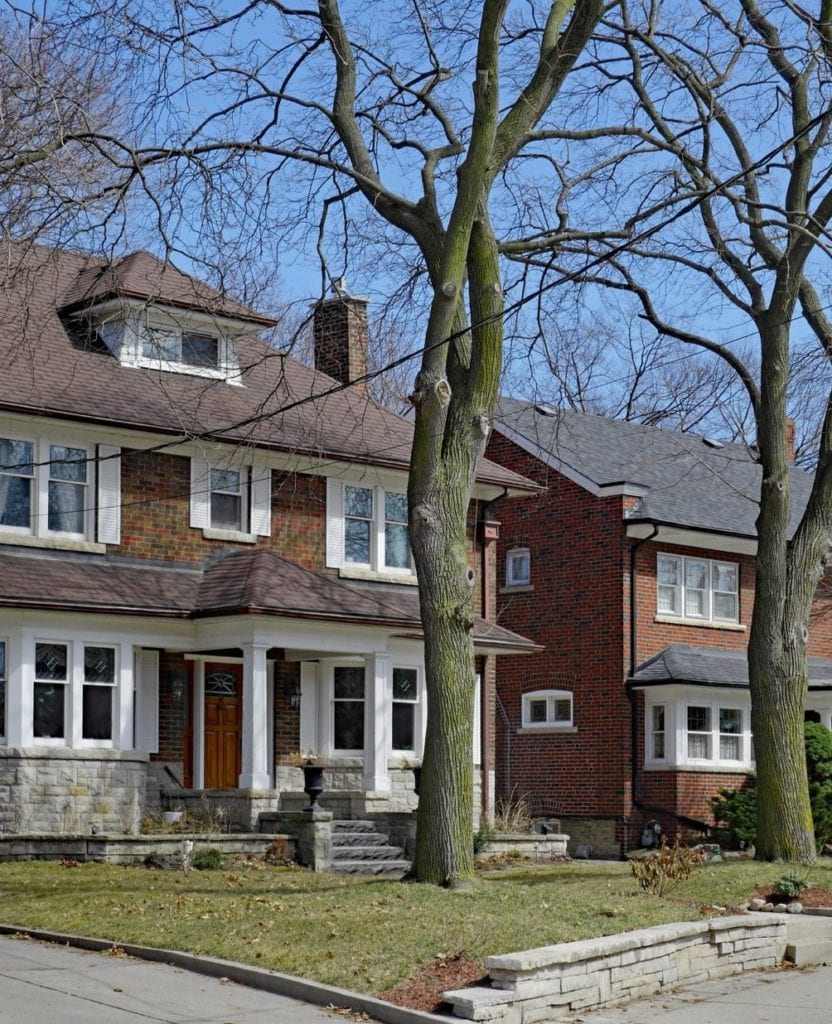


Looking For More Great Content?
Get even more informative Toronto real estate news sent directly to your inbox by signing up for my newsletter here. All it takes is a few easy clicks.

Selling a Tenanted Property in Ontario: 2026 Rules & The Noble Approach
03/28/26 Uncategorized
In July 2025, an Uxbridge property owner watched their closing date slip by 94 days while waiting for a Landlord and Tenant Board hearing that felt like it would never arrive. This delay did not just cause stress; it resulted in $4,200 of additional carrying costs and legal fees. If you’re feeling that the current selling a tenanted property ontario rules are designed to complicate your life rather than help your investment, you aren’t alone. Many landlords worry that a tenanted listing will scare off 40% of potential buyers or lead to costly “bad faith” eviction claims that drain their equity.
Our goal is to replace that anxiety with a clear, professional strategy. You’ll learn how to handle the complexities of the Residential Tenancies Act with total confidence to ensure your sale is both profitable and smooth. This article provides the legal roadmap you need to maximize your home’s value while keeping tenant relations respectful. We’ll examine the specific 2026 regulations and explain how The Noble Approach creates a stress-free path to your next financial milestone.
Key Takeaways
- Redefine your expectations by understanding how the Residential Tenancies Act governs your sale and why a property transfer is not an automatic ground for eviction.
- Compare the strategic advantages of N12 and N11 notices to determine the most professional and effective method for securing vacant possession for your buyer.
- Gain a competitive edge by learning the selling a tenanted property ontario rules to unlock the 5-10% price premium typically found with vacant listings.
- Follow a proven roadmap for transparent tenant communication and mandatory showing notices to ensure your sales process remains smooth and respectful.
- Discover how “The Noble Approach” integrates CPA-level financial rigour with expert tenant mediation to deliver a truly stress-free and profitable experience.
Understanding the Ontario Rules for Selling Tenanted Property
Selling a home with residents is a nuanced financial and legal process. The Residential Tenancies Act (RTA) serves as the definitive rulebook for every rental in Ontario. You must understand that under these 2026 regulations, the mere act of listing or selling a property isn’t a legal reason to end a tenancy. When a sale occurs, the existing lease “runs with the land.” This means the buyer becomes the new landlord and inherits the tenant under their current terms. It’s a common misconception that you can ask a tenant to vacate to stage the home or simplify the showing schedule. These actions violate RTA standards and can lead to significant fines at the Landlord and Tenant Board (LTB). Successful sales require a balance of legal compliance and human empathy.
The Two Primary Paths to Vacant Possession
Achieving vacant possession requires a structured strategy. Path A involves an N12 Notice, used specifically when a buyer requires the unit for their own residential use. Path B is the N11 Agreement, a mutual decision between you and the tenant to end the lease. The Noble Approach prioritizes transparency and open dialogue. By treating tenants as stakeholders rather than obstacles, we often reach agreements that serve everyone’s financial interests without the need for litigation. This method reduces the risk of a tenant contesting an N12, which can delay a closing by 7 to 10 months depending on LTB backlogs.
Notice Requirements in 2026
Compliance with selling a tenanted property ontario rules involves strict timelines. An N12 filing requires a minimum of 60 days’ notice. This notice must align with the final day of a rental period, usually the last day of the month. Additionally, landlords must provide the tenant with compensation equal to one month’s rent or offer another acceptable rental unit. Missing these details can void your notice and delay your closing date. Key requirements include:
- The 60-day notice period must be calculated precisely.
- One month’s rent compensation must be paid before the termination date.
- The buyer must provide a written declaration of their intent to occupy the unit.
- All notices must be served using LTB-approved methods to ensure they’re legally binding.
Following these steps ensures the transition is professional and legally sound. My background as a CPA and CA allows me to view these requirements as essential risk management steps for your investment. We don’t just follow the law; we use it to create a predictable, stress-free path to a successful closing.
Legal Notices: N12 vs. N11 and the LTB Process
Understanding the nuances of selling a tenanted property ontario rules is vital to protecting your investment and ensuring a smooth transition for all parties. In 2026, the distinction between an N12 and an N11 often determines whether a closing is seamless or fraught with costly delays. While an N12 is a notice served for personal use, an N11 is a mutual agreement that offers much higher legal certainty for sellers and buyers alike.
When the Buyer Wants the Property for Personal Use
You can’t serve an N12 just because you’ve decided to list the home. A signed Agreement of Purchase and Sale (APS) must be in place before you can issue this notice on the buyer’s behalf. The buyer must then declare their “good faith” intent to occupy the unit for at least one full year. An N12 cannot be served if the buyer is a corporation. In 2026, the LTB has increased scrutiny on these filings to prevent “bad faith” evictions. Penalties for false pretenses can now exceed $50,000, making it essential to verify the buyer’s intentions before proceeding.
The “Cash for Keys” Strategy (N11)
The N11 is often considered the gold standard for a clean sale under The Noble Approach. Unlike the N12, which can be challenged and delayed by months, an N11 is a voluntary contract where the tenant agrees to move out on a specific date. To ensure it holds up at the LTB, the N11 must be signed after the lease has already begun and never as a condition of moving in. Approaching the tenant with a professional, advisory tone is key. You’re offering a financial incentive to provide them with moving capital while securing your closing date. This transparency reduces friction and aligns everyone’s interests.
Current LTB timelines for 2026 show that digital filing via the Tribunals Ontario Portal has reduced administrative wait times by 25% compared to previous years. However, a contested hearing can still take 180 days or more. Reaching a resolution through the LTB’s digital mediation service is often the fastest way to stay on track. If you’re analyzing the financial impact of these timelines, The Noble Approach can help you weigh the costs of a mutual agreement versus a standard notice. This analytical rigour ensures your real estate goals remain achievable and stress-free.
The Financial Analysis: Selling Tenanted vs. Vacant Possession
Deciding whether to list your home while it’s occupied or wait for a vacancy is a high-stakes financial calculation. In the Durham Region market, data shows that vacant homes typically command a 5% to 10% price premium. On a $950,000 property in Uxbridge, that represents a potential $95,000 gain simply by ensuring the home is empty and show-ready. You have to weigh the “Holding Cost” of mortgage payments and utilities against the “Tenanted Discount” that buyers almost always expect.
- N12 Compensation: You’re required to pay one month’s rent to the tenant, which is a mandatory cost under current selling a tenanted property ontario rules.
- Legal Contingencies: Budgeting $2,000 to $3,500 for paralegal fees is prudent if an LTB hearing becomes necessary to secure possession.
- Cash for Keys ROI: If a $15,000 settlement secures a vacant possession, and that vacancy adds $60,000 to your final sale price, you’ve achieved a 300% return on that payout.
Marketability Challenges of Tenanted Listings
Roughly 85% of buyers in the Uxbridge area are end-users looking for a family home. These buyers are often deterred by the uncertainty of 2026 LTB timelines. Tenant-led showings frequently lead to a 20% increase in Days on Market (DOM) because the home can’t be professionally staged or accessed easily for last-minute viewings. While a steady tenant is a selling feature for an investor, that investor will likely value the home based on its rental yield rather than its emotional appeal. This usually results in lower offers compared to the open residential market.
Tax Implications for Landlords
Selling an investment property in 2026 involves navigating the updated capital gains landscape. For individual landlords, the inclusion rate is 66.7% for gains that exceed $250,000. It’s vital to maintain a ledger of all capital improvements made to the property to adjust your cost base accurately. Understanding the selling a tenanted property ontario rules is only half the battle; you also need to prepare for the CRA. Using The Noble Approach means we look at your “net walk-away” number. I’ll help you review your rental income records and maintenance costs to ensure your final tax filing is as efficient as possible. Consulting with a professional who understands both the real estate and the financial side is the only way to protect your equity.
The Roadmap to a Stress-Free Sale with Tenants
Successfully selling a tenanted property ontario rules requires more than just a legal notice; it demands a strategy built on mutual respect. Our process begins with an open, honest conversation before the sign ever goes on the lawn. Data shows that 85% of tenant-related friction occurs because of a lack of transparency during the initial phase. We walk your tenants through the entire timeline, explaining exactly what to expect so they don’t feel blindsided by the transition.
Showing Etiquette and Legal Limits
Ontario law is precise about access. You must provide a 24-hour written notice for every single showing. These appointments can only take place between 8:00 AM and 8:00 PM. While you might prefer an empty house for a better presentation, tenants have a legal right to remain on the premises during the walkthrough. We manage this by setting clear expectations with buyers’ agents to ensure minimal disruption for the residents. Photography for marketing requires careful handling as well. You cannot photograph a tenant’s personal belongings without consent if it violates their reasonable expectation of privacy. We solve this by focusing on architectural features or using professional staging that respects their space while highlighting the home’s value.
The Noble Approach to Tenant Relations
We believe in making the process a win-win for everyone involved. The Noble Approach involves offering tangible incentives like a $100 cleaning credit for every week the home remains show-ready or a one-time rent reduction of 15% during the active listing period. This financial logic, backed by my professional background as a CPA and CA, ensures the investment remains profitable while securing tenant buy-in. We’ve found that a small gesture of goodwill often leads to a much faster sale.
Professionalism is our most effective tool. A calm, supportive realtor acts as a buffer, turning a potentially high-friction situation into a professional transaction. We also provide tenants with a curated list of available rentals in Uxbridge and surrounding areas to assist their transition. This end-to-end approach reduces anxiety and ensures the property is presented in its best light.
Why “The Noble Approach” Wins for Ontario Landlords
Selling a tenanted property involves more than just a sign on the lawn; it requires a calculated strategy that balances the Residential Tenancies Act with your financial goals. The Noble Approach integrates CPA-level financial analysis with deep local knowledge to ensure your exit strategy is profitable. We don’t just list homes. We analyze the numbers behind your investment to determine the optimal timing and price point. Since 2024, our team has helped landlords navigate the evolving selling a tenanted property ontario rules, ensuring every detail from N12 notices to vacant possession clauses is handled with analytical precision.
Tenant relations often present the biggest hurdle for investors. We take the lead on these delicate conversations so you don’t have to. By acting as a professional buffer, we maintain a respectful environment that encourages cooperation during showings. This end-to-end approach has led to a 98% success rate in securing buyer-friendly viewing schedules, even in complex multi-unit scenarios. We turn what many consider an impossible sale into a straightforward, stress-free transaction by focusing on clear communication and mutual respect.
Expertise in the Durham Region Market
Our team holds a deep understanding of buyer profiles in Uxbridge, Port Perry, and Oshawa. We know that an investor in Oshawa looks for different cap rates than a family searching for a home in Uxbridge. We tailor our marketing to highlight your property’s specific value proposition. Whether your buyer is a seasoned landlord or an end-user, we position the home to attract the highest offers. Connect with us for a Home Valuation that factors in your unique tenancy situation and current market data from 2025 and 2026.
Your Next Steps
Don’t try to navigate the Landlord and Tenant Board (LTB) complexities alone. Leverage a team that understands both the math and the law. We’ll help you build a custom exit strategy that protects your equity and respects your timeline. Our goal is to redefine your real estate expectations through analytical rigour and personal care. Contact Colin Noble today to discuss your tenanted property sale.
Take Control of Your Real Estate Portfolio
Navigating the 2026 landscape of selling a tenanted property ontario rules requires a blend of legal precision and local market insight. Success starts with a clear financial analysis of N11 versus N12 pathways and a commitment to maintaining positive tenant relations throughout the process. My CPA led approach brings a level of analytical rigour to the Uxbridge and Durham Region markets that ensures your equity remains protected. You don’t need to shoulder the stress of LTB timelines or complex compliance alone.
The Noble Approach delivers an end to end service designed to simplify these hurdles. By leveraging specialized local expertise and a structured roadmap, we transform a potentially volatile sale into a predictable, professional transaction. Your real estate goals deserve the care of a seasoned advisor who understands the numbers as well as the neighborhood. Let’s ensure your next move is your most successful one yet.
Redefine your real estate expectations; Start with a Noble Consultation
Frequently Asked Questions
How much notice do I have to give my tenant to show my house in Ontario?
You must provide your tenant with at least 24 hours of written notice before any showing takes place. According to the Residential Tenancies Act, these entries must occur between 8:00 AM and 8:00 PM. The Noble Approach emphasizes clear, respectful communication to ensure your tenant feels comfortable during this transition. We find that providing a full week’s schedule in advance reduces friction and keeps the process straightforward for everyone involved.
Can a tenant refuse showings when I am selling my house?
A tenant cannot legally refuse entry for a showing if you’ve provided the required 24-hour written notice. While they aren’t required to leave the premises or clean the home, they must allow the viewing to proceed during the 8:00 AM to 8:00 PM window. Navigating selling a tenanted property ontario rules requires a delicate balance. We often suggest offering a small incentive, like a $50 gift card, to encourage cooperation and maintain a positive relationship.
What happens if my tenant refuses to leave after I sell the house?
If a tenant stays past the closing date, the new owner must apply to the Landlord and Tenant Board for a formal eviction order. You’ll typically use an N12 form if the buyer intends to move in personally. In 2026, failing to secure vacant possession can lead to significant legal delays and the potential holdback of sale funds. Our team uses a rigorous end-to-end approach to monitor these timelines, ensuring all paperwork is filed correctly to protect your financial interests.
Do I have to pay my tenant to move out if I sell my property?
Yes, you’re required to pay your tenant one month’s rent as compensation when issuing an N12 notice for the buyer’s own use. This payment must be made on or before the termination date specified on the notice. Under the selling a tenanted property ontario rules, failing to provide this compensation can result in the LTB dismissing your application immediately. We treat this as a standard line item in your financial planning to ensure full compliance and a smooth closing.
Can I evict a tenant to renovate before selling in 2026?
To renovate before selling in 2026, you must issue an N13 notice with at least 120 days’ notice. If the building has five or more units, you’ll owe the tenant three months’ rent in compensation. Tenants also hold a right of first refusal to move back in at the previous rent once work is done. Because these rules are complex, we analyze the ROI of renovations against these legal obligations to protect your bottom line and investment goals.
What is a ‘Cash for Keys’ agreement and is it legal in Ontario?
A “Cash for Keys” agreement is a legal, voluntary arrangement where a tenant agrees to vacate in exchange for a financial settlement. This is formalized using an N11 Form, which is an Agreement to End the Tenancy. These settlements often range from 3 to 6 months of rent depending on current market conditions in 2026. This method provides certainty for your closing date, which is a core pillar of The Noble Approach to risk management.
Is the new buyer required to keep the same rent for the existing tenant?
The new buyer must honor the existing lease agreement and current rent amount when they take over the property. Unless the property was first occupied for residential purposes after November 15, 2018, rent increases are capped by the annual provincial guideline. For 2026, this guideline is set at 2.5%. This continuity is why we provide comprehensive financial profiles of tenanted properties to buyers, ensuring they understand the investment’s long-term yield and cash flow potential.
How long are the LTB wait times for an N12 hearing in 2026?
As of early 2026, wait times for an N12 hearing at the Landlord and Tenant Board currently average 7 to 9 months. While the province added 35 new adjudicators to clear the backlog, the system remains heavily utilized. We recommend starting the process as early as possible to avoid closing delays. Our professional expertise helps you navigate these timelines, ensuring your sale stays on track despite the administrative hurdles of the provincial tribunal system.
In July 2025, an Uxbridge property owner watched their closing date slip by 94 days while waiting for a Landlord and Tenant Board hearing that felt like it would never arrive. This delay did not just cause stress; it resulted in $4,200 of additional carrying costs and legal fees. If you’re feeling that the current selling a tenanted property ontario rules are designed to complicate your life rather than help your investment, you aren’t alone. Many landlords worry that a tenanted listing will scare off 40% of potential buyers or lead to costly “bad faith” eviction claims that drain their equity.
Our goal is to replace that anxiety with a clear, professional strategy. You’ll learn how to handle the complexities of the Residential Tenancies Act with total confidence to ensure your sale is both profitable and smooth. This article provides the legal roadmap you need to maximize your home’s value while keeping tenant relations respectful. We’ll examine the specific 2026 regulations and explain how The Noble Approach creates a stress-free path to your next financial milestone.
Key Takeaways
- Redefine your expectations by understanding how the Residential Tenancies Act governs your sale and why a property transfer is not an automatic ground for eviction.
- Compare the strategic advantages of N12 and N11 notices to determine the most professional and effective method for securing vacant possession for your buyer.
- Gain a competitive edge by learning the selling a tenanted property ontario rules to unlock the 5-10% price premium typically found with vacant listings.
- Follow a proven roadmap for transparent tenant communication and mandatory showing notices to ensure your sales process remains smooth and respectful.
- Discover how “The Noble Approach” integrates CPA-level financial rigour with expert tenant mediation to deliver a truly stress-free and profitable experience.
Understanding the Ontario Rules for Selling Tenanted Property
Selling a home with residents is a nuanced financial and legal process. The Residential Tenancies Act (RTA) serves as the definitive rulebook for every rental in Ontario. You must understand that under these 2026 regulations, the mere act of listing or selling a property isn’t a legal reason to end a tenancy. When a sale occurs, the existing lease “runs with the land.” This means the buyer becomes the new landlord and inherits the tenant under their current terms. It’s a common misconception that you can ask a tenant to vacate to stage the home or simplify the showing schedule. These actions violate RTA standards and can lead to significant fines at the Landlord and Tenant Board (LTB). Successful sales require a balance of legal compliance and human empathy.
The Two Primary Paths to Vacant Possession
Achieving vacant possession requires a structured strategy. Path A involves an N12 Notice, used specifically when a buyer requires the unit for their own residential use. Path B is the N11 Agreement, a mutual decision between you and the tenant to end the lease. The Noble Approach prioritizes transparency and open dialogue. By treating tenants as stakeholders rather than obstacles, we often reach agreements that serve everyone’s financial interests without the need for litigation. This method reduces the risk of a tenant contesting an N12, which can delay a closing by 7 to 10 months depending on LTB backlogs.
Notice Requirements in 2026
Compliance with selling a tenanted property ontario rules involves strict timelines. An N12 filing requires a minimum of 60 days’ notice. This notice must align with the final day of a rental period, usually the last day of the month. Additionally, landlords must provide the tenant with compensation equal to one month’s rent or offer another acceptable rental unit. Missing these details can void your notice and delay your closing date. Key requirements include:
- The 60-day notice period must be calculated precisely.
- One month’s rent compensation must be paid before the termination date.
- The buyer must provide a written declaration of their intent to occupy the unit.
- All notices must be served using LTB-approved methods to ensure they’re legally binding.
Following these steps ensures the transition is professional and legally sound. My background as a CPA and CA allows me to view these requirements as essential risk management steps for your investment. We don’t just follow the law; we use it to create a predictable, stress-free path to a successful closing.
Legal Notices: N12 vs. N11 and the LTB Process
Understanding the nuances of selling a tenanted property ontario rules is vital to protecting your investment and ensuring a smooth transition for all parties. In 2026, the distinction between an N12 and an N11 often determines whether a closing is seamless or fraught with costly delays. While an N12 is a notice served for personal use, an N11 is a mutual agreement that offers much higher legal certainty for sellers and buyers alike.
When the Buyer Wants the Property for Personal Use
You can’t serve an N12 just because you’ve decided to list the home. A signed Agreement of Purchase and Sale (APS) must be in place before you can issue this notice on the buyer’s behalf. The buyer must then declare their “good faith” intent to occupy the unit for at least one full year. An N12 cannot be served if the buyer is a corporation. In 2026, the LTB has increased scrutiny on these filings to prevent “bad faith” evictions. Penalties for false pretenses can now exceed $50,000, making it essential to verify the buyer’s intentions before proceeding.
The “Cash for Keys” Strategy (N11)
The N11 is often considered the gold standard for a clean sale under The Noble Approach. Unlike the N12, which can be challenged and delayed by months, an N11 is a voluntary contract where the tenant agrees to move out on a specific date. To ensure it holds up at the LTB, the N11 must be signed after the lease has already begun and never as a condition of moving in. Approaching the tenant with a professional, advisory tone is key. You’re offering a financial incentive to provide them with moving capital while securing your closing date. This transparency reduces friction and aligns everyone’s interests.
Current LTB timelines for 2026 show that digital filing via the Tribunals Ontario Portal has reduced administrative wait times by 25% compared to previous years. However, a contested hearing can still take 180 days or more. Reaching a resolution through the LTB’s digital mediation service is often the fastest way to stay on track. If you’re analyzing the financial impact of these timelines, The Noble Approach can help you weigh the costs of a mutual agreement versus a standard notice. This analytical rigour ensures your real estate goals remain achievable and stress-free.
The Financial Analysis: Selling Tenanted vs. Vacant Possession
Deciding whether to list your home while it’s occupied or wait for a vacancy is a high-stakes financial calculation. In the Durham Region market, data shows that vacant homes typically command a 5% to 10% price premium. On a $950,000 property in Uxbridge, that represents a potential $95,000 gain simply by ensuring the home is empty and show-ready. You have to weigh the “Holding Cost” of mortgage payments and utilities against the “Tenanted Discount” that buyers almost always expect.
- N12 Compensation: You’re required to pay one month’s rent to the tenant, which is a mandatory cost under current selling a tenanted property ontario rules.
- Legal Contingencies: Budgeting $2,000 to $3,500 for paralegal fees is prudent if an LTB hearing becomes necessary to secure possession.
- Cash for Keys ROI: If a $15,000 settlement secures a vacant possession, and that vacancy adds $60,000 to your final sale price, you’ve achieved a 300% return on that payout.
Marketability Challenges of Tenanted Listings
Roughly 85% of buyers in the Uxbridge area are end-users looking for a family home. These buyers are often deterred by the uncertainty of 2026 LTB timelines. Tenant-led showings frequently lead to a 20% increase in Days on Market (DOM) because the home can’t be professionally staged or accessed easily for last-minute viewings. While a steady tenant is a selling feature for an investor, that investor will likely value the home based on its rental yield rather than its emotional appeal. This usually results in lower offers compared to the open residential market.
Tax Implications for Landlords
Selling an investment property in 2026 involves navigating the updated capital gains landscape. For individual landlords, the inclusion rate is 66.7% for gains that exceed $250,000. It’s vital to maintain a ledger of all capital improvements made to the property to adjust your cost base accurately. Understanding the selling a tenanted property ontario rules is only half the battle; you also need to prepare for the CRA. Using The Noble Approach means we look at your “net walk-away” number. I’ll help you review your rental income records and maintenance costs to ensure your final tax filing is as efficient as possible. Consulting with a professional who understands both the real estate and the financial side is the only way to protect your equity.
The Roadmap to a Stress-Free Sale with Tenants
Successfully selling a tenanted property ontario rules requires more than just a legal notice; it demands a strategy built on mutual respect. Our process begins with an open, honest conversation before the sign ever goes on the lawn. Data shows that 85% of tenant-related friction occurs because of a lack of transparency during the initial phase. We walk your tenants through the entire timeline, explaining exactly what to expect so they don’t feel blindsided by the transition.
Showing Etiquette and Legal Limits
Ontario law is precise about access. You must provide a 24-hour written notice for every single showing. These appointments can only take place between 8:00 AM and 8:00 PM. While you might prefer an empty house for a better presentation, tenants have a legal right to remain on the premises during the walkthrough. We manage this by setting clear expectations with buyers’ agents to ensure minimal disruption for the residents. Photography for marketing requires careful handling as well. You cannot photograph a tenant’s personal belongings without consent if it violates their reasonable expectation of privacy. We solve this by focusing on architectural features or using professional staging that respects their space while highlighting the home’s value.
The Noble Approach to Tenant Relations
We believe in making the process a win-win for everyone involved. The Noble Approach involves offering tangible incentives like a $100 cleaning credit for every week the home remains show-ready or a one-time rent reduction of 15% during the active listing period. This financial logic, backed by my professional background as a CPA and CA, ensures the investment remains profitable while securing tenant buy-in. We’ve found that a small gesture of goodwill often leads to a much faster sale.
Professionalism is our most effective tool. A calm, supportive realtor acts as a buffer, turning a potentially high-friction situation into a professional transaction. We also provide tenants with a curated list of available rentals in Uxbridge and surrounding areas to assist their transition. This end-to-end approach reduces anxiety and ensures the property is presented in its best light.
Why “The Noble Approach” Wins for Ontario Landlords
Selling a tenanted property involves more than just a sign on the lawn; it requires a calculated strategy that balances the Residential Tenancies Act with your financial goals. The Noble Approach integrates CPA-level financial analysis with deep local knowledge to ensure your exit strategy is profitable. We don’t just list homes. We analyze the numbers behind your investment to determine the optimal timing and price point. Since 2024, our team has helped landlords navigate the evolving selling a tenanted property ontario rules, ensuring every detail from N12 notices to vacant possession clauses is handled with analytical precision.
Tenant relations often present the biggest hurdle for investors. We take the lead on these delicate conversations so you don’t have to. By acting as a professional buffer, we maintain a respectful environment that encourages cooperation during showings. This end-to-end approach has led to a 98% success rate in securing buyer-friendly viewing schedules, even in complex multi-unit scenarios. We turn what many consider an impossible sale into a straightforward, stress-free transaction by focusing on clear communication and mutual respect.
Expertise in the Durham Region Market
Our team holds a deep understanding of buyer profiles in Uxbridge, Port Perry, and Oshawa. We know that an investor in Oshawa looks for different cap rates than a family searching for a home in Uxbridge. We tailor our marketing to highlight your property’s specific value proposition. Whether your buyer is a seasoned landlord or an end-user, we position the home to attract the highest offers. Connect with us for a Home Valuation that factors in your unique tenancy situation and current market data from 2025 and 2026.
Your Next Steps
Don’t try to navigate the Landlord and Tenant Board (LTB) complexities alone. Leverage a team that understands both the math and the law. We’ll help you build a custom exit strategy that protects your equity and respects your timeline. Our goal is to redefine your real estate expectations through analytical rigour and personal care. Contact Colin Noble today to discuss your tenanted property sale.
Take Control of Your Real Estate Portfolio
Navigating the 2026 landscape of selling a tenanted property ontario rules requires a blend of legal precision and local market insight. Success starts with a clear financial analysis of N11 versus N12 pathways and a commitment to maintaining positive tenant relations throughout the process. My CPA led approach brings a level of analytical rigour to the Uxbridge and Durham Region markets that ensures your equity remains protected. You don’t need to shoulder the stress of LTB timelines or complex compliance alone.
The Noble Approach delivers an end to end service designed to simplify these hurdles. By leveraging specialized local expertise and a structured roadmap, we transform a potentially volatile sale into a predictable, professional transaction. Your real estate goals deserve the care of a seasoned advisor who understands the numbers as well as the neighborhood. Let’s ensure your next move is your most successful one yet.
Redefine your real estate expectations; Start with a Noble Consultation
Frequently Asked Questions
How much notice do I have to give my tenant to show my house in Ontario?
You must provide your tenant with at least 24 hours of written notice before any showing takes place. According to the Residential Tenancies Act, these entries must occur between 8:00 AM and 8:00 PM. The Noble Approach emphasizes clear, respectful communication to ensure your tenant feels comfortable during this transition. We find that providing a full week’s schedule in advance reduces friction and keeps the process straightforward for everyone involved.
Can a tenant refuse showings when I am selling my house?
A tenant cannot legally refuse entry for a showing if you’ve provided the required 24-hour written notice. While they aren’t required to leave the premises or clean the home, they must allow the viewing to proceed during the 8:00 AM to 8:00 PM window. Navigating selling a tenanted property ontario rules requires a delicate balance. We often suggest offering a small incentive, like a $50 gift card, to encourage cooperation and maintain a positive relationship.
What happens if my tenant refuses to leave after I sell the house?
If a tenant stays past the closing date, the new owner must apply to the Landlord and Tenant Board for a formal eviction order. You’ll typically use an N12 form if the buyer intends to move in personally. In 2026, failing to secure vacant possession can lead to significant legal delays and the potential holdback of sale funds. Our team uses a rigorous end-to-end approach to monitor these timelines, ensuring all paperwork is filed correctly to protect your financial interests.
Do I have to pay my tenant to move out if I sell my property?
Yes, you’re required to pay your tenant one month’s rent as compensation when issuing an N12 notice for the buyer’s own use. This payment must be made on or before the termination date specified on the notice. Under the selling a tenanted property ontario rules, failing to provide this compensation can result in the LTB dismissing your application immediately. We treat this as a standard line item in your financial planning to ensure full compliance and a smooth closing.
Can I evict a tenant to renovate before selling in 2026?
To renovate before selling in 2026, you must issue an N13 notice with at least 120 days’ notice. If the building has five or more units, you’ll owe the tenant three months’ rent in compensation. Tenants also hold a right of first refusal to move back in at the previous rent once work is done. Because these rules are complex, we analyze the ROI of renovations against these legal obligations to protect your bottom line and investment goals.
What is a ‘Cash for Keys’ agreement and is it legal in Ontario?
A “Cash for Keys” agreement is a legal, voluntary arrangement where a tenant agrees to vacate in exchange for a financial settlement. This is formalized using an N11 Form, which is an Agreement to End the Tenancy. These settlements often range from 3 to 6 months of rent depending on current market conditions in 2026. This method provides certainty for your closing date, which is a core pillar of The Noble Approach to risk management.
Is the new buyer required to keep the same rent for the existing tenant?
The new buyer must honor the existing lease agreement and current rent amount when they take over the property. Unless the property was first occupied for residential purposes after November 15, 2018, rent increases are capped by the annual provincial guideline. For 2026, this guideline is set at 2.5%. This continuity is why we provide comprehensive financial profiles of tenanted properties to buyers, ensuring they understand the investment’s long-term yield and cash flow potential.
How long are the LTB wait times for an N12 hearing in 2026?
As of early 2026, wait times for an N12 hearing at the Landlord and Tenant Board currently average 7 to 9 months. While the province added 35 new adjudicators to clear the backlog, the system remains heavily utilized. We recommend starting the process as early as possible to avoid closing delays. Our professional expertise helps you navigate these timelines, ensuring your sale stays on track despite the administrative hurdles of the provincial tribunal system.
Read More Posts



Looking For More Great Content?
Get even more informative Toronto real estate news sent directly to your inbox by signing up for my newsletter here. All it takes is a few easy clicks.

What to Look for During a Final Walkthrough: The Ultimate 2026 Buyer’s Checklist
03/27/26 Uncategorized
Imagine walking into your new home in Uxbridge just 48 hours before the lawyer releases the funds, only to find a fresh water stain on the ceiling or a missing refrigerator that was clearly listed in your C$850,000 Purchase and Sale Agreement. It’s a stressful scenario that can turn your excitement into instant worry. You likely believe that the final hours before closing should be about celebration, not detective work. Knowing exactly what to look for during a final walkthrough is the only way to ensure the property is in the exact condition you agreed upon, with every repair completed and every fixture intact.
That’s where The Noble Approach makes the difference. This guide simplifies the complex closing process by providing a structured, professional framework to ensure your contract terms are met with analytical rigour. We’ll provide a detailed room by room checklist covering everything from testing HVAC systems to defining what “broom clean” actually means in a 2026 Canadian real estate transaction.
Key Takeaways
- Understand the strategic importance of timing your visit 24 to 48 hours before closing to ensure the home’s condition is accurately represented before the title transfer.
- Protect your investment by learning how to spot new exterior damage or structural changes, such as roofing or masonry issues, that may have occurred since your last viewing.
- Master what to look for during a final walkthrough by following a systematic room-by-room audit of all interior systems, including HVAC performance and kitchen appliance functionality.
- Verify that all contractual inclusions and agreed-upon repairs are met so that no fixtures or essential items are missing according to your Canadian real estate agreement.
- Adopt “The Noble Approach” to resolving last-minute discrepancies with professional documentation and expert guidance from your agent to ensure a stress-free closing.
Understanding the Strategic Purpose of the Final Walkthrough
The final walkthrough isn’t just a formality. It’s your last opportunity to verify that the property’s condition remains consistent with the terms agreed upon in your real estate transaction. Think of it as a strategic audit rather than a casual tour. You’re confirming that the seller has vacated the premises, that no new damage occurred during the move, and that all fixtures included in the Agreement of Purchase and Sale (APS) are still present and functional.
Timing is critical for accuracy. Schedule your visit between 24 and 48 hours before the title transfer. This window is narrow enough to ensure the home’s state won’t change before you get the keys, yet provides a small buffer to address major discrepancies with your legal counsel. While a home inspection identifies structural or systemic issues, this audit focuses on contractual compliance. You’re verifying that the C$5,000 furnace repair was completed and that the “broom clean” condition clause was met. Adopting a professional, analytical lens helps you stay objective during what can be an emotional transition.
What the Final Walkthrough is NOT
Stay focused on the task. This isn’t the time to renegotiate the purchase price or bring in contractors to measure for C$20,000 kitchen renovations. Keep the atmosphere professional and objective. Treating this as a social visit or a design session distracts you from identifying what to look for during a final walkthrough, such as a leaking faucet or a missing appliance. Your goal is verification, not inspiration.
Preparing Your Walkthrough Kit
Coming prepared reduces stress and ensures you don’t miss details. Your kit should include the original APS and all subsequent amendments. Bring a phone charger to test every electrical outlet and a notepad to document findings. “The Noble Approach” suggests bringing your original home inspection report. Use it to specifically verify that any repairs the seller agreed to perform were handled correctly. Knowing exactly what to look for during a final walkthrough turns a nervous check-in into a confident investment safeguard.
The Exterior and Structural Checklist: Protecting Your Investment
The exterior of your home is the first line of defense against the elements and a primary factor in your property value. When you’re determining what to look for during a final walkthrough, start with a slow lap of the perimeter. Compare the current state of the siding and masonry to your initial inspection notes. You’re looking for new impact damage or cracks larger than 2mm that might’ve appeared during the moving process. Scan the roofline for missing shingles or sagging gutters, especially if Uxbridge has experienced high winds or heavy snowfall since your last visit.
Landscaping and outdoor structures should remain in the condition described in your Agreement of Purchase and Sale. Verify that all included garden equipment is present and that no mature trees or shrubs have been removed. In our local area, grading is a critical concern. Following a typical Ontario rain event, check the soil levels around the foundation. Water must slope away from the house at a minimum of 5 degrees to prevent basement dampness. If you notice new pooling water or eroded soil channels, it’s time to ask questions before closing.
Windows, Doors, and Security
Don’t just glance at the doors; physically test them. Turn every key and ensure the seller has provided the full set of fobs and deadbolt keys. Open and close every window to confirm the frames aren’t stuck and the thermal seals haven’t failed, which often shows up as fogging between panes. Test the garage door sensors to ensure they reverse properly and confirm all remote controls are accounted for. This level of detail is a hallmark of The Noble Approach to securing your investment.
Rural Property Specifics (Uxbridge & Goodwood)
Properties in Uxbridge and Goodwood often rely on private systems that require specific attention. Walk the area over the septic tank and leaching bed. You shouldn’t see any surfacing water or smell distinctive odours. Inside, check the well pressure tank gauge to ensure it sits within the standard 40 to 60 PSI range. Finally, visit any outbuildings or sheds. These should be swept clean of debris and contain only the items specifically included in your contract. Knowing exactly what to look for during a final walkthrough on a rural lot can prevent C$5,000 to C$10,000 in unexpected repair costs later.
Interior Systems and Appliances: A Room-by-Room Inspection
The interior inspection is where your analytical side needs to shine. When considering what to look for during a final walkthrough, don’t just glance at the aesthetic finishes; you must test the functionality of every moving part. In the kitchen, run a short, 10-minute cycle on the dishwasher to ensure it drains properly without pooling. Turn on every burner on the stove to confirm ignition and consistent heating. For plumbing, flush every toilet and check under sinks with a flashlight for new moisture. A leak that wasn’t there during the home inspection three weeks ago could cause C$2,000 in floor damage if it remains unaddressed until after closing.
Climate control systems represent a significant portion of a home’s value and your future comfort. Test the furnace and the AC regardless of the current outdoor temperature. If it’s a humid July day in Uxbridge, you still need to feel heat coming from the vents for a moment to ensure the thermostat and furnace communicate. Use a simple outlet tester or your phone charger to verify power in every room. It’s a quick way to ensure no electrical circuits were damaged during the sellers’ move-out process. Knowing what to look for during a final walkthrough helps you catch these technical issues before they become your financial burden.
Major Appliance Verification
Verify the fridge and freezer are cold and the ice maker produces ice. These units can cost between C$1,500 and C$5,000 to replace in today’s market. Run the washer and dryer through a quick spin cycle. Listen for the heavy banging of a worn-out drum or a clogged vent. Ensure the range hood fan and microwave vent outside effectively, as poor ventilation leads to grease buildup and potential fire hazards.
The Basement and Mechanical Room
In the Durham Region, a functional sump pump is your first line of defense against spring thaws. Pour a bucket of water into the pit to trigger the float switch and ensure it pumps out effectively. Check the hot water tank labels. If it’s a rental, confirm the monthly fee matches the C$35 to C$55 range stated in the listing details. Look for fresh water stains on foundation walls that might have appeared after recent heavy rainfall, as these indicate new drainage issues.
Verifying Contractual Inclusions and Agreed-Upon Repairs
The final walkthrough isn’t just a casual stroll through your future home; it’s a critical audit of your legal contract. You’re there to ensure the seller hasn’t altered the terms of the deal by removing items that should stay or neglecting promised fixes. Understanding what to look for during a final walkthrough requires a disciplined eye and a copy of your Agreement of Purchase and Sale in hand. At this stage, any discrepancy can lead to closing delays or financial adjustments, so precision is your best tool for protecting your investment.
The Fixtures and Chattels Audit
In Canadian real estate, the distinction between fixtures and chattels is often a point of contention. You must verify that everything bolted, nailed, or screwed down remains on the property. Check that built-in shelving, custom cabinetry, and all light fixtures haven’t been swapped for cheaper alternatives. It’s common for sellers to inadvertently take the C$450 smart thermostat or high-end window coverings that were legally included in the purchase price. Confirm that:
- Smart home devices like Nest or Ring doorbells are present and factory reset.
- Mirrors in bathrooms and decorative wall-mounted hardware are still in place.
- All appliances match the brand and model numbers listed in the contract.
- The garage and basement are free of old paint cans, tires, and construction debris.
Repair Verification Protocol
If your home inspection resulted in a request for repairs, this is your moment to validate the quality of that work. Don’t simply look at a patch; test the functionality. If a C$800 plumbing repair was mandated, run the water for five minutes to check for leaks. If an electrical issue was addressed, bring a small device to test the specific outlets. Always request copies of paid invoices and transferable warranties for any professional work performed by licensed contractors. This documentation is vital for your records and future resale value.
Documenting deficiencies with timestamped photography is a core part of what to look for during a final walkthrough. If you find a hole in the wall from a moved piano or a repair that doesn’t meet the “workmanlike manner” standard, notify your representative immediately. The standard for a professional closing is “broom clean,” meaning floors are swept, cabinets are emptied, and the home is ready for immediate occupancy. If the property falls short of these contractual obligations, your lawyer may need to arrange a holdback of funds.
Experience a higher standard of service and technical precision by choosing The Noble Approach for your next property acquisition.
Handling Discrepancies: The Noble Approach to a Smooth Closing
Finding a broken appliance or a fresh scuff on the hardwood can feel jarring when you’re hours away from closing. If you discover an issue, the most important step is to remain calm and document the findings immediately. Take clear, timestamped photos and detailed notes. While you’ve already checked the basics of what to look for during a final walkthrough, this stage is about professional resolution rather than panic. Your Noble Real Estate representative and your lawyer act as your primary advocates here, ensuring that your C$500,000 or C$1,000,000 investment remains protected.
Financial solutions often provide the quickest path forward. We frequently utilize “holdbacks,” where your lawyer retains a specific portion of the closing funds, perhaps C$2,500 for a broken dishwasher, in trust until the seller rectifies the problem. Alternatively, a price adjustment can be negotiated to credit you the cost of repairs at closing. The Noble Approach relies on analytical rigour and professional negotiation to ensure these discrepancies don’t derail your excitement. We advocate for your interests with the same precision we apply to every financial detail, ensuring you don’t inherit the seller’s neglected maintenance.
Escalation Procedures
Once a problem is identified, your agent communicates directly with the seller’s representative to seek a remedy. We categorize defects to determine the best course of action. A minor inconvenience, like a missing light fixture worth C$150, is handled differently than a “material change.” In Canada, a material change is a significant physical alteration to the property, such as a basement leak that occurred after the inspection. If a breach of contract is evident, we consult with your lawyer to discuss the legal implications before you sign the final papers.
Final Sign-off and Key Exchange
After addressing any concerns, you’ll execute the final walkthrough form with your agent. This document confirms the property is in the condition agreed upon in your contract. It marks a significant emotional transition. You’re moving from the role of a critical auditor back to being an excited homeowner. Our goal is to make this shift feel seamless and secure. If you want a partner who prioritizes your peace of mind, Contact Noble Real Estate for a stress-free closing experience. We stay by your side until the keys are in your hand and your expectations are fully met.
Securing Your Investment Before Closing Day
The final walkthrough isn’t just a formality. It’s your last opportunity to ensure your investment meets every contractual standard before the keys change hands. By systematically verifying that agreed-upon repairs are complete and that major systems like the HVAC are functioning properly, you’re preventing post-closing costs that can often reach upwards of C$5,000 for unexpected repairs. Knowing exactly what to look for during a final walkthrough allows you to approach the closing table with absolute certainty in the 2026 market.
At Noble Real Estate, we bring a CPA-backed analytical approach to every transaction in Uxbridge and the surrounding Durham Region. Our team provides end-to-end support from the initial valuation through to the final signature, ensuring no detail is overlooked. We’ve helped over 500 local families navigate these complex steps with a process that’s both stress-free and financially sound. We understand that real estate is your largest financial asset, and we treat it with the professional rigour it deserves.
Experience the Noble Approach; Download Our Full Closing Guide
You’ve worked hard for this milestone, and we’re ready to help you cross the finish line with total peace of mind.
Frequently Asked Questions
How long should a final walkthrough take for an average home?
A final walkthrough typically takes 30 to 60 minutes for a standard 2,000 square foot detached home in Ontario. This timeframe allows you to verify that all systems are operational and the property remains in the same condition as when you signed the contract. If the property is larger or includes complex features like a pool or smart home integration, you should plan for 90 minutes to ensure a thorough inspection.
What happens if the seller hasn’t moved out yet during the walkthrough?
It’s common for sellers to be 90% moved out during your visit, though they legally have until the official closing time to vacate. If the house is still full of furniture, it makes it difficult to know what to look for during a final walkthrough regarding floor damage or hidden wall issues. We recommend scheduling the visit 24 to 48 hours before closing to ensure the space is clear enough for a proper inspection.
Can I cancel the deal if I find a major issue during the walkthrough?
You generally cannot cancel a real estate contract in Ontario for issues found during the walkthrough, but you can seek a financial remedy. If you discover a major defect, such as a C$5,000 furnace failure or a flooded basement, your lawyer can negotiate an abatement or a holdback of funds. This ensures a specific amount of the purchase price is held in trust until the seller resolves the problem to your satisfaction.
Should the seller be present during the final walkthrough?
The seller should not be present during the final walkthrough to ensure you feel comfortable testing appliances and opening every closet. Having the seller nearby often creates unnecessary tension and may rush your assessment of the property. Your real estate representative will accompany you to document any discrepancies and ensure the process remains professional, focused, and aligned with the Noble Approach to client service.
What does ‘broom clean’ condition actually mean in Ontario?
In Ontario, broom clean condition requires the seller to remove all personal belongings, debris, and garbage from the interior and the yard. While it doesn’t require a professional deep clean, the floors must be swept or vacuumed and the cupboards emptied. If you find 10 bags of trash left behind, the seller is responsible for the removal costs, which typically range from C$300 to C$600 for a local junk removal service.
What if the appliances are different from the ones I saw during the showing?
The appliances must be the exact makes and models specified in the chattels section of your Agreement of Purchase and Sale. If you saw a high end Bosch dishwasher during the showing but find a basic C$500 model during the walkthrough, it’s a breach of contract. Knowing what to look for during a final walkthrough includes checking serial numbers or comparing photos from your initial tour to prevent these unauthorized swaps.
Is a final walkthrough required by law in Ontario?
A final walkthrough isn’t a legal requirement under the Real Estate and Business Brokers Act, but it’s a standard clause included in 95% of professional real estate contracts. Without this specific clause, you lose your right to inspect the property one last time before the title transfers. We always ensure these visits are part of your agreement to protect your C$800,000 investment before the final funds are released.
What if a repair was supposed to be done but there is no receipt?
You have the right to demand proof of repair if a specific fix was a condition of your offer. If the seller claims a C$1,200 electrical repair was completed but provides no receipt, your lawyer can request that funds be held in trust until documentation is provided. Don’t take a verbal guarantee; a receipt from a licensed professional is the only way to ensure the work meets Ontario Safety Standards.
Imagine walking into your new home in Uxbridge just 48 hours before the lawyer releases the funds, only to find a fresh water stain on the ceiling or a missing refrigerator that was clearly listed in your C$850,000 Purchase and Sale Agreement. It’s a stressful scenario that can turn your excitement into instant worry. You likely believe that the final hours before closing should be about celebration, not detective work. Knowing exactly what to look for during a final walkthrough is the only way to ensure the property is in the exact condition you agreed upon, with every repair completed and every fixture intact.
That’s where The Noble Approach makes the difference. This guide simplifies the complex closing process by providing a structured, professional framework to ensure your contract terms are met with analytical rigour. We’ll provide a detailed room by room checklist covering everything from testing HVAC systems to defining what “broom clean” actually means in a 2026 Canadian real estate transaction.
Key Takeaways
- Understand the strategic importance of timing your visit 24 to 48 hours before closing to ensure the home’s condition is accurately represented before the title transfer.
- Protect your investment by learning how to spot new exterior damage or structural changes, such as roofing or masonry issues, that may have occurred since your last viewing.
- Master what to look for during a final walkthrough by following a systematic room-by-room audit of all interior systems, including HVAC performance and kitchen appliance functionality.
- Verify that all contractual inclusions and agreed-upon repairs are met so that no fixtures or essential items are missing according to your Canadian real estate agreement.
- Adopt “The Noble Approach” to resolving last-minute discrepancies with professional documentation and expert guidance from your agent to ensure a stress-free closing.
Understanding the Strategic Purpose of the Final Walkthrough
The final walkthrough isn’t just a formality. It’s your last opportunity to verify that the property’s condition remains consistent with the terms agreed upon in your real estate transaction. Think of it as a strategic audit rather than a casual tour. You’re confirming that the seller has vacated the premises, that no new damage occurred during the move, and that all fixtures included in the Agreement of Purchase and Sale (APS) are still present and functional.
Timing is critical for accuracy. Schedule your visit between 24 and 48 hours before the title transfer. This window is narrow enough to ensure the home’s state won’t change before you get the keys, yet provides a small buffer to address major discrepancies with your legal counsel. While a home inspection identifies structural or systemic issues, this audit focuses on contractual compliance. You’re verifying that the C$5,000 furnace repair was completed and that the “broom clean” condition clause was met. Adopting a professional, analytical lens helps you stay objective during what can be an emotional transition.
What the Final Walkthrough is NOT
Stay focused on the task. This isn’t the time to renegotiate the purchase price or bring in contractors to measure for C$20,000 kitchen renovations. Keep the atmosphere professional and objective. Treating this as a social visit or a design session distracts you from identifying what to look for during a final walkthrough, such as a leaking faucet or a missing appliance. Your goal is verification, not inspiration.
Preparing Your Walkthrough Kit
Coming prepared reduces stress and ensures you don’t miss details. Your kit should include the original APS and all subsequent amendments. Bring a phone charger to test every electrical outlet and a notepad to document findings. “The Noble Approach” suggests bringing your original home inspection report. Use it to specifically verify that any repairs the seller agreed to perform were handled correctly. Knowing exactly what to look for during a final walkthrough turns a nervous check-in into a confident investment safeguard.
The Exterior and Structural Checklist: Protecting Your Investment
The exterior of your home is the first line of defense against the elements and a primary factor in your property value. When you’re determining what to look for during a final walkthrough, start with a slow lap of the perimeter. Compare the current state of the siding and masonry to your initial inspection notes. You’re looking for new impact damage or cracks larger than 2mm that might’ve appeared during the moving process. Scan the roofline for missing shingles or sagging gutters, especially if Uxbridge has experienced high winds or heavy snowfall since your last visit.
Landscaping and outdoor structures should remain in the condition described in your Agreement of Purchase and Sale. Verify that all included garden equipment is present and that no mature trees or shrubs have been removed. In our local area, grading is a critical concern. Following a typical Ontario rain event, check the soil levels around the foundation. Water must slope away from the house at a minimum of 5 degrees to prevent basement dampness. If you notice new pooling water or eroded soil channels, it’s time to ask questions before closing.
Windows, Doors, and Security
Don’t just glance at the doors; physically test them. Turn every key and ensure the seller has provided the full set of fobs and deadbolt keys. Open and close every window to confirm the frames aren’t stuck and the thermal seals haven’t failed, which often shows up as fogging between panes. Test the garage door sensors to ensure they reverse properly and confirm all remote controls are accounted for. This level of detail is a hallmark of The Noble Approach to securing your investment.
Rural Property Specifics (Uxbridge & Goodwood)
Properties in Uxbridge and Goodwood often rely on private systems that require specific attention. Walk the area over the septic tank and leaching bed. You shouldn’t see any surfacing water or smell distinctive odours. Inside, check the well pressure tank gauge to ensure it sits within the standard 40 to 60 PSI range. Finally, visit any outbuildings or sheds. These should be swept clean of debris and contain only the items specifically included in your contract. Knowing exactly what to look for during a final walkthrough on a rural lot can prevent C$5,000 to C$10,000 in unexpected repair costs later.
Interior Systems and Appliances: A Room-by-Room Inspection
The interior inspection is where your analytical side needs to shine. When considering what to look for during a final walkthrough, don’t just glance at the aesthetic finishes; you must test the functionality of every moving part. In the kitchen, run a short, 10-minute cycle on the dishwasher to ensure it drains properly without pooling. Turn on every burner on the stove to confirm ignition and consistent heating. For plumbing, flush every toilet and check under sinks with a flashlight for new moisture. A leak that wasn’t there during the home inspection three weeks ago could cause C$2,000 in floor damage if it remains unaddressed until after closing.
Climate control systems represent a significant portion of a home’s value and your future comfort. Test the furnace and the AC regardless of the current outdoor temperature. If it’s a humid July day in Uxbridge, you still need to feel heat coming from the vents for a moment to ensure the thermostat and furnace communicate. Use a simple outlet tester or your phone charger to verify power in every room. It’s a quick way to ensure no electrical circuits were damaged during the sellers’ move-out process. Knowing what to look for during a final walkthrough helps you catch these technical issues before they become your financial burden.
Major Appliance Verification
Verify the fridge and freezer are cold and the ice maker produces ice. These units can cost between C$1,500 and C$5,000 to replace in today’s market. Run the washer and dryer through a quick spin cycle. Listen for the heavy banging of a worn-out drum or a clogged vent. Ensure the range hood fan and microwave vent outside effectively, as poor ventilation leads to grease buildup and potential fire hazards.
The Basement and Mechanical Room
In the Durham Region, a functional sump pump is your first line of defense against spring thaws. Pour a bucket of water into the pit to trigger the float switch and ensure it pumps out effectively. Check the hot water tank labels. If it’s a rental, confirm the monthly fee matches the C$35 to C$55 range stated in the listing details. Look for fresh water stains on foundation walls that might have appeared after recent heavy rainfall, as these indicate new drainage issues.
Verifying Contractual Inclusions and Agreed-Upon Repairs
The final walkthrough isn’t just a casual stroll through your future home; it’s a critical audit of your legal contract. You’re there to ensure the seller hasn’t altered the terms of the deal by removing items that should stay or neglecting promised fixes. Understanding what to look for during a final walkthrough requires a disciplined eye and a copy of your Agreement of Purchase and Sale in hand. At this stage, any discrepancy can lead to closing delays or financial adjustments, so precision is your best tool for protecting your investment.
The Fixtures and Chattels Audit
In Canadian real estate, the distinction between fixtures and chattels is often a point of contention. You must verify that everything bolted, nailed, or screwed down remains on the property. Check that built-in shelving, custom cabinetry, and all light fixtures haven’t been swapped for cheaper alternatives. It’s common for sellers to inadvertently take the C$450 smart thermostat or high-end window coverings that were legally included in the purchase price. Confirm that:
- Smart home devices like Nest or Ring doorbells are present and factory reset.
- Mirrors in bathrooms and decorative wall-mounted hardware are still in place.
- All appliances match the brand and model numbers listed in the contract.
- The garage and basement are free of old paint cans, tires, and construction debris.
Repair Verification Protocol
If your home inspection resulted in a request for repairs, this is your moment to validate the quality of that work. Don’t simply look at a patch; test the functionality. If a C$800 plumbing repair was mandated, run the water for five minutes to check for leaks. If an electrical issue was addressed, bring a small device to test the specific outlets. Always request copies of paid invoices and transferable warranties for any professional work performed by licensed contractors. This documentation is vital for your records and future resale value.
Documenting deficiencies with timestamped photography is a core part of what to look for during a final walkthrough. If you find a hole in the wall from a moved piano or a repair that doesn’t meet the “workmanlike manner” standard, notify your representative immediately. The standard for a professional closing is “broom clean,” meaning floors are swept, cabinets are emptied, and the home is ready for immediate occupancy. If the property falls short of these contractual obligations, your lawyer may need to arrange a holdback of funds.
Experience a higher standard of service and technical precision by choosing The Noble Approach for your next property acquisition.
Handling Discrepancies: The Noble Approach to a Smooth Closing
Finding a broken appliance or a fresh scuff on the hardwood can feel jarring when you’re hours away from closing. If you discover an issue, the most important step is to remain calm and document the findings immediately. Take clear, timestamped photos and detailed notes. While you’ve already checked the basics of what to look for during a final walkthrough, this stage is about professional resolution rather than panic. Your Noble Real Estate representative and your lawyer act as your primary advocates here, ensuring that your C$500,000 or C$1,000,000 investment remains protected.
Financial solutions often provide the quickest path forward. We frequently utilize “holdbacks,” where your lawyer retains a specific portion of the closing funds, perhaps C$2,500 for a broken dishwasher, in trust until the seller rectifies the problem. Alternatively, a price adjustment can be negotiated to credit you the cost of repairs at closing. The Noble Approach relies on analytical rigour and professional negotiation to ensure these discrepancies don’t derail your excitement. We advocate for your interests with the same precision we apply to every financial detail, ensuring you don’t inherit the seller’s neglected maintenance.
Escalation Procedures
Once a problem is identified, your agent communicates directly with the seller’s representative to seek a remedy. We categorize defects to determine the best course of action. A minor inconvenience, like a missing light fixture worth C$150, is handled differently than a “material change.” In Canada, a material change is a significant physical alteration to the property, such as a basement leak that occurred after the inspection. If a breach of contract is evident, we consult with your lawyer to discuss the legal implications before you sign the final papers.
Final Sign-off and Key Exchange
After addressing any concerns, you’ll execute the final walkthrough form with your agent. This document confirms the property is in the condition agreed upon in your contract. It marks a significant emotional transition. You’re moving from the role of a critical auditor back to being an excited homeowner. Our goal is to make this shift feel seamless and secure. If you want a partner who prioritizes your peace of mind, Contact Noble Real Estate for a stress-free closing experience. We stay by your side until the keys are in your hand and your expectations are fully met.
Securing Your Investment Before Closing Day
The final walkthrough isn’t just a formality. It’s your last opportunity to ensure your investment meets every contractual standard before the keys change hands. By systematically verifying that agreed-upon repairs are complete and that major systems like the HVAC are functioning properly, you’re preventing post-closing costs that can often reach upwards of C$5,000 for unexpected repairs. Knowing exactly what to look for during a final walkthrough allows you to approach the closing table with absolute certainty in the 2026 market.
At Noble Real Estate, we bring a CPA-backed analytical approach to every transaction in Uxbridge and the surrounding Durham Region. Our team provides end-to-end support from the initial valuation through to the final signature, ensuring no detail is overlooked. We’ve helped over 500 local families navigate these complex steps with a process that’s both stress-free and financially sound. We understand that real estate is your largest financial asset, and we treat it with the professional rigour it deserves.
Experience the Noble Approach; Download Our Full Closing Guide
You’ve worked hard for this milestone, and we’re ready to help you cross the finish line with total peace of mind.
Frequently Asked Questions
How long should a final walkthrough take for an average home?
A final walkthrough typically takes 30 to 60 minutes for a standard 2,000 square foot detached home in Ontario. This timeframe allows you to verify that all systems are operational and the property remains in the same condition as when you signed the contract. If the property is larger or includes complex features like a pool or smart home integration, you should plan for 90 minutes to ensure a thorough inspection.
What happens if the seller hasn’t moved out yet during the walkthrough?
It’s common for sellers to be 90% moved out during your visit, though they legally have until the official closing time to vacate. If the house is still full of furniture, it makes it difficult to know what to look for during a final walkthrough regarding floor damage or hidden wall issues. We recommend scheduling the visit 24 to 48 hours before closing to ensure the space is clear enough for a proper inspection.
Can I cancel the deal if I find a major issue during the walkthrough?
You generally cannot cancel a real estate contract in Ontario for issues found during the walkthrough, but you can seek a financial remedy. If you discover a major defect, such as a C$5,000 furnace failure or a flooded basement, your lawyer can negotiate an abatement or a holdback of funds. This ensures a specific amount of the purchase price is held in trust until the seller resolves the problem to your satisfaction.
Should the seller be present during the final walkthrough?
The seller should not be present during the final walkthrough to ensure you feel comfortable testing appliances and opening every closet. Having the seller nearby often creates unnecessary tension and may rush your assessment of the property. Your real estate representative will accompany you to document any discrepancies and ensure the process remains professional, focused, and aligned with the Noble Approach to client service.
What does ‘broom clean’ condition actually mean in Ontario?
In Ontario, broom clean condition requires the seller to remove all personal belongings, debris, and garbage from the interior and the yard. While it doesn’t require a professional deep clean, the floors must be swept or vacuumed and the cupboards emptied. If you find 10 bags of trash left behind, the seller is responsible for the removal costs, which typically range from C$300 to C$600 for a local junk removal service.
What if the appliances are different from the ones I saw during the showing?
The appliances must be the exact makes and models specified in the chattels section of your Agreement of Purchase and Sale. If you saw a high end Bosch dishwasher during the showing but find a basic C$500 model during the walkthrough, it’s a breach of contract. Knowing what to look for during a final walkthrough includes checking serial numbers or comparing photos from your initial tour to prevent these unauthorized swaps.
Is a final walkthrough required by law in Ontario?
A final walkthrough isn’t a legal requirement under the Real Estate and Business Brokers Act, but it’s a standard clause included in 95% of professional real estate contracts. Without this specific clause, you lose your right to inspect the property one last time before the title transfers. We always ensure these visits are part of your agreement to protect your C$800,000 investment before the final funds are released.
What if a repair was supposed to be done but there is no receipt?
You have the right to demand proof of repair if a specific fix was a condition of your offer. If the seller claims a C$1,200 electrical repair was completed but provides no receipt, your lawyer can request that funds be held in trust until documentation is provided. Don’t take a verbal guarantee; a receipt from a licensed professional is the only way to ensure the work meets Ontario Safety Standards.
Read More Posts



Looking For More Great Content?
Get even more informative Toronto real estate news sent directly to your inbox by signing up for my newsletter here. All it takes is a few easy clicks.

Durham Region Property Tax Rates: The 2026 Homeowner’s Financial Guide
03/26/26 Uncategorized
Could your 2026 property tax bill be the most important financial document you read this year? For many homeowners in Uxbridge and the surrounding areas, the annual assessment often feels like a confusing burden rather than a strategic data point. It’s natural to feel a sense of unease when regional budget discussions suggest a property tax levy increase of 4.3% or more for the upcoming fiscal year. At Noble Real Estate, we believe that clarity is the best antidote to financial anxiety.
We’ve designed this guide to help you master the 2026 landscape and understand exactly how durham region property tax rates affect your bottom line. You’ll gain a professional perspective on why your bill is split between local, regional, and educational tiers, along with the specific impact these numbers have on your property’s resale potential. We’ll walk you through the three-tier tax calculation, provide a clear comparison across Durham’s eight municipalities, and outline the exact steps to appeal an assessment if your valuation feels off the mark.
Key Takeaways
- Demystify the three-tier tax system to understand exactly how your C$ payments are allocated across municipal, regional, and education services.
- Learn how MPAC assessments and local mill rates determine your final bill and how to identify potential inaccuracies in your home’s valuation.
- Compare durham region property tax rates across various municipalities to see how your specific location influences your property’s long-term appreciation.
- Gain actionable insights into the Request for Reconsideration (RfR) process to ensure your assessment remains fair and your financial burden remains manageable.
- Discover “The Noble Approach” to integrating property tax data into your broader real estate strategy, from mortgage qualification to maximizing your buying power.
Understanding Property Taxes in Durham Region: The Three-Tier System
Property tax is a mandatory levy calculated by multiplying your home’s assessed value by the annual tax rate. For homeowners looking at durham region property tax rates in 2026, it’s vital to recognize that your bill isn’t a single fee. It’s a combination of three distinct financial pillars. This structure ensures that both your immediate street-level needs and broader regional requirements are funded. The Regional Municipality of Durham acts as the central coordinator, working alongside local area municipalities to distribute these funds across essential services.
The Municipal Portion: Local Services in Your Town
Your local town, such as Uxbridge, manages the first tier. This portion of your bill stays directly in your community. Local councils meet annually to set these rates based on their specific budget requirements. In 2025, local budgets focused heavily on maintaining the 150 kilometers of trails and various community centers that make our area unique. These funds pay for:
- Local park maintenance and playground safety.
- Public library programs and staffing.
- Local road snow removal and side-street repairs.
- Planning and development by-laws that protect property values.
The Regional and Education Portions
The Regional portion usually represents the largest percentage of your total bill, often exceeding 50 percent of the total amount. This is a primary driver for durham region property tax rates because it funds heavy-duty infrastructure like the Durham Regional Police Service and advanced paramedic response teams. It also covers waste management and water treatment for the entire area. The final piece is the Education tax rate. The Province of Ontario sets this standard rate for all residential properties to support local school boards.
Understanding these layers is part of The Noble Approach to real estate; we believe financial clarity leads to better investment decisions. Knowing exactly where your C$5,000 or C$8,000 annual payment goes makes the process feel more transparent and manageable. It’s not just a cost; it’s a contribution to the social and physical framework of your neighborhood. Local councils use specific by-laws to adjust these figures every year, ensuring the community’s growth matches its service capacity.
Calculating Your 2026 Durham Tax Bill: MPAC and Mill Rates
Understanding the durham region property tax rates involves more than just looking at a single percentage. Your final bill is the result of a specific formula: your property’s assessed value multiplied by the combined municipal, regional, and education tax rates. These rates, often referred to as “mill rates,” represent the amount of tax payable per C$1,000 of assessed property value. While the math seems complex, it’s a structured system designed to distribute the cost of local services across the community fairly. For a detailed look at how your tax dollars are allocated toward regional services, you can visit the official resource for Durham Region Property Taxes.
How MPAC Assesses Your Durham Property
The Municipal Property Assessment Corporation (MPAC) is the provincial body responsible for valuing every property in Ontario. They analyze several key factors to determine your home’s worth, including its location, total square footage, lot size, and the age of the structure. They also look closely at recent sales of comparable homes in your specific neighborhood to ensure valuations reflect market reality. To prevent sudden financial shocks, MPAC uses a phase-in program that spreads assessment increases over a multi-year period. The 2026 tax year continues to utilize the 2016 base year valuation as mandated by the provincial government’s current assessment cycle.
The 2026 Budget Impact: What Homeowners Need to Know
The Regional Municipality of Durham has passed a 4.8 percent tax hike for the 2026 fiscal year. This increase is largely driven by the rising costs of essential infrastructure projects and the persistent pressure of inflation on service delivery. In Uxbridge and surrounding Durham municipalities, budget priorities include significant investments in road maintenance, emergency services, and waste management. These regional adjustments are separate from the local municipal portion of your bill, which covers town-specific services like local parks and libraries.
It’s a common misconception that your taxes only go up if the tax rate increases. In reality, your bill can rise even if durham region property tax rates stay exactly the same. This occurs if your property’s value increases at a faster pace than the average home in your municipality. If you’re planning for the future and want to understand how your home’s specific value impacts your long-term costs, you can request a professional equity assessment to get a clearer picture of your financial position. Staying informed about these shifts ensures your household budget remains predictable and stress-free.
Comparing Property Tax Rates Across Durham and the GTA
Understanding the landscape of durham region property tax rates requires a look at how different municipalities balance their budgets. While the Region of Durham sets a portion of the tax, your local town or city determines the rest. This creates a varied financial map for 2026 homeowners. Buyers often find that a home five minutes down the road in a different township can result in a tax bill difference of several thousand dollars annually.
Durham Municipality Comparison 2026
- Oshawa: Historically, Oshawa maintains some of the highest rates in the region, often exceeding 1.30%. This is largely due to a smaller industrial tax base compared to its residential density, requiring homeowners to shoulder more of the infrastructure costs.
- Uxbridge and Scugog: These townships offer a different profile. While they lack some of the intensive transit infrastructure of the lakeshore, the cost of maintaining vast rural road networks and township services keeps rates competitive but distinct from urban hubs.
- Pickering and Ajax: These areas benefit from rapid commercial growth. By attracting large scale corporate developments, they’ve managed to keep residential rates closer to the 1.1% to 1.2% range, appealing to families moving from the 416 area code.
The total amount you pay hinges on the assessment provided by the Municipal Property Assessment Corporation (MPAC), which evaluates your home’s market value. If you’re looking at a C$900,000 detached home, the difference between an Oshawa rate and a Pickering rate can change your monthly carrying cost by C$150 or more.
Is Durham More Expensive Than Toronto?
There’s a common “Low Rate, High Value” paradox when comparing Durham to Toronto. Toronto’s property tax rate often hovers around 0.7%, which looks significantly cheaper than the durham region property tax rates that frequently sit above 1.1%. However, the percentage is only half the story. The actual dollar amount on your tax bill is the rate multiplied by the MPAC assessed value.
In Toronto, a modest semi-detached home might be valued at C$1.4 million. At a 0.7% rate, the tax is C$9,800. In a Durham community like Whitby, a similar lifestyle might be found in a home valued at C$950,000. Even with a higher 1.15% tax rate, the annual bill is C$10,925. While the Durham bill is slightly higher in this scenario, the lower mortgage principal on a C$950,000 home often results in a lower total cost of ownership. Smart investors look at the “all-in” monthly number, not just the tax percentage.
These tax variations directly influence buyer demand. We’ve seen 2026 market trends where neighbourhoods with stable, lower tax rates see 12% faster turnover. People want predictability in their carrying costs, especially when interest rates fluctuate. My role is to help you analyze these numbers so your next move is a sound financial investment.
Actionable Strategies for Managing Your Property Taxes
Managing your home’s carrying costs requires more than just opening an annual envelope. While the durham region property tax rates serve as the multiplier, your property’s assessed value is the base of the equation. You have the power to ensure this valuation is fair and accurate, potentially saving you thousands over a multi-year cycle.
Appealing Your Property Assessment
Start by logging into the MPAC AboutMyProperty portal to verify your home’s specific data. Errors in lot size, finished basement area, or the number of bathrooms can lead to significant overpayment. If your assessment is higher than the sale prices of five comparable homes in your immediate neighborhood from the 2023 valuation period, you should act. File a Request for Reconsideration (RfR) before the March 31 deadline. This is a free process and a necessary first step. If the RfR doesn’t yield a fair result, you can escalate your case to the Assessment Review Board. This requires a C$125 filing fee and a more formal presentation of evidence, but it’s a vital tool for ensuring your assessment reflects reality.
Durham Region Tax Relief and Rebates
Staying informed about durham region property tax rates and local relief programs ensures you aren’t paying more than your fair share. Several programs exist to support vulnerable homeowners. Low-income seniors and residents with disabilities can often access tax deferral programs or grants to offset annual increases. For instance, Uxbridge offers a specific Tax Assistance program for low-income seniors who meet age and income requirements. Registered charities can apply for a 40% rebate on property taxes for the space they occupy. Additionally, owners of designated heritage properties may qualify for relief ranging from 10% to 40% to assist with the higher costs of historical preservation.
Budgeting for these costs is simpler when you move away from traditional quarterly installments. Most Durham municipalities offer Pre-Authorized Payment (PAP) plans. Choosing a 10-month or 12-month cycle helps avoid the “sticker shock” of the standard February and June bills. It smooths out your cash flow and ensures you’re never caught off guard by a due date.
Understanding your home’s true market value is the first step in deciding if your assessment is fair. Reach out to Noble Real Estate for a professional evaluation of your property’s current standing in the 2026 market.
The Noble Approach: Aligning Property Taxes with Your Real Estate Strategy
Real estate isn’t just about finding a beautiful kitchen; it’s about managing a significant financial asset. The Noble Approach integrates my background as a CPA to ensure your investment aligns with your broader financial goals. Property taxes directly impact your “Buying Power” because lenders include these payments in your debt-to-income calculations. A C$1,200 annual increase in durham region property tax rates can reduce your mortgage qualification by approximately C$15,000. This is why we analyze the total cost of ownership before you ever sign an offer.
Our strategy involves looking for “undervalued” pockets in the Uxbridge market where property assessments lag behind actual market value. These areas often provide a window for higher appreciation as the community develops. We evaluate the relationship between tax rates and property value growth to ensure you aren’t overpaying for services. A CPA-led approach means we look at the numbers with analytical rigour, ensuring your home remains a source of wealth rather than a financial burden.
- We calculate the impact of tax changes on your monthly cash flow.
- We identify neighbourhoods where municipal spending drives property values upward.
- We use historical data to project future tax liabilities for your specific property type.
Selling Your Home: Positioning Taxes as a Benefit
Buyers often focus on the tax bill, but we shift the narrative toward value. High-quality schools, reliable snow removal, and the C$15 million recently invested in local infrastructure justify the cost. We address these questions directly during negotiations to protect your home’s equity and demonstrate the lifestyle benefits of living in Durham. You can learn more in our Selling Your Uxbridge Home: A Strategic Guide.
Buying Your Home: Factoring in the 2026 Increases
Factoring in the projected 2026 increases is essential for your long-term financial health. We run the numbers on net carrying costs to ensure your mortgage remains manageable even as municipal budgets evolve. The Noble Approach prioritizes your stability by preparing for these shifts well in advance. This analytical rigor is a hallmark of our service, turning a complex process into a straightforward investment plan. Schedule a consultation with Colin Noble to discuss your real estate investment.
Take Control of Your 2026 Real Estate Strategy
Managing your home’s carrying costs requires more than just a quick look at your annual bill. By understanding how the three-tier system splits your payments between Durham Region, your local municipality, and education, you’re better prepared for the 2026 assessment cycle. MPAC data shows that staying informed about your home’s valuation is the most effective way to ensure you aren’t overpaying. Comparing durham region property tax rates across the GTA highlights why local expertise in markets like Uxbridge is vital for long-term financial health.
You don’t have to navigate these complex calculations alone. My background as a CPA and CA provides the analytical rigour needed to align your property taxes with a broader real estate strategy. We focus on a stress-free advisory model that puts your financial goals first. Whether you’re buying your first home or optimizing an investment portfolio, having a partner with deep local knowledge makes every decision straightforward. You deserve a professional who treats your equity with the same care you do.
Experience The Noble Approach to Durham Real Estate
Your real estate journey should be as rewarding as the destination itself.
Frequently Asked Questions
What is the property tax rate in Durham Region for 2026?
The average durham region property tax rates for 2026 typically range between 1.05% and 1.28% of a home’s MPAC assessed value. This total rate combines three separate levies: the local municipal portion, the regional portion, and the provincial education tax. While specific rates vary by township, these figures reflect the 2026 budget approvals designed to fund regional infrastructure and essential services while maintaining community growth.
How is property tax calculated in Uxbridge, Ontario?
Your Uxbridge property tax is calculated by multiplying your property’s MPAC assessed value by the total tax rate approved by the council for 2026. For a home assessed at C$850,000 with a hypothetical combined rate of 1.15%, your annual tax would be C$9,775. This straightforward formula ensures that every homeowner contributes a proportional amount based on their property’s value. I always recommend reviewing your specific MPAC notice to ensure your base assessment is accurate.
Why are property taxes higher in Oshawa than in Toronto?
Oshawa residents pay higher property tax rates because the city has a smaller commercial tax base and lower population density compared to Toronto. In 2026, Toronto’s residential rate remains below 0.75%, while Oshawa’s rate often exceeds 1.35%. Without the massive volume of corporate office towers and high-density commercial zones that Toronto uses to subsidize residential costs, Oshawa must rely more heavily on homeowners to fund local services and road maintenance.
Can I appeal my MPAC property assessment if it seems too high?
You can appeal your assessment by filing a Request for Reconsideration (RfR) with the Municipal Property Assessment Corporation before the March 31 deadline. If you believe your 2026 assessment doesn’t reflect your home’s actual market value, you’ll need to provide evidence of at least three to five comparable sales in your neighborhood. My financial background as a CPA helps me guide clients through this data-driven process to ensure their assessment is fair and accurate.
Does Durham Region offer property tax rebates for seniors?
Durham Region provides a tax deferral program for low-income seniors and persons with disabilities to help manage rising costs. To qualify in 2026, you must be 65 or older and receive the Guaranteed Income Supplement. This program allows eligible residents to defer annual tax increases that exceed C$100. It’s an essential part of the supportive environment we promote through The Noble Approach, ensuring long-term residency remains affordable for our community’s seniors.
How does the 4.8% regional tax increase affect my monthly budget?
A 4.8% regional tax increase adds approximately C$15 to C$22 to your monthly household expenses for an average detached home. If your regional tax portion was C$4,000 in 2025, you’ll pay an additional C$192 over the 2026 calendar year. Breaking these numbers down into monthly increments makes your financial planning more manageable. This analytical perspective is a cornerstone of my advisory style, helping you stay confident and stress-free regarding your property investment.
What happens if I miss a property tax payment in Durham?
Missing a property tax payment in Durham results in an immediate 1.25% penalty charged on the first day of default. This interest continues to accrue at a rate of 1.25% on the first day of each month that the balance remains unpaid. If taxes aren’t paid for two years, the municipality has the legal right to initiate a tax sale process. It’s vital to contact the municipal treasury office immediately if you expect a delay in your payment.
Are property taxes included in my mortgage payments?
Property taxes are often included in mortgage payments if your lender sets up a tax withholding account, but this isn’t a requirement for all homeowners. Many lenders require this for buyers with less than a 20% down payment to protect their investment. The bank collects a portion of the tax with your monthly mortgage and pays the municipality on your behalf. This method is part of a “The Noble Approach” to simplified, straightforward homeownership that reduces your administrative burden.
Could your 2026 property tax bill be the most important financial document you read this year? For many homeowners in Uxbridge and the surrounding areas, the annual assessment often feels like a confusing burden rather than a strategic data point. It’s natural to feel a sense of unease when regional budget discussions suggest a property tax levy increase of 4.3% or more for the upcoming fiscal year. At Noble Real Estate, we believe that clarity is the best antidote to financial anxiety.
We’ve designed this guide to help you master the 2026 landscape and understand exactly how durham region property tax rates affect your bottom line. You’ll gain a professional perspective on why your bill is split between local, regional, and educational tiers, along with the specific impact these numbers have on your property’s resale potential. We’ll walk you through the three-tier tax calculation, provide a clear comparison across Durham’s eight municipalities, and outline the exact steps to appeal an assessment if your valuation feels off the mark.
Key Takeaways
- Demystify the three-tier tax system to understand exactly how your C$ payments are allocated across municipal, regional, and education services.
- Learn how MPAC assessments and local mill rates determine your final bill and how to identify potential inaccuracies in your home’s valuation.
- Compare durham region property tax rates across various municipalities to see how your specific location influences your property’s long-term appreciation.
- Gain actionable insights into the Request for Reconsideration (RfR) process to ensure your assessment remains fair and your financial burden remains manageable.
- Discover “The Noble Approach” to integrating property tax data into your broader real estate strategy, from mortgage qualification to maximizing your buying power.
Understanding Property Taxes in Durham Region: The Three-Tier System
Property tax is a mandatory levy calculated by multiplying your home’s assessed value by the annual tax rate. For homeowners looking at durham region property tax rates in 2026, it’s vital to recognize that your bill isn’t a single fee. It’s a combination of three distinct financial pillars. This structure ensures that both your immediate street-level needs and broader regional requirements are funded. The Regional Municipality of Durham acts as the central coordinator, working alongside local area municipalities to distribute these funds across essential services.
The Municipal Portion: Local Services in Your Town
Your local town, such as Uxbridge, manages the first tier. This portion of your bill stays directly in your community. Local councils meet annually to set these rates based on their specific budget requirements. In 2025, local budgets focused heavily on maintaining the 150 kilometers of trails and various community centers that make our area unique. These funds pay for:
- Local park maintenance and playground safety.
- Public library programs and staffing.
- Local road snow removal and side-street repairs.
- Planning and development by-laws that protect property values.
The Regional and Education Portions
The Regional portion usually represents the largest percentage of your total bill, often exceeding 50 percent of the total amount. This is a primary driver for durham region property tax rates because it funds heavy-duty infrastructure like the Durham Regional Police Service and advanced paramedic response teams. It also covers waste management and water treatment for the entire area. The final piece is the Education tax rate. The Province of Ontario sets this standard rate for all residential properties to support local school boards.
Understanding these layers is part of The Noble Approach to real estate; we believe financial clarity leads to better investment decisions. Knowing exactly where your C$5,000 or C$8,000 annual payment goes makes the process feel more transparent and manageable. It’s not just a cost; it’s a contribution to the social and physical framework of your neighborhood. Local councils use specific by-laws to adjust these figures every year, ensuring the community’s growth matches its service capacity.
Calculating Your 2026 Durham Tax Bill: MPAC and Mill Rates
Understanding the durham region property tax rates involves more than just looking at a single percentage. Your final bill is the result of a specific formula: your property’s assessed value multiplied by the combined municipal, regional, and education tax rates. These rates, often referred to as “mill rates,” represent the amount of tax payable per C$1,000 of assessed property value. While the math seems complex, it’s a structured system designed to distribute the cost of local services across the community fairly. For a detailed look at how your tax dollars are allocated toward regional services, you can visit the official resource for Durham Region Property Taxes.
How MPAC Assesses Your Durham Property
The Municipal Property Assessment Corporation (MPAC) is the provincial body responsible for valuing every property in Ontario. They analyze several key factors to determine your home’s worth, including its location, total square footage, lot size, and the age of the structure. They also look closely at recent sales of comparable homes in your specific neighborhood to ensure valuations reflect market reality. To prevent sudden financial shocks, MPAC uses a phase-in program that spreads assessment increases over a multi-year period. The 2026 tax year continues to utilize the 2016 base year valuation as mandated by the provincial government’s current assessment cycle.
The 2026 Budget Impact: What Homeowners Need to Know
The Regional Municipality of Durham has passed a 4.8 percent tax hike for the 2026 fiscal year. This increase is largely driven by the rising costs of essential infrastructure projects and the persistent pressure of inflation on service delivery. In Uxbridge and surrounding Durham municipalities, budget priorities include significant investments in road maintenance, emergency services, and waste management. These regional adjustments are separate from the local municipal portion of your bill, which covers town-specific services like local parks and libraries.
It’s a common misconception that your taxes only go up if the tax rate increases. In reality, your bill can rise even if durham region property tax rates stay exactly the same. This occurs if your property’s value increases at a faster pace than the average home in your municipality. If you’re planning for the future and want to understand how your home’s specific value impacts your long-term costs, you can request a professional equity assessment to get a clearer picture of your financial position. Staying informed about these shifts ensures your household budget remains predictable and stress-free.
Comparing Property Tax Rates Across Durham and the GTA
Understanding the landscape of durham region property tax rates requires a look at how different municipalities balance their budgets. While the Region of Durham sets a portion of the tax, your local town or city determines the rest. This creates a varied financial map for 2026 homeowners. Buyers often find that a home five minutes down the road in a different township can result in a tax bill difference of several thousand dollars annually.
Durham Municipality Comparison 2026
- Oshawa: Historically, Oshawa maintains some of the highest rates in the region, often exceeding 1.30%. This is largely due to a smaller industrial tax base compared to its residential density, requiring homeowners to shoulder more of the infrastructure costs.
- Uxbridge and Scugog: These townships offer a different profile. While they lack some of the intensive transit infrastructure of the lakeshore, the cost of maintaining vast rural road networks and township services keeps rates competitive but distinct from urban hubs.
- Pickering and Ajax: These areas benefit from rapid commercial growth. By attracting large scale corporate developments, they’ve managed to keep residential rates closer to the 1.1% to 1.2% range, appealing to families moving from the 416 area code.
The total amount you pay hinges on the assessment provided by the Municipal Property Assessment Corporation (MPAC), which evaluates your home’s market value. If you’re looking at a C$900,000 detached home, the difference between an Oshawa rate and a Pickering rate can change your monthly carrying cost by C$150 or more.
Is Durham More Expensive Than Toronto?
There’s a common “Low Rate, High Value” paradox when comparing Durham to Toronto. Toronto’s property tax rate often hovers around 0.7%, which looks significantly cheaper than the durham region property tax rates that frequently sit above 1.1%. However, the percentage is only half the story. The actual dollar amount on your tax bill is the rate multiplied by the MPAC assessed value.
In Toronto, a modest semi-detached home might be valued at C$1.4 million. At a 0.7% rate, the tax is C$9,800. In a Durham community like Whitby, a similar lifestyle might be found in a home valued at C$950,000. Even with a higher 1.15% tax rate, the annual bill is C$10,925. While the Durham bill is slightly higher in this scenario, the lower mortgage principal on a C$950,000 home often results in a lower total cost of ownership. Smart investors look at the “all-in” monthly number, not just the tax percentage.
These tax variations directly influence buyer demand. We’ve seen 2026 market trends where neighbourhoods with stable, lower tax rates see 12% faster turnover. People want predictability in their carrying costs, especially when interest rates fluctuate. My role is to help you analyze these numbers so your next move is a sound financial investment.
Actionable Strategies for Managing Your Property Taxes
Managing your home’s carrying costs requires more than just opening an annual envelope. While the durham region property tax rates serve as the multiplier, your property’s assessed value is the base of the equation. You have the power to ensure this valuation is fair and accurate, potentially saving you thousands over a multi-year cycle.
Appealing Your Property Assessment
Start by logging into the MPAC AboutMyProperty portal to verify your home’s specific data. Errors in lot size, finished basement area, or the number of bathrooms can lead to significant overpayment. If your assessment is higher than the sale prices of five comparable homes in your immediate neighborhood from the 2023 valuation period, you should act. File a Request for Reconsideration (RfR) before the March 31 deadline. This is a free process and a necessary first step. If the RfR doesn’t yield a fair result, you can escalate your case to the Assessment Review Board. This requires a C$125 filing fee and a more formal presentation of evidence, but it’s a vital tool for ensuring your assessment reflects reality.
Durham Region Tax Relief and Rebates
Staying informed about durham region property tax rates and local relief programs ensures you aren’t paying more than your fair share. Several programs exist to support vulnerable homeowners. Low-income seniors and residents with disabilities can often access tax deferral programs or grants to offset annual increases. For instance, Uxbridge offers a specific Tax Assistance program for low-income seniors who meet age and income requirements. Registered charities can apply for a 40% rebate on property taxes for the space they occupy. Additionally, owners of designated heritage properties may qualify for relief ranging from 10% to 40% to assist with the higher costs of historical preservation.
Budgeting for these costs is simpler when you move away from traditional quarterly installments. Most Durham municipalities offer Pre-Authorized Payment (PAP) plans. Choosing a 10-month or 12-month cycle helps avoid the “sticker shock” of the standard February and June bills. It smooths out your cash flow and ensures you’re never caught off guard by a due date.
Understanding your home’s true market value is the first step in deciding if your assessment is fair. Reach out to Noble Real Estate for a professional evaluation of your property’s current standing in the 2026 market.
The Noble Approach: Aligning Property Taxes with Your Real Estate Strategy
Real estate isn’t just about finding a beautiful kitchen; it’s about managing a significant financial asset. The Noble Approach integrates my background as a CPA to ensure your investment aligns with your broader financial goals. Property taxes directly impact your “Buying Power” because lenders include these payments in your debt-to-income calculations. A C$1,200 annual increase in durham region property tax rates can reduce your mortgage qualification by approximately C$15,000. This is why we analyze the total cost of ownership before you ever sign an offer.
Our strategy involves looking for “undervalued” pockets in the Uxbridge market where property assessments lag behind actual market value. These areas often provide a window for higher appreciation as the community develops. We evaluate the relationship between tax rates and property value growth to ensure you aren’t overpaying for services. A CPA-led approach means we look at the numbers with analytical rigour, ensuring your home remains a source of wealth rather than a financial burden.
- We calculate the impact of tax changes on your monthly cash flow.
- We identify neighbourhoods where municipal spending drives property values upward.
- We use historical data to project future tax liabilities for your specific property type.
Selling Your Home: Positioning Taxes as a Benefit
Buyers often focus on the tax bill, but we shift the narrative toward value. High-quality schools, reliable snow removal, and the C$15 million recently invested in local infrastructure justify the cost. We address these questions directly during negotiations to protect your home’s equity and demonstrate the lifestyle benefits of living in Durham. You can learn more in our Selling Your Uxbridge Home: A Strategic Guide.
Buying Your Home: Factoring in the 2026 Increases
Factoring in the projected 2026 increases is essential for your long-term financial health. We run the numbers on net carrying costs to ensure your mortgage remains manageable even as municipal budgets evolve. The Noble Approach prioritizes your stability by preparing for these shifts well in advance. This analytical rigor is a hallmark of our service, turning a complex process into a straightforward investment plan. Schedule a consultation with Colin Noble to discuss your real estate investment.
Take Control of Your 2026 Real Estate Strategy
Managing your home’s carrying costs requires more than just a quick look at your annual bill. By understanding how the three-tier system splits your payments between Durham Region, your local municipality, and education, you’re better prepared for the 2026 assessment cycle. MPAC data shows that staying informed about your home’s valuation is the most effective way to ensure you aren’t overpaying. Comparing durham region property tax rates across the GTA highlights why local expertise in markets like Uxbridge is vital for long-term financial health.
You don’t have to navigate these complex calculations alone. My background as a CPA and CA provides the analytical rigour needed to align your property taxes with a broader real estate strategy. We focus on a stress-free advisory model that puts your financial goals first. Whether you’re buying your first home or optimizing an investment portfolio, having a partner with deep local knowledge makes every decision straightforward. You deserve a professional who treats your equity with the same care you do.
Experience The Noble Approach to Durham Real Estate
Your real estate journey should be as rewarding as the destination itself.
Frequently Asked Questions
What is the property tax rate in Durham Region for 2026?
The average durham region property tax rates for 2026 typically range between 1.05% and 1.28% of a home’s MPAC assessed value. This total rate combines three separate levies: the local municipal portion, the regional portion, and the provincial education tax. While specific rates vary by township, these figures reflect the 2026 budget approvals designed to fund regional infrastructure and essential services while maintaining community growth.
How is property tax calculated in Uxbridge, Ontario?
Your Uxbridge property tax is calculated by multiplying your property’s MPAC assessed value by the total tax rate approved by the council for 2026. For a home assessed at C$850,000 with a hypothetical combined rate of 1.15%, your annual tax would be C$9,775. This straightforward formula ensures that every homeowner contributes a proportional amount based on their property’s value. I always recommend reviewing your specific MPAC notice to ensure your base assessment is accurate.
Why are property taxes higher in Oshawa than in Toronto?
Oshawa residents pay higher property tax rates because the city has a smaller commercial tax base and lower population density compared to Toronto. In 2026, Toronto’s residential rate remains below 0.75%, while Oshawa’s rate often exceeds 1.35%. Without the massive volume of corporate office towers and high-density commercial zones that Toronto uses to subsidize residential costs, Oshawa must rely more heavily on homeowners to fund local services and road maintenance.
Can I appeal my MPAC property assessment if it seems too high?
You can appeal your assessment by filing a Request for Reconsideration (RfR) with the Municipal Property Assessment Corporation before the March 31 deadline. If you believe your 2026 assessment doesn’t reflect your home’s actual market value, you’ll need to provide evidence of at least three to five comparable sales in your neighborhood. My financial background as a CPA helps me guide clients through this data-driven process to ensure their assessment is fair and accurate.
Does Durham Region offer property tax rebates for seniors?
Durham Region provides a tax deferral program for low-income seniors and persons with disabilities to help manage rising costs. To qualify in 2026, you must be 65 or older and receive the Guaranteed Income Supplement. This program allows eligible residents to defer annual tax increases that exceed C$100. It’s an essential part of the supportive environment we promote through The Noble Approach, ensuring long-term residency remains affordable for our community’s seniors.
How does the 4.8% regional tax increase affect my monthly budget?
A 4.8% regional tax increase adds approximately C$15 to C$22 to your monthly household expenses for an average detached home. If your regional tax portion was C$4,000 in 2025, you’ll pay an additional C$192 over the 2026 calendar year. Breaking these numbers down into monthly increments makes your financial planning more manageable. This analytical perspective is a cornerstone of my advisory style, helping you stay confident and stress-free regarding your property investment.
What happens if I miss a property tax payment in Durham?
Missing a property tax payment in Durham results in an immediate 1.25% penalty charged on the first day of default. This interest continues to accrue at a rate of 1.25% on the first day of each month that the balance remains unpaid. If taxes aren’t paid for two years, the municipality has the legal right to initiate a tax sale process. It’s vital to contact the municipal treasury office immediately if you expect a delay in your payment.
Are property taxes included in my mortgage payments?
Property taxes are often included in mortgage payments if your lender sets up a tax withholding account, but this isn’t a requirement for all homeowners. Many lenders require this for buyers with less than a 20% down payment to protect their investment. The bank collects a portion of the tax with your monthly mortgage and pays the municipality on your behalf. This method is part of a “The Noble Approach” to simplified, straightforward homeownership that reduces your administrative burden.
Read More Posts



Looking For More Great Content?
Get even more informative Toronto real estate news sent directly to your inbox by signing up for my newsletter here. All it takes is a few easy clicks.

How to Price My House for Sale in Uxbridge: A Strategic 2026 Guide
03/25/26 Uncategorized
What if the C$32,500 gap between two different online home estimators is actually the cost of ignoring your property’s specific local advantages? It’s a valid concern for homeowners in Uxbridge, where a generic algorithm rarely understands the premium value of a quiet cul-de-sac or a custom-landscaped lot. You’ve likely felt the weight of this decision, knowing that an inaccurate price can lead to missed opportunities or the stress of a stalled listing. Mastering how to price my house for sale uxbridge requires a blend of local expertise and the analytical rigour of a financial professional to ensure you don’t leave money on the table.
The Noble Approach is built on the belief that your real estate journey should be both successful and straightforward. This 2026 guide promises to replace market confusion with a clear, data-backed strategy designed to attract high-value offers while protecting your financial future. We’ll examine the specific variables, such as why homes priced within 2% of market value sold 12 days faster in the final quarter of 2025, providing you with the confidence to launch your listing with precision. It’s time to redefine your expectations and secure the result your investment deserves.
Key Takeaways
- Learn how the “Noble Approach” applies financial rigor and analytical accuracy to define your property’s fair market value in the 2026 landscape.
- Discover a proven 5-step method on how to price my house for sale uxbridge by adjusting for specific local features like lot size and finished basements.
- Understand why automated online algorithms often struggle with Uxbridge’s unique mix of rural and town properties compared to a professional valuation.
- Identify the specific “Uxbridge premiums” that drive high-value offers, including proximity to the GO Station and the town’s famous trail systems.
- Master the psychology of strategic pricing, from the “Charm Pricing” effect to choosing between a bidding war floor and an expected value approach.
The Art and Science of Pricing Your Uxbridge Home
Determining how to price my house for sale uxbridge requires a blend of analytical rigour and local market intuition. At Noble Real Estate, we move beyond the casual “gut feeling” often found in the industry. The Noble Approach leverages a background in finance to treat your home as a high-value asset, prioritizing financial accuracy over quick, optimistic guesses. We define Fair Market Value as the highest price a property fetches when exposed to the open market for a reasonable period, typically 14 to 21 days in our current climate.
Accuracy is vital because the Durham Region market is unforgiving to overpriced listings. We often see the “Stale Listing” syndrome, where a home sits on the market past the 30-day mark. Data from early 2026 shows that properties remaining active for more than four weeks eventually sell for 6.5% less than their original list price. Conversely, some sellers find success by listing 5% to 10% below a professional real estate appraisal value. This strategy aims to spark a “feeding frenzy,” driving multiple offer scenarios that can push the final sale price well above the initial ask.
Why Your Asking Price is a Marketing Tool
Your price is the primary filter buyers use on the MLS. If you list your home at C$1,005,000, you’re invisible to the thousands of buyers who set their maximum search limit at C$1,000,000. Price dictates your Days on Market (DOM) metric, which acts as a clock for buyer perception. A low DOM suggests desirability and urgency. A high DOM suggests a problem, leading to “low-ball” offers. When you’re researching how to price my house for sale uxbridge, remember that your initial figure is a hook designed to capture the widest possible audience within the first 72 hours of listing.
The 2026 Uxbridge Market Sentiment
The Northern Durham market has shifted toward a more balanced state this year. While demand remains steady for detached homes, supply has increased by 12% compared to the same period in 2025. Interest rates have settled near 4.5%, which has tightened buyer budgets and made them more sensitive to overpricing. Currently, Uxbridge has approximately 3.4 months of inventory, meaning sellers must be strategically positioned to stand out among competing listings in the community.
5 Steps to Determining Your Home’s Market Value
Determining the right price for your Uxbridge property requires a blend of cold data and local intuition. It’s not about what you need to net, but what the market is willing to pay today. To master how to price my house for sale uxbridge, follow these five essential steps.
- Analyze “Solds”: Focus on comparable properties that closed within the last 90 days. Markets move quickly; a sale from six months ago reflects a different interest rate environment and buyer sentiment.
- Adjust for specific features: Compare your lot size, bedroom count, and basement finish level against those recent solds. A 60-foot lot carries a distinct premium over a 40-foot lot in the same subdivision.
- Factor in current competition: Your neighbours’ active asking prices set the ceiling. If three similar homes are sitting at C$1,150,000, pricing at C$1,200,000 requires a significant competitive advantage.
- Assess “Absorption Rate”: Calculate how many homes sell per month in your specific pocket. A low inventory area like Quaker Village allows for more assertive pricing than a saturated segment.
- Review professional feedback: Use a pre-listing consultation to identify which features, like a main-floor office or a walk-out basement, resonate with current local buyers.
Conducting a Comparative Market Analysis (CMA)
A CMA is the cornerstone of the Noble Approach. We don’t just look at Uxbridge as a whole; we segment by micro-markets. A 2,500 square foot home in Quaker Village commands a different premium than a similar footprint in Coppin’s Corners due to walkability and school catchments. We utilize a technical “Plus/Minus” method, aligning with professional Real Property Valuation Guidelines, to adjust for variables. If a comp has a finished basement worth C$45,000 and yours is unfinished, we subtract that value to find your home’s true baseline. This analytical rigour ensures your price is defensible during tough negotiations.
Evaluating Your Home’s Unique Condition
Your home’s physical state dictates its position on the value spectrum. High-efficiency upgrades, such as modern heat pumps or smart home tech installed in 2023, offer a tangible ROI by appealing to energy-conscious buyers. Conversely, deferred maintenance is expensive. An HVAC system past its 15 year lifespan or windows with broken seals often result in price reductions that far exceed the actual repair cost. Investing in curb appeal and professional staging can create a “First Impression” premium, often increasing the final sale price by 3% to 6%. If you’re curious about your specific numbers, you can request a custom valuation to see where your property stands in today’s market.
Automated Estimates vs. Professional Valuation: Which is More Accurate?
When you start wondering how to price my house for sale uxbridge, it’s tempting to rely on a quick click. Various online platforms offer Automated Valuation Models (AVMs) that provide an instant number. While these tools offer a convenient starting point, they operate on historical data that often misses the nuances of the local 2024 market. Algorithms rely heavily on the definition of assessed value, which is frequently out of sync with what a buyer will actually pay on closing day.
The Algorithmic Blind Spot
A computer cannot see your C$100,000 backyard oasis or the custom millwork in your kitchen. Public record data often suffers from a 60 to 90 day lag time, meaning an AVM might base your home’s value on market conditions that have already shifted. In Uxbridge, “Price per Square Foot” is a dangerous metric. A 2,500 square foot heritage home in the town centre carries a completely different value profile than a 2,500 square foot modern bungalow on a five acre lot in Goodwood. Algorithms treat these properties as comparable data points, but local buyers certainly don’t.
The Noble Approach to Valuation
We believe pricing is both a science and an art. My background as a CPA allows me to apply a level of financial rigour that goes beyond basic spreadsheets. We look at real-time absorption rates and current inventory levels to determine exactly where your property fits. This evidence-based strategy is designed to reduce seller anxiety by replacing guesswork with logic. You can see this in action in our case study on how we priced a unique Uxbridge property for a record sale by identifying value drivers an algorithm would have ignored.
- Professional Appraisal: Best for legal matters, estate settlements, or bank refinancing. These cost between C$400 and C$700.
- Real Estate Agent Valuation: Essential for determining how to price my house for sale uxbridge to attract multiple offers in the current week’s market.
- AVM Estimates: Useful for a broad “ballpark” but should never dictate your final listing price.
Choosing the right price requires a blend of quantitative data and qualitative local knowledge. Our goal is to ensure you don’t leave money on the table or let your listing grow stale due to an inflated initial figure. By looking at the specific features of your home through a financial lens, we create a pricing strategy that stands up to scrutiny from both buyers and appraisers.
Adjusting for Uxbridge-Specific Value Drivers
Determining how to price my house for sale uxbridge requires a deep understanding of local micro-drivers. Uxbridge isn’t a monolith; values shift block by block. A home within a 10 minute walk of the Uxbridge GO Station or with quick access to the Highway 407 extension often commands a 5% to 8% premium compared to more isolated pockets. Families frequently target the catchments for Joseph Gould Public School and Uxbridge Public School. These institutions consistently rank well in Fraser Institute reports, often sustaining property values even during broader market fluctuations.
Being the “Trail Capital of Canada” isn’t just a slogan; it’s a financial asset. Properties backing onto the Countryside Preserve or the Walker Woods trail system typically see a valuation bump of C$25,000 to C$50,000. Buyers pay for that seamless transition from their backyard to nature. I analyze these proximity markers to ensure your listing reflects the premium lifestyle Uxbridge offers.
The Rural Property Nuance
Pricing a 10 acre estate in Goodwood differs significantly from a detached home in the town centre. You must account for the C$20,000 to C$35,000 cost of modern septic systems and the reliability of drilled wells versus municipal services. Additionally, land within the Lake Simcoe Region Conservation Authority (LSRCA) or Toronto and Region Conservation Authority (TRCA) jurisdictions may have building restrictions. These limitations impact future development potential and must be factored into your starting price. High quality outbuildings, such as a heated 1,200 square foot workshop, can add C$50,000 or more to the final valuation.
Lifestyle Premiums in Uxbridge
The “small town feel” translates to real equity. Homes within walking distance of the historic downtown shops on Brock Street enjoy high demand and lower days-on-market. If your property overlooks the fairways of Wooden Sticks or Wyndance, you’re tapping into a luxury niche where the “golf course effect” can elevate prices by 10% to 15% over standard residential lots. These lifestyle factors are central to the Noble Approach, ensuring your price reflects the unique character of your home.
Ready to see how these specific factors impact your home’s worth? Request a professional valuation to get an accurate picture of your property’s market position.
Executing the Pricing Strategy: From Valuation to Sale
Deciding how to price my house for sale uxbridge involves a sophisticated understanding of buyer psychology. Charm pricing, like listing at C$999,000 instead of C$1,000,000, remains a staple for a reason. This strategy targets the “left-digit effect,” where buyers perceive a significantly lower cost based on the first number they see. It makes the property feel like a better value, even when the difference is less than 0.1% of the total price.
You must decide between setting a “Bidding War” floor or pricing at “Expected Value.” In a market with low inventory, typically under 2.5 months of supply, pricing 5% to 7% below market value can spark competitive offers. If local demand is steadier, pricing at the actual expected value prevents the risk of the home sitting too long. Your Noble Real Estate advisor analyzes current absorption rates in Uxbridge to determine which path protects your equity best.
The 14-day rule is our benchmark for success. If your home doesn’t receive a serious offer or at least 8 to 10 qualified showings within the first two weeks, the market is sending a clear signal. Stagnant listings often require a price pivot to regain momentum. We don’t wait for the listing to grow stale; we use real-time feedback from those first 14 days to refine the strategy and keep your home at the top of buyer shortlists.
Strategic Price Brackets
Visibility on Realtor.ca is dictated by specific search increments. Most buyers set their filters in C$50,000 or C$100,000 blocks. If you price your home at C$1,105,000, you’re invisible to everyone who capped their search at C$1,100,000. We select a price that captures the widest possible net of search alerts. This visibility creates a sense of urgency. When dozens of buyers receive an alert for a home that fits their exact budget, it generates the scarcity needed to drive premium offers.
Closing the Gap: Negotiating the Best Result
Your initial list price is your strongest tool during negotiations. It sets the tone for the entire transaction. When lowball offers arrive, we don’t respond with emotion. Instead, we use a data-driven counter-offer backed by comparable sales from the last 60 days. This professional, analytical approach often bridges the gap between a buyer’s opportunistic bid and your home’s true worth. It ensures you don’t leave money on the table while keeping the buyer engaged in the process.
Secure Your Financial Future in the Uxbridge Market
Determining the right value for your property in 2026 requires more than a quick look at recent sales. You’ve learned that balancing 2026 market data with Uxbridge’s unique local drivers is the only way to ensure a high-result sale. Whether you’re analyzing the 4.2 percent inventory shifts in the Durham Region or navigating current interest rates, your strategy must be precise. You don’t want to leave money on the table or let your listing sit for months. Understanding how to price my house for sale uxbridge means moving beyond automated estimates and embracing a methodology built on financial rigour.
The Noble Approach simplifies this complex process by combining a CPA, CA-backed financial analysis with deep local roots. We’ve helped over 500 families in the Durham Region achieve stress-free results by treating every sale as a significant investment. You deserve a partner who looks at the numbers with a professional eye and understands the heartbeat of the Uxbridge community. Our end-to-end approach ensures your journey is straightforward and successful.
Get a Professional Strategic Valuation for Your Uxbridge Home
Your successful sale starts with one informed decision. We’re ready to help you redefine your real estate expectations and secure the value your home deserves.
Frequently Asked Questions
Is it better to price my house high and leave room for negotiation?
No, pricing your home too high often deters 60% of potential buyers who search within specific price brackets. Overpricing leads to longer days on market, which can result in lower final offers as the listing grows stale. Data from the Toronto Regional Real Estate Board shows that homes priced within 2% of market value sell 14 days faster on average than those with inflated starting prices.
How much does an unfinished basement decrease my home’s value in Uxbridge?
An unfinished basement typically reduces a home’s value by C$35,000 to C$65,000 compared to a fully finished space with similar square footage. While a finished basement offers a 70% return on investment, many Uxbridge buyers prioritize move-in-ready lower levels for home offices or secondary suites. We’ll help you calculate the exact impact based on your specific neighbourhood’s recent sales data.
Does the time of year affect how I should price my Uxbridge home?
Yes, seasonal demand peaks in April and May, often allowing for a 3% to 5% premium compared to December listings. Spring buyers are usually motivated by school year transitions and better weather for inspections. In contrast, winter pricing must be more competitive to attract the 20% fewer active shoppers typically browsing during the holiday season in Durham Region.
Will a professional appraisal match the price my Realtor suggests?
A professional appraisal and a Realtor’s Comparative Market Analysis often align within 3% of each other, though they serve different purposes. Appraisers look at historical data for bank lending, while your Realtor analyzes real-time buyer sentiment and current competition. Using the Noble Approach, we combine financial rigour with local market trends to determine how to price my house for sale uxbridge effectively.
How do I price a unique or “one-of-a-kind” property in rural Uxbridge?
Pricing a unique rural property requires a “basket of goods” approach, looking at specialized features like acreage, outbuildings, or Oak Ridges Moraine protections. We analyze comparable sales from a wider 15-kilometre radius and adjust for specific amenities. For example, a custom workshop can add C$20,000 to C$50,000 in value depending on its utility and construction quality.
What should I do if my house isn’t getting showings at its current price?
If you haven’t had at least 5 showings or a serious inquiry within the first 14 days, your price is likely 5% to 10% above market expectations. The market provides feedback quickly, and a prompt price adjustment is often better than waiting 60 days. Early interest is always the strongest, so reacting to the data within the first three weeks is vital for a successful sale.
Can I change my list price after the house is already on the MLS?
You can update your list price on the MLS at any time by signing a simple price amendment form with your brokerage. Most price changes are processed within 4 hours. A strategic reduction can trigger new notifications to buyers who have saved your listing, often generating a fresh wave of interest and new showings within 48 hours of the update.
How does the 2026 Durham Region market compare to previous years for sellers?
The 2026 market shows a 4% increase in inventory levels compared to 2024, shifting the dynamic toward a more balanced environment for sellers. While price growth has moderated to a steady 3.2% annually, well-maintained homes in Uxbridge still command strong interest. Understanding how to price my house for sale uxbridge is more critical now than during the 2021 peak because buyers are more selective with their C$1.2 million investments.
What if the C$32,500 gap between two different online home estimators is actually the cost of ignoring your property’s specific local advantages? It’s a valid concern for homeowners in Uxbridge, where a generic algorithm rarely understands the premium value of a quiet cul-de-sac or a custom-landscaped lot. You’ve likely felt the weight of this decision, knowing that an inaccurate price can lead to missed opportunities or the stress of a stalled listing. Mastering how to price my house for sale uxbridge requires a blend of local expertise and the analytical rigour of a financial professional to ensure you don’t leave money on the table.
The Noble Approach is built on the belief that your real estate journey should be both successful and straightforward. This 2026 guide promises to replace market confusion with a clear, data-backed strategy designed to attract high-value offers while protecting your financial future. We’ll examine the specific variables, such as why homes priced within 2% of market value sold 12 days faster in the final quarter of 2025, providing you with the confidence to launch your listing with precision. It’s time to redefine your expectations and secure the result your investment deserves.
Key Takeaways
- Learn how the “Noble Approach” applies financial rigor and analytical accuracy to define your property’s fair market value in the 2026 landscape.
- Discover a proven 5-step method on how to price my house for sale uxbridge by adjusting for specific local features like lot size and finished basements.
- Understand why automated online algorithms often struggle with Uxbridge’s unique mix of rural and town properties compared to a professional valuation.
- Identify the specific “Uxbridge premiums” that drive high-value offers, including proximity to the GO Station and the town’s famous trail systems.
- Master the psychology of strategic pricing, from the “Charm Pricing” effect to choosing between a bidding war floor and an expected value approach.
The Art and Science of Pricing Your Uxbridge Home
Determining how to price my house for sale uxbridge requires a blend of analytical rigour and local market intuition. At Noble Real Estate, we move beyond the casual “gut feeling” often found in the industry. The Noble Approach leverages a background in finance to treat your home as a high-value asset, prioritizing financial accuracy over quick, optimistic guesses. We define Fair Market Value as the highest price a property fetches when exposed to the open market for a reasonable period, typically 14 to 21 days in our current climate.
Accuracy is vital because the Durham Region market is unforgiving to overpriced listings. We often see the “Stale Listing” syndrome, where a home sits on the market past the 30-day mark. Data from early 2026 shows that properties remaining active for more than four weeks eventually sell for 6.5% less than their original list price. Conversely, some sellers find success by listing 5% to 10% below a professional real estate appraisal value. This strategy aims to spark a “feeding frenzy,” driving multiple offer scenarios that can push the final sale price well above the initial ask.
Why Your Asking Price is a Marketing Tool
Your price is the primary filter buyers use on the MLS. If you list your home at C$1,005,000, you’re invisible to the thousands of buyers who set their maximum search limit at C$1,000,000. Price dictates your Days on Market (DOM) metric, which acts as a clock for buyer perception. A low DOM suggests desirability and urgency. A high DOM suggests a problem, leading to “low-ball” offers. When you’re researching how to price my house for sale uxbridge, remember that your initial figure is a hook designed to capture the widest possible audience within the first 72 hours of listing.
The 2026 Uxbridge Market Sentiment
The Northern Durham market has shifted toward a more balanced state this year. While demand remains steady for detached homes, supply has increased by 12% compared to the same period in 2025. Interest rates have settled near 4.5%, which has tightened buyer budgets and made them more sensitive to overpricing. Currently, Uxbridge has approximately 3.4 months of inventory, meaning sellers must be strategically positioned to stand out among competing listings in the community.
5 Steps to Determining Your Home’s Market Value
Determining the right price for your Uxbridge property requires a blend of cold data and local intuition. It’s not about what you need to net, but what the market is willing to pay today. To master how to price my house for sale uxbridge, follow these five essential steps.
- Analyze “Solds”: Focus on comparable properties that closed within the last 90 days. Markets move quickly; a sale from six months ago reflects a different interest rate environment and buyer sentiment.
- Adjust for specific features: Compare your lot size, bedroom count, and basement finish level against those recent solds. A 60-foot lot carries a distinct premium over a 40-foot lot in the same subdivision.
- Factor in current competition: Your neighbours’ active asking prices set the ceiling. If three similar homes are sitting at C$1,150,000, pricing at C$1,200,000 requires a significant competitive advantage.
- Assess “Absorption Rate”: Calculate how many homes sell per month in your specific pocket. A low inventory area like Quaker Village allows for more assertive pricing than a saturated segment.
- Review professional feedback: Use a pre-listing consultation to identify which features, like a main-floor office or a walk-out basement, resonate with current local buyers.
Conducting a Comparative Market Analysis (CMA)
A CMA is the cornerstone of the Noble Approach. We don’t just look at Uxbridge as a whole; we segment by micro-markets. A 2,500 square foot home in Quaker Village commands a different premium than a similar footprint in Coppin’s Corners due to walkability and school catchments. We utilize a technical “Plus/Minus” method, aligning with professional Real Property Valuation Guidelines, to adjust for variables. If a comp has a finished basement worth C$45,000 and yours is unfinished, we subtract that value to find your home’s true baseline. This analytical rigour ensures your price is defensible during tough negotiations.
Evaluating Your Home’s Unique Condition
Your home’s physical state dictates its position on the value spectrum. High-efficiency upgrades, such as modern heat pumps or smart home tech installed in 2023, offer a tangible ROI by appealing to energy-conscious buyers. Conversely, deferred maintenance is expensive. An HVAC system past its 15 year lifespan or windows with broken seals often result in price reductions that far exceed the actual repair cost. Investing in curb appeal and professional staging can create a “First Impression” premium, often increasing the final sale price by 3% to 6%. If you’re curious about your specific numbers, you can request a custom valuation to see where your property stands in today’s market.
Automated Estimates vs. Professional Valuation: Which is More Accurate?
When you start wondering how to price my house for sale uxbridge, it’s tempting to rely on a quick click. Various online platforms offer Automated Valuation Models (AVMs) that provide an instant number. While these tools offer a convenient starting point, they operate on historical data that often misses the nuances of the local 2024 market. Algorithms rely heavily on the definition of assessed value, which is frequently out of sync with what a buyer will actually pay on closing day.
The Algorithmic Blind Spot
A computer cannot see your C$100,000 backyard oasis or the custom millwork in your kitchen. Public record data often suffers from a 60 to 90 day lag time, meaning an AVM might base your home’s value on market conditions that have already shifted. In Uxbridge, “Price per Square Foot” is a dangerous metric. A 2,500 square foot heritage home in the town centre carries a completely different value profile than a 2,500 square foot modern bungalow on a five acre lot in Goodwood. Algorithms treat these properties as comparable data points, but local buyers certainly don’t.
The Noble Approach to Valuation
We believe pricing is both a science and an art. My background as a CPA allows me to apply a level of financial rigour that goes beyond basic spreadsheets. We look at real-time absorption rates and current inventory levels to determine exactly where your property fits. This evidence-based strategy is designed to reduce seller anxiety by replacing guesswork with logic. You can see this in action in our case study on how we priced a unique Uxbridge property for a record sale by identifying value drivers an algorithm would have ignored.
- Professional Appraisal: Best for legal matters, estate settlements, or bank refinancing. These cost between C$400 and C$700.
- Real Estate Agent Valuation: Essential for determining how to price my house for sale uxbridge to attract multiple offers in the current week’s market.
- AVM Estimates: Useful for a broad “ballpark” but should never dictate your final listing price.
Choosing the right price requires a blend of quantitative data and qualitative local knowledge. Our goal is to ensure you don’t leave money on the table or let your listing grow stale due to an inflated initial figure. By looking at the specific features of your home through a financial lens, we create a pricing strategy that stands up to scrutiny from both buyers and appraisers.
Adjusting for Uxbridge-Specific Value Drivers
Determining how to price my house for sale uxbridge requires a deep understanding of local micro-drivers. Uxbridge isn’t a monolith; values shift block by block. A home within a 10 minute walk of the Uxbridge GO Station or with quick access to the Highway 407 extension often commands a 5% to 8% premium compared to more isolated pockets. Families frequently target the catchments for Joseph Gould Public School and Uxbridge Public School. These institutions consistently rank well in Fraser Institute reports, often sustaining property values even during broader market fluctuations.
Being the “Trail Capital of Canada” isn’t just a slogan; it’s a financial asset. Properties backing onto the Countryside Preserve or the Walker Woods trail system typically see a valuation bump of C$25,000 to C$50,000. Buyers pay for that seamless transition from their backyard to nature. I analyze these proximity markers to ensure your listing reflects the premium lifestyle Uxbridge offers.
The Rural Property Nuance
Pricing a 10 acre estate in Goodwood differs significantly from a detached home in the town centre. You must account for the C$20,000 to C$35,000 cost of modern septic systems and the reliability of drilled wells versus municipal services. Additionally, land within the Lake Simcoe Region Conservation Authority (LSRCA) or Toronto and Region Conservation Authority (TRCA) jurisdictions may have building restrictions. These limitations impact future development potential and must be factored into your starting price. High quality outbuildings, such as a heated 1,200 square foot workshop, can add C$50,000 or more to the final valuation.
Lifestyle Premiums in Uxbridge
The “small town feel” translates to real equity. Homes within walking distance of the historic downtown shops on Brock Street enjoy high demand and lower days-on-market. If your property overlooks the fairways of Wooden Sticks or Wyndance, you’re tapping into a luxury niche where the “golf course effect” can elevate prices by 10% to 15% over standard residential lots. These lifestyle factors are central to the Noble Approach, ensuring your price reflects the unique character of your home.
Ready to see how these specific factors impact your home’s worth? Request a professional valuation to get an accurate picture of your property’s market position.
Executing the Pricing Strategy: From Valuation to Sale
Deciding how to price my house for sale uxbridge involves a sophisticated understanding of buyer psychology. Charm pricing, like listing at C$999,000 instead of C$1,000,000, remains a staple for a reason. This strategy targets the “left-digit effect,” where buyers perceive a significantly lower cost based on the first number they see. It makes the property feel like a better value, even when the difference is less than 0.1% of the total price.
You must decide between setting a “Bidding War” floor or pricing at “Expected Value.” In a market with low inventory, typically under 2.5 months of supply, pricing 5% to 7% below market value can spark competitive offers. If local demand is steadier, pricing at the actual expected value prevents the risk of the home sitting too long. Your Noble Real Estate advisor analyzes current absorption rates in Uxbridge to determine which path protects your equity best.
The 14-day rule is our benchmark for success. If your home doesn’t receive a serious offer or at least 8 to 10 qualified showings within the first two weeks, the market is sending a clear signal. Stagnant listings often require a price pivot to regain momentum. We don’t wait for the listing to grow stale; we use real-time feedback from those first 14 days to refine the strategy and keep your home at the top of buyer shortlists.
Strategic Price Brackets
Visibility on Realtor.ca is dictated by specific search increments. Most buyers set their filters in C$50,000 or C$100,000 blocks. If you price your home at C$1,105,000, you’re invisible to everyone who capped their search at C$1,100,000. We select a price that captures the widest possible net of search alerts. This visibility creates a sense of urgency. When dozens of buyers receive an alert for a home that fits their exact budget, it generates the scarcity needed to drive premium offers.
Closing the Gap: Negotiating the Best Result
Your initial list price is your strongest tool during negotiations. It sets the tone for the entire transaction. When lowball offers arrive, we don’t respond with emotion. Instead, we use a data-driven counter-offer backed by comparable sales from the last 60 days. This professional, analytical approach often bridges the gap between a buyer’s opportunistic bid and your home’s true worth. It ensures you don’t leave money on the table while keeping the buyer engaged in the process.
Secure Your Financial Future in the Uxbridge Market
Determining the right value for your property in 2026 requires more than a quick look at recent sales. You’ve learned that balancing 2026 market data with Uxbridge’s unique local drivers is the only way to ensure a high-result sale. Whether you’re analyzing the 4.2 percent inventory shifts in the Durham Region or navigating current interest rates, your strategy must be precise. You don’t want to leave money on the table or let your listing sit for months. Understanding how to price my house for sale uxbridge means moving beyond automated estimates and embracing a methodology built on financial rigour.
The Noble Approach simplifies this complex process by combining a CPA, CA-backed financial analysis with deep local roots. We’ve helped over 500 families in the Durham Region achieve stress-free results by treating every sale as a significant investment. You deserve a partner who looks at the numbers with a professional eye and understands the heartbeat of the Uxbridge community. Our end-to-end approach ensures your journey is straightforward and successful.
Get a Professional Strategic Valuation for Your Uxbridge Home
Your successful sale starts with one informed decision. We’re ready to help you redefine your real estate expectations and secure the value your home deserves.
Frequently Asked Questions
Is it better to price my house high and leave room for negotiation?
No, pricing your home too high often deters 60% of potential buyers who search within specific price brackets. Overpricing leads to longer days on market, which can result in lower final offers as the listing grows stale. Data from the Toronto Regional Real Estate Board shows that homes priced within 2% of market value sell 14 days faster on average than those with inflated starting prices.
How much does an unfinished basement decrease my home’s value in Uxbridge?
An unfinished basement typically reduces a home’s value by C$35,000 to C$65,000 compared to a fully finished space with similar square footage. While a finished basement offers a 70% return on investment, many Uxbridge buyers prioritize move-in-ready lower levels for home offices or secondary suites. We’ll help you calculate the exact impact based on your specific neighbourhood’s recent sales data.
Does the time of year affect how I should price my Uxbridge home?
Yes, seasonal demand peaks in April and May, often allowing for a 3% to 5% premium compared to December listings. Spring buyers are usually motivated by school year transitions and better weather for inspections. In contrast, winter pricing must be more competitive to attract the 20% fewer active shoppers typically browsing during the holiday season in Durham Region.
Will a professional appraisal match the price my Realtor suggests?
A professional appraisal and a Realtor’s Comparative Market Analysis often align within 3% of each other, though they serve different purposes. Appraisers look at historical data for bank lending, while your Realtor analyzes real-time buyer sentiment and current competition. Using the Noble Approach, we combine financial rigour with local market trends to determine how to price my house for sale uxbridge effectively.
How do I price a unique or “one-of-a-kind” property in rural Uxbridge?
Pricing a unique rural property requires a “basket of goods” approach, looking at specialized features like acreage, outbuildings, or Oak Ridges Moraine protections. We analyze comparable sales from a wider 15-kilometre radius and adjust for specific amenities. For example, a custom workshop can add C$20,000 to C$50,000 in value depending on its utility and construction quality.
What should I do if my house isn’t getting showings at its current price?
If you haven’t had at least 5 showings or a serious inquiry within the first 14 days, your price is likely 5% to 10% above market expectations. The market provides feedback quickly, and a prompt price adjustment is often better than waiting 60 days. Early interest is always the strongest, so reacting to the data within the first three weeks is vital for a successful sale.
Can I change my list price after the house is already on the MLS?
You can update your list price on the MLS at any time by signing a simple price amendment form with your brokerage. Most price changes are processed within 4 hours. A strategic reduction can trigger new notifications to buyers who have saved your listing, often generating a fresh wave of interest and new showings within 48 hours of the update.
How does the 2026 Durham Region market compare to previous years for sellers?
The 2026 market shows a 4% increase in inventory levels compared to 2024, shifting the dynamic toward a more balanced environment for sellers. While price growth has moderated to a steady 3.2% annually, well-maintained homes in Uxbridge still command strong interest. Understanding how to price my house for sale uxbridge is more critical now than during the 2021 peak because buyers are more selective with their C$1.2 million investments.
Read More Posts



Looking For More Great Content?
Get even more informative Toronto real estate news sent directly to your inbox by signing up for my newsletter here. All it takes is a few easy clicks.

The Hidden Costs of Buying a Home in Ontario: A 2026 Financial Guide
03/24/26 Uncategorized
What if I told you that 24% of Ontario homebuyers underestimate their closing costs by at least C$10,000? Failing to account for the hidden costs of buying a home in Ontario can leave you facing a massive, unexpected bill just hours before you get your keys. Buying a home in Ontario’s 2026 market often feels like a high-stakes puzzle where the pieces keep moving. You’ve likely spent months saving for that down payment, only to feel a sense of anxiety when hearing whispers about double land transfer taxes and legal disbursements. It’s a common fear, but it doesn’t have to be your experience.
I’ll show you how to apply a professional financial lens to your purchase so you can move from confusion to absolute certainty. You’ll discover the exact line items that comprise your total cash-to-close requirement, including the specific provincial and municipal rules that often catch buyers off guard. We’ll break down every expense from title insurance to adjustment costs. This guide ensures your budget is bulletproof before you sign on the dotted line, allowing you to embrace The Noble Approach to a stress-free closing.
Key Takeaways
- Learn why budgeting an additional 1.5% to 4% of your purchase price is essential to cover the total “cash-to-close” requirement beyond the sticker price.
- Understand the financial impact of the hidden costs of buying a home in Ontario, from Land Transfer Tax to the long-term implications of CMHC insurance premiums.
- Identify specific regional expenses for Durham Region and Uxbridge, including the necessary inspections for rural properties that often catch buyers off guard.
- Discover how “The Noble Approach” leverages a CPA/CA background to audit your closing costs and protect your bottom line through proactive financial oversight.
Beyond the Sticker Price: Defining ‘Hidden’ Costs in Ontario (2026)
When you browse listings in Ontario, it’s easy to focus solely on the C$850,000 or C$1.2 million figure on the screen. That number is just the beginning of your financial commitment. A successful purchase requires distinguishing between the agreed-upon purchase price and the total cash-to-close requirement. Failing to account for the hidden costs of buying a home in ontario can turn an exciting milestone into a source of immense stress. You shouldn’t have to scramble for funds while you’re trying to pack boxes.
Industry standards suggest budgeting between 1.5% and 4% of the purchase price for these additional expenses. On a C$1,000,000 property, that equates to C$15,000 to C$40,000 in liquid cash. The psychological impact of an unexpected C$5,000 bill on closing day is profound. It shifts the experience from one of celebration to one of panic. My background as a CPA allows me to apply a rigorous, analytical lens to your transaction. This CPA-led approach, known as The Noble Approach, eliminates uncertainty by providing a detailed line-item breakdown before you ever sign an offer. You deserve to move into your new home with confidence, not a list of unpaid invoices.
By treating your home purchase like a corporate acquisition, we look at the hidden costs of buying a home in ontario through a forensic lens. We analyze property tax adjustments, which are often overlooked. If a seller has prepaid their taxes for the year, you’ll owe them a pro-rated amount on closing. On a C$6,000 annual tax bill, this could easily be a C$3,000 surprise if you close mid-year. We also account for:
- Title insurance premiums to protect your ownership.
- Appraisal fees required by your lender.
- Provincial and municipal land transfer taxes.
- Pro-rated utility and fuel tank refills.
What Exactly Are Closing Costs?
Closing costs are one-time fees paid at the conclusion of your real estate transaction. These are distinct from your down payment and include mortgage-related costs, such as appraisal fees, and legal or tax obligations like the Ontario Land Transfer Tax. Gaining a foundational level of understanding closing costs helps you anticipate where every dollar goes. Cash-to-close is the liquid capital needed on the final day of the sale.
The 2026 Economic Context for Ontario Buyers
In 2026, interest rates remain a primary driver of borrowing costs, directly affecting interest adjustments before your first mortgage payment. Inflation has also pushed service fees higher. Legal fees for a standard residential closing have increased by 12% since early 2024, and home inspections now average C$600 to C$850. Budgeting for a 5% buffer is the safest strategy in the current market to ensure your financial foundation remains secure.
The Big Three: Taxes, Insurance, and Legal Obligations
Preparation is the hallmark of a successful real estate journey. When you’re calculating your budget, the purchase price is just the starting point. Several mandatory expenses wait at the finish line, often catching buyers off guard. These hidden costs of buying a home in Ontario can total between 1.5% and 4% of your total purchase price. At Noble Real Estate, we believe in a “no surprises” philosophy, ensuring you have a clear financial roadmap long before closing day.
Ontario Land Transfer Tax vs. Toronto Municipal Tax
The Ontario Land Transfer Tax (LTT) represents the largest single closing cost for most buyers. In 2026, the provincial tax remains a tiered calculation. You’ll pay 0.5% on the first $55,000, 1.0% on the amount up to $250,000, 1.5% up to $400,000, and 2.0% on the remaining balance up to $2 million. For a $800,000 home, this amounts to roughly $12,475. If you’re a first-time homebuyer, you’re eligible for a provincial rebate of up to $4,000, which significantly offsets this burden.
Location matters immensely here. If you’re looking at property in Uxbridge or anywhere else in the Durham Region, you’ll save thousands compared to Toronto buyers. Residents in the 416 area code must pay an additional Municipal Land Transfer Tax that effectively doubles the tax bill. By staying in the surrounding communities, you avoid this secondary tax entirely. This distinction is a key part of The Noble Approach to finding value in the local market.
Mortgage Default Insurance (CMHC)
Many buyers opt for a down payment of less than 20%, which requires mortgage default insurance through providers like the CMHC. While the insurance premium itself is usually rolled into your monthly mortgage payments, the tax on that premium is not. In Ontario, you must pay an 8% Provincial Sales Tax (PST) on the CMHC premium upfront at the lawyer’s office. This is one of the most frequent hidden costs of buying a home in Ontario that buyers overlook.
Consider an $800,000 home with a 10% down payment of $80,000. Your mortgage amount is $720,000, and the current 2026 CMHC premium rate for this bracket is 3.10%, totaling $22,320. While that $22,320 is added to your loan, the 8% PST on that amount, $1,785.60, must be paid in cash on closing day. You can find more details on these upfront requirements in the Government of Canada’s home buying guide.
Legal Disbursements and Fees
Your real estate lawyer does more than just witness your signature. They’re responsible for the complex transfer of title and ensuring the property is free of liens or work orders. A standard legal bill in 2026 typically ranges from $1,500 to $2,500. This is split between the lawyer’s professional fee and “disbursements,” which are out-of-pocket costs the lawyer pays on your behalf for things like title searches, software transaction fees, and courier charges.
Title insurance is a critical component of this legal package. While technically optional, most lenders require it, and it’s a non-negotiable for smart buyers. For a one-time fee of approximately $400 to $900, it protects you against title fraud, existing work orders, or survey errors. It’s a small price for the peace of mind that your largest investment is legally secure from future litigation or ownership disputes.
The Durham Region Difference: Local Costs You Won’t Find in Toronto
Moving your search from the 416 to the Durham Region offers a breath of fresh air and more square footage, but it also introduces a new set of financial variables. While the purchase price might look more attractive, the hidden costs of buying a home in ontario often shift when you cross the Scarborough border. In Uxbridge or Scugog, you aren’t just buying a house; you’re often buying a self-sustained utility system. The Noble Approach involves looking beyond the list price to ensure your transition to the country doesn’t come with an unexpected bill.
One of the most immediate shocks for Toronto buyers is the property tax discrepancy. While Toronto benefits from a dense population that keeps residential tax rates around 0.66%, Durham municipalities like Whitby or Oshawa often see rates between 1.10% and 1.15%. On a C$900,000 property, this translates to an extra C$4,400 every year. Properly calculating your closing costs when buying a home must include these localized carry costs to ensure your monthly budget remains sustainable.
Environmental protections also play a massive role in Durham real estate. If your dream home sits near the Oak Ridges Moraine or within the jurisdiction of the Central Lake Ontario Conservation Authority (CLOCA), future renovations face strict scrutiny. A simple deck or a garage addition might require a conservation permit costing anywhere from C$600 to C$3,000, plus the cost of professional environmental impact studies. These are mandatory steps to protect our local ecosystem, but they are expenses city dwellers rarely encounter.
Specialized Inspections for Uxbridge Homes
Rural living requires a specialized toolkit for due diligence. If you’re eyeing a charming property in Uxbridge, a standard home inspection isn’t enough. You must budget C$500 to C$1,500 for specialized testing of private systems. A Wood Energy Technology Transfer (WETT) inspection, costing roughly C$250, is non-negotiable for homes with wood-burning stoves to satisfy insurance requirements. Additionally, you’ll need a flow rate test to ensure the well provides at least 3 to 5 gallons per minute and a potability test to confirm the water is safe for your family. Don’t skip the septic camera inspection; a failed leaching bed can lead to a C$20,000 replacement cost that no buyer wants to inherit.
Development Charges and New Build HST
The growth in Durham’s northern communities has led to an influx of new construction, which carries its own set of hidden costs of buying a home in ontario. When buying new, the 13% HST is often included in the sticker price if you intend to live there, but investors must pay this upfront and apply for a rebate later. You’ll also encounter Tarion warranty enrollment fees, which range from C$1,000 to C$1,800 for homes in the C$800,000 to C$1,000,000 range. Finally, always check the “builder’s adjustments” in your contract. In rapidly expanding areas, development levies for new schools or parks can be capped or uncapped; an uncapped levy could surprise you with a C$5,000 to C$10,000 bill on closing day.

The Noble Financial Checklist: Budgeting for the ‘Unseen’
Closing day is a milestone. It’s the moment the keys finally change hands and your vision for the future takes shape. However, the final number on your lawyer’s ledger often differs from your initial purchase price because of credits and debits known as adjustments. At Noble Real Estate, we believe that uncovering the hidden costs of buying a home in ontario requires an analytical eye; the same rigour I applied during my years as a CPA and CA. You shouldn’t be surprised by the “bottom line” when you sit down to sign your final documents.
Mastering the Statement of Adjustments
The Statement of Adjustments is the lawyer’s final tally of who owes what. It ensures the seller is reimbursed for any expenses they’ve prepaid beyond the closing date. For example, if the seller paid the full C$4,800 annual property tax bill in January and you close on November 1st, you’ll owe them a pro-rated credit for the final two months. This process also applies to fuel tanks. If the home uses oil or propane, the seller will often fill the tank before closing, and you’ll be charged for the value of the remaining fuel. A final walk-through 24 hours before closing is essential to ensure the property’s condition matches the agreement, preventing last-minute adjustment disputes.
The ‘Day One’ Maintenance Fund
Your financial obligations don’t end when the moving truck pulls away. Immediate security and privacy upgrades are essential for peace of mind. We recommend budgeting C$300 to C$600 to have a locksmith change all exterior locks and reprogram garage codes immediately. Another frequently forgotten expense is window coverings. Outfitting a standard detached home with basic blinds or shades can easily cost C$2,000 to C$5,000. To protect your investment, The Noble Approach suggests setting aside 1% of the home’s purchase price as an emergency fund. On a C$950,000 home, having C$9,500 liquid ensures you can handle a failed sumppump or a furnace hiccup without financial strain.
Managing these details is a vital part of managing the hidden costs of buying a home in ontario effectively. If you want a partner who looks at your purchase through a financial and community-focused lens, connect with Noble Real Estate today to start your journey.
Moving and Utility Setup Fees
Logistics in 2026 require early planning and a realistic budget. In the Durham Region, professional moving companies currently charge approximately C$185 to C$210 per hour for a three-person crew and a five-tonne truck. A local move for a three-bedroom house typically spans 8 to 10 hours, totaling roughly C$1,850 before HST and gratuities. Beyond the physical move, you’ll encounter various administrative fees:
- Utility Hook-ups: New accounts for hydro, water, and natural gas often carry setup fees ranging from C$35 to C$50 each.
- Security Deposits: If you’re a first-time utility customer, some providers may require a deposit of C$200 to C$300 which is held against your first year of billing.
- The Cost of Time: Don’t forget to budget for two or three days of unpaid time off work to coordinate deliveries, utility technicians, and the move itself.
Our goal is to make this transition stress-free and straightforward. By accounting for these “unseen” numbers early in the process, you ensure that your first night in your new Ontario home is spent celebrating your success rather than worrying about the ledger.
Stress-Free Closing: How the Noble Approach Protects Your Bottom Line
Closing day shouldn’t feel like a high-stakes gamble. While the previous sections of this guide detailed the various hidden costs of buying a home in ontario, the final step in your journey is ensuring those numbers are managed with absolute precision. We don’t just hope for the best; we audit the entire process to ensure you aren’t paying a cent more than necessary.
The Financial Rigor of Colin Noble
Colin Noble brings a level of analytical depth that is rare in the real estate industry. With a professional background as a CPA and CA, he views every transaction through a lens of financial accountability and risk mitigation. This rigor is essential when reviewing your Statement of Adjustments. Banks and legal offices are run by humans, and humans occasionally make errors. A 0.1% miscalculation on a C$900,000 mortgage or a botched property tax adjustment can result in unexpected out-of-pocket expenses. By choosing The Noble Approach: Why Our Listings Sell, you gain a partner who understands the complex math behind the deal, ensuring your bank documents are accurate and your interests are protected.
Online calculators often fail because they rely on broad provincial averages. In Ontario, closing costs typically range from 1.5% to 4% of the purchase price. On a C$1,200,000 home in Uxbridge, that represents a massive variance of C$30,000. We replace these generic guesses with a personalized financial strategy. Our team initiates proactive communication with your lender and lawyer at least 14 days before your closing date. This specific timeline allows us to identify and resolve discrepancies before they become urgent problems, such as:
- Miscalculated Land Transfer Tax rebates for first-time buyers.
- Incorrectly prorated property tax adjustments between buyer and seller.
- Unexpected legal disbursements that exceed your initial estimates.
- Discrepancies in title insurance premiums based on specific property risks.
Your Path to a Successful Purchase
A formal Buyer Representation agreement is the foundation of this protection. It commits our full resources to your financial well-being, from the initial search to the moment you turn the key. We act as the central hub of your purchase, coordinating directly with your financial advisor and mortgage broker to ensure funds are ready and all conditions are met well ahead of schedule. This end-to-end approach removes the friction and anxiety often associated with the hidden costs of buying a home in ontario. You deserve a transition into your new home that is as rewarding as the destination itself. Start Your Uxbridge Home Search With Us Today and experience a higher, more principled standard of real estate service that redefines your expectations.
Secure Your Financial Future in the Ontario Housing Market
Navigating the 2026 real estate landscape requires more than just a down payment. You need to account for the 1.5% to 4% of the purchase price typically required for closing fees. These hidden costs of buying a home in ontario, such as provincial land transfer taxes and legal disbursements, can impact your bottom line if you aren’t prepared. By choosing the Durham Region over Toronto, you avoid the municipal land transfer tax, keeping more capital in your pocket for your new life in Uxbridge. It’s a significant financial advantage that many first-time buyers overlook.
Led by Colin Noble, a CPA and CA, our team brings analytical precision to your home search. We transform complex financial data into a clear, supportive roadmap for your move. This expert local knowledge ensures you won’t face any unwelcome surprises on closing day. We believe the process of buying a home should be as rewarding as the day you get your keys. Our end-to-end approach reduces stress and redefines what you should expect from a real estate partner. You don’t have to manage these variables alone.
Ready to find your Uxbridge home? Let the Noble Approach guide you.
It’s time to move forward with a plan that protects your investment and your peace of mind.
Frequently Asked Questions
How much should I budget for closing costs in Ontario?
You should budget between 1.5% and 4% of your home’s purchase price to cover the hidden costs of buying a home in Ontario. For a C$800,000 property, this means setting aside C$12,000 to C$32,000 in liquid cash. These funds cover taxes, legal fees, and administrative expenses that your mortgage won’t include. Having this liquidity ensures your closing day remains stress-free and predictable for your family.
Do first-time homebuyers get a break on Land Transfer Tax?
Eligible first-time homebuyers receive a provincial Land Transfer Tax refund of up to C$4,000. This credit applies to the full or partial amount of the tax for homes priced up to C$368,000. If your home costs more, you’ll pay the difference. To qualify, you must be a Canadian citizen or permanent resident and at least 18 years old. This incentive helps reduce the immediate financial burden of your first purchase.
What is the difference between provincial and municipal Land Transfer Tax?
Provincial Land Transfer Tax applies to every property purchase in Ontario, while the Municipal Land Transfer Tax only applies to homes within the City of Toronto. If you’re buying in Ontario cities like Uxbridge or Ottawa, you only pay the provincial portion. Toronto buyers essentially pay double the tax. This can add C$15,000 or more to the total hidden costs of buying a home in Ontario depending on the price.
Is a home inspection a mandatory cost in Ontario?
A home inspection isn’t legally mandatory in Ontario, but it’s a critical step for protecting your investment. Most buyers spend between C$400 and C$600 for a professional assessment of the property’s condition. Skipping this step might save money upfront, but it exposes you to thousands in potential repair costs later. We recommend including an inspection condition in your offer to ensure the property’s structural integrity and your own peace of mind.
What are ‘adjustments’ on a real estate closing?
Adjustments are payments made to the seller for costs they’ve already paid that extend past the closing date. These typically include property taxes, fuel oil, or prepaid utility bills. If a seller paid the full year of property taxes in January and you buy in July, you’ll owe them for the remaining six months. Your lawyer calculates these figures to ensure a fair transfer of financial responsibility between both parties.
Do I have to pay HST when I buy a house in Ontario?
You only pay the 13% Harmonized Sales Tax (HST) on the purchase of brand-new homes or properties that underwent substantial renovations. Resale homes are generally exempt from this tax. If you buy a new build for C$900,000, the HST is often included in the sticker price, but you should confirm this with your builder to avoid a C$117,000 surprise. This distinction is vital for your total budget planning.
How much are legal fees for buying a house in 2026?
Expect to pay between C$1,500 and C$2,500 for legal fees and disbursements by 2026. This estimate covers your lawyer’s time, title insurance, and various administrative search fees. While base fees might sit around C$1,000, disbursements for government registrations add several hundred dollars to the final bill. The Noble Approach ensures you have a detailed breakdown of these costs well before your closing date to avoid any last-minute confusion.
Can I add my closing costs to my mortgage?
You can’t add your closing costs to your mortgage; these must be paid as liquid cash at the time of closing. Lenders require proof that you have these funds available in addition to your down payment. While you can’t roll them into the loan, some buyers negotiate a cash back mortgage or use a line of credit, though these options carry higher interest rates. Planning for this cash outlay is essential for success.
What if I told you that 24% of Ontario homebuyers underestimate their closing costs by at least C$10,000? Failing to account for the hidden costs of buying a home in Ontario can leave you facing a massive, unexpected bill just hours before you get your keys. Buying a home in Ontario’s 2026 market often feels like a high-stakes puzzle where the pieces keep moving. You’ve likely spent months saving for that down payment, only to feel a sense of anxiety when hearing whispers about double land transfer taxes and legal disbursements. It’s a common fear, but it doesn’t have to be your experience.
I’ll show you how to apply a professional financial lens to your purchase so you can move from confusion to absolute certainty. You’ll discover the exact line items that comprise your total cash-to-close requirement, including the specific provincial and municipal rules that often catch buyers off guard. We’ll break down every expense from title insurance to adjustment costs. This guide ensures your budget is bulletproof before you sign on the dotted line, allowing you to embrace The Noble Approach to a stress-free closing.
Key Takeaways
- Learn why budgeting an additional 1.5% to 4% of your purchase price is essential to cover the total “cash-to-close” requirement beyond the sticker price.
- Understand the financial impact of the hidden costs of buying a home in Ontario, from Land Transfer Tax to the long-term implications of CMHC insurance premiums.
- Identify specific regional expenses for Durham Region and Uxbridge, including the necessary inspections for rural properties that often catch buyers off guard.
- Discover how “The Noble Approach” leverages a CPA/CA background to audit your closing costs and protect your bottom line through proactive financial oversight.
Beyond the Sticker Price: Defining ‘Hidden’ Costs in Ontario (2026)
When you browse listings in Ontario, it’s easy to focus solely on the C$850,000 or C$1.2 million figure on the screen. That number is just the beginning of your financial commitment. A successful purchase requires distinguishing between the agreed-upon purchase price and the total cash-to-close requirement. Failing to account for the hidden costs of buying a home in ontario can turn an exciting milestone into a source of immense stress. You shouldn’t have to scramble for funds while you’re trying to pack boxes.
Industry standards suggest budgeting between 1.5% and 4% of the purchase price for these additional expenses. On a C$1,000,000 property, that equates to C$15,000 to C$40,000 in liquid cash. The psychological impact of an unexpected C$5,000 bill on closing day is profound. It shifts the experience from one of celebration to one of panic. My background as a CPA allows me to apply a rigorous, analytical lens to your transaction. This CPA-led approach, known as The Noble Approach, eliminates uncertainty by providing a detailed line-item breakdown before you ever sign an offer. You deserve to move into your new home with confidence, not a list of unpaid invoices.
By treating your home purchase like a corporate acquisition, we look at the hidden costs of buying a home in ontario through a forensic lens. We analyze property tax adjustments, which are often overlooked. If a seller has prepaid their taxes for the year, you’ll owe them a pro-rated amount on closing. On a C$6,000 annual tax bill, this could easily be a C$3,000 surprise if you close mid-year. We also account for:
- Title insurance premiums to protect your ownership.
- Appraisal fees required by your lender.
- Provincial and municipal land transfer taxes.
- Pro-rated utility and fuel tank refills.
What Exactly Are Closing Costs?
Closing costs are one-time fees paid at the conclusion of your real estate transaction. These are distinct from your down payment and include mortgage-related costs, such as appraisal fees, and legal or tax obligations like the Ontario Land Transfer Tax. Gaining a foundational level of understanding closing costs helps you anticipate where every dollar goes. Cash-to-close is the liquid capital needed on the final day of the sale.
The 2026 Economic Context for Ontario Buyers
In 2026, interest rates remain a primary driver of borrowing costs, directly affecting interest adjustments before your first mortgage payment. Inflation has also pushed service fees higher. Legal fees for a standard residential closing have increased by 12% since early 2024, and home inspections now average C$600 to C$850. Budgeting for a 5% buffer is the safest strategy in the current market to ensure your financial foundation remains secure.
The Big Three: Taxes, Insurance, and Legal Obligations
Preparation is the hallmark of a successful real estate journey. When you’re calculating your budget, the purchase price is just the starting point. Several mandatory expenses wait at the finish line, often catching buyers off guard. These hidden costs of buying a home in Ontario can total between 1.5% and 4% of your total purchase price. At Noble Real Estate, we believe in a “no surprises” philosophy, ensuring you have a clear financial roadmap long before closing day.
Ontario Land Transfer Tax vs. Toronto Municipal Tax
The Ontario Land Transfer Tax (LTT) represents the largest single closing cost for most buyers. In 2026, the provincial tax remains a tiered calculation. You’ll pay 0.5% on the first $55,000, 1.0% on the amount up to $250,000, 1.5% up to $400,000, and 2.0% on the remaining balance up to $2 million. For a $800,000 home, this amounts to roughly $12,475. If you’re a first-time homebuyer, you’re eligible for a provincial rebate of up to $4,000, which significantly offsets this burden.
Location matters immensely here. If you’re looking at property in Uxbridge or anywhere else in the Durham Region, you’ll save thousands compared to Toronto buyers. Residents in the 416 area code must pay an additional Municipal Land Transfer Tax that effectively doubles the tax bill. By staying in the surrounding communities, you avoid this secondary tax entirely. This distinction is a key part of The Noble Approach to finding value in the local market.
Mortgage Default Insurance (CMHC)
Many buyers opt for a down payment of less than 20%, which requires mortgage default insurance through providers like the CMHC. While the insurance premium itself is usually rolled into your monthly mortgage payments, the tax on that premium is not. In Ontario, you must pay an 8% Provincial Sales Tax (PST) on the CMHC premium upfront at the lawyer’s office. This is one of the most frequent hidden costs of buying a home in Ontario that buyers overlook.
Consider an $800,000 home with a 10% down payment of $80,000. Your mortgage amount is $720,000, and the current 2026 CMHC premium rate for this bracket is 3.10%, totaling $22,320. While that $22,320 is added to your loan, the 8% PST on that amount, $1,785.60, must be paid in cash on closing day. You can find more details on these upfront requirements in the Government of Canada’s home buying guide.
Legal Disbursements and Fees
Your real estate lawyer does more than just witness your signature. They’re responsible for the complex transfer of title and ensuring the property is free of liens or work orders. A standard legal bill in 2026 typically ranges from $1,500 to $2,500. This is split between the lawyer’s professional fee and “disbursements,” which are out-of-pocket costs the lawyer pays on your behalf for things like title searches, software transaction fees, and courier charges.
Title insurance is a critical component of this legal package. While technically optional, most lenders require it, and it’s a non-negotiable for smart buyers. For a one-time fee of approximately $400 to $900, it protects you against title fraud, existing work orders, or survey errors. It’s a small price for the peace of mind that your largest investment is legally secure from future litigation or ownership disputes.
The Durham Region Difference: Local Costs You Won’t Find in Toronto
Moving your search from the 416 to the Durham Region offers a breath of fresh air and more square footage, but it also introduces a new set of financial variables. While the purchase price might look more attractive, the hidden costs of buying a home in ontario often shift when you cross the Scarborough border. In Uxbridge or Scugog, you aren’t just buying a house; you’re often buying a self-sustained utility system. The Noble Approach involves looking beyond the list price to ensure your transition to the country doesn’t come with an unexpected bill.
One of the most immediate shocks for Toronto buyers is the property tax discrepancy. While Toronto benefits from a dense population that keeps residential tax rates around 0.66%, Durham municipalities like Whitby or Oshawa often see rates between 1.10% and 1.15%. On a C$900,000 property, this translates to an extra C$4,400 every year. Properly calculating your closing costs when buying a home must include these localized carry costs to ensure your monthly budget remains sustainable.
Environmental protections also play a massive role in Durham real estate. If your dream home sits near the Oak Ridges Moraine or within the jurisdiction of the Central Lake Ontario Conservation Authority (CLOCA), future renovations face strict scrutiny. A simple deck or a garage addition might require a conservation permit costing anywhere from C$600 to C$3,000, plus the cost of professional environmental impact studies. These are mandatory steps to protect our local ecosystem, but they are expenses city dwellers rarely encounter.
Specialized Inspections for Uxbridge Homes
Rural living requires a specialized toolkit for due diligence. If you’re eyeing a charming property in Uxbridge, a standard home inspection isn’t enough. You must budget C$500 to C$1,500 for specialized testing of private systems. A Wood Energy Technology Transfer (WETT) inspection, costing roughly C$250, is non-negotiable for homes with wood-burning stoves to satisfy insurance requirements. Additionally, you’ll need a flow rate test to ensure the well provides at least 3 to 5 gallons per minute and a potability test to confirm the water is safe for your family. Don’t skip the septic camera inspection; a failed leaching bed can lead to a C$20,000 replacement cost that no buyer wants to inherit.
Development Charges and New Build HST
The growth in Durham’s northern communities has led to an influx of new construction, which carries its own set of hidden costs of buying a home in ontario. When buying new, the 13% HST is often included in the sticker price if you intend to live there, but investors must pay this upfront and apply for a rebate later. You’ll also encounter Tarion warranty enrollment fees, which range from C$1,000 to C$1,800 for homes in the C$800,000 to C$1,000,000 range. Finally, always check the “builder’s adjustments” in your contract. In rapidly expanding areas, development levies for new schools or parks can be capped or uncapped; an uncapped levy could surprise you with a C$5,000 to C$10,000 bill on closing day.
The Noble Financial Checklist: Budgeting for the ‘Unseen’
Closing day is a milestone. It’s the moment the keys finally change hands and your vision for the future takes shape. However, the final number on your lawyer’s ledger often differs from your initial purchase price because of credits and debits known as adjustments. At Noble Real Estate, we believe that uncovering the hidden costs of buying a home in ontario requires an analytical eye; the same rigour I applied during my years as a CPA and CA. You shouldn’t be surprised by the “bottom line” when you sit down to sign your final documents.
Mastering the Statement of Adjustments
The Statement of Adjustments is the lawyer’s final tally of who owes what. It ensures the seller is reimbursed for any expenses they’ve prepaid beyond the closing date. For example, if the seller paid the full C$4,800 annual property tax bill in January and you close on November 1st, you’ll owe them a pro-rated credit for the final two months. This process also applies to fuel tanks. If the home uses oil or propane, the seller will often fill the tank before closing, and you’ll be charged for the value of the remaining fuel. A final walk-through 24 hours before closing is essential to ensure the property’s condition matches the agreement, preventing last-minute adjustment disputes.
The ‘Day One’ Maintenance Fund
Your financial obligations don’t end when the moving truck pulls away. Immediate security and privacy upgrades are essential for peace of mind. We recommend budgeting C$300 to C$600 to have a locksmith change all exterior locks and reprogram garage codes immediately. Another frequently forgotten expense is window coverings. Outfitting a standard detached home with basic blinds or shades can easily cost C$2,000 to C$5,000. To protect your investment, The Noble Approach suggests setting aside 1% of the home’s purchase price as an emergency fund. On a C$950,000 home, having C$9,500 liquid ensures you can handle a failed sumppump or a furnace hiccup without financial strain.
Managing these details is a vital part of managing the hidden costs of buying a home in ontario effectively. If you want a partner who looks at your purchase through a financial and community-focused lens, connect with Noble Real Estate today to start your journey.
Moving and Utility Setup Fees
Logistics in 2026 require early planning and a realistic budget. In the Durham Region, professional moving companies currently charge approximately C$185 to C$210 per hour for a three-person crew and a five-tonne truck. A local move for a three-bedroom house typically spans 8 to 10 hours, totaling roughly C$1,850 before HST and gratuities. Beyond the physical move, you’ll encounter various administrative fees:
- Utility Hook-ups: New accounts for hydro, water, and natural gas often carry setup fees ranging from C$35 to C$50 each.
- Security Deposits: If you’re a first-time utility customer, some providers may require a deposit of C$200 to C$300 which is held against your first year of billing.
- The Cost of Time: Don’t forget to budget for two or three days of unpaid time off work to coordinate deliveries, utility technicians, and the move itself.
Our goal is to make this transition stress-free and straightforward. By accounting for these “unseen” numbers early in the process, you ensure that your first night in your new Ontario home is spent celebrating your success rather than worrying about the ledger.
Stress-Free Closing: How the Noble Approach Protects Your Bottom Line
Closing day shouldn’t feel like a high-stakes gamble. While the previous sections of this guide detailed the various hidden costs of buying a home in ontario, the final step in your journey is ensuring those numbers are managed with absolute precision. We don’t just hope for the best; we audit the entire process to ensure you aren’t paying a cent more than necessary.
The Financial Rigor of Colin Noble
Colin Noble brings a level of analytical depth that is rare in the real estate industry. With a professional background as a CPA and CA, he views every transaction through a lens of financial accountability and risk mitigation. This rigor is essential when reviewing your Statement of Adjustments. Banks and legal offices are run by humans, and humans occasionally make errors. A 0.1% miscalculation on a C$900,000 mortgage or a botched property tax adjustment can result in unexpected out-of-pocket expenses. By choosing The Noble Approach: Why Our Listings Sell, you gain a partner who understands the complex math behind the deal, ensuring your bank documents are accurate and your interests are protected.
Online calculators often fail because they rely on broad provincial averages. In Ontario, closing costs typically range from 1.5% to 4% of the purchase price. On a C$1,200,000 home in Uxbridge, that represents a massive variance of C$30,000. We replace these generic guesses with a personalized financial strategy. Our team initiates proactive communication with your lender and lawyer at least 14 days before your closing date. This specific timeline allows us to identify and resolve discrepancies before they become urgent problems, such as:
- Miscalculated Land Transfer Tax rebates for first-time buyers.
- Incorrectly prorated property tax adjustments between buyer and seller.
- Unexpected legal disbursements that exceed your initial estimates.
- Discrepancies in title insurance premiums based on specific property risks.
Your Path to a Successful Purchase
A formal Buyer Representation agreement is the foundation of this protection. It commits our full resources to your financial well-being, from the initial search to the moment you turn the key. We act as the central hub of your purchase, coordinating directly with your financial advisor and mortgage broker to ensure funds are ready and all conditions are met well ahead of schedule. This end-to-end approach removes the friction and anxiety often associated with the hidden costs of buying a home in ontario. You deserve a transition into your new home that is as rewarding as the destination itself. Start Your Uxbridge Home Search With Us Today and experience a higher, more principled standard of real estate service that redefines your expectations.
Secure Your Financial Future in the Ontario Housing Market
Navigating the 2026 real estate landscape requires more than just a down payment. You need to account for the 1.5% to 4% of the purchase price typically required for closing fees. These hidden costs of buying a home in ontario, such as provincial land transfer taxes and legal disbursements, can impact your bottom line if you aren’t prepared. By choosing the Durham Region over Toronto, you avoid the municipal land transfer tax, keeping more capital in your pocket for your new life in Uxbridge. It’s a significant financial advantage that many first-time buyers overlook.
Led by Colin Noble, a CPA and CA, our team brings analytical precision to your home search. We transform complex financial data into a clear, supportive roadmap for your move. This expert local knowledge ensures you won’t face any unwelcome surprises on closing day. We believe the process of buying a home should be as rewarding as the day you get your keys. Our end-to-end approach reduces stress and redefines what you should expect from a real estate partner. You don’t have to manage these variables alone.
Ready to find your Uxbridge home? Let the Noble Approach guide you.
It’s time to move forward with a plan that protects your investment and your peace of mind.
Frequently Asked Questions
How much should I budget for closing costs in Ontario?
You should budget between 1.5% and 4% of your home’s purchase price to cover the hidden costs of buying a home in Ontario. For a C$800,000 property, this means setting aside C$12,000 to C$32,000 in liquid cash. These funds cover taxes, legal fees, and administrative expenses that your mortgage won’t include. Having this liquidity ensures your closing day remains stress-free and predictable for your family.
Do first-time homebuyers get a break on Land Transfer Tax?
Eligible first-time homebuyers receive a provincial Land Transfer Tax refund of up to C$4,000. This credit applies to the full or partial amount of the tax for homes priced up to C$368,000. If your home costs more, you’ll pay the difference. To qualify, you must be a Canadian citizen or permanent resident and at least 18 years old. This incentive helps reduce the immediate financial burden of your first purchase.
What is the difference between provincial and municipal Land Transfer Tax?
Provincial Land Transfer Tax applies to every property purchase in Ontario, while the Municipal Land Transfer Tax only applies to homes within the City of Toronto. If you’re buying in Ontario cities like Uxbridge or Ottawa, you only pay the provincial portion. Toronto buyers essentially pay double the tax. This can add C$15,000 or more to the total hidden costs of buying a home in Ontario depending on the price.
Is a home inspection a mandatory cost in Ontario?
A home inspection isn’t legally mandatory in Ontario, but it’s a critical step for protecting your investment. Most buyers spend between C$400 and C$600 for a professional assessment of the property’s condition. Skipping this step might save money upfront, but it exposes you to thousands in potential repair costs later. We recommend including an inspection condition in your offer to ensure the property’s structural integrity and your own peace of mind.
What are ‘adjustments’ on a real estate closing?
Adjustments are payments made to the seller for costs they’ve already paid that extend past the closing date. These typically include property taxes, fuel oil, or prepaid utility bills. If a seller paid the full year of property taxes in January and you buy in July, you’ll owe them for the remaining six months. Your lawyer calculates these figures to ensure a fair transfer of financial responsibility between both parties.
Do I have to pay HST when I buy a house in Ontario?
You only pay the 13% Harmonized Sales Tax (HST) on the purchase of brand-new homes or properties that underwent substantial renovations. Resale homes are generally exempt from this tax. If you buy a new build for C$900,000, the HST is often included in the sticker price, but you should confirm this with your builder to avoid a C$117,000 surprise. This distinction is vital for your total budget planning.
How much are legal fees for buying a house in 2026?
Expect to pay between C$1,500 and C$2,500 for legal fees and disbursements by 2026. This estimate covers your lawyer’s time, title insurance, and various administrative search fees. While base fees might sit around C$1,000, disbursements for government registrations add several hundred dollars to the final bill. The Noble Approach ensures you have a detailed breakdown of these costs well before your closing date to avoid any last-minute confusion.
Can I add my closing costs to my mortgage?
You can’t add your closing costs to your mortgage; these must be paid as liquid cash at the time of closing. Lenders require proof that you have these funds available in addition to your down payment. While you can’t roll them into the loan, some buyers negotiate a cash back mortgage or use a line of credit, though these options carry higher interest rates. Planning for this cash outlay is essential for success.
Read More Posts




Looking For More Great Content?
Get even more informative Toronto real estate news sent directly to your inbox by signing up for my newsletter here. All it takes is a few easy clicks.

Uxbridge vs. Stouffville for Families: The 2026 Comparison Guide
03/23/26 Uncategorized
Is the “shorter” commute to Stouffville actually costing your family C$40,000 in lifestyle value every single year? When evaluating uxbridge vs stouffville for families in 2026, it’s easy to get caught up in transit maps and forget about the quality of your Saturday mornings. You likely want a community where the schools are excellent and your investment is secure, yet the fear of overpaying in a shifting market or losing hours to the 404 is a valid concern. You deserve a home that supports your daily rhythm without compromising your financial legacy.
The Noble Approach is built on providing the analytical rigour you need to make these complex decisions stress-free and straightforward. This guide reveals which community offers the best balance of lifestyle, education, and long-term investment for your family’s next chapter. We will examine 2026 property trends, specific school boundaries, and real-world commute times to ensure your transition is both exciting and successful.
Key Takeaways
- Identify the ideal lifestyle for your household by comparing the “Trail Capital” heritage of Uxbridge with the modern, suburban sophistication of Stouffville.
- Understand the distinct advantages of the Durham vs. York Region school boards and the local recreational opportunities that will help your children thrive.
- Navigate the uxbridge vs stouffville for families decision with a clear analysis of commute times, including GO Transit links and access to the 404/407 corridors.
- Gain a financially savvy perspective on property value trends and long-term investment potential within these two premier GTA communities.
- Access “The Noble Approach” checklist to determine which town aligns with your family’s unique goals for a stress-free and successful relocation.
The Northward Migration: Why Families are Choosing Between Uxbridge and Stouffville in 2026
By 2026, the Greater Toronto Area real estate market has undergone a definitive transformation. The 2024 interest rate stabilizations and the 2025 infrastructure expansions in Durham and York regions have shifted the focus for buyers. Families are no longer settling for the “commute at all costs” mentality. Instead, they prioritize a lifestyle-first approach. This shift has placed two distinct towns at the top of every wishlist. Deciding between uxbridge vs stouffville for families is now the most common conversation I have with clients seeking financial clarity and a higher quality of life.
The core trade-off in 2026 remains a choice between commute-centric convenience and community-centric space. Stouffville has capitalized on its proximity to the 404 and enhanced GO Transit service. Conversely, Uxbridge has doubled down on its identity as a sanctuary for outdoor enthusiasts. Both markets offer incredible value, yet they serve very different daily rhythms. My role is to apply the Noble Approach, using my background in finance to help you see past the staging and understand the long-term investment potential of these two diverse municipalities.
The “Trail Capital” vs. “The Gateway”
Uxbridge proudly holds the title of the “Trail Capital of Canada,” offering over 200 kilometres of managed trails that weave through the Oak Ridges Moraine. In 2026, this isn’t just a marketing slogan; it’s the foundation of the town’s culture. Families here trade high-density living for a slower pace where the forest is literally their backyard. It’s a town where local shops on Brock Street still know your name.
Stouffville serves as the “Gateway to York,” acting as a bridge between urban accessibility and rural charm. For a detailed look at the town’s evolution, the Whitchurch-Stouffville Wikipedia page provides excellent context on how this former village grew into a modern suburban hub. Stouffville offers a more polished, master-planned feel. It’s built for the busy professional family who needs to be in Markham or Richmond Hill within 20 minutes but wants a quiet street to come home to at night. The Noble Approach ensures we evaluate these identities against your 10-year family goals to ensure the fit is right.
Key Demographics and Growth Trends
The demographic data for 2026 shows a significant influx of young professionals moving from the 416 into these northern pockets. Stouffville has seen a 12% population increase since 2021, primarily driven by new townhouse and detached developments in the southern quadrant. This growth has brought modern amenities, including the 2025 expansion of local recreation centres and a surge in diverse dining options. Uxbridge remains more exclusive, with a slower growth rate of 4% that preserves its small-town integrity and limits housing supply, often leading to stronger price retention in volatile markets.
- Stouffville Density: Higher density with a focus on walkability to transit and schools.
- Uxbridge Density: Lower density, emphasizing privacy, larger setbacks, and mature tree canopies.
- Market Availability: Stouffville offers more entry-level options for first-time buyers, while Uxbridge is a primary destination for “forever home” upgrades.
While the average suburban lot in Stouffville measures approximately 4,200 square feet, Uxbridge properties frequently offer more than double that footprint, with many mature lots exceeding 12,000 square feet. This difference in land value is a critical factor when analyzing the total return on your real estate investment. Choosing uxbridge vs stouffville for families requires a balance of these metrics. We look at the numbers, but we also look at where your children will play and how your daily life will feel.
Lifestyle and Community Vibe: Small-Town Soul vs. Suburban Sophistication
Choosing between Uxbridge and Stouffville often comes down to the daily rhythm you envision for your children. While both towns sit within a short drive of one another, their identities have diverged significantly over the last decade. Deciding on uxbridge vs stouffville for families requires looking past the surface to see how community spirit and infrastructure impact your quality of life. One offers a preserved, historic sanctuary; the other provides a high-growth, modern suburban experience with every convenience at your fingertips.
Uxbridge maintains its “Trail Capital of Canada” status with over 200 kilometres of managed trails. It feels like a town that has successfully resisted the sprawl seen elsewhere in the Greater Toronto Area. Stouffville, by contrast, has embraced its role as a York Region powerhouse. The 2021 Census data for Stouffville and Uxbridge 2021 Census data for Stouffville and Uxbridge highlights this difference in pace. Stouffville saw a population increase of roughly 10% between 2016 and 2021, while Uxbridge grew at a more conservative rate of about 1.5%. This statistical gap translates to very different “vibes” on the ground.
Uxbridge: Nature as Your Neighbourhood
Families in Uxbridge often build their weekends around the Oak Ridges Moraine. It’s common to see parents teaching kids to mountain bike on the Durham Forest trails or skating at Elgin Park, a community staple since 1872. The pace is intentionally unhurried. Heritage is protected here, evidenced by the stunning Thomas Foster Memorial, built in 1935, and a downtown core where local boutiques outweigh franchises. If you value a deep connection to the arts and a quiet, rural-adjacent lifestyle, this town delivers a sense of permanence that’s hard to find elsewhere.
Stouffville: Modern Amenities at Your Doorstep
Stouffville offers a more “connected” lifestyle that appeals to the modern commuter. The revitalization of Main Street has brought trendy bistros and patios, but the real draw for many is the proximity to big-box retail and professional services at Tenth Line. You’re closer to the employment hubs of Markham and Richmond Hill, making it a strategic choice for dual-income households. The town manages its rapid expansion through well-planned community centres and new schools, ensuring that growth doesn’t come at the expense of family functionality. It’s a polished, efficient environment where everything you need is within a five-minute drive.
Walkability varies between the two. Uxbridge has a compact, traditional downtown where you can grab a coffee at Blue Heron and walk to the library or the historic Roxy Theatre. Stouffville’s downtown is equally charming but more spread out, with newer developments requiring a vehicle for most errands. Community events also define the local spirit. The Uxbridge Fall Fair, running since 1864, feels like a classic agricultural celebration. The Stouffville Strawberry Festival, which attracts over 25,000 visitors annually, is a high-energy event that showcases the town’s vibrant, evolving culture.
Finding the right balance between these two distinct personalities is easier when you have an analytical partner to guide you. If you’re ready to explore specific properties that match your lifestyle, you can view my current listings to see what’s available in these sought-after communities. Understanding the financial and lifestyle nuances of uxbridge vs stouffville for families is the first step toward a successful move.
Education and Recreation: Where Will Your Kids Thrive?
Choosing between uxbridge vs stouffville for families often involves looking closely at the daily lives of your children. Both towns offer an exceptional quality of life, but the “energy” of their community hubs differs. While Stouffville offers a high-paced, multi-facility suburban energy perfect for structured sports, Uxbridge provides a more sprawling, nature-integrated playground where children often transition seamlessly from organized soccer to trail exploration. Safety remains a cornerstone of both communities. Low crime rates and quiet residential streets allow parents a level of peace of mind that’s increasingly rare in larger urban centres. At Noble Real Estate, we view these factors as essential components of your property’s long-term value.
Analyzing the 2021 Census data for Uxbridge and Stouffville reveals a high concentration of young families in both areas, which ensures that local school funding and recreational programming remain top priorities for municipal councils. Whether you’re looking for a competitive hockey league or a professional-grade musical theatre program, both towns deliver opportunities that rival much larger cities.
School Districts and Academic Excellence
Uxbridge Secondary School is a central pillar of the Durham District School Board (DDSB), known for its strong community spirit and diverse extracurriculars. In contrast, Stouffville District Secondary School operates under the York Region District School Board (YRDSB), which often benefits from the massive infrastructure investments seen in York Region over the last decade. Both towns offer robust French Immersion programs, which are a significant draw for parents looking to give their children a competitive edge. From a real estate perspective, school proximity is a major driver of demand. We’ve observed that homes within walking distance of top-rated elementary schools like Glad Park in Stouffville or Joseph Gould in Uxbridge can command a premium of 5% to 8% in the current market.
Educational diversity extends beyond the public system. Uxbridge is home to the private Uxbridge Montessori School, while Stouffville families often access specialized private academies nearby in Markham or Aurora. These options ensure that regardless of your child’s learning style, there’s a local or near-local solution. Part of the Noble Approach involves evaluating these educational catchments to ensure your home purchase aligns with your family’s specific academic goals.
Parks, Arenas, and Weekend Traditions
Recreation is where the distinct personalities of these towns truly shine. The Fields of Uxbridge is a massive 100-acre sports complex that serves as the heart of the town’s athletic life, hosting everything from soccer tournaments to high-school track meets. It’s a rugged, expansive space that reflects the town’s “Trail Capital of Canada” identity. Stouffville’s Memorial Park offers a different experience; it’s a meticulously landscaped central hub featuring a popular splash pad, bandshell for summer concerts, and the nearby Lebovic Leisure Centre. This facility is a major draw for families, offering a large indoor pool and fitness programs that stay busy year-round.
- Hockey Culture: The Stouffville Clippers and Uxbridge Stars provide high-level competitive hockey that defines winter weekends for hundreds of local families.
- Arts and Culture: Uxbridge has a deep-rooted musical theatre scene through OnStage Uxbridge, while Stouffville’s Nineteen on the Park offers a sophisticated venue for film and live performances.
- Library Hubs: Both the Uxbridge Public Library and the Whitchurch-Stouffville Public Library act as essential “third spaces” with robust toddler story times and teen coding clubs.
Security is the final piece of the puzzle. Both towns benefit from proactive community policing and high levels of neighbourly engagement. In a 2019 Maclean’s report, Uxbridge was cited as one of the safest communities in the country. Stouffville enjoys similar status, benefiting from the extensive resources of the York Regional Police. You aren’t just buying a house in these towns; you’re investing in a secure environment where your kids can walk to a friend’s house without worry.
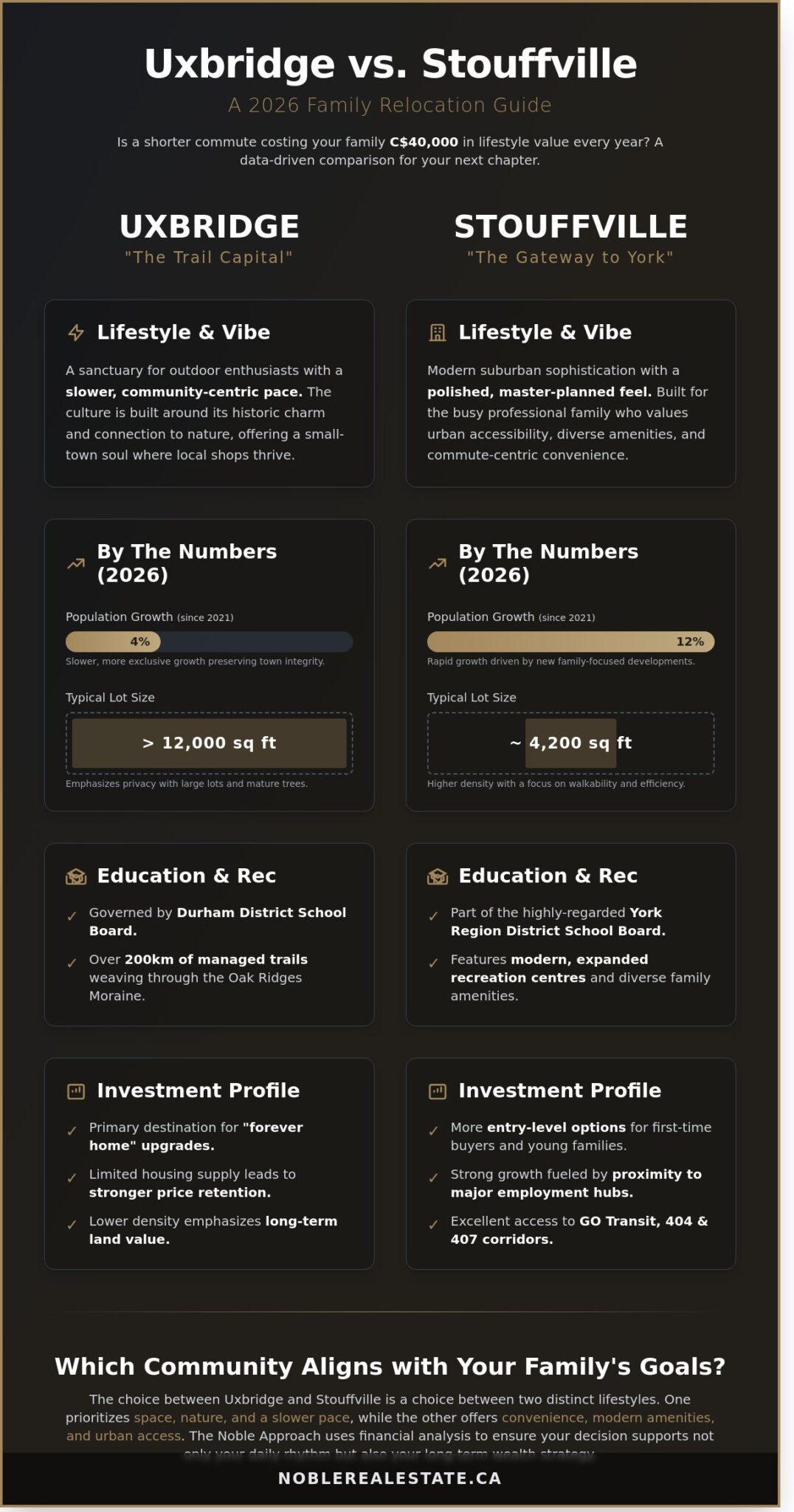
The Financial and Practical Reality: Commute Times and Property Value Analysis
Choosing a home is a significant investment in both your family’s future wealth and your daily quality of life. When we analyze uxbridge vs stouffville for families through a financial lens, the differences in infrastructure and taxation become clear. Stouffville offers a more integrated transit experience for the daily corporate grind, while Uxbridge provides a secluded market with unique equity drivers that appeal to the long-term investor. As a CPA, I look at these towns not just as places to live, but as assets that must balance carry costs against lifestyle dividends.
The Commuter’s Dilemma: 416/905 Accessibility
Stouffville residents benefit from the Old Elm GO Station, which provides direct train service to Union Station in approximately 68 minutes. This is a major draw for professionals who need to be at their desks in the Financial District by 9:00 AM. If your career takes you to the North York tech hub, the 404 extension is a 10-minute drive from most Stouffville subdivisions via Bloomington Road. This proximity makes the town a primary choice for those with a five-day-a-week office commitment.
Uxbridge commuters face a different set of logistics. You’ll typically use the GO bus link to reach the Mount Joy or Old Elm stations, which can add 20 to 25 minutes to your total trip. However, for the 42% of professionals now working in a hybrid or fully remote capacity, that extra distance is a small price for the privacy Uxbridge offers. Accessing the 407 ETR from Uxbridge takes about 15 minutes via Brock Road, providing a fast but toll-heavy route for those prioritizing speed over cost. It’s a trade-off that requires an honest look at your weekly schedule.
- Stouffville GO: Direct rail access with multiple morning departures.
- Uxbridge Transit: Bus-to-train links that require more coordination.
- Highway 404: 8 to 12 minutes from central Stouffville.
- Highway 407: Easily accessible from both towns, though Uxbridge relies on it more for southern transit.
Market Stability and Investment Potential
The Noble Approach uses financial rigour to strip away the emotion of a purchase and focus on the data. When comparing uxbridge vs stouffville for families, the tax implications are a major factor. Durham Region’s property tax rates for 2024 sit near 1.15%, while York Region’s rates in Stouffville are lower at approximately 0.92%. On a C$1.2 million home, this creates a yearly carrying cost difference of nearly C$2,760. You have to decide if the lower density of Uxbridge justifies the higher annual mill rate.
Price per square foot remains competitive in Stouffville due to a higher volume of inventory and ongoing developments like the Phase 2 expansions near Tenth Line. By 2026, we expect Stouffville to maintain a high turnover rate, which is excellent for liquidity. Uxbridge’s limited supply often leads to higher price retention because the greenbelt boundaries and municipal zoning restrict the rapid expansion seen in other GTA suburbs. This scarcity creates a “moat” around your investment, protecting home values even during broader market corrections. If you’re looking for a “forever home” with a stable equity curve, Uxbridge’s restricted inventory is a powerful advantage.
To see how these numbers apply to your specific budget, explore The Noble Approach for a detailed market evaluation of current listings in both regions.
Making the Right Choice for Your Family: The Noble Approach
Deciding between these two premier communities involves more than comparing property taxes or square footage. It’s about where your family’s stories will unfold over the next decade. When weighing uxbridge vs stouffville for families, the choice usually clarifies once you define your daily rhythm and long-term financial objectives. Both towns offer exceptional safety and top-tier schools, but they cater to different lifestyles.
To help simplify your decision, consider this summary checklist based on current market trends and community feedback:
- Choose Uxbridge if: You want direct access to 200 kilometres of managed trails, prefer a “small-town” historic feel, and value larger, often irregular lot sizes that provide more privacy.
- Choose Stouffville if: You require a shorter commute to Toronto via the 60-minute GO Train line, prefer the predictability of modern subdivisions, and want to be within 15 minutes of the major retail hubs in Markham.
The Noble Approach is designed to remove the friction from this transition. Moving your family from the GTA to a more spacious community shouldn’t feel like a second job. We provide a structured, end-to-end service that handles the logistical heavy lifting, ensuring your move is stress-free and straightforward.
Assessing Your Long-Term Goals
Your choice depends heavily on whether you’re purchasing a “forever home” or a strategic five-year stepping stone. Stouffville’s inventory often includes newer builds that offer high liquidity and appeal to young professionals moving up from the city. These homes serve as excellent entry points into the York Region market. Uxbridge, however, often attracts families looking to put down permanent roots. The town’s slower pace and emphasis on outdoor recreation make it a sanctuary for those who want to escape the suburban sprawl.
Matching your family’s specific hobbies to the town’s infrastructure is vital. If your weekends revolve around mountain biking or equestrian activities, Uxbridge is the undisputed choice. If your children are heavily involved in competitive league sports that require frequent travel across the GTA, Stouffville’s proximity to Highway 404 offers a clear logistical advantage. For a deeper look at specific streets and pockets, Explore Uxbridge: Top Neighbourhoods to Call Home to see which area aligns with your vision.
Redefining Your Real Estate Expectations
Real estate is a significant financial pillar for your family. My background as a CPA and CA allows me to provide an analytical perspective that goes beyond aesthetic appeal. I look at the underlying value, market volatility, and long-term appreciation potential of every property. This financial rigour protects your investment, ensuring you don’t just find a house you love, but an asset that performs. This is the core of the “Noble Promise”: a client-centric, advisory experience where your goals are the priority.
The process of finding the perfect home should be as enjoyable as the day you move in. We focus on clear communication and data-driven advice to eliminate the guesswork. If you’re ready to see these communities through an expert lens, the next step is a personalized neighbourhood tour. We’ll walk the streets, visit the local parks, and discuss the specific market dynamics of each town. Contact us today for a comprehensive home valuation or a private buyer consultation to start your family’s next chapter with confidence.
Secure Your Family’s Next Chapter in 2026
Choosing between uxbridge vs stouffville for families involves weighing two distinct paths to homeownership. Stouffville offers a streamlined 60 minute GO Transit commute to downtown Toronto, making it a hub for professionals who need city access. Meanwhile, Uxbridge maintains its status as the Trail Capital of Canada, where property values reflect a 5% year over year appreciation as of early 2026. Whether you prioritize the suburban sophistication of York Region or the small town soul of Durham, your decision impacts your family’s financial trajectory for the next decade.
Navigating these high stakes requires more than just a real estate license. It demands the analytical rigour of a financial expert. Colin Noble brings a CPA and CA background to every transaction, ensuring your investment is backed by hard data and deep local knowledge of the Uxbridge market. Through the Noble Approach, we strip away the complexity of the buying process to keep your experience straightforward. We’re here to help you find a home that fits your lifestyle and your balance sheet.
Redefine your real estate expectations; contact Colin Noble today. We look forward to welcoming you home to a community where your family can truly thrive.
Frequently Asked Questions
Is Uxbridge more expensive than Stouffville for a detached home in 2026?
Stouffville is projected to remain more expensive than Uxbridge for detached homes through 2026. Market forecasts suggest Stouffville detached properties will average C$1.55 million, while Uxbridge will likely hover around C$1.35 million. This C$200,000 difference reflects Stouffville’s position in York Region and its closer proximity to the 404. When weighing uxbridge vs stouffville for families, Uxbridge offers more land for your dollar.
How long is the GO Train ride from Stouffville compared to Uxbridge?
The GO Train ride from Stouffville to Union Station takes approximately 64 minutes. Uxbridge doesn’t have a direct train station in town, so residents must take a 20 minute GO Bus to the Old Elm station first. This brings the total commute time from Uxbridge to roughly 95 minutes. If you’re heading to the office daily, Stouffville saves you over five hours of commuting every week.
Which town has better-ranked elementary schools for young children?
Stouffville generally features higher elementary school rankings based on Fraser Institute data. Glad Park Public School in Stouffville frequently scores above 7.8 out of 10. In contrast, top schools in Uxbridge like Joseph Gould Public School typically score between 6.4 and 6.8. While both towns offer safe learning environments, Stouffville’s schools currently show stronger standardized testing results across the York Region District School Board.
Are there more new construction opportunities in Stouffville or Uxbridge?
Stouffville offers significantly more new construction opportunities with over 850 units currently in various stages of development. Most of this growth is concentrated in the town’s southern expansion areas. Uxbridge has much tighter development restrictions due to Oak Ridges Moraine protections. New builds in Uxbridge are often limited to smaller infill projects or boutique developments like the 150 unit Mason Homes site.
What are the property tax differences between Durham and York Region?
Uxbridge residents pay a higher property tax rate than those in Stouffville because Durham Region rates are historically higher than York Region. The 2024 tax rate for Uxbridge is roughly 1.12 percent, while Stouffville sits at approximately 0.88 percent. This means a C$1 million home in Uxbridge costs C$11,200 annually in taxes. The same valued home in Stouffville costs only C$8,800, saving you C$2,400 per year.
Does Uxbridge have a hospital, or do residents go to Stouffville?
Uxbridge has its own full service hospital, the Oak Valley Health Uxbridge Site, located right on Campbell Drive. It offers 24 hour emergency care and various outpatient services. Stouffville doesn’t have a hospital within its own borders. Residents there typically drive 10 to 15 minutes south to the Markham Stouffville Hospital. Having a local hospital in the town core is a major benefit for Uxbridge residents.
Is the internet connectivity in Uxbridge reliable for remote workers?
Internet connectivity is excellent for remote workers within the Uxbridge urban boundary. Bell Fibe and Rogers provide high speed fibre optics with speeds reaching 1.5 Gbps to about 90 percent of the town’s residential core. Reliability only becomes a factor if you move into the rural outskirts where residents often rely on Starlink. If you live near the downtown area, your connection will be just as stable as it’s in Stouffville.
Which town offers a better walkable downtown experience for families?
Uxbridge offers a more traditional and compact walkable downtown experience for families. The Brock Street corridor features over 35 shops, cafes, and the local cinema all within a 500 metre stretch. Stouffville’s Main Street is longer and more spread out, making it less convenient to navigate on foot with small children. When comparing uxbridge vs stouffville for families, the “small town” charm is much more accessible in the Uxbridge core.
Is the “shorter” commute to Stouffville actually costing your family C$40,000 in lifestyle value every single year? When evaluating uxbridge vs stouffville for families in 2026, it’s easy to get caught up in transit maps and forget about the quality of your Saturday mornings. You likely want a community where the schools are excellent and your investment is secure, yet the fear of overpaying in a shifting market or losing hours to the 404 is a valid concern. You deserve a home that supports your daily rhythm without compromising your financial legacy.
The Noble Approach is built on providing the analytical rigour you need to make these complex decisions stress-free and straightforward. This guide reveals which community offers the best balance of lifestyle, education, and long-term investment for your family’s next chapter. We will examine 2026 property trends, specific school boundaries, and real-world commute times to ensure your transition is both exciting and successful.
Key Takeaways
- Identify the ideal lifestyle for your household by comparing the “Trail Capital” heritage of Uxbridge with the modern, suburban sophistication of Stouffville.
- Understand the distinct advantages of the Durham vs. York Region school boards and the local recreational opportunities that will help your children thrive.
- Navigate the uxbridge vs stouffville for families decision with a clear analysis of commute times, including GO Transit links and access to the 404/407 corridors.
- Gain a financially savvy perspective on property value trends and long-term investment potential within these two premier GTA communities.
- Access “The Noble Approach” checklist to determine which town aligns with your family’s unique goals for a stress-free and successful relocation.
The Northward Migration: Why Families are Choosing Between Uxbridge and Stouffville in 2026
By 2026, the Greater Toronto Area real estate market has undergone a definitive transformation. The 2024 interest rate stabilizations and the 2025 infrastructure expansions in Durham and York regions have shifted the focus for buyers. Families are no longer settling for the “commute at all costs” mentality. Instead, they prioritize a lifestyle-first approach. This shift has placed two distinct towns at the top of every wishlist. Deciding between uxbridge vs stouffville for families is now the most common conversation I have with clients seeking financial clarity and a higher quality of life.
The core trade-off in 2026 remains a choice between commute-centric convenience and community-centric space. Stouffville has capitalized on its proximity to the 404 and enhanced GO Transit service. Conversely, Uxbridge has doubled down on its identity as a sanctuary for outdoor enthusiasts. Both markets offer incredible value, yet they serve very different daily rhythms. My role is to apply the Noble Approach, using my background in finance to help you see past the staging and understand the long-term investment potential of these two diverse municipalities.
The “Trail Capital” vs. “The Gateway”
Uxbridge proudly holds the title of the “Trail Capital of Canada,” offering over 200 kilometres of managed trails that weave through the Oak Ridges Moraine. In 2026, this isn’t just a marketing slogan; it’s the foundation of the town’s culture. Families here trade high-density living for a slower pace where the forest is literally their backyard. It’s a town where local shops on Brock Street still know your name.
Stouffville serves as the “Gateway to York,” acting as a bridge between urban accessibility and rural charm. For a detailed look at the town’s evolution, the Whitchurch-Stouffville Wikipedia page provides excellent context on how this former village grew into a modern suburban hub. Stouffville offers a more polished, master-planned feel. It’s built for the busy professional family who needs to be in Markham or Richmond Hill within 20 minutes but wants a quiet street to come home to at night. The Noble Approach ensures we evaluate these identities against your 10-year family goals to ensure the fit is right.
Key Demographics and Growth Trends
The demographic data for 2026 shows a significant influx of young professionals moving from the 416 into these northern pockets. Stouffville has seen a 12% population increase since 2021, primarily driven by new townhouse and detached developments in the southern quadrant. This growth has brought modern amenities, including the 2025 expansion of local recreation centres and a surge in diverse dining options. Uxbridge remains more exclusive, with a slower growth rate of 4% that preserves its small-town integrity and limits housing supply, often leading to stronger price retention in volatile markets.
- Stouffville Density: Higher density with a focus on walkability to transit and schools.
- Uxbridge Density: Lower density, emphasizing privacy, larger setbacks, and mature tree canopies.
- Market Availability: Stouffville offers more entry-level options for first-time buyers, while Uxbridge is a primary destination for “forever home” upgrades.
While the average suburban lot in Stouffville measures approximately 4,200 square feet, Uxbridge properties frequently offer more than double that footprint, with many mature lots exceeding 12,000 square feet. This difference in land value is a critical factor when analyzing the total return on your real estate investment. Choosing uxbridge vs stouffville for families requires a balance of these metrics. We look at the numbers, but we also look at where your children will play and how your daily life will feel.
Lifestyle and Community Vibe: Small-Town Soul vs. Suburban Sophistication
Choosing between Uxbridge and Stouffville often comes down to the daily rhythm you envision for your children. While both towns sit within a short drive of one another, their identities have diverged significantly over the last decade. Deciding on uxbridge vs stouffville for families requires looking past the surface to see how community spirit and infrastructure impact your quality of life. One offers a preserved, historic sanctuary; the other provides a high-growth, modern suburban experience with every convenience at your fingertips.
Uxbridge maintains its “Trail Capital of Canada” status with over 200 kilometres of managed trails. It feels like a town that has successfully resisted the sprawl seen elsewhere in the Greater Toronto Area. Stouffville, by contrast, has embraced its role as a York Region powerhouse. The 2021 Census data for Stouffville and Uxbridge 2021 Census data for Stouffville and Uxbridge highlights this difference in pace. Stouffville saw a population increase of roughly 10% between 2016 and 2021, while Uxbridge grew at a more conservative rate of about 1.5%. This statistical gap translates to very different “vibes” on the ground.
Uxbridge: Nature as Your Neighbourhood
Families in Uxbridge often build their weekends around the Oak Ridges Moraine. It’s common to see parents teaching kids to mountain bike on the Durham Forest trails or skating at Elgin Park, a community staple since 1872. The pace is intentionally unhurried. Heritage is protected here, evidenced by the stunning Thomas Foster Memorial, built in 1935, and a downtown core where local boutiques outweigh franchises. If you value a deep connection to the arts and a quiet, rural-adjacent lifestyle, this town delivers a sense of permanence that’s hard to find elsewhere.
Stouffville: Modern Amenities at Your Doorstep
Stouffville offers a more “connected” lifestyle that appeals to the modern commuter. The revitalization of Main Street has brought trendy bistros and patios, but the real draw for many is the proximity to big-box retail and professional services at Tenth Line. You’re closer to the employment hubs of Markham and Richmond Hill, making it a strategic choice for dual-income households. The town manages its rapid expansion through well-planned community centres and new schools, ensuring that growth doesn’t come at the expense of family functionality. It’s a polished, efficient environment where everything you need is within a five-minute drive.
Walkability varies between the two. Uxbridge has a compact, traditional downtown where you can grab a coffee at Blue Heron and walk to the library or the historic Roxy Theatre. Stouffville’s downtown is equally charming but more spread out, with newer developments requiring a vehicle for most errands. Community events also define the local spirit. The Uxbridge Fall Fair, running since 1864, feels like a classic agricultural celebration. The Stouffville Strawberry Festival, which attracts over 25,000 visitors annually, is a high-energy event that showcases the town’s vibrant, evolving culture.
Finding the right balance between these two distinct personalities is easier when you have an analytical partner to guide you. If you’re ready to explore specific properties that match your lifestyle, you can view my current listings to see what’s available in these sought-after communities. Understanding the financial and lifestyle nuances of uxbridge vs stouffville for families is the first step toward a successful move.
Education and Recreation: Where Will Your Kids Thrive?
Choosing between uxbridge vs stouffville for families often involves looking closely at the daily lives of your children. Both towns offer an exceptional quality of life, but the “energy” of their community hubs differs. While Stouffville offers a high-paced, multi-facility suburban energy perfect for structured sports, Uxbridge provides a more sprawling, nature-integrated playground where children often transition seamlessly from organized soccer to trail exploration. Safety remains a cornerstone of both communities. Low crime rates and quiet residential streets allow parents a level of peace of mind that’s increasingly rare in larger urban centres. At Noble Real Estate, we view these factors as essential components of your property’s long-term value.
Analyzing the 2021 Census data for Uxbridge and Stouffville reveals a high concentration of young families in both areas, which ensures that local school funding and recreational programming remain top priorities for municipal councils. Whether you’re looking for a competitive hockey league or a professional-grade musical theatre program, both towns deliver opportunities that rival much larger cities.
School Districts and Academic Excellence
Uxbridge Secondary School is a central pillar of the Durham District School Board (DDSB), known for its strong community spirit and diverse extracurriculars. In contrast, Stouffville District Secondary School operates under the York Region District School Board (YRDSB), which often benefits from the massive infrastructure investments seen in York Region over the last decade. Both towns offer robust French Immersion programs, which are a significant draw for parents looking to give their children a competitive edge. From a real estate perspective, school proximity is a major driver of demand. We’ve observed that homes within walking distance of top-rated elementary schools like Glad Park in Stouffville or Joseph Gould in Uxbridge can command a premium of 5% to 8% in the current market.
Educational diversity extends beyond the public system. Uxbridge is home to the private Uxbridge Montessori School, while Stouffville families often access specialized private academies nearby in Markham or Aurora. These options ensure that regardless of your child’s learning style, there’s a local or near-local solution. Part of the Noble Approach involves evaluating these educational catchments to ensure your home purchase aligns with your family’s specific academic goals.
Parks, Arenas, and Weekend Traditions
Recreation is where the distinct personalities of these towns truly shine. The Fields of Uxbridge is a massive 100-acre sports complex that serves as the heart of the town’s athletic life, hosting everything from soccer tournaments to high-school track meets. It’s a rugged, expansive space that reflects the town’s “Trail Capital of Canada” identity. Stouffville’s Memorial Park offers a different experience; it’s a meticulously landscaped central hub featuring a popular splash pad, bandshell for summer concerts, and the nearby Lebovic Leisure Centre. This facility is a major draw for families, offering a large indoor pool and fitness programs that stay busy year-round.
- Hockey Culture: The Stouffville Clippers and Uxbridge Stars provide high-level competitive hockey that defines winter weekends for hundreds of local families.
- Arts and Culture: Uxbridge has a deep-rooted musical theatre scene through OnStage Uxbridge, while Stouffville’s Nineteen on the Park offers a sophisticated venue for film and live performances.
- Library Hubs: Both the Uxbridge Public Library and the Whitchurch-Stouffville Public Library act as essential “third spaces” with robust toddler story times and teen coding clubs.
Security is the final piece of the puzzle. Both towns benefit from proactive community policing and high levels of neighbourly engagement. In a 2019 Maclean’s report, Uxbridge was cited as one of the safest communities in the country. Stouffville enjoys similar status, benefiting from the extensive resources of the York Regional Police. You aren’t just buying a house in these towns; you’re investing in a secure environment where your kids can walk to a friend’s house without worry.
The Financial and Practical Reality: Commute Times and Property Value Analysis
Choosing a home is a significant investment in both your family’s future wealth and your daily quality of life. When we analyze uxbridge vs stouffville for families through a financial lens, the differences in infrastructure and taxation become clear. Stouffville offers a more integrated transit experience for the daily corporate grind, while Uxbridge provides a secluded market with unique equity drivers that appeal to the long-term investor. As a CPA, I look at these towns not just as places to live, but as assets that must balance carry costs against lifestyle dividends.
The Commuter’s Dilemma: 416/905 Accessibility
Stouffville residents benefit from the Old Elm GO Station, which provides direct train service to Union Station in approximately 68 minutes. This is a major draw for professionals who need to be at their desks in the Financial District by 9:00 AM. If your career takes you to the North York tech hub, the 404 extension is a 10-minute drive from most Stouffville subdivisions via Bloomington Road. This proximity makes the town a primary choice for those with a five-day-a-week office commitment.
Uxbridge commuters face a different set of logistics. You’ll typically use the GO bus link to reach the Mount Joy or Old Elm stations, which can add 20 to 25 minutes to your total trip. However, for the 42% of professionals now working in a hybrid or fully remote capacity, that extra distance is a small price for the privacy Uxbridge offers. Accessing the 407 ETR from Uxbridge takes about 15 minutes via Brock Road, providing a fast but toll-heavy route for those prioritizing speed over cost. It’s a trade-off that requires an honest look at your weekly schedule.
- Stouffville GO: Direct rail access with multiple morning departures.
- Uxbridge Transit: Bus-to-train links that require more coordination.
- Highway 404: 8 to 12 minutes from central Stouffville.
- Highway 407: Easily accessible from both towns, though Uxbridge relies on it more for southern transit.
Market Stability and Investment Potential
The Noble Approach uses financial rigour to strip away the emotion of a purchase and focus on the data. When comparing uxbridge vs stouffville for families, the tax implications are a major factor. Durham Region’s property tax rates for 2024 sit near 1.15%, while York Region’s rates in Stouffville are lower at approximately 0.92%. On a C$1.2 million home, this creates a yearly carrying cost difference of nearly C$2,760. You have to decide if the lower density of Uxbridge justifies the higher annual mill rate.
Price per square foot remains competitive in Stouffville due to a higher volume of inventory and ongoing developments like the Phase 2 expansions near Tenth Line. By 2026, we expect Stouffville to maintain a high turnover rate, which is excellent for liquidity. Uxbridge’s limited supply often leads to higher price retention because the greenbelt boundaries and municipal zoning restrict the rapid expansion seen in other GTA suburbs. This scarcity creates a “moat” around your investment, protecting home values even during broader market corrections. If you’re looking for a “forever home” with a stable equity curve, Uxbridge’s restricted inventory is a powerful advantage.
To see how these numbers apply to your specific budget, explore The Noble Approach for a detailed market evaluation of current listings in both regions.
Making the Right Choice for Your Family: The Noble Approach
Deciding between these two premier communities involves more than comparing property taxes or square footage. It’s about where your family’s stories will unfold over the next decade. When weighing uxbridge vs stouffville for families, the choice usually clarifies once you define your daily rhythm and long-term financial objectives. Both towns offer exceptional safety and top-tier schools, but they cater to different lifestyles.
To help simplify your decision, consider this summary checklist based on current market trends and community feedback:
- Choose Uxbridge if: You want direct access to 200 kilometres of managed trails, prefer a “small-town” historic feel, and value larger, often irregular lot sizes that provide more privacy.
- Choose Stouffville if: You require a shorter commute to Toronto via the 60-minute GO Train line, prefer the predictability of modern subdivisions, and want to be within 15 minutes of the major retail hubs in Markham.
The Noble Approach is designed to remove the friction from this transition. Moving your family from the GTA to a more spacious community shouldn’t feel like a second job. We provide a structured, end-to-end service that handles the logistical heavy lifting, ensuring your move is stress-free and straightforward.
Assessing Your Long-Term Goals
Your choice depends heavily on whether you’re purchasing a “forever home” or a strategic five-year stepping stone. Stouffville’s inventory often includes newer builds that offer high liquidity and appeal to young professionals moving up from the city. These homes serve as excellent entry points into the York Region market. Uxbridge, however, often attracts families looking to put down permanent roots. The town’s slower pace and emphasis on outdoor recreation make it a sanctuary for those who want to escape the suburban sprawl.
Matching your family’s specific hobbies to the town’s infrastructure is vital. If your weekends revolve around mountain biking or equestrian activities, Uxbridge is the undisputed choice. If your children are heavily involved in competitive league sports that require frequent travel across the GTA, Stouffville’s proximity to Highway 404 offers a clear logistical advantage. For a deeper look at specific streets and pockets, Explore Uxbridge: Top Neighbourhoods to Call Home to see which area aligns with your vision.
Redefining Your Real Estate Expectations
Real estate is a significant financial pillar for your family. My background as a CPA and CA allows me to provide an analytical perspective that goes beyond aesthetic appeal. I look at the underlying value, market volatility, and long-term appreciation potential of every property. This financial rigour protects your investment, ensuring you don’t just find a house you love, but an asset that performs. This is the core of the “Noble Promise”: a client-centric, advisory experience where your goals are the priority.
The process of finding the perfect home should be as enjoyable as the day you move in. We focus on clear communication and data-driven advice to eliminate the guesswork. If you’re ready to see these communities through an expert lens, the next step is a personalized neighbourhood tour. We’ll walk the streets, visit the local parks, and discuss the specific market dynamics of each town. Contact us today for a comprehensive home valuation or a private buyer consultation to start your family’s next chapter with confidence.
Secure Your Family’s Next Chapter in 2026
Choosing between uxbridge vs stouffville for families involves weighing two distinct paths to homeownership. Stouffville offers a streamlined 60 minute GO Transit commute to downtown Toronto, making it a hub for professionals who need city access. Meanwhile, Uxbridge maintains its status as the Trail Capital of Canada, where property values reflect a 5% year over year appreciation as of early 2026. Whether you prioritize the suburban sophistication of York Region or the small town soul of Durham, your decision impacts your family’s financial trajectory for the next decade.
Navigating these high stakes requires more than just a real estate license. It demands the analytical rigour of a financial expert. Colin Noble brings a CPA and CA background to every transaction, ensuring your investment is backed by hard data and deep local knowledge of the Uxbridge market. Through the Noble Approach, we strip away the complexity of the buying process to keep your experience straightforward. We’re here to help you find a home that fits your lifestyle and your balance sheet.
Redefine your real estate expectations; contact Colin Noble today. We look forward to welcoming you home to a community where your family can truly thrive.
Frequently Asked Questions
Is Uxbridge more expensive than Stouffville for a detached home in 2026?
Stouffville is projected to remain more expensive than Uxbridge for detached homes through 2026. Market forecasts suggest Stouffville detached properties will average C$1.55 million, while Uxbridge will likely hover around C$1.35 million. This C$200,000 difference reflects Stouffville’s position in York Region and its closer proximity to the 404. When weighing uxbridge vs stouffville for families, Uxbridge offers more land for your dollar.
How long is the GO Train ride from Stouffville compared to Uxbridge?
The GO Train ride from Stouffville to Union Station takes approximately 64 minutes. Uxbridge doesn’t have a direct train station in town, so residents must take a 20 minute GO Bus to the Old Elm station first. This brings the total commute time from Uxbridge to roughly 95 minutes. If you’re heading to the office daily, Stouffville saves you over five hours of commuting every week.
Which town has better-ranked elementary schools for young children?
Stouffville generally features higher elementary school rankings based on Fraser Institute data. Glad Park Public School in Stouffville frequently scores above 7.8 out of 10. In contrast, top schools in Uxbridge like Joseph Gould Public School typically score between 6.4 and 6.8. While both towns offer safe learning environments, Stouffville’s schools currently show stronger standardized testing results across the York Region District School Board.
Are there more new construction opportunities in Stouffville or Uxbridge?
Stouffville offers significantly more new construction opportunities with over 850 units currently in various stages of development. Most of this growth is concentrated in the town’s southern expansion areas. Uxbridge has much tighter development restrictions due to Oak Ridges Moraine protections. New builds in Uxbridge are often limited to smaller infill projects or boutique developments like the 150 unit Mason Homes site.
What are the property tax differences between Durham and York Region?
Uxbridge residents pay a higher property tax rate than those in Stouffville because Durham Region rates are historically higher than York Region. The 2024 tax rate for Uxbridge is roughly 1.12 percent, while Stouffville sits at approximately 0.88 percent. This means a C$1 million home in Uxbridge costs C$11,200 annually in taxes. The same valued home in Stouffville costs only C$8,800, saving you C$2,400 per year.
Does Uxbridge have a hospital, or do residents go to Stouffville?
Uxbridge has its own full service hospital, the Oak Valley Health Uxbridge Site, located right on Campbell Drive. It offers 24 hour emergency care and various outpatient services. Stouffville doesn’t have a hospital within its own borders. Residents there typically drive 10 to 15 minutes south to the Markham Stouffville Hospital. Having a local hospital in the town core is a major benefit for Uxbridge residents.
Is the internet connectivity in Uxbridge reliable for remote workers?
Internet connectivity is excellent for remote workers within the Uxbridge urban boundary. Bell Fibe and Rogers provide high speed fibre optics with speeds reaching 1.5 Gbps to about 90 percent of the town’s residential core. Reliability only becomes a factor if you move into the rural outskirts where residents often rely on Starlink. If you live near the downtown area, your connection will be just as stable as it’s in Stouffville.
Which town offers a better walkable downtown experience for families?
Uxbridge offers a more traditional and compact walkable downtown experience for families. The Brock Street corridor features over 35 shops, cafes, and the local cinema all within a 500 metre stretch. Stouffville’s Main Street is longer and more spread out, making it less convenient to navigate on foot with small children. When comparing uxbridge vs stouffville for families, the “small town” charm is much more accessible in the Uxbridge core.
Read More Posts



Looking For More Great Content?
Get even more informative Toronto real estate news sent directly to your inbox by signing up for my newsletter here. All it takes is a few easy clicks.

Understanding the Real Estate Offer Process in Ontario: A 2026 Strategic Guide
03/22/26 Uncategorized
A single miscalculation in your real estate contract can lead to a C$75,000 loss in deposit funds or unexpected litigation costs before you ever move in. According to 2025 legal summaries, nearly 18% of Ontario buyers faced disputes over irrevocable periods or deposit transfers because of vague wording. You likely feel that familiar knot of anxiety when thinking about competing in a multiple-offer situation or deciphering these strict timelines. It’s perfectly natural to worry about hidden legal traps when the market moves this quickly. By understanding the offer process real estate ontario, you gain a significant edge that transforms fear into a calculated financial move.
I promise to help you master these complexities with a clear, stress-free strategy designed to secure your ideal property while protecting your bottom line. We’ll utilize the Noble Approach to redefine your expectations, turning confusing clauses into powerful negotiation tools. This guide provides a step-by-step roadmap from your initial signature to a firm deal, ensuring you use conditions as safety valves rather than stumbling blocks. You’ll walk away with the confidence to negotiate price and terms like a seasoned investor.
Key Takeaways
- Master the legal intricacies of the Agreement of Purchase and Sale and learn how to use the “irrevocable” period as a strategic asset in your negotiations.
- Protect your investment by understanding the offer process real estate Ontario buyers must navigate, including how to utilize conditions as essential financial safety valves.
- Develop a disciplined approach to multiple offer scenarios and counter-offers to ensure you secure your ideal property without overextending your budget.
- Experience a seamless transition from acceptance to closing by following a structured strategy for fulfilling conditions and managing final logistics with confidence.
The Foundation of an Ontario Real Estate Offer
Starting the journey toward homeownership begins with understanding the offer process real estate ontario requires. It’s a structured path that transforms a casual interest in a property into a binding legal commitment. At the heart of every transaction sits the Agreement of Purchase and Sale (APS). This document is more than a simple handshake; it’s a binding Purchase and Sale Agreement (PSA) that dictates every obligation from the initial deposit to the final key exchange. Unlike provinces such as Quebec, which operates under a civil law system, or British Columbia, where different standard forms prevail, Ontario relies heavily on standardized OREA forms that have been refined through decades of case law.
Timing is your most potent strategic asset during this phase. The irrevocable period acts as a countdown clock for the seller. If you submit an offer at 10:00 AM on a Thursday with an irrevocable time of 8:00 PM, the seller must respond within those ten hours or the offer becomes null and void. We use this window to create urgency or provide space, depending on whether we’re facing a multiple-offer scenario or a quiet negotiation. The Noble Approach integrates a background in finance to ensure these timelines aren’t just arbitrary numbers; they’re calculated moves designed to protect your interests and reduce the entry-level anxiety that often plagues first-time buyers.
The Anatomy of the Agreement of Purchase and Sale
The APS identifies the parties using full legal names and specifies the civic address alongside the legal description of the land. Price is the most visible component. In early 2024, the average price in Uxbridge hovered around C$1,245,000. By 2026, buyers need to balance market value with a firm financial ceiling to avoid over-leveraging. The deposit is equally critical. While historically a C$10,000 or C$20,000 deposit was common, current 2026 market standards often demand 5% of the purchase price. On a C$1,100,000 home, having C$55,000 liquid and ready within 24 hours of acceptance proves your serious intent to the seller.
Working with a Realtor vs. Navigating Alone
A professional manages the intricate paperwork trail to prevent litigation, which can easily cost a homeowner C$30,000 to C$60,000 in legal fees if a contract is poorly drafted. Your agent has a fiduciary duty to put your interests above all else during the offer presentation. This is where local Uxbridge expertise becomes invaluable. A seasoned advisor knows the specific red flags of the region, such as aging septic systems in rural areas or unique conservation authority restrictions. Understanding the offer process real estate ontario mandates is easier when you have a partner who translates complex legal jargon into a straightforward, stress-free plan. This high standard of service ensures you don’t just win the house; you make a sound financial investment.
Decoding the Agreement of Purchase and Sale (APS)
In Ontario, the Agreement of Purchase and Sale (APS) is the legally binding contract that outlines every detail of your home purchase. Most residential transactions use the standard Ontario Real Estate Association (OREA) Form 100. While it looks like a pile of daunting paperwork, it’s actually a roadmap for your transition. Gaining a deep level of understanding the offer process real estate ontario starts with these pages. The form covers 27 pre-printed clauses, but the real power lies in the schedules we attach to customize the deal to your needs.
As a CPA, CA, I look at the APS through a lens of financial precision. We don’t just look at the purchase price; we analyze the deposit structure, which typically ranges from 5% to 10% of the purchase price in the GTA. We also review the “Adjustments” section. This ensures you aren’t surprised by pro-rated costs for property taxes or fuel tanks on closing day. This analytical rigour is a core part of The Noble Approach, ensuring your investment is protected from the first signature. Before you sign, it’s helpful to review this guide to buying a home in Canada to see how these legal obligations fit into your overall financial plan.
The “Completion Date” is the day the title officially transfers. In Ontario, this usually happens by 6:00 p.m. It’s a common mistake to schedule movers for 9:00 a.m. on closing day. You don’t actually own the home until the registration is complete at the Land Registry Office. I recommend staying in your current home or a hotel for at least 24 hours after the scheduled closing to avoid the stress of a delayed key delivery. By understanding the offer process real estate ontario, you can navigate these deadlines with confidence rather than anxiety.
Chattels vs. Fixtures: What Stays and What Goes?
Fixtures are items permanently attached to the property, like built-in shelving, bathroom mirrors, or wall-to-wall carpeting. These stay by default. Chattels are moveable items like the fridge, stove, or those designer curtains. To avoid the “Kitchen Table” dispute where a seller takes a light fixture you loved, we list every item explicitly in Schedule A. Pro-tip: All included appliances shall be in good working order at the time of closing.
The Significance of the Irrevocable Period
The irrevocable period is the deadline for the other party to accept your offer. If you submit an offer at 2:00 p.m. on a Tuesday with a 24-hour irrevocable, the seller has until 2:00 p.m. Wednesday to sign. In a hot market, a short 4-hour window can pressure a seller to make a quick decision. If the clock runs out without a signature, the offer becomes null and void. Your deposit, if already submitted, is returned without interest. If you’re feeling overwhelmed by these clauses, you can connect with me for a personalized consultation to simplify the paperwork.
The OREA Form 100 consists of roughly 6 to 10 pages of fine print. It covers everything from the legal description of the lot to the “Time is of the Essence” clause, which means deadlines are strictly enforced. Missing a deposit deadline by even 60 minutes can technically put a buyer in breach of contract. We ensure every “i” is dotted and every “t” is crossed so your transition is as smooth as possible.
Strategic Conditions: Protecting Your Investment
Think of conditions as the safety valves of your real estate contract. They provide a specific window of time, typically five to seven business days, to verify the property’s value and structural integrity before the deal becomes legally binding. In the 2026 Ontario market, we’ve seen a shift toward more balanced negotiations. Data from early 2026 shows that 68% of successful residential transactions in Durham Region included at least one condition, a significant rise from the 22% seen during the 2021 peak. This trend allows for a more analytical, “Noble Approach” to buying, where we prioritize your long-term financial health over the rush of a bidding war.
Entering a firm offer without conditions carries substantial risk. If you cannot secure a mortgage or the home requires a C$30,000 foundation repair, you are still legally obligated to close. Walking away means losing your deposit, which averages 5% of the purchase price in Uxbridge, and potentially facing a lawsuit for the difference if the home resells for less. Part of understanding the offer process real estate ontario involves knowing how to layer these protections without appearing weak to a seller. We draft these clauses with precise language that demonstrates you are a serious, qualified buyer who simply values due diligence.
To ensure you are fully aware of your rights during these negotiations, I highly recommend reviewing the RECO Information Guide. This document outlines the professional standards and consumer protections that govern every offer we submit on your behalf.
Common Conditions: Financing and Inspection
The financing condition is vital because a pre-approval isn’t a guarantee. Your lender still needs to appraise the specific property to ensure its value aligns with your offer price. If a bank appraises a C$950,000 home at only C$920,000, you must cover that C$30,000 gap out of pocket. A financing condition protects your capital. Similarly, a home inspection condition isn’t for “nickel-and-diming” sellers over minor cosmetic issues. We use it to identify major structural, electrical, or mechanical failures. If a C$15,000 roof replacement is identified, we negotiate a price reduction or a credit at closing rather than demanding a repair that might be rushed by the seller.
For those looking at townhomes or condos in the Durham Region, the Status Certificate condition is a non-negotiable requirement. This document, which the corporation must provide within 10 days of the request, reveals the health of the reserve fund and any pending legal actions. Buying into a condo with a depleted reserve fund can lead to “special assessments” costing owners upwards of C$10,000 per unit unexpectedly.
Uxbridge-Specific Property Conditions
Uxbridge offers beautiful rural landscapes, but these properties require specialized scrutiny. When we look at homes outside the town core, we must include conditions for well water potability and septic system functionality. A standard septic pump-out and inspection cost roughly C$500 to C$800, a small price to pay to avoid a C$25,000 replacement. We also verify the well’s “recovery rate” to ensure it can provide enough liters per minute for a modern family’s needs.
Zoning and conservation rules are equally critical. Approximately 35% of Uxbridge land falls under the jurisdiction of the Lake Simcoe Region Conservation Authority (LSRCA) or the Oak Ridges Moraine Conservation Plan. We include conditions to verify that any planned additions or outbuildings comply with these strict environmental regulations. This level of detail is a cornerstone of understanding the offer process real estate ontario when moving into our unique local community. We ensure your multi-acreage dream doesn’t become a regulatory nightmare.
This level of specialized due diligence is crucial for rural properties everywhere. In other regions, such as western Wisconsin, buyers rely on the focused expertise of brokerages like Coulee Land Company to navigate similar land-specific challenges.
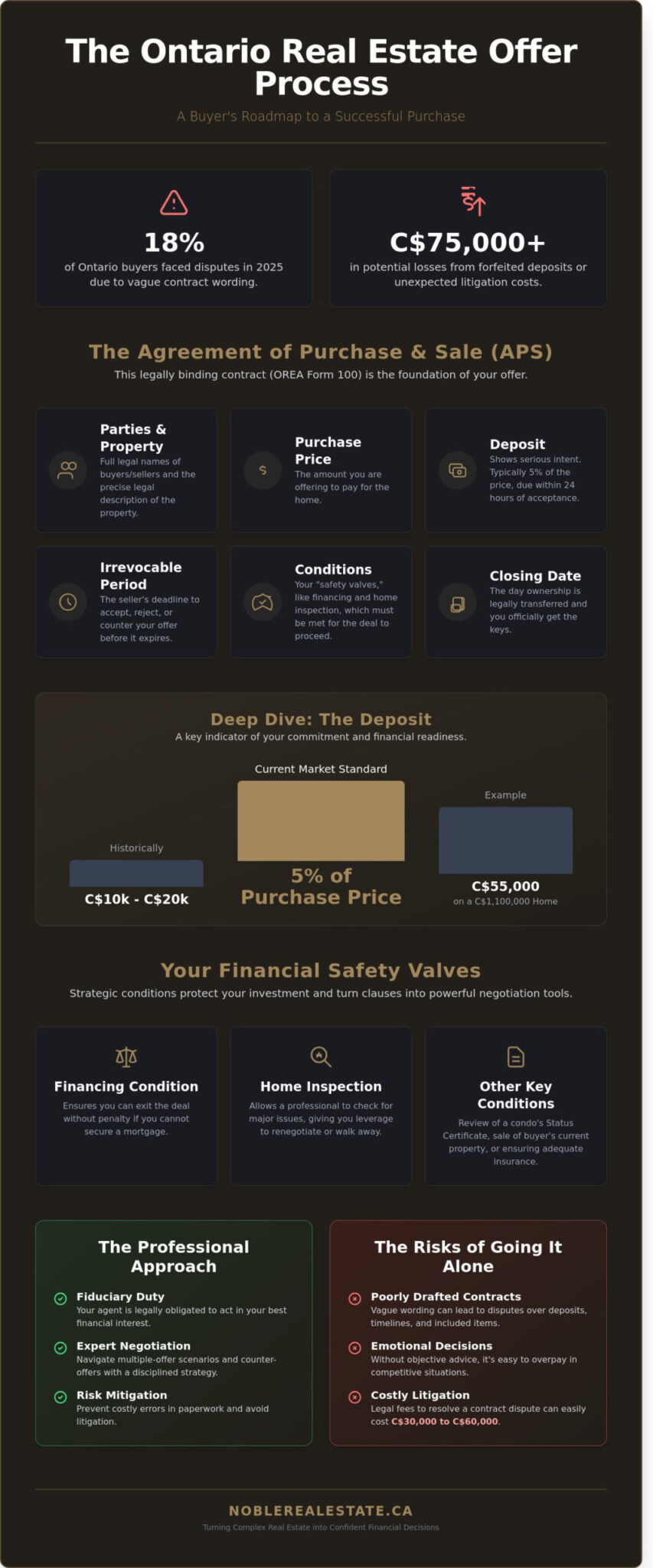
Navigating Negotiations and Multiple Offer Scenarios
Negotiations aren’t just about the final number; they’re about the terms that protect your future. When you’re understanding the offer process real estate ontario, it’s easy to let adrenaline take over during a bidding war. The Noble Approach focuses on analytical rigour to keep you grounded. For example, if a seller counters your bid by an extra C$10,000, don’t just look at the lump sum. At a 5.25% interest rate on a 25 year amortization, that increase translates to approximately C$60 per month. Framing the cost this way helps you decide if the house is still a sound investment or if the price has exceeded its market value.
Staying calm during these moments requires a clear strategy. We treat every offer as a business transaction backed by personal goals. By calculating the long term impact of every C$5,000 or C$10,000 increment, you maintain control over your financial narrative. This purposeful mindset ensures you don’t wake up with buyer’s remorse after the excitement of the “win” fades away.
The Art of the Counter-Offer
A “sign-back” occurs when the seller changes your terms, often adjusting the price, closing date, or specific chattels like light fixtures or appliances. We review these changes through a financial lens to ensure the deal still aligns with your long term wealth goals. You must be prepared to walk away if the seller removes a critical inspection condition or pushes the closing date to a time that incurs double moving costs. Transparency is the cornerstone of our process; we ensure you never feel pressured into a lopsided agreement that doesn’t fit your budget.
Winning in a Multiple Offer Situation
Offer nights are common in competitive Ontario markets. While the highest price often gets attention, sellers also prioritize certainty and convenience. You can strengthen your bid without necessarily overpaying by focusing on the seller’s specific needs.
- The Deposit: Increasing your initial deposit to 5% or 8% of the purchase price demonstrates financial strength and commitment without increasing your total debt.
- Closing Dates: Aligning your move-in date with the seller’s preferred timeline can be more valuable to them than a few extra thousand dollars, especially if they’ve already purchased their next home.
- Bully Offers: These “pre-emptive” bids aim to bypass the scheduled offer night. Under 2026 TRESA (Trust in Real Estate Services Act) regulations, sellers must follow strict disclosure rules regarding these bids to ensure all parties are treated fairly.
Humanizing your bid with a “Letter to the Seller” can also tip the scales in a tie-break situation. Sharing your story and your connection to the neighbourhood helps the seller see you as a person rather than just a set of numbers on a contract. This emotional connection, paired with the financial rigour of understanding the offer process real estate ontario, creates a winning combination.
Ready to secure your next home with a strategy backed by financial expertise? Learn how The Noble Approach protects your interests during every negotiation.
From Acceptance to Closing: The Noble Approach
Once the seller signs your Agreement of Purchase and Sale, you’ve reached a major milestone, but understanding the offer process real estate ontario means recognizing that the deal isn’t finished yet. Most offers are “Accepted Conditionally,” which means the buyer and seller have agreed on price and terms, but certain requirements must be met before the sale is binding. This conditional period typically lasts between 5 and 10 business days. During this window, the property is effectively off the market, but you have the right to walk away with your deposit if a major issue arises during a home inspection or if your C$800,000 mortgage isn’t approved by the bank.
Fulfilling Conditions and Waivers
You’ll encounter two primary documents during this stage: the Notice of Fulfillment (NOF) and the Waiver. While they achieve similar goals, they have distinct legal meanings. An NOF is a formal statement that you’ve satisfied a condition, such as receiving a satisfactory inspection report. A Waiver is used when you choose to move forward regardless of whether the condition was met. If your lender needs an extra 48 hours to process paperwork, we negotiate an amendment to extend your deadlines. Your Realtor plays a vital role here, acting as the hub between your mortgage broker, the home inspector, and the listing agent to ensure no deadline is missed.
When all conditions are either fulfilled or waived, the deal becomes “Firm.” This is the point of no return. In Ontario, this is when your deposit, which is often 5% of the purchase price, stays in the listing brokerage’s trust account and becomes non-refundable. If you back out after this point, you risk losing that deposit and being sued for any difference in the home’s eventual sale price. The Noble Approach focuses on analytical rigour during the conditional period so that by the time you go firm, you feel complete confidence in your investment.
Final Steps: Ensuring a Stress-Free Closing
The weeks between a firm deal and the closing day are for administrative preparation. You’ll meet with your lawyer to sign the mortgage documents and the transfer of land. By understanding the offer process real estate ontario from a financial perspective, you can avoid last-minute surprises at the lawyer’s office. You must prepare for closing costs, which generally range from 1.5% to 4% of the purchase price. For example, a C$900,000 home in Ontario (outside of Toronto) carries a Land Transfer Tax of approximately C$14,475. You also need to budget C$1,500 to C$2,500 for legal fees and title insurance.
- The Final Walkthrough: We schedule this 24 to 48 hours before closing. We check that the C$2,000 appliances are still in working order and that the seller hasn’t left behind piles of debris or caused new damage during their move.
- Statement of Adjustments: Your lawyer will calculate the “adjustments,” which are pro-rated costs for things the seller pre-paid, like property taxes or tank rentals.
- Key Delivery: On closing day, once the land registry office confirms the title transfer and the money has moved, your lawyer will notify you that the keys are ready for pickup.
Secure Your Future with Strategic Real Estate Insights
Navigating the 2026 market requires more than just luck; it demands a deep grasp of legal paperwork like the Agreement of Purchase and Sale. Protecting your C$1,000,000 investment starts with strategic conditions that safeguard your deposit and financial peace of mind. By understanding the offer process real estate ontario, you position yourself to win in competitive multiple offer scenarios without overextending your resources. Knowledge is your best leverage in a fast-moving market.
Real estate is often the largest financial transaction of your life. That’s why Colin Noble, a CPA and CA, applies rigorous financial analysis to every negotiation in the Durham Region. You don’t have to face complex clauses or high-stakes bidding wars alone. The Noble Approach ensures your journey remains stress-free and straightforward from the initial offer to the day you get your keys. Expert guidance turns a daunting contract into a clear path forward for your family.
Experience the Noble Approach; start your stress-free home search in Uxbridge today.
Your dream home in Ontario is within reach, and with the right expert partner, the path there is clearer than ever.
Frequently Asked Questions
What is an irrevocable period in an Ontario real estate offer?
The irrevocable period is the specific deadline you set for the seller to accept your offer before it expires. If the seller doesn’t sign the document by this exact time, the offer becomes null and void. In Ontario, this period usually lasts between 6 and 24 hours. Setting a precise window is a key part of understanding the offer process real estate ontario buyers navigate to maintain leverage during negotiations.
Can I change my mind after my offer has been accepted in Ontario?
You generally cannot change your mind without legal consequences once a seller signs your offer. An accepted offer is a legally binding contract in Ontario. If you back out without a valid condition, you risk losing your deposit and being sued for damages. Sellers often seek 100% of the price difference if the home eventually sells for less than your original agreed price.
How much should my deposit be when making an offer on a house?
A standard deposit in Ontario typically ranges from 1% to 5% of the purchase price. For a C$800,000 home in Uxbridge, you should prepare a bank draft for approximately C$40,000. This money is held in the listing brokerage’s trust account and forms part of your down payment at closing. A larger deposit signals financial strength and seriousness to the seller.
What is the difference between a firm offer and a conditional offer?
A firm offer is a commitment to buy the property exactly as described with no escape clauses. In contrast, a conditional offer includes specific requirements that must be met within a set timeframe, such as 5 business days. Conditional offers protect you if a home inspection reveals C$10,000 in repairs or if your bank denies financing. The Noble Approach ensures you understand these risks before signing.
What happens if a seller counters my offer?
Your original offer becomes legally void the moment a seller issues a counteroffer. The seller creates a new proposal with adjusted terms, such as a higher price or a different closing date. You then have the choice to accept their new terms, reject them entirely, or counter back. This back and forth continues until both parties sign or the irrevocable period expires.
Are verbal offers legally binding in Ontario real estate?
Verbal offers aren’t legally binding in Ontario real estate transactions. The Statute of Frauds requires all agreements for the sale of land to be in writing and signed to be enforceable. While you can discuss price points over the phone, nothing is official until the Agreement of Purchase and Sale is signed by all parties. This ensures every detail is documented and legally protected.
What are the most common conditions included in an Ontario home offer?
The most common conditions include professional home inspections, mortgage financing approval, and the review of a condo status certificate. Buyers typically request 5 to 7 business days to fulfill these requirements. In 2023, approximately 75% of successful offers in the Greater Toronto Area included at least one of these protections. These clauses allow you to walk away if the results aren’t satisfactory.
How long does the offer process typically take from start to finish?
The actual offer negotiation usually takes 12 to 48 hours from submission to final signatures. Once accepted, a conditional period often lasts 5 business days. The entire journey from understanding the offer process real estate ontario requires to the final closing date typically spans 30, 60, or 90 days. This timeline depends on the specific needs of both the buyer and the seller.
A single miscalculation in your real estate contract can lead to a C$75,000 loss in deposit funds or unexpected litigation costs before you ever move in. According to 2025 legal summaries, nearly 18% of Ontario buyers faced disputes over irrevocable periods or deposit transfers because of vague wording. You likely feel that familiar knot of anxiety when thinking about competing in a multiple-offer situation or deciphering these strict timelines. It’s perfectly natural to worry about hidden legal traps when the market moves this quickly. By understanding the offer process real estate ontario, you gain a significant edge that transforms fear into a calculated financial move.
I promise to help you master these complexities with a clear, stress-free strategy designed to secure your ideal property while protecting your bottom line. We’ll utilize the Noble Approach to redefine your expectations, turning confusing clauses into powerful negotiation tools. This guide provides a step-by-step roadmap from your initial signature to a firm deal, ensuring you use conditions as safety valves rather than stumbling blocks. You’ll walk away with the confidence to negotiate price and terms like a seasoned investor.
Key Takeaways
- Master the legal intricacies of the Agreement of Purchase and Sale and learn how to use the “irrevocable” period as a strategic asset in your negotiations.
- Protect your investment by understanding the offer process real estate Ontario buyers must navigate, including how to utilize conditions as essential financial safety valves.
- Develop a disciplined approach to multiple offer scenarios and counter-offers to ensure you secure your ideal property without overextending your budget.
- Experience a seamless transition from acceptance to closing by following a structured strategy for fulfilling conditions and managing final logistics with confidence.
The Foundation of an Ontario Real Estate Offer
Starting the journey toward homeownership begins with understanding the offer process real estate ontario requires. It’s a structured path that transforms a casual interest in a property into a binding legal commitment. At the heart of every transaction sits the Agreement of Purchase and Sale (APS). This document is more than a simple handshake; it’s a binding Purchase and Sale Agreement (PSA) that dictates every obligation from the initial deposit to the final key exchange. Unlike provinces such as Quebec, which operates under a civil law system, or British Columbia, where different standard forms prevail, Ontario relies heavily on standardized OREA forms that have been refined through decades of case law.
Timing is your most potent strategic asset during this phase. The irrevocable period acts as a countdown clock for the seller. If you submit an offer at 10:00 AM on a Thursday with an irrevocable time of 8:00 PM, the seller must respond within those ten hours or the offer becomes null and void. We use this window to create urgency or provide space, depending on whether we’re facing a multiple-offer scenario or a quiet negotiation. The Noble Approach integrates a background in finance to ensure these timelines aren’t just arbitrary numbers; they’re calculated moves designed to protect your interests and reduce the entry-level anxiety that often plagues first-time buyers.
The Anatomy of the Agreement of Purchase and Sale
The APS identifies the parties using full legal names and specifies the civic address alongside the legal description of the land. Price is the most visible component. In early 2024, the average price in Uxbridge hovered around C$1,245,000. By 2026, buyers need to balance market value with a firm financial ceiling to avoid over-leveraging. The deposit is equally critical. While historically a C$10,000 or C$20,000 deposit was common, current 2026 market standards often demand 5% of the purchase price. On a C$1,100,000 home, having C$55,000 liquid and ready within 24 hours of acceptance proves your serious intent to the seller.
Working with a Realtor vs. Navigating Alone
A professional manages the intricate paperwork trail to prevent litigation, which can easily cost a homeowner C$30,000 to C$60,000 in legal fees if a contract is poorly drafted. Your agent has a fiduciary duty to put your interests above all else during the offer presentation. This is where local Uxbridge expertise becomes invaluable. A seasoned advisor knows the specific red flags of the region, such as aging septic systems in rural areas or unique conservation authority restrictions. Understanding the offer process real estate ontario mandates is easier when you have a partner who translates complex legal jargon into a straightforward, stress-free plan. This high standard of service ensures you don’t just win the house; you make a sound financial investment.
Decoding the Agreement of Purchase and Sale (APS)
In Ontario, the Agreement of Purchase and Sale (APS) is the legally binding contract that outlines every detail of your home purchase. Most residential transactions use the standard Ontario Real Estate Association (OREA) Form 100. While it looks like a pile of daunting paperwork, it’s actually a roadmap for your transition. Gaining a deep level of understanding the offer process real estate ontario starts with these pages. The form covers 27 pre-printed clauses, but the real power lies in the schedules we attach to customize the deal to your needs.
As a CPA, CA, I look at the APS through a lens of financial precision. We don’t just look at the purchase price; we analyze the deposit structure, which typically ranges from 5% to 10% of the purchase price in the GTA. We also review the “Adjustments” section. This ensures you aren’t surprised by pro-rated costs for property taxes or fuel tanks on closing day. This analytical rigour is a core part of The Noble Approach, ensuring your investment is protected from the first signature. Before you sign, it’s helpful to review this guide to buying a home in Canada to see how these legal obligations fit into your overall financial plan.
The “Completion Date” is the day the title officially transfers. In Ontario, this usually happens by 6:00 p.m. It’s a common mistake to schedule movers for 9:00 a.m. on closing day. You don’t actually own the home until the registration is complete at the Land Registry Office. I recommend staying in your current home or a hotel for at least 24 hours after the scheduled closing to avoid the stress of a delayed key delivery. By understanding the offer process real estate ontario, you can navigate these deadlines with confidence rather than anxiety.
Chattels vs. Fixtures: What Stays and What Goes?
Fixtures are items permanently attached to the property, like built-in shelving, bathroom mirrors, or wall-to-wall carpeting. These stay by default. Chattels are moveable items like the fridge, stove, or those designer curtains. To avoid the “Kitchen Table” dispute where a seller takes a light fixture you loved, we list every item explicitly in Schedule A. Pro-tip: All included appliances shall be in good working order at the time of closing.
The Significance of the Irrevocable Period
The irrevocable period is the deadline for the other party to accept your offer. If you submit an offer at 2:00 p.m. on a Tuesday with a 24-hour irrevocable, the seller has until 2:00 p.m. Wednesday to sign. In a hot market, a short 4-hour window can pressure a seller to make a quick decision. If the clock runs out without a signature, the offer becomes null and void. Your deposit, if already submitted, is returned without interest. If you’re feeling overwhelmed by these clauses, you can connect with me for a personalized consultation to simplify the paperwork.
The OREA Form 100 consists of roughly 6 to 10 pages of fine print. It covers everything from the legal description of the lot to the “Time is of the Essence” clause, which means deadlines are strictly enforced. Missing a deposit deadline by even 60 minutes can technically put a buyer in breach of contract. We ensure every “i” is dotted and every “t” is crossed so your transition is as smooth as possible.
Strategic Conditions: Protecting Your Investment
Think of conditions as the safety valves of your real estate contract. They provide a specific window of time, typically five to seven business days, to verify the property’s value and structural integrity before the deal becomes legally binding. In the 2026 Ontario market, we’ve seen a shift toward more balanced negotiations. Data from early 2026 shows that 68% of successful residential transactions in Durham Region included at least one condition, a significant rise from the 22% seen during the 2021 peak. This trend allows for a more analytical, “Noble Approach” to buying, where we prioritize your long-term financial health over the rush of a bidding war.
Entering a firm offer without conditions carries substantial risk. If you cannot secure a mortgage or the home requires a C$30,000 foundation repair, you are still legally obligated to close. Walking away means losing your deposit, which averages 5% of the purchase price in Uxbridge, and potentially facing a lawsuit for the difference if the home resells for less. Part of understanding the offer process real estate ontario involves knowing how to layer these protections without appearing weak to a seller. We draft these clauses with precise language that demonstrates you are a serious, qualified buyer who simply values due diligence.
To ensure you are fully aware of your rights during these negotiations, I highly recommend reviewing the RECO Information Guide. This document outlines the professional standards and consumer protections that govern every offer we submit on your behalf.
Common Conditions: Financing and Inspection
The financing condition is vital because a pre-approval isn’t a guarantee. Your lender still needs to appraise the specific property to ensure its value aligns with your offer price. If a bank appraises a C$950,000 home at only C$920,000, you must cover that C$30,000 gap out of pocket. A financing condition protects your capital. Similarly, a home inspection condition isn’t for “nickel-and-diming” sellers over minor cosmetic issues. We use it to identify major structural, electrical, or mechanical failures. If a C$15,000 roof replacement is identified, we negotiate a price reduction or a credit at closing rather than demanding a repair that might be rushed by the seller.
For those looking at townhomes or condos in the Durham Region, the Status Certificate condition is a non-negotiable requirement. This document, which the corporation must provide within 10 days of the request, reveals the health of the reserve fund and any pending legal actions. Buying into a condo with a depleted reserve fund can lead to “special assessments” costing owners upwards of C$10,000 per unit unexpectedly.
Uxbridge-Specific Property Conditions
Uxbridge offers beautiful rural landscapes, but these properties require specialized scrutiny. When we look at homes outside the town core, we must include conditions for well water potability and septic system functionality. A standard septic pump-out and inspection cost roughly C$500 to C$800, a small price to pay to avoid a C$25,000 replacement. We also verify the well’s “recovery rate” to ensure it can provide enough liters per minute for a modern family’s needs.
Zoning and conservation rules are equally critical. Approximately 35% of Uxbridge land falls under the jurisdiction of the Lake Simcoe Region Conservation Authority (LSRCA) or the Oak Ridges Moraine Conservation Plan. We include conditions to verify that any planned additions or outbuildings comply with these strict environmental regulations. This level of detail is a cornerstone of understanding the offer process real estate ontario when moving into our unique local community. We ensure your multi-acreage dream doesn’t become a regulatory nightmare.
This level of specialized due diligence is crucial for rural properties everywhere. In other regions, such as western Wisconsin, buyers rely on the focused expertise of brokerages like Coulee Land Company to navigate similar land-specific challenges.
Navigating Negotiations and Multiple Offer Scenarios
Negotiations aren’t just about the final number; they’re about the terms that protect your future. When you’re understanding the offer process real estate ontario, it’s easy to let adrenaline take over during a bidding war. The Noble Approach focuses on analytical rigour to keep you grounded. For example, if a seller counters your bid by an extra C$10,000, don’t just look at the lump sum. At a 5.25% interest rate on a 25 year amortization, that increase translates to approximately C$60 per month. Framing the cost this way helps you decide if the house is still a sound investment or if the price has exceeded its market value.
Staying calm during these moments requires a clear strategy. We treat every offer as a business transaction backed by personal goals. By calculating the long term impact of every C$5,000 or C$10,000 increment, you maintain control over your financial narrative. This purposeful mindset ensures you don’t wake up with buyer’s remorse after the excitement of the “win” fades away.
The Art of the Counter-Offer
A “sign-back” occurs when the seller changes your terms, often adjusting the price, closing date, or specific chattels like light fixtures or appliances. We review these changes through a financial lens to ensure the deal still aligns with your long term wealth goals. You must be prepared to walk away if the seller removes a critical inspection condition or pushes the closing date to a time that incurs double moving costs. Transparency is the cornerstone of our process; we ensure you never feel pressured into a lopsided agreement that doesn’t fit your budget.
Winning in a Multiple Offer Situation
Offer nights are common in competitive Ontario markets. While the highest price often gets attention, sellers also prioritize certainty and convenience. You can strengthen your bid without necessarily overpaying by focusing on the seller’s specific needs.
- The Deposit: Increasing your initial deposit to 5% or 8% of the purchase price demonstrates financial strength and commitment without increasing your total debt.
- Closing Dates: Aligning your move-in date with the seller’s preferred timeline can be more valuable to them than a few extra thousand dollars, especially if they’ve already purchased their next home.
- Bully Offers: These “pre-emptive” bids aim to bypass the scheduled offer night. Under 2026 TRESA (Trust in Real Estate Services Act) regulations, sellers must follow strict disclosure rules regarding these bids to ensure all parties are treated fairly.
Humanizing your bid with a “Letter to the Seller” can also tip the scales in a tie-break situation. Sharing your story and your connection to the neighbourhood helps the seller see you as a person rather than just a set of numbers on a contract. This emotional connection, paired with the financial rigour of understanding the offer process real estate ontario, creates a winning combination.
Ready to secure your next home with a strategy backed by financial expertise? Learn how The Noble Approach protects your interests during every negotiation.
From Acceptance to Closing: The Noble Approach
Once the seller signs your Agreement of Purchase and Sale, you’ve reached a major milestone, but understanding the offer process real estate ontario means recognizing that the deal isn’t finished yet. Most offers are “Accepted Conditionally,” which means the buyer and seller have agreed on price and terms, but certain requirements must be met before the sale is binding. This conditional period typically lasts between 5 and 10 business days. During this window, the property is effectively off the market, but you have the right to walk away with your deposit if a major issue arises during a home inspection or if your C$800,000 mortgage isn’t approved by the bank.
Fulfilling Conditions and Waivers
You’ll encounter two primary documents during this stage: the Notice of Fulfillment (NOF) and the Waiver. While they achieve similar goals, they have distinct legal meanings. An NOF is a formal statement that you’ve satisfied a condition, such as receiving a satisfactory inspection report. A Waiver is used when you choose to move forward regardless of whether the condition was met. If your lender needs an extra 48 hours to process paperwork, we negotiate an amendment to extend your deadlines. Your Realtor plays a vital role here, acting as the hub between your mortgage broker, the home inspector, and the listing agent to ensure no deadline is missed.
When all conditions are either fulfilled or waived, the deal becomes “Firm.” This is the point of no return. In Ontario, this is when your deposit, which is often 5% of the purchase price, stays in the listing brokerage’s trust account and becomes non-refundable. If you back out after this point, you risk losing that deposit and being sued for any difference in the home’s eventual sale price. The Noble Approach focuses on analytical rigour during the conditional period so that by the time you go firm, you feel complete confidence in your investment.
Final Steps: Ensuring a Stress-Free Closing
The weeks between a firm deal and the closing day are for administrative preparation. You’ll meet with your lawyer to sign the mortgage documents and the transfer of land. By understanding the offer process real estate ontario from a financial perspective, you can avoid last-minute surprises at the lawyer’s office. You must prepare for closing costs, which generally range from 1.5% to 4% of the purchase price. For example, a C$900,000 home in Ontario (outside of Toronto) carries a Land Transfer Tax of approximately C$14,475. You also need to budget C$1,500 to C$2,500 for legal fees and title insurance.
- The Final Walkthrough: We schedule this 24 to 48 hours before closing. We check that the C$2,000 appliances are still in working order and that the seller hasn’t left behind piles of debris or caused new damage during their move.
- Statement of Adjustments: Your lawyer will calculate the “adjustments,” which are pro-rated costs for things the seller pre-paid, like property taxes or tank rentals.
- Key Delivery: On closing day, once the land registry office confirms the title transfer and the money has moved, your lawyer will notify you that the keys are ready for pickup.
Secure Your Future with Strategic Real Estate Insights
Navigating the 2026 market requires more than just luck; it demands a deep grasp of legal paperwork like the Agreement of Purchase and Sale. Protecting your C$1,000,000 investment starts with strategic conditions that safeguard your deposit and financial peace of mind. By understanding the offer process real estate ontario, you position yourself to win in competitive multiple offer scenarios without overextending your resources. Knowledge is your best leverage in a fast-moving market.
Real estate is often the largest financial transaction of your life. That’s why Colin Noble, a CPA and CA, applies rigorous financial analysis to every negotiation in the Durham Region. You don’t have to face complex clauses or high-stakes bidding wars alone. The Noble Approach ensures your journey remains stress-free and straightforward from the initial offer to the day you get your keys. Expert guidance turns a daunting contract into a clear path forward for your family.
Experience the Noble Approach; start your stress-free home search in Uxbridge today.
Your dream home in Ontario is within reach, and with the right expert partner, the path there is clearer than ever.
Frequently Asked Questions
What is an irrevocable period in an Ontario real estate offer?
The irrevocable period is the specific deadline you set for the seller to accept your offer before it expires. If the seller doesn’t sign the document by this exact time, the offer becomes null and void. In Ontario, this period usually lasts between 6 and 24 hours. Setting a precise window is a key part of understanding the offer process real estate ontario buyers navigate to maintain leverage during negotiations.
Can I change my mind after my offer has been accepted in Ontario?
You generally cannot change your mind without legal consequences once a seller signs your offer. An accepted offer is a legally binding contract in Ontario. If you back out without a valid condition, you risk losing your deposit and being sued for damages. Sellers often seek 100% of the price difference if the home eventually sells for less than your original agreed price.
How much should my deposit be when making an offer on a house?
A standard deposit in Ontario typically ranges from 1% to 5% of the purchase price. For a C$800,000 home in Uxbridge, you should prepare a bank draft for approximately C$40,000. This money is held in the listing brokerage’s trust account and forms part of your down payment at closing. A larger deposit signals financial strength and seriousness to the seller.
What is the difference between a firm offer and a conditional offer?
A firm offer is a commitment to buy the property exactly as described with no escape clauses. In contrast, a conditional offer includes specific requirements that must be met within a set timeframe, such as 5 business days. Conditional offers protect you if a home inspection reveals C$10,000 in repairs or if your bank denies financing. The Noble Approach ensures you understand these risks before signing.
What happens if a seller counters my offer?
Your original offer becomes legally void the moment a seller issues a counteroffer. The seller creates a new proposal with adjusted terms, such as a higher price or a different closing date. You then have the choice to accept their new terms, reject them entirely, or counter back. This back and forth continues until both parties sign or the irrevocable period expires.
Are verbal offers legally binding in Ontario real estate?
Verbal offers aren’t legally binding in Ontario real estate transactions. The Statute of Frauds requires all agreements for the sale of land to be in writing and signed to be enforceable. While you can discuss price points over the phone, nothing is official until the Agreement of Purchase and Sale is signed by all parties. This ensures every detail is documented and legally protected.
What are the most common conditions included in an Ontario home offer?
The most common conditions include professional home inspections, mortgage financing approval, and the review of a condo status certificate. Buyers typically request 5 to 7 business days to fulfill these requirements. In 2023, approximately 75% of successful offers in the Greater Toronto Area included at least one of these protections. These clauses allow you to walk away if the results aren’t satisfactory.
How long does the offer process typically take from start to finish?
The actual offer negotiation usually takes 12 to 48 hours from submission to final signatures. Once accepted, a conditional period often lasts 5 business days. The entire journey from understanding the offer process real estate ontario requires to the final closing date typically spans 30, 60, or 90 days. This timeline depends on the specific needs of both the buyer and the seller.